





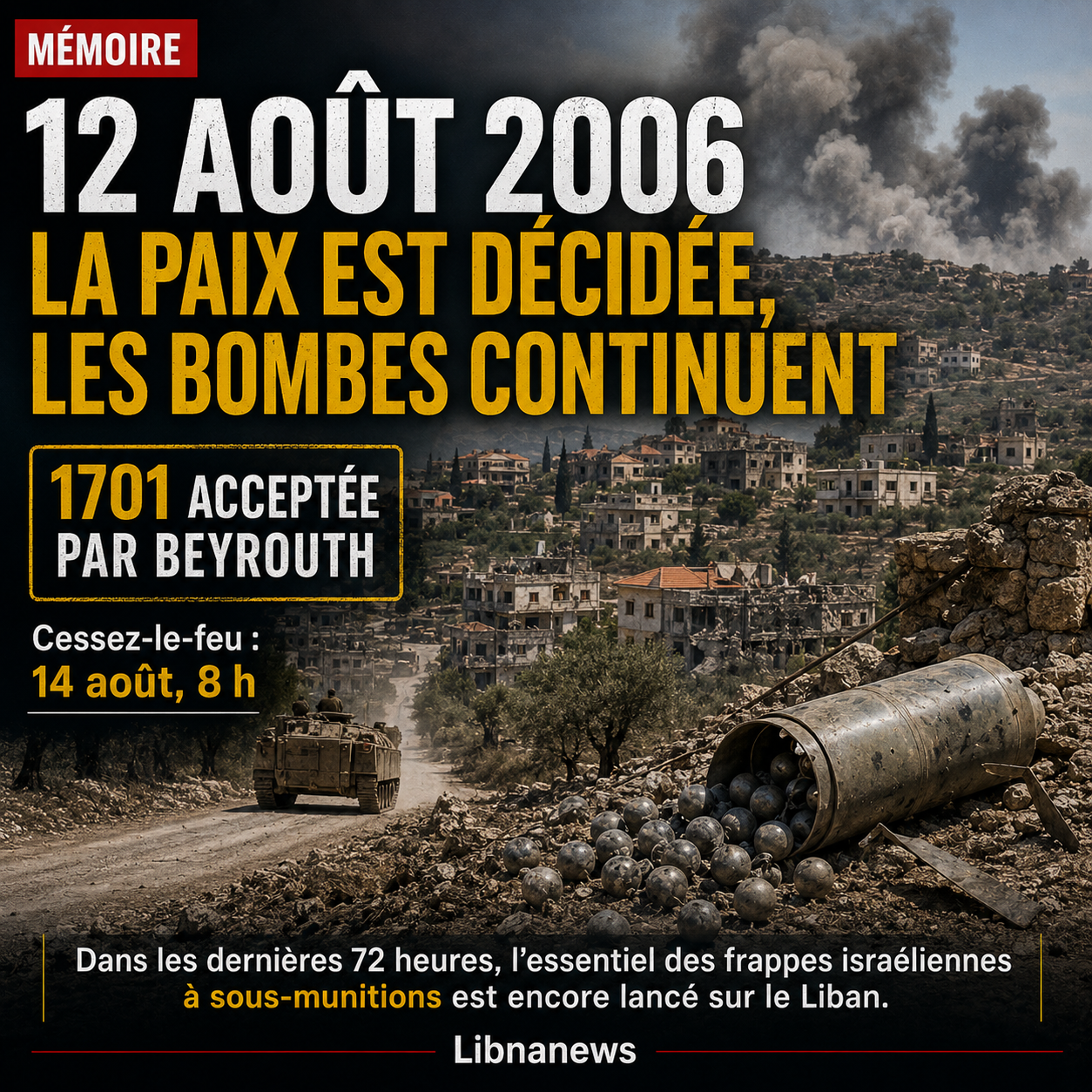
On 12 August 2006, the Lebanese Government accepts UN Security Council Resolution 1701. The end of the war is now marked by a cessation of hostilities, the withdrawal of Israeli forces, the deployment of 15,000 Lebanese troops in the South and the strengthening of UNIFIL. Yet, at the same time, Israel continues its offensive. Its aircraft continue to strike Lebanon, its artillery fire and its ground forces seek to advance further towards the Litani. Hezbollah, for its part, continues its rocket fire into Israel and fights Israeli soldiers in Lebanon. The cease-fire must only enter into force on 14 August at 8 a.m., leaving almost two more days to a war whose political outcome is already known.
This chronology gives the last hours of the conflict a particularly controversial dimension. Resolution 1701 was adopted unanimously by the 15 members of the Security Council on 11 August. Beirut accepts it the next day. Israel will formally approve on 13 August. Legally, the cessation of hostilities has not yet entered into force on the 12th, and Hezbollah is also continuing its operations. But politically, the situation has changed: Israel knows that a mechanism for its withdrawal is now accepted by Lebanon, that the Lebanese army must take a position in the South and that an enhanced UNIFIL must accompany this deployment. This does not prevent IDF from intensifying certain operations until the last hours. Even heavier, approximately 90 per cent of Israeli cluster munitions strikes during the war were reported to have taken place in the last 72 hours of the conflict, according to subsequent international assessments.
On August 11, the resolution to end the war
A month earlier, on 12 July, a Hezbollah operation on the border led to the capture of two Israeli soldiers and the death of several others. Israel had responded with a massive military campaign against Lebanon. The bombings were not limited to Hezbollah positions in the South: the southern suburbs of Beirut, the Bekaa, bridges, roads, power stations and Beirut International Airport were hit. Several hundred thousand Lebanese had left their homes as the fighting spread.
After 30 days of war, international negotiations finally ended on 11 August. The Security Council adopted resolution 1701 without objection or abstention. It calls for a « complete cessation of hostilities », based in particular on the immediate cessation of all attacks by Hezbollah and all Israeli offensive military operations. The language is important: the United Nations does not only call for the opening of additional negotiations. It establishes the precise framework under which fighting must stop.
The text then provides that the Lebanese army and UNIFIL will deploy to the South as Israeli forces withdraw. UNIFIL has a strength of up to 15,000 troops. Lebanon itself has pledged to deploy 15,000 troops. The area between the Blue Line and the Litani must be cleared of any armed presence or military equipment outside the Lebanese Government or the international force.
The resolution also reaffirms the authority of the Lebanese State throughout its territory. It recalls the need to implement previous international decisions on armed groups and provides for measures to prevent the entry into Lebanon of weapons without government authorization. It is therefore all the security balance of the South that needs to be reorganized after the war.
Lebanon accepts Israeli withdrawal mechanism on 12 August
The following day, the Council of Ministers chaired by Fouad Siniora accepted the resolution. This decision is not insignificant. Five days earlier, on 7 August, the Government had already announced its willingness to deploy 15,000 troops to the South in parallel with the Israeli withdrawal. On 12 August, this proposal became an integral part of the international mechanism accepted by Beirut.
Hezbollah, represented in the government, does not block the decision. Hassan Nasrallah accepts the principle of cessation of hostilities when it actually enters into force, while maintaining several reservations to the text. In particular, the movement considers that it retains the right to fight Israeli forces as long as they remain engaged in Lebanese territory. Hezbollah’s fire into northern Israel therefore continued until the ceasefire came into force.
This reality must be mentioned to understand exactly the sequence. At 12 noon on 12 August, there was not yet a legally effective ceasefire that Israel would formally violate by continuing all its operations. But this clarification is not enough to erase the political question posed by Israeli conduct: Lebanon has just accepted the main provisions designed to meet the security requirements invoked by Israel, while the Israeli army continues to expand its offensive on Lebanese territory.
UN Secretary-General Kofi Annan then fixes the entry into force of the cessation of hostilities on Monday 14 August at 8 a.m. Beirut time. From then on, everyone knows the deadline. The war now has an hour of end. For civilians in the South, however, there are almost two days of bombing and fighting to cross.
Israel chooses to move forward before the time limit
Instead of gradually slowing down its operations, Israel is pursuing a major ground offensive. The final phase of the campaign aims to widen the IDF penetration depth and reach or approach the Litani. Additional units are being deployed and helicopter operations are being carried out to deposit soldiers inside Lebanese territory. The Israeli staff wants to use the last hours available to further strike Hezbollah and improve its positions before the cessation of hostilities.
The military objective can be understood: after a month of war, Hezbollah continues to fire rockets at Israel and retains an important capacity to combat ground units. The government of Ehud Olmert seeks to complete the campaign by reducing these capacities as much as possible. But the calendar makes the choice particularly questionable. The international resolution organizing the Israeli withdrawal already exists and the Lebanese government has just accepted it. The positions conquered in the following hours must therefore, by definition, be abandoned as the Lebanese army and UNIFIL deploy.
Israel thus engages soldiers in extremely hard fighting to take ground that its own Government knows cannot maintain in the diplomatic framework now adopted. Israeli soldiers are killed and dozens more injured during this phase. Hezbollah also suffered casualties while continuing rocket fire. For Lebanese civilians, the consequence is a further intensification of operations in areas that have already been hit for a month.
The question therefore is not to deny that Hezbollah too continues the war until the ceasefire. It consists of examining the decision of a foreign army to continue and expand its offensive on Lebanese territory while Beirut has just accepted the international mechanism for precisely withdrawing that army and deploying Lebanese State forces in its place.
The Litani, a military objective Israel knows must withdraw from
The Litani acquires in these hours an importance that goes beyond its geography. It becomes the northern limit of the area where resolution 1701 seeks to establish a new security mechanism. Between the river and the Blue Line, the only armed forces authorized must be the Lebanese State and UNIFIL.
For Israel, progress to this area before the ceasefire allows for a final blow to Hezbollah’s positions and to occupy more ground as the withdrawal begins. But this does not change the political outcome. On 12 August, the principle is already established: the IDF will have to leave the South as the Lebanese army and UNIFIL deploy.
This contradiction partly explains the criticisms that will arise after the war, even in the Israeli debate. The last offensive costs lives without producing the decisive strategic change that could have justified such an acceleration. Hezbollah is not eliminated, its arsenal is not destroyed and its fire is not completely interrupted by military action until 14 August.
The cessation of hostilities will ultimately be achieved by the diplomatic mechanism whose contours are already fixed when the offensive is continued. This does not detract from Hezbollah’s responsibility for the outbreak of the conflict and its indiscriminate rocket fire into Israeli civilian areas. However, it makes it more difficult to present the Israeli operations of 12 and 13 August as indispensable for reaching an agreement that already exists.
The last 72 hours and the submunition flood
The most serious issue, however, is cluster munitions. After the war, the United Nations and several international organisations established that90 per cent of israeli strikes using these weapons were carried out during the last 72 hours of the conflict. In other words, most of their use comes at the very moment when resolution 1701 is adopted, accepted by Lebanon and approved by Israel.
The extent of use is considerable. Commonly selected evaluations show that4 million submunitionsdispersed in Lebanon during the war. Until1 millioncould not have exploded immediately. Israel uses various means of delivery: artillery, ground rockets and bombs dropped from the air. Small loads are dispersed on sometimes extended surfaces.
The principle of such weapons poses a particular danger to civilians. A main ammunition opens in flight and releases many small bombs. Some explode immediately, others remain intact on the ground. Once the fighting is over, they can still detonate when a resident touches them, when a farmer works his land or when a child manipulates an object that he does not recognize.
Post-war research will identify the use of Israeli submunitions in over 40 cities and villages. Human rights organizations will conclude that several attacks have been carried out under indiscriminate or disproportionate conditions. Human Rights Watch will even consider that certain cases could constitute war crimes, a characterization based on the rules of international humanitarian law and which does not mean that a criminal court has condemned Israel for each of these acts.
When the ceasefire arrives, the bombs remain
This is where the legacy of the last hours becomes the most tangible. On 14 August at 0800 hours, the aircraft stopped their strikes and the opposing units interrupted most of their fighting. But unexploded submunitions are not familiar with Kofi Annan’s schedule.
Hundreds of thousands of displaced persons are beginning to return to the South almost immediately. Many discover their villages before demining teams have been able to inspect houses, roads and farmland. Explosive devices are found in gardens, fields, near homes and sometimes even within residential areas.
The first victims after the ceasefire appear quickly. Civilians were killed or maimed by submunitions that had not exploded during the fighting. Farmers must wait before entering certain plots. Children are among the most exposed populations due to the small size and appearance of some devices.
In January 2008, almost200 civilian casualtieswere identified after the war because of submunitions. Among them,61 were under 18 years of ageaccording to the data used by the demining organizations. At least 42 civilian or military deminers had also been killed or injured in clean-up operations.
The Israeli war did not end entirely for these victims on the morning of 14 August. A weapon fired a few hours earlier may explode weeks or months later. The political calendar says the war is over; the field of a farmer continues to contain his ammunition.
More than 37,000 submunitions destroyed in less than one year
The extent of mine clearance is a material measure of contamination. As of 20 June 2007, less than a year after the war, teams in the South had already destroyed37 055 submunitions. This number represented only part of the equipment scattered throughout the territory.
The operations involve the Lebanese army, the United Nations and several specialised organisations. Each area must be identified, marked and then methodically cleaned. It is not enough to rebuild a house or repair a road: it is necessary to check that the inhabitants can walk in their garden or return to pick their olives without triggering an explosion.
Economic costs add to the human balance. In the South, a large proportion of families depend on agriculture. Olives, tobacco, fruit and vegetable crops require regular access to land. A contaminated plot may represent an entire lost season.
The massive use of submunitions in the last few hours thus gives a lasting dimension to an offensive whose deadline was already known. Israel could stop operations on 14 August, but previously dispersed devices continued to impose their effects on the Lebanese population.
On August 13, Israel said yes in turn
On Sunday, 13 August, the Israeli government formally approved resolution 1701. From this decision, there is no longer any formal disagreement between Beirut and Israel on the principle of the cessation of hostilities mechanism. Both Governments have accepted the text and the time for its entry into force is set.
Yet the fighting continues. Hezbollah is firing rockets and fighting Israeli units. Israel continues its ground operations and strikes until the deadline. The soldiers and civilians who have died in recent hours are therefore doing so while the two Governments concerned have already accepted the mechanism that will stop the war the next day.
This situation is not unique to military history: many ceasefires are preceded by attempts by the belligerents to improve their positions until the last moment. But it becomes particularly sensitive in the Lebanese case because of the extent of the means used and the contamination left by the submunitions.
A distinction must therefore be maintained between formal legality and political responsibility. The cease-fire of 8 a.m. on 14 August was not yet applicable on 12. But there was nothing mechanically forcing Israel to exploit every remaining hour to expand its offensive, nor did anything oblige Hezbollah to continue its rocket fire on Israel until the last moment. These are military choices made in the space left between the diplomatic agreement and its entry into force.
On 14 August at 8 a.m.: one million displaced persons can finally return
On Monday, 14 August, at 0800 hours, the cessation of hostilities shall enter into force. The change is almost immediate. After thirty-three days of war, massive bombings and fighting ceased in most of the area. Hundreds of thousands of internally displaced persons quickly travel southward, often without waiting for their villages to be fully secured.
Nearly one million people had been displaced inside Lebanon during the fighting. They discover a territory marked by strikes: destroyed houses, heavily damaged neighbourhoods, cut roads, destroyed bridges and damaged civilian infrastructure. Unexploded ordnance contamination adds an invisible danger to this landscape.
The balance sheets differ according to the methods used, but around1,200 people killed in Lebanonwith a majority of civilians according to international assessments. Several thousand others were injured. In Israel, more than 160 people died, including a majority of the military. Hezbollah rocket fire killed Israeli civilians, damaged towns and forced several hundred thousand people to temporarily leave the north or live regularly in shelters.
The cessation of hostilities thus stopped two forms of violence: the Israeli bombardment and offensive in Lebanon, but also the Hezbollah fire to Israel. However, it is neither a peace treaty nor a final settlement of the conflict.
Lebanese Army deploys where Israel says it wants a new reality
The implementation of the resolution then begins. Israel must withdraw its forces as the Lebanese army and UNIFIL deploy to the South. Beirut commits the15,000 military personnelannounced before the adoption of the text. UNIFIL is also beginning to increase its strength with the arrival of additional troops.
For Lebanon, this deployment is a major change. The army must resume a significant presence in a region that is successively marked by Israeli occupation and the military domination of Hezbollah. It must deploy to the Blue Line and work with the international force to implement the provisions of the resolution.
For Israel, the arrangement responds to a significant part of the objectives formally advanced during the war: to remove Hezbollah fighters from the border and to replace their visible presence with the Lebanese army and a strengthened international force. However, this result stems from the diplomatic mechanism accepted by Beirut on 12 August, and not from the long-term occupation of positions taken in the last few hours.
This reality retrospectively feeds the criticism of the final offensive. Israel continued to send soldiers deeper into Lebanon when the Lebanese State had already agreed to deploy its own forces in the area. The additional terrain is not preserved; it is gradually evacuated in accordance with the 1701 system.
A resolution never fully implemented
Resolution 1701 put an end to the 2006 war, but it never produced the final settlement it had to prepare. In the following years, Hezbollah retained its weapons and rebuilt a much larger arsenal. Israel regularly denounces this development as a violation of the provisions providing for the absence of unauthorized armed forces in the South and the disarmament of armed groups.
At the same time, Lebanon and the United Nations report a large number of Israeli violations of Lebanese airspace. Israeli aircraft and drones continue to fly over the territory. Several points of the Blue Line remain disputed, while the issue of the Shebaa farms remains politically sensitive.
1701 thus becomes a paradoxical text. It succeeded in stopping the 2006 war and helped to establish a relatively long period without conflict of the same magnitude. But the military and political causes of confrontation do not disappear. Hezbollah and Israel continue to prepare for a possible new conflict.
This later story, however, must not be projected on the day of August 12 to erase what is happening there. On that day, the Lebanese government agreed to deploy the army to the South and enter into the UN mechanism. However, Israel chose to continue its campaign until the time agreed two days later.
On 12 August 1982, a precedent in Lebanese memory
The date has an additional historical resonance. Twenty-four years earlier, the12 august 1982West Beirut had undergone one of the most violent days of the Israeli siege, while negotiations on the departure of the Palestine Liberation Organization were already very advanced.
Situations are not the same. In 1982, the Israeli army sat in Beirut and sought, inter alia, the evacuation of Yasser Arafat and Palestinian fighters. In 2006, the centre of the conflict is in the South and the main adversary is Hezbollah. But the two days have a historical similarity: the diplomatic solution is already identifiable while the Israeli military power continues to exercise itself on Lebanese territory.
In August 1982, the evacuation of the PLO will become effective a few days later. Palestinian fighters will gradually leave Beirut under international supervision and Yasser Arafat will leave on 30 August. On 12 August, however, it was marked by bombardments of such intensity that they would remain associated at the end of the siege.
In August 2006, the mechanism was different, but the sense of chronology was similar: the war continued while the political exit was already in sight.
11, 12, 13 and 14 august: four dates to understand the end of the war
The exact chronology allows us to measure the responsibility of each decision without transforming history.11 Augustthe Security Council unanimously adopts resolution 1701.12 AugustThe Lebanese Government accepts the text and the deployment of its army in the South is part of the international mechanism.13 AugustIsrael, in turn, endorses the resolution.14 August at 8 a.mthe cessation of hostilities officially enters into force.
Hezbollah continues to fire and fight until the ceasefire. This fact belongs entirely to the history of these days. But Israel has an unmeasured capacity for destruction on Lebanese territory and chooses to pursue a land and air offensive whose term is now known. It is this disproportion of means and, above all, the massive use of submunitions during the last 72 hours that give at the end of the war its particularly heavy character.
The paradox can be seen in the text of the resolution. The Security Council is already calling for the immediate cessation of Hizbullah attacks and Israeli offensive military operations. However, the practical mechanism for stopping fighting is set for 14 August. In between, the staffs use the deadline.
For Israel, these hours are used to strike Hezbollah again, expand the offensive and reach new positions. For Hezbollah, they serve to continue resistance against Israeli forces and to maintain rocket fire. For civilians, they offer no measurable strategic benefit: they simply prolong the risk of dying before the hour of the ceasefire.
And for Lebanon, some of these hours will not end on August 14. Small bombs scattered in the South remain in the fields and villages. Hundreds of people will be killed or injured after the conflict, tens of thousands of vehicles will have to be neutralized and farmers will have to wait for the deminers to return to their land.
12 August 2006 remains a pivotal date. Peace has not yet entered into force legally, but it is decided. The Lebanese Government has accepted the resolution to allow Israeli withdrawal and the return of its army to the South. Yet Israel continues its war for the remaining hours, until it disperses in the last days a massive portion of the submunitions that will contaminate the territory. On 14 August at 0800 hours, the bombing stopped. In some fields in southern Lebanon, the last bombs of the war will wait years before being neutralized.