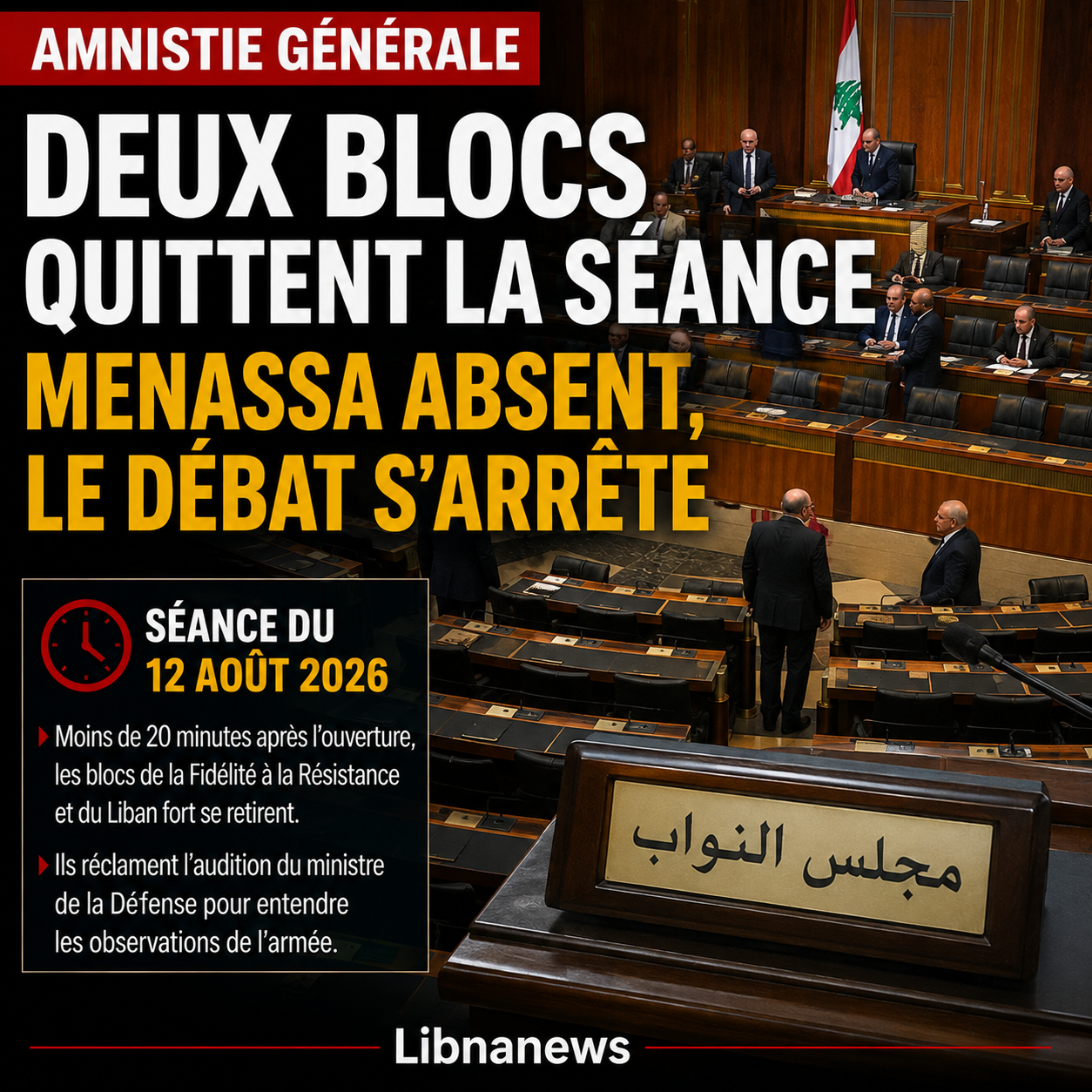
The resumption of debates on the general amnesty took place on Wednesday 12 August 2026 in the Lebanese Parliament. Less than 20 minutes after the opening of the sitting, the members of the Resistance Faith Block and the Lebanon Strong Block withdrew from the Chamber. They protest against the absence of Defence Minister Michel Menassa and demand that he be able to present to parliamentarians the army’s observations on the law. The withdrawal of the deputies thus prolongs the institutional arm of the day between Prime Minister Nawaf Salam and his Minister of Defence.
However, the meeting resumed with the explicit objective of considering the proposal granting a general amnesty and exceptionally reducing the duration of certain sentences. At 11:20 a.m., the members had started studying the text. At 1137 hours, both blocks announced their withdrawal. A few minutes later, the deputy of the Free Patriotic Current Salim Aoun justified this decision by refusing to participate in a procedure that would prevent the army from making its opinion heard.
The withdrawal of Members takes place at the beginning of the debate
The morning calendar illustrates the rapid recovery of the crisis. The House met instead of the Star in Beirut to continue the legislative session adjourned the day before. The text on the general amnesty was at the centre of the work after the tensions that had already prevented its full review on Tuesday.
Barely the discussion started, the absence of Michel Menassa became the main point of friction. Members of the Resistance-related Loyalty bloc and those of the strong Lebanon bloc, whose Free Patriotic Current is the main component, left the room. Their decision is therefore not only about the content of the amnesty. It is directly concerned with the conditions under which Parliament is called upon to debate it.
For these Members, the vote cannot proceed normally until the opinion of the military institution has been presented to the assembly. This requirement is particularly sensitive because certain provisions may affect the situation of persons prosecuted or convicted in cases involving attacks against the army.
Collective departure gives the conflict a scope that goes beyond exchanges between a few elected officials. The disagreement between Salam and Menassa, which appeared on Tuesday as a dispute within the executive, now directly influences the functioning of the Chamber.
Salim Aoun refuses to endorse a « violation »
Salim Aoun gave, at the end of the session, one of the most precise explanations of the choice of the free Patriotic Current. The Member states that his block has withdrawn in order not to see against him the fact of having participated in what he considers a violation of the procedure.
At the heart of his argument is a distinction between the word of the government and that of the army. Salim Aoun acknowledges that the Prime Minister is responsible for expressing the government’s position. However, he refused to infer that Michel Menassa could not transmit to Parliament the observations of the military institution and his ministry.
The Member asks a simple question: why refuse to hear an opinion that does not bind Parliament or the government? According to him, the presentation of the military position would not have the effect of depriving the deputies of their decision-making power. It would provide them with an additional element before the vote on a text that directly affects several security issues.
Salim Aoun also insists on the parliamentary origin of the project. The amnesty proposal was not submitted by the government. He therefore considered that the debate was not just a confrontation between two governmental positions. For him, the fact that Nawaf Salam speaks on behalf of the Council of Ministers does not remove the possibility of hearing the Minister of Defence on an issue within his portfolio.
The absence of Michel Menassa remains at the heart of the conflict
Wednesday’s withdrawal is the direct continuation of the crisis that occurred the previous day. Michel Menassa then wished to present to the deputies the army’s observations on the general amnesty. Nawaf Salam had defended another reading of government operations and recalled his role as the executive spokesman.
In particular, the Prime Minister had invoked article 64 of the Constitution, which gives him the representation of the Government and the ability to speak on his behalf. His contradictors had responded by invoking rule 67, which provides for the presence of ministers before the House and their right to be heard when they request the floor.
The constitutional dispute therefore does not concern Parliament’s right to vote. It is not contested by any of the protagonists. It deals with the possibility for a minister to present a position related to his or her department when it does not necessarily coincide with the collective position expressed by the Prime Minister.
This discrepancy had not been resolved on Tuesday. The new meeting was intended to allow a resumption of the debate, but the absence of Menassa on Wednesday morning immediately showed that the compromise sought had not been reached.
Before the opening of the work, however, contacts had taken place in an attempt to resolve the dispute. They clearly did not allow for the necessary conditions for the return of the Minister of Defence to the Chamber.
Why MEPs want to hear the army
The application cannot be separated from the content of the law. The general amnesty currently under consideration does not cover a single category of detainees and does not have a uniform legal effect. The text combines several mechanisms, including exceptional reductions in sentences and provisions on lengthy detention.
The most sensitive point concerns people involved in security matters. The cases mentioned in the discussions included convicted or detained persons qualified as Islamists, some of whom had been prosecuted for acts related to clashes with the army.
The debates over the past few months have, among other things, brought up Abra’s cases in 2013 and other cases in which military personnel were killed. The case of Ahmad al-Assir is regularly cited in the controversy, although the exact effect of the future law on its situation will depend on the final drafting and the planned exclusions.
It is precisely this type of case that explains the army’s reserves. Its officials want to avoid a mechanism designed to correct excessively long detentions leading, through its scope of application, to severely reduce the sentences of persons convicted of crimes committed against soldiers.
The question is therefore less whether the army can decide the content of the law than whether Parliament must hear its objections before deciding itself.
Sentence reductions that remain controversial
The text currently under discussion was built around several compromises. One of the mechanisms examined concerns persons who have been imprisoned for exceptionally long periods. Negotiations have changed the thresholds and the conditions for benefiting from release or reduction.
Another part of the debate concerns the heaviest convictions. Parliament adopted on Tuesday the abolition of the death penalty. This change changes the situation of convicted persons who have been sentenced and requires the determination of the regime that will now apply to them.
Discussions on amnesty also include proposals for certain life sentences. Their combination with the abolition of the death penalty feeds into concerns about the real effects of the scheme for convicted persons involved in the most serious security cases.
Amnesty defenders point out, on the other hand, that many detainees have spent years in prison in extremely lengthy proceedings and that not all persons under the name of « Islamic detainees » are accused of the same acts. They therefore call for a distinction between situations rather than an overall rejection of the measure.
It is precisely this border that Parliament is still trying to define. What crimes must be absolutely excluded? From what time can an exceptional measure apply? How can we prevent a general system from producing unintended consequences in cases involving the death of military personnel? These questions remain at the heart of the text.
Fidelity to the Resistance and Lebanon strong together
The simultaneous withdrawal of the two blocs gives an additional political dimension to the crisis. The Resistance Loyalty Block and the Free Patriotic Current do not necessarily defend identical positions on all provisions of amnesty. However, they converge on the need to hear Michel Menassa.
This position had already emerged in Tuesday’s debates. Several MPs had asked that the Minister of Defence should be able to come to the assembly to present the military’s observations. The problem then became significant enough to disrupt the continuation of the meeting.
On Wednesday, there was disagreement in the first few minutes. Withdrawal is no longer just a threat used during discussion. It becomes a means of direct pressure on the presidency of the House and the government.
The two blocs want to mean that they refuse to allow Parliament to proceed directly to study and vote on the text without first resolving the question of the minister’s presence. Their departure mechanically increases the pressure on Nabih Berri, responsible for maintaining the conditions necessary for the continuation of the work.
Nabih Berri again faced with parliamentary risk
The Speaker had already had to deal with the consequences of successive withdrawals and absences on Tuesday. The meeting had finally been interrupted before the amnesty could be settled. Wednesday’s resumption was to allow Members to come back to this text.
The scenario is repeated almost immediately. The meeting began with the amnesty, but the substantive debate was again caught up in the question by Michel Menassa.
The situation places Nabih Berri in a delicate position. The Speaker of the House shall permit Parliament to exercise its legislative power while taking into account requests from Members of Parliament to attend the hearing of the Minister of Defence.
The immediate issue therefore becomes that of the continuity of the session. Each withdrawal reduces the number of Members present and brings the House closer to a quorum problem if departures multiply.
At this point in the morning, the crisis remains open. However, the decision of the resistance loyalty blocs and strong Lebanon shows that the compromise sought since the previous day did not hold.
Amnesty again suspended from institutional conflict
Wednesday’s scene now summarizes the paradox of the file. Parliament has the power to vote for amnesty. The government does not have to substitute for deputies and the army does not have any veto power over a law.
But the content of the text makes it politically difficult to vote without taking military reserves into account. When certain reductions in sentences may affect cases involving attacks against the army, several MPs consider that a hearing by Michel Menassa is a necessary prerequisite.
Nawaf Salam defends the coherence of the executive and its constitutional role as representative of the government. Its opponents do not dispute this prerogative, but refuse to allow it to be interpreted as preventing the minister from providing a technical or institutional opinion to Members.
The withdrawal of Members on Wednesday morning therefore once again moves the centre of the debate. The question is no longer just which sentences will be reduced or which prisoners will be affected. It now deals with the institutional conditions necessary for voting to take place.
Less than twenty minutes after the resumption of the meeting, the two blocs chose to leave the Chamber rather than continue without Michel Menassa. The continuation now depends on the ability of Nabih Berri, the government and parliamentary groups to find a formula to hear the army’s reservations without reopening the conflict over the prerogatives of Nawaf Salam. As long as this question remains unanswered, the general amnesty remains subject to further parliamentary blockade.