





In the middle of 1969, the Middle East remains marked by the aftermath of the 1967 war, with continuing tensions along the ceasefire lines. The border between Lebanon and Israel, established by the 1949 Armistice Agreement, became a hotbed of repeated incidents involving exchanges of fire, infiltration and air raids. These events are part of a broader context in which Palestinian Fedayins, operating from Lebanese territory, launch attacks against Israeli targets, causing responses that affect civilian areas. The Lebanese government, faced with a fragile internal situation, denounces these violations as unjustified attacks, while Israel justifies its actions by the need to defend itself against what it calls terrorist bases. The 11 August aerial attack on several villages in southern Lebanon marks a culmination of this escalation, resulting in civilian casualties and increased diplomatic mobilization at the United Nations.
The border incidents of this period illustrate the precariousness of the ceasefire. As early as the first months of the year, mutual complaints were exchanged, stressing the lack of effective monitoring in the field. The role of United Nations military observers from the United Nations Truce Supervision Organisation (UNTSO) is then limited to ad hoc investigations, without a permanent presence along the border. These observers, deployed for specific missions, collect evidence of violations, but their effectiveness is hampered by restrictions imposed by the parties in conflict.
Border incidents at the beginning of the year: A gradual increase in hostilities
The year 1969 begins with tensions accumulated since the end of the Six Days War. On 2 and 3 January, Israeli mortar shells were shelling four Lebanese villages near the border, causing damage without causing any casualties. The Lebanese authorities report that the fire came from Israeli positions, targeting civilian areas without apparent provocation. Local witnesses describe explosions that damage homes and agricultural infrastructure, disrupt the daily lives of the inhabitants. In response, Israel denies any free aggression, assigning these actions to defensive measures against potential infiltration.
A few weeks later, on 21 February, Israeli aircraft violated Lebanese airspace. Twelve overflights were reported, with Mirage aircraft seen near border villages. Lebanese forces are responding, engaging an exchange of fire that highlights the vulnerability of the border. UN observers, mandated to investigate, confirm aerial activity, noting trajectories that cross the ceasefire lines. These incidents do not cause immediate casualties, but they contribute to a growing climate of mistrust, where each overflight is perceived as a potential threat of wider attack.
In the spring, internal tensions in Lebanon further complicate border dynamics. Conflicts between the Lebanese army and armed Palestinian groups based in the refugee camps broke out in April and May. These clashes, which cause dozens of injuries, reveal the difficulties of the Lebanese government in controlling its southern territory, where the fedayins operate with relative autonomy. Israel takes advantage of this instability to accuse Beirut of hosting « terrorist bases », justifying preventive operations. On 16 July, an Israeli patrol entered Lebanese territory near El-Megidieh, destroying three houses, killing 14 sheep and removing two Lebanese nationals. UN observers, sent to the scene, examined the debris and found an unexploded grenade marked in Hebrew, confirming the incursion. The Lebanese authorities describe this act as a flagrant violation of the Armistice Agreement, while Israel presents it as a response to previous attacks on its border areas.
These isolated events, although limited in scale, accumulate pressure leading to a major escalation in August. Southern Lebanon, a densely populated agricultural region, became the main scene of these confrontations, with villages like those near the Litani River exposed to constant risks. The inhabitants, mostly farmers and shepherds, report nights disturbed by aircraft noises and sporadic explosions, forcing temporary movements to the north.
The 11 August aerial attack: A premeditated act and its immediate consequences
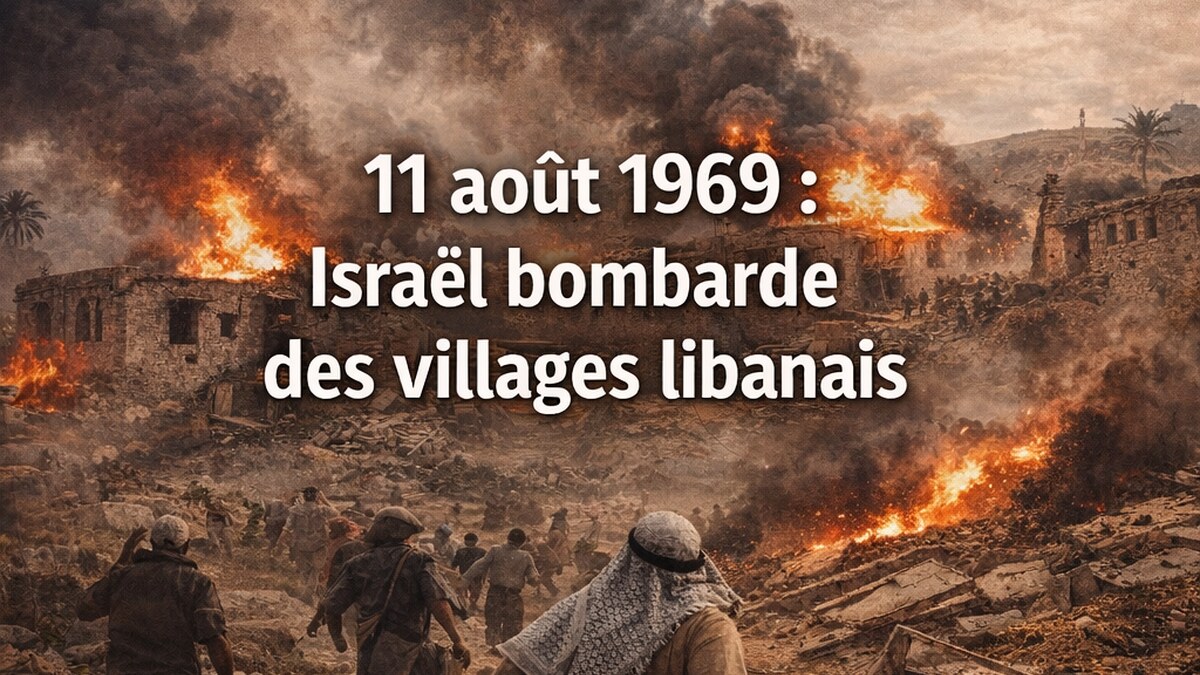
On 11 August 1969 marks a turning point in border tensions with an Israeli air attack on six villages in southern Lebanon. Israeli jets, armed with napalm bombs, rockets and machine guns, bombed civilian areas, killing four people and wounding three others. Targeted villages, located near the border, include localities such as those around Hasbaya and Marjayoun, where homes and fields are burned. The Lebanese authorities describe the assault as a « massive and unprovoked act of aerial aggression », explicitly targeting civilians and violating obligations under the UN Charter and Security Council resolutions.
Israel justifies this operation with a series of previous attacks from Lebanese territory. According to Israeli complaints, 21 incidents – including shelling, shooting and mining – have targeted Israeli communities in previous months, causing civilian and military casualties. The targets of the 11 August attack are described as « irregular terrorist encampments », although Lebanese reports emphasize the civilian character of the affected areas. Eyewitnesses in Lebanon report scenes of chaos: flames engulfing wooden houses, families fleeing under bombardments, and improvised aid to evacuate the wounded to hospitals in Sidon or Beirut.
Immediately after the attack, Lebanon seizes the Security Council, calling for an urgent meeting to consider this « serious violation ». He stressed that his country, committed to peace, did not have the means to counter such attacks and called for sanctions against Israel, with reference to resolution 262 (1968), which warned against the recurrence of violence. Israel, for its part, counter-attack by accusing Lebanon of condoning bases for terrorist operations, also calling for a Council meeting to discuss these « repeated armed attacks » against its territory.
The human consequences of the attack are immediate and profound. The four victims, including women and children, symbolize for Lebanon the injustice of a proxy war. Estimated material damage to thousands of Lebanese pounds affects the already fragile local economy, with burned crops and destroyed infrastructure. This event strengthens internal divisions in Lebanon, where Christian and Muslim communities debate the Palestinian presence, perceived by some as a factor of instability.
Discussions in the Security Council: Reciprocal charges and calls for moderation
On 12 August, the Security Council meets urgently at the request of both parties. Lebanon rejects any justification for reprisals, affirming its adherence to the Armistice Agreement of 1949 and delinking its government from the actions of Palestinian commandos. His representative stressed the validity of the Israel-Lebanon Joint Armistice Commission, calling on the Council to impose measures to prevent further deterioration. Israel denied any initial responsibility, accusing Lebanon of hosting terrorists and refusing to contain them.
The discussions, which extended from 13 to 15 August, saw interventions by both permanent and non-permanent members. Algeria describes Israeli actions as part of an expansionist plan, calling for measures against aggression. The USSR condemns Israel for refusing a settlement under resolution 242 (1967), supporting firm actions. France highlights the dangers without a political solution, condemning reprisals. The United States, while opposing the attack, notes mutual violations and suggests the deployment of UNTSO observers along the border to prevent incidents.
Other countries, such as Finland, link violations to a wider cycle of violence, urging compliance with the ceasefire. Pakistan, Senegal, Zambia and China deplore the attack on a peaceful Lebanon, calling for action. Nepal and Colombia condemn violations regardless of their origin. These debates highlight the polarisation within the Council, where regional alliances influence positions.
On 18 August, the Secretary-General issued a note calling for observers to be stationed on both sides of the border to observe and maintain the ceasefire. He noted the lack of verified information due to the absence of operations since June 1967, and stressed that the presence of observers could deter incidents. Lebanon accepts, citing its continued accession to the Armistice Agreement and the existing presence of observers in its territory. Israel makes its agreement conditional on the will of Lebanon, seeing the ceasefire as requiring a strengthening beyond the disarmament framework.
Security Council resolution 270: Unanimous condemnation
On 26 August, the Council unanimously adopted resolution 270 (1969). The Commission condemns Israel’s premeditated aerial attack on villages in southern Lebanon as a violation of the Charter and Council resolutions. It deplores all violent incidents in violation of the ceasefire, the expansion of the area of fighting, and military reprisals. The resolution warns that such violations could result in additional effective measures under the Charter to prevent their recurrence.
This resolution, though symbolic, reinforces diplomatic pressure on Israel, while recognizing reciprocal violations. It is part of a broader effort to link border incidents with peace negotiations, including Ambassador Jarring’s mission and four-Power discussions. However, it does not involve the immediate deployment of observers, leaving the border vulnerable to new incidents.
Subsequent incidents and continuing tensions
After the resolution, hostilities do not calm down. On 3 September, Lebanon reported Israeli bombings of villages in the south, causing damage and injuries. On 5 September, shells struck other localities, intensifying fear among border populations. On 3 October, an Israeli helicopter force landed in Lebanon, removing three civilians and wounding four. Israel accuses Lebanon of frequent attacks on its border villages, mines and abductions, with incidents reported on 4 September, 10 October and 15 December.
On 6 October, a new air attack hit civilian areas, while on 4 December, shelling damaged infrastructure. These reciprocal violations include infiltration, shelling and mining, with each party blaming the other in the midst of broader demands for « terrorist war ». United Nations observers continue their ad hoc investigations, gathering evidence such as weapons debris, but without an extended mandate for a permanent presence.
In November, the Cairo agreement between Lebanon and the Palestine Liberation Organization formalizes the Palestinian armed presence in the camps, further complicating border control. This agreement, signed on 3 November, allows women to operate under certain restrictions, but it is perceived by Israel as a legitimization of cross-border attacks. The Lebanese villages in the south, like those near Nabatiyah, are undergoing ongoing disruption, with displaced families and a local economy affected by agricultural destruction.
The immediate implications of tensions on regional stability
The events of 1969 highlight the challenges posed by the absence of a robust observation force. The proposals to deploy additional observers, although supported by several members of the Council, remain a dead letter in the face of Israeli conditions. Lebanon, as host State to hundreds of thousands of Palestinian refugees, faces double pressure: internal, with religious tensions exacerbated by the Palestinian armed presence, and external, with Israeli responses aimed at deterring infiltration.
The year’s air and land incidents cause cumulative losses: dozens of civilians injured or killed, hundreds of homes damaged, and an economic disruption in southern Lebanon, where agriculture is a vital source of income. Lebanese forces, limited in resources, focus on maintaining internal order, leaving the border exposed. Israel, for its part, is strengthening its defensive positions, with increased patrols and preventive measures that include regular overflights.
At the end of the year, complaints persisted, with Israel reporting attacks on its localities and Lebanon reporting bombings. These immediate dynamics illustrate how localized incidents fit into a cycle of reprisals, affecting Lebanese sovereignty and Israeli security without concrete diplomatic resolution. UN efforts, focused on investigations and proposals, highlight the limitations of ad hoc monitoring in the face of deep structural tensions.