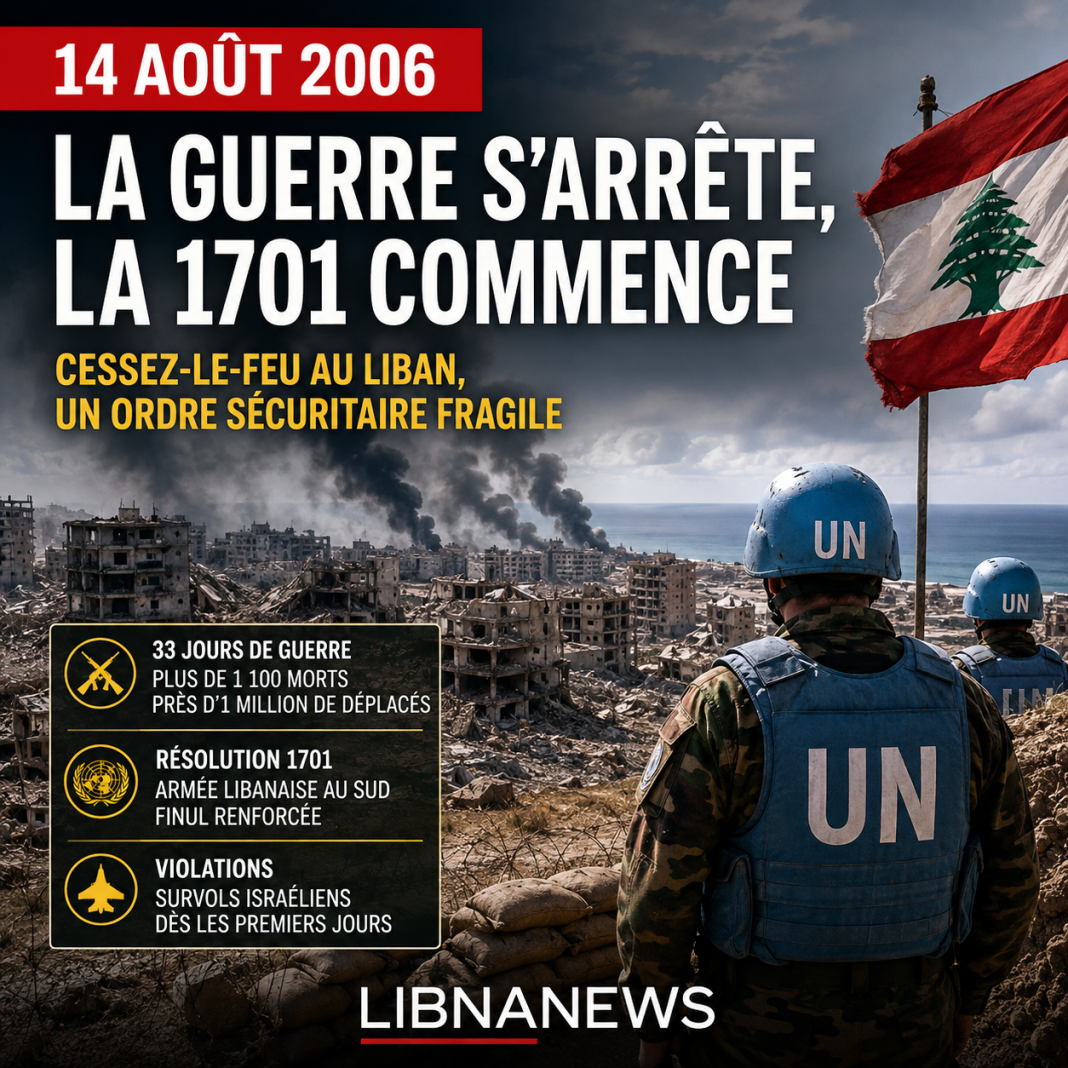






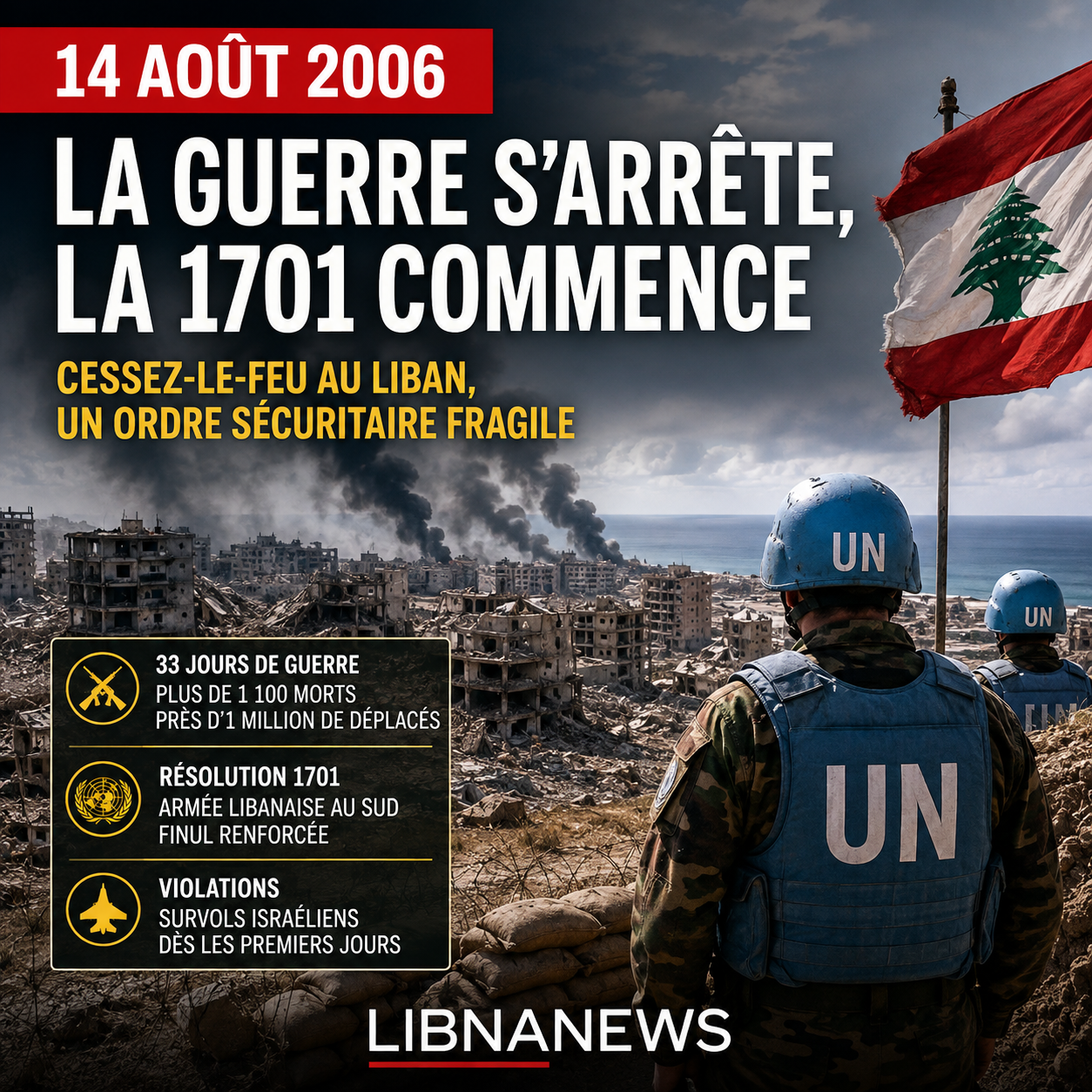
At 8 a.m. on Monday, 14 August 2006, the cessation of hostilities under UN Security Council Resolution 1701 enters into force between Israel and Hezbollah. It ended thirty-three days of a war that ravaged part of Lebanon, killed more than a thousand people, displaced hundreds of thousands of people and destroyed essential infrastructure. But this day does not mark peace between Lebanon and Israel, nor does it mark the beginning of an unwavering application of the new international machinery. From the first few days, the violations appeared: Israeli overflights of Lebanese airspace continued after the ceasefire and became one of the permanent post-war disputes. Five days later, an Israeli operation in the Bekaa was denounced by the United Nations as a violation of the cessation of hostilities.
The14 august 2006yet it remains a pivotal date in Lebanon’s contemporary history. Resolution 1701 imposes a new framework in the South: the gradual withdrawal of Israeli forces, the deployment of the Lebanese army to the border, the massive strengthening of UNIFIL and the principle of an area between the Blue Line and the Litani where no armed force other than the Lebanese State and UNIFIL should be present. This will help to avoid for almost 18 years a new general war of the magnitude of that of 2006, without resolving the root causes of the conflict. Hezbollah will retain and strengthen its arsenal, while Israel will continue its aerial incursions over Lebanese territory for years. 1701 will thus function more as a restraint mechanism than as a fully implemented settlement.
On 14 August 2006, weapons were silent at 8 a.m
The cessation of hostilities officially enters into force at 8 a.m. local time. After thirty-three days of bombing, rocket fire and ground fighting, the change was brutal. In a large part of the country, the noise of the strikes stops. In northern Israel, Hizbullah rocket fire also stopped.
The text adopted three days earlier by the Security Council does not refer to a peace treaty. It calls for a « complete cessation of hostilities », including the cessation of all Hezbollah attacks and the cessation of all Israeli offensive military operations. The formula is the result of a difficult compromise between the United States, France, the Lebanese Government and other members of the Security Council.
This nuance is essential. Israel does not immediately withdraw all its forces in the morning of 14 August. The mechanism foresees the gradual withdrawal of the Israeli army as the Lebanese army and UNIFIL take positions in the South. The aim is to avoid a military vacuum between the departure of Israeli forces and the return of the Lebanese State.
The ceasefire therefore interrupts major operations, but it does not instantly erase the Israeli military presence or the violations that accompany the first days of the operation.
Israeli violations begin immediately
One of the fundamental elements of understanding resolution 1701 is that its implementation remains incomplete from the outset. Israeli overflights of Lebanese airspace continue after the cessation of hostilities has entered into force. They soon became one of Beirut’s main reasons for protesting to the United Nations.
For Lebanon, these incursions constitute a direct attack on its sovereignty. The United Nations will regularly regard them as violations of resolution 1701 and will ask Israel to put an end to them. The Secretary-General’s successive reports on the implementation of the text will continue to identify these air activities for years.
Israel stands for another reading. Its authorities invoke their intelligence needs and the need to monitor Hezbollah, including its movements, military installations and weapons supplies. But this security justification is not a legal authorization to enter Lebanese airspace.
The situation reveals from the outset the fragility of the system. On the ground, Israel must gradually withdraw and let the Lebanese army and UNIFIL settle. In the air, the Israeli army maintains an almost permanent surveillance capacity over Lebanon.
This contradiction will accompany the entire history of resolution 1701.
19 August, an Israeli operation in Bekaa
The first week after the ceasefire shows even more clearly that the new framework is not being implemented smoothly. On 19 August 2006, only five days after the cessation of hostilities came into force, Israeli forces were conducting an operation in the Bekaa.
Israel claims to want to prevent the transfer of weapons to Hezbollah. The operation provoked a firm reaction from UN Secretary-General Kofi Annan, who considered it a violation of the cessation of hostilities.
The incident is important to understand the following years. Israel considers that the rearming of Hezbollah violates the objectives of the resolution and considers it necessary to maintain freedom of action to prevent certain transfers. Lebanon and the United Nations, for their part, recall that Israel cannot invoke these suspicions to sovereignly violate Lebanese territory.
The debate that began in August 2006 will remain almost unchanged in the following years: each side invokes the other’s shortcomings to justify or explain its own practices.
The resolution therefore never installs a perfectly respected order. It imposes a legal and security framework in which violations themselves become a permanent element of the balance of power.
The war had started thirty-three days earlier
The conflict began on 12 July 2006 with a Hezbollah operation near the border. ISIS fighters are attacking an Israeli patrol. Two Israeli soldiers, Ehud Goldwasser and Eldad Regev, were captured. Several Israeli soldiers were killed during the attack and subsequent clashes.
Hezbollah presents the operation as a means of obtaining an exchange of prisoners. This type of action corresponds to a strategy previously used by the organisation.
The Israeli reaction immediately changed the scale of the conflict. The government of Ehud Olmert decides to conduct a major military campaign in Lebanon. The bombings are not limited to Hezbollah positions near the border.
Israeli aviation hits Beirut International Airport, roads, bridges, energy infrastructure, southern suburbs and many localities in the South and the Bekaa. Israel also imposed an air and maritime blockade.
Hezbollah responded with massive rocket fire into northern Israel. Cities such as Haifa, Nahariya, Kiryat Shmona and Safed are regularly affected or placed on alert. Part of the Israeli population in the North temporarily leaves the area or lives for several weeks near shelters.
In a few days, a cross-border operation turns into an open war.
Israel wants to permanently change balance in the South
The Israeli government pursues several objectives. He wants to secure the return of captured soldiers, weaken Hezbollah, severely reduce its ability to fire rockets and transform security conditions along the border.
The issue of Hezbollah’s armament largely precedes the war. Security Council resolution 1559, adopted in September 2004, had already called for the dissolution and disarmament of Lebanese and foreign militias. But in July 2006, Hezbollah retained its military capabilities and a large settlement in the South.
For Israel, the 12 July attack shows that the situation created after its withdrawal from Lebanon in May 2000 does not bring it the security expected. The military campaign must therefore impose a new reality.
Israeli leaders are first and foremost strongly focusing on air power. The strikes destroy part of Hezbollah’s infrastructure and cause significant damage, but they do not stop rocket fire.
Land war then becomes more important. The Israeli army entered several parts of the South and confronted Hezbollah fighters in defence-ready localities.
Maroun al-Ras, Bint Jbeil, Aitah al-Sha`b and other areas become places of intense fighting.
Hezbollah remains able to fight until the last day
Hezbollah’s ability to continue rocket fire and ground fighting until the eve of the ceasefire became one of the key elements in the political interpretation of the conflict.
Militaryly, the organization suffers losses and part of its infrastructure is affected. But Israel failed to destroy it. Hezbollah continues to fight despite thirty-three days of strikes and retains its ability to launch projectiles on Israeli territory.
This survival provides Hassan Nasrallah with the basis of his victory story. For Hezbollah, resisting an army with overwhelming technological and aerial superiority is already a strategic success.
The reasoning is not that of a conventional military victory. Hezbollah does not conquer Israeli territory and does not expel all opposing forces by itself. But it prevents Israel from achieving many of its initial goals.
The two captured soldiers are not forcibly released. Rocket fire does not cease until the diplomatic agreement. The organization was not eliminated and retained its political and military apparatus after the war.
This is what Hassan Nasrallah will turn into a « divine victory. ».
A disputed « divine victory » in Lebanon
The expression is quickly required in the communication of Hezbollah. It becomes one of the pillars of the memory of war among the supporters of the organization and its allies.
But this reading immediately causes controversy in Lebanon. Hizbullah’s opponents underline the enormous human and material cost of the conflict. They mainly challenge the right of an armed organisation to conduct an operation that could lead the whole country into a war without a prior decision by the government.
This issue has a particularly strong post-conflict dimension. The debate no longer focuses solely on Hezbollah’s military performance against Israel. It concerns the very principle of war and peace: who should be able to decide to engage Lebanon in a confrontation?
For Hezbollah defenders, the existence of « resistance » remains justified by the Israeli threat and the limits of the Lebanese army. They consider that the war has proved the effectiveness of the organization as a deterrent.
On the contrary, for its opponents, the conflict proves the danger of a system in which an autonomous military force can make a strategic decision whose consequences affect all Lebanese.
This fracture does not disappear on August 14. It’s getting stronger.
More than 1,000 dead in Lebanon
Human costs are the heaviest of war. Post-conflict assessments indicate more than 1,100 deaths in Lebanon. Official figures from the United Nations included 1,187 deaths and more than 4,000 injuries at the end of August 2006.
A significant proportion of the victims are civilians. Several bombings become emblematic of the violence of the conflict and provoke strong international reactions.
On 30 July, the bombing of Cana killed dozens of refugees in a building, including many children. The event caused an international shock wave and increased diplomatic pressure to obtain a ceasefire.
Israel claims during the war to target Hezbollah and the infrastructure used by the organization. However, the Lebanese authorities and many international organizations denounce the extent of civilian casualties and destruction.
The war particularly affects the South, the southern suburbs of Beirut and the Bekaa, but the economic and social consequences concern the entire country.
Nearly 1 million displaced persons
Travel is another measure of the scale of the disaster. The UN estimates that about 1 million Lebanese were forced to leave their homes during the conflict.
Hundreds of thousands of people take refuge in other parts of the country. Schools, public buildings, private apartments and associations serve as temporary accommodation. Other Lebanese leave the territory through Syria or through organized evacuations.
For a country with a population of a few million inhabitants, the proportion is considerable.
The South partially emptied of its population during the fighting. The inhabitants fled the bombings, but the roads themselves became dangerous. Some villages remain isolated for several days.
On 14 August, the phenomenon almost immediately reverses.
As soon as the cease-fire was announced, tens of thousands of internally displaced persons took the road back. The main axes towards the South are filled with vehicles. Many families still do not know if their homes still exist.
This massive return becomes one of the strongest images of the day.
Destroyed villages and immense reconstruction
The inhabitants discover a deeply damaged territory. Buildings are being destroyed in the southern suburbs of Beirut. Several villages in the South were heavily bombed. Roads and bridges are closed.
Electrical infrastructure, communication networks and many economic facilities were also affected. The Israeli blockade paralyzed some of the foreign trade for several weeks.
Economic cost estimates vary according to the methods used. Direct and indirect damages amount to several billion dollars.
Reconstruction therefore immediately becomes a political issue. The Lebanese State must repair the infrastructure and support the families affected. At the same time, Hizbullah is mobilizing its own social and financial network to provide prompt compensation to some residents whose homes have been destroyed.
This intervention contributes to the post-war political battle. Hezbollah wants to demonstrate that it is capable not only of fighting, but also of addressing the social consequences of the conflict in its areas of influence.
Cluster bombs prolong war after August 14
The ceasefire does not mean that the population can return safely everywhere. A considerable amount of unexploded ordnance remains scattered in the bombed areas.
The issue of cluster munitions is becoming particularly serious. Many small submunitions do not explode during dispersal and remain in fields, gardens, roads or near homes.
The danger directly affects civilians returning home. People are killed or injured after the official end of hostilities by handling or approaching unexploded ordnance.
Demining teams need to work on considerable surfaces. The problem also affects agriculture, as access to certain land becomes impossible or dangerous.
Thus, even when the bombing stopped at 8 a.m., the war continued to produce casualties.
This reality reminds us that a ceasefire constitutes a legal and military border, but that it does not instantly remove the material consequences of the thirty-three previous days.
Resolution 1701 was adopted on 11 August
The cessation of hostilities was the result of several weeks of difficult diplomatic negotiations. The Security Council finally unanimously adopted resolution 1701 on Friday, 11 August 2006.
France and the United States play a central role in shaping the compromise. The differences are important. Washington strongly supports Israel and wants to avoid a ceasefire that would simply bring the situation back to the status quo ante. Paris insists more on Lebanese sovereignty and the need to reach a text acceptable to the government of Fouad Siniora.
A first formulation raises significant reservations in Beirut. In particular, Lebanon refuses any solution that would give the impression of endorsing a prolonged Israeli occupation.
The final text combines several elements. Hezbollah must stop its attacks. Israel must cease its offensive military operations. The Lebanese army and UNIFIL must deploy to the South. Israel must withdraw its forces in parallel with this deployment.
The resolution also provides for a significant increase in the strength of UNIFIL.
Lebanese Army returns south
One of the most important changes in the regulation concerns the Lebanese army. Prior to the war, its presence south of the Litani remains limited compared to the post-August 2006 arrangement.
The government decided to deploy approximately 15,000 troops to the South. This movement should enable the State to reaffirm its authority over a region where Hezbollah has long had a very important military and social settlement.
The deployment begins after the ceasefire and accompanies the Israeli withdrawal. For the first time in several decades, the Lebanese army has taken a large-scale stand up to areas close to the Blue Line.
Political significance is important. The resolution is based on the principle that the Lebanese State must exercise its authority over all its territory.
But an ambiguity immediately arises: the deployment of the army is not accompanied by the forced disarmament of Hezbollah.
The State therefore returns physically to the South without immediately acquiring the effective monopoly of armed force.
This contradiction will become one of the central problems of the application of 1701.
UNIFIL is changing dramatically
The United Nations Interim Force in Lebanon has existed since 1978. Before the 2006 war, there were about 2,000 soldiers. Resolution 1701 authorizes an increase of up to 15,000 military personnel.
This transformation profoundly alters its role. UNIFIL must now accompany the deployment of the Lebanese army, monitor the cessation of hostilities and help maintain a secure environment in the South.
Large European contingents join the mission. France, Italy, Spain and other countries are strengthening their presence. UNIFIL thus became one of the main United Nations peacekeeping operations.
However, its mandate remains limited. It is not transformed into a force to wage war against Hezbollah or systematically search the territory for its weapons.
It acts in coordination with the Lebanese Armed Forces and within the scope of the powers set out in the resolution.
This distinction will be a regular source of Israeli criticism. Israel will blame UNIFIL for not preventing Hezbollah from rebuilding its military capabilities. The UN will recall that the mission has neither the nature nor the mandate of an occupying force that can act independently of the Lebanese authorities.
Southern Litani becomes an area of special security status
One of the most frequently cited provisions of the resolution concerns the space between the Blue Line and the Litani River.
The text provides that no armed personnel, weapons and military equipment other than those of the Lebanese Government and UNIFIL shall be found there.
The Litani does not become a political border. It lies entirely within Lebanon. But it becomes the northern boundary of a space subject to a particular security requirement.
This provision is central because it directly targets the military presence of Hezbollah in the South.
She also explains why the term « Litani » reappears in discussions after October 2023. The demands for the withdrawal of Hezbollah fighters and military infrastructure north of the river do not arise with the new war. They are based on the framework adopted in 2006.
Similarly, the current references to UNIFIL and the deployment of the Lebanese Armed Forces take almost word for word the architecture built 18 years earlier.
Israeli overflights become a permanent violation
The other dimension of the resolution is often less prominent in political debates: respect for Lebanese sovereignty also concerns Israel.
In the weeks and months following the ceasefire, Israeli aircraft continues to fly regularly over Lebanon. Fighting aircraft and drones penetrate national airspace, sometimes deep over the territory.
Beirut protested to the United Nations. UNIFIL and the Secretary-General of the United Nations have repeatedly recalled that they are violations of Lebanese sovereignty and the resolution.
These flights are not exceptional. They become a structural characteristic of the post-2006 period.
For years, international reports on the implementation of 1701 have documented Israeli air violations. Israel continues to justify these missions by the need to monitor the Hezbollah arsenal and arms transfers.
The problem is therefore at the heart of the scheme from the very beginning: Israel accuses Hezbollah of violating the resolution by maintaining arms and strengthening its capabilities, while Lebanon accuses Israel of violating the same text by its air incursions and other violations of its sovereignty.
Israeli withdrawal remains progressive
The Israeli army did not leave Lebanon entirely on 14 August. Its withdrawal is linked to the gradual arrival of the Lebanese Army and UNIFIL in the evacuated areas.
This organization takes several weeks. UNIFIL acts as an intermediary between the Lebanese and Israeli armed forces in order to avoid direct contacts that could lead to further incidents.
The withdrawal of most Israeli forces ended in early October 2006.
But litigation remains open. The issue of the Shebaa farms remains unresolved. Lebanon claims this area occupied by Israel, while the United Nations has historically attached it to the occupied Syrian Golan.
Other points along the Blue Line remain disputed or are subject to Lebanese reservations.
The resolution therefore does not create a definitive boundary between two peace-making States. It organises a withdrawal line and a mechanism to reduce the risk of confrontation.
Resolution 1701 does not disarm Hezbollah
The most lasting problem concerns Hezbollah’s weapons. The resolution recalls the principles of previous texts calling for the disarmament of armed groups in Lebanon and the exclusive exercise of State authority.
It also affirms the objective of a Lebanon where no weapon or authority can exist outside the Government’s consent.
But no military mechanism is created to immediately disarm Hezbollah.
UNIFIL is not mandated to launch an operation against the organization. The Lebanese army is not in charge of confronting him to withdraw his weapons.
In the political context of 2006, such a confrontation would in any case have put the country at great risk of internal conflict.
The result is a partial application. Hezbollah’s visible weapons largely disappear from some areas close to the border, but the organization retains its military apparatus and stockpiles.
Over the years, it reconstructs and increases its arsenal considerably.
Israel considers rearmament as the main violation
For Israel, this is evidence that the 2006 system did not fulfil its essential function.
Israeli officials claim that Iran and Syria have allowed Hezbollah to receive missiles, rockets and equipment in increasing quantities.
The organisation also develops its military capabilities in other areas: precision missiles, drones, anti-tank systems, communications and underground structures.
Israel therefore believes that 1701 is gradually emptied of its substance on the disarmament and demilitarization of the South.
This reading is not without foundation on the observation that a non-State military apparatus is maintained. But it does not remove Israel’s own obligations.
This is what Lebanon regularly recalls: a party cannot demand the full application of the provisions aimed at its opponent while considering as optional those concerning Lebanese sovereignty.
The controversy over 1701 thus became a permanent battle over symmetry of obligations.
Israel saw war as a strategic failure
Within days of the ceasefire, the Israeli debate quickly became severe. The war had been launched with ambitious objectives, but many were not achieved.
The two captured soldiers are not brought back by the army. Hezbollah continues to fire rockets until the end of the conflict. His command survived and the organization remained armed.
Criticism also includes the preparation of ground forces, the improvisation of certain operations and coordination between the government and the staff.
Chief of Staff Dan Halutz eventually resigned in January 2007.
The Winograd Commission, set up to investigate the conduct of war, published a particularly critical report a few months later on the process leading to intervention and how the objectives were defined.
Prime Minister Ehud Olmert and Defence Minister Amir Peretz are also vulnerable.
Israel does not formally consider that it was defeated in the military sense. But war destroys the image of a rapid campaign that has achieved the stated goals.
Winograd Commission dissects errors
The work of the Winograd Commission gives an institutional dimension to Israeli self-criticism. Its 2007 interim report criticises, inter alia, how politicians have decided to enter a large-scale war without sufficiently clear objectives or a coherent strategy to achieve them.
The conduct of ground operations is also discussed. Weaknesses in training, logistics, reservist preparation and command are widely debated in Israeli society.
The army then draws many lessons from the confrontation.
The following years saw an improvement in ground readiness, a development of missile defence and a much greater focus on Hezbollah capabilities.
Thus, the war that the Lebanese organization transforms into a political victory becomes a military reform laboratory for Israel.
This dynamic also contributes to the relative calm of the following years: both sides discovered in 2006 the cost of a general war and are preparing for the next, while seeking to avoid it for a long time.
The captured soldiers only return in 2008
The fate of Ehud Goldwasser and Eldad Regev remains outstanding after 14 August. Their liberation was one of the major objectives set by Israel at the beginning of the war.
Resolution 1701 addresses the issue of captured soldiers, but it does not cause their immediate surrender.
Almost two years later, in July 2008, an exchange of prisoners allowed the return of their remains to Israel.
In return, Israel released Samir Kantar, several other prisoners, and returned the bodies of combatants.
This outcome reinforces the two antagonistic readings of war.
For Israel, it confirms that thirty-three days of military operations failed to achieve one of the central objectives announced in July 2006.
For Hezbollah, it allows to present the initial capture as having finally produced the exchange of wanted prisoners.
However, the price paid by Lebanon between 12 July and 14 August remains incongruous with the initial operation.
August 14 opens a long period without general war
Despite all the violations of the resolution and the recurring tensions, one fact remains: from the summer of 2006 until the autumn of 2023, the Lebanese-Israeli border is not experiencing a new general war comparable to that of July.
Serious incidents occur. Soldiers are killed, firing takes place, operations are carried out and Israeli air violations continue. At the same time, Hezbollah is developing an arsenal without comparison with 2006.
But the deterrent mechanism, the presence of UNIFIL, the Lebanese army and the mutual fear of the consequences of a new war help to prevent a total escalation for almost 18 years.
We must therefore talk about relative stability rather than successful implementation of the resolution.
The difference is fundamental. The scheme avoids war on a lasting basis, but it does not address the causes of war.
The border remains somewhat stabilized over an unresolved conflict.
1701 becomes a conflict management system
This is probably the best way to understand the text adopted in August 2006. Resolution 1701 does not build a lasting peace between Lebanon and Israel.
It does not disarm Hezbollah. It does not resolve all territorial disputes. It does not prevent Israel from continuing its overflights. It does not end accusations of arms transfers from Syria.
On the other hand, it creates concrete mechanisms.
The Lebanese army is present in the South. UNIFIL has thousands of troops. Connection channels are used to deal with certain incidents. Blue Line is under surveillance. The parties are aware of the limits which the crossing may cause an escalation.
The system can therefore work even when it is imperfectly respected.
For almost 18 years, this contradiction produced a paradoxical result: many violations were reported, but they did not lead to a new general war.
October 2023 blows up balance
This order began to collapse after 7 October 2023 and Hamas’ attack on Israel. The following day, Hezbollah opened a front from Lebanon that was presented as support for Gaza.
The clashes resume along the border. Initially relatively contained, they gradually increase in intensity.
Israel strikes Hezbollah positions and cadres. The organization is firing rockets, anti-tank missiles and drones. Tens of thousands of inhabitants leave the border areas on both sides.
The concept of « support front » no longer corresponds to the relative stability of previous years.
As the escalation progresses, the 2006 diplomatic vocabulary reappears almost intact.
Discussions again focused on the Litani, the presence of the Lebanese army, the role of UNIFIL, Hezbollah weapons, the Blue Line and the need to end Israeli violations.
Eighteen years after its adoption, resolution 1701 remains the international reference available.
The same obligations lie at the heart of the debate
The period after 2023 shows above all that the selective application of the resolution cannot provide lasting stability.
Israel stresses the absence of Hezbollah armed forces south of the Litani River and the need to ensure the security of its border communities.
Lebanon insists on its territorial integrity, Israeli withdrawal from Lebanese territories and the cessation of violations of its airspace and sovereignty.
International partners seek to strengthen the Lebanese army and maintain the role of UNIFIL.
These are almost exactly the parameters defined in August 2006.
The issue of non-state weapons remains central. But that of Israel’s obligations cannot be separated from this aspect if the objective is full implementation of the text.
This is one of the most important lessons in the history of 1701: its application cannot be reduced to a single part of its provisions.
A resolution violated but never replaced
The longevity of resolution itself is a paradox. It was repeatedly violated, interpreted differently by the parties and applied only in part. Yet no more sustainable international architecture has replaced it.
Every new crisis brings diplomats back to the same document.
The reason lies in the structure of the text. 1701 brings together in one framework most of the elements necessary for the stabilization of the South: Lebanese sovereignty, Israeli withdrawal, State authority, army presence, enhanced UNIFIL and absence of unauthorized weapons.
Its problem is not so much the absence of principles as the inability of the parties and the international community to apply them simultaneously.
For years Israel has denounced the rearmament of Hezbollah while continuing its air violations. Hezbollah denounced Israeli violations while maintaining an arsenal beyond the State’s military monopoly.
Stability was therefore based less on respect for the text than on mutual deterrence and on the will of the parties to avoid a total war.
August 14, 2006 remains a founding date
At 8 a.m. on 14 August, Lebanon passed a war open to a ceasefire in a matter of minutes, and no one was yet solid. Displaced people are beginning to return. Israeli forces are still present in some areas. The Lebanese army is preparing its deployment. UNIFIL is about to change its scale.
The country is gradually discovering the extent of destruction.
In the following days, the limits of the new system already appear. Israeli overflights continue. An Israeli operation was conducted in Bekaa on 19 August. The issue of Hezbollah weapons remains unresolved. Differences over the very meaning of the war are beginning to deeply divide Lebanese political life.
Yet the architecture created at that time will survive all these contradictions.
The Lebanese Army will remain a permanent player in the South. UNIFIL will maintain an important presence there. The Litani will become the central geographical reference for all discussions on the Hezbollah military apparatus. Israel and Lebanon will continue to accuse each other of violations of the resolution.
The14 august 2006this is not only the day that the July war ends. This is the day when a system begins that will organize for nearly two decades the confrontation between Israel and Hezbollah without achieving a solution.
Twenty years later, the question left open remains almost the same as that of summer 2006: can a cessation of hostilities be transformed into a lasting order if the obligations concerning Hezbollah weapons, the authority of the Lebanese State, Israeli withdrawal and respect for Lebanon’s sovereignty are not implemented together? It is around this equation, already present from the first Israeli overflights following the ceasefire, that the security future of southern Lebanon continues to play.