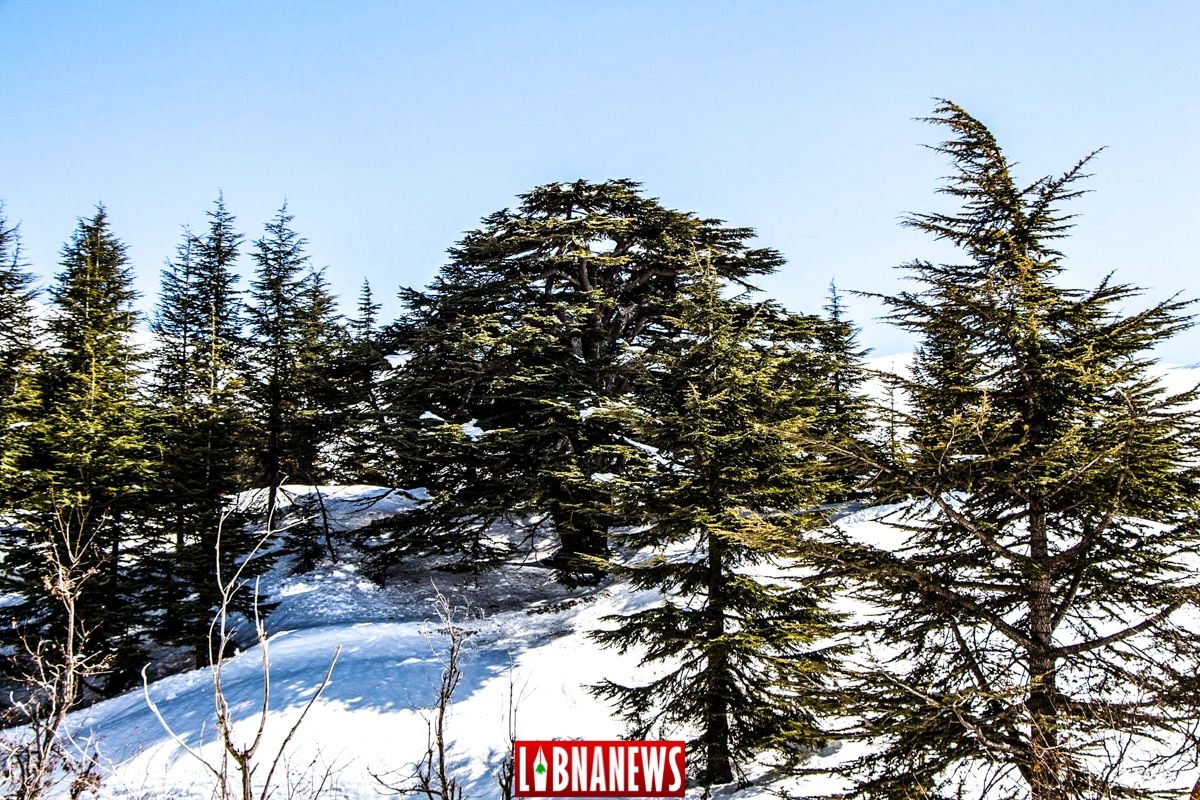
In Gilgamesh’s epic, the king of Uruk and his companion Enkidu go to the cedar forest to face Humbaba, his guardian. The story is Mesopotamian, but its imaginary looks towards the high mountains of the Levant, where the cedar of Lebanon becomes both richness, divine symbol and stake of conquest.
Before being a national emblem, the cedar of Lebanon was an object of imperial desire. The kings wanted it for their temples, their palaces, their ships, their monumental gates. Its height, fragrance, resistance and rarity made it an almost political wood. In antiquity, owning the cedar was already dominating part of the world.
This is what one of the most ancient stories of humanity tells, in his own way: the epic of Gilgamesh. The text comes from Mesopotamia, not Lebanon. Gilgamesh is king of Uruk, in the present south of Iraq. Enkidu is his double savage, created by the gods to face him before becoming his companion. Humbaba, or Huwawa in the older Sumerian versions, is the terrifying guardian of the cedar forest.
But this forest is not an ordinary forest. It is described as a distant, sacred, dangerous space reserved for the gods. In several late versions of the story, it is associated with the western mountains, the Levant, North Syria, Hermon, Sirion and Lebanon. That’s where the myth joins our geography. Not as a historical chronicle proving that Gilgamesh walked in the cedars of Bcharre, but as an ancient memory where Lebanon becomes the dream decor of a forbidden forest.
The King who wanted to survive by glory
Initially, Gilgamesh did not look for wood to build a simple door. He seeks immortality by name. He knows that man dies. He knows that even kings disappear. So he wants to accomplish a feat big enough to survive in the memory of men.
The choice of cedar forest is not innocent. Going to cut trees, it’s crossing a line. It’s entering a protected area. It’s defying the guardian placed there by the gods. It is also to bring to Uruk a prestigious matter, worthy of the great sacred and royal buildings.
In the ancient Sumerian versions, the account of Gilgamesh and Huwawa is already centered on this expedition to cedars. Electronic Text Corpus of Sumerian Literature, University of Oxford project, maintains a translation ofGilgamesh and Huwawa, where Huwawa is presented as a dreadful being installed in his house among the cedars, whose gaze inspires death and terror.
The expedition is therefore not a heroic walk. It’s a violent penetration into a sacred space.
The cedar forest, remains gods
Gilgamesh and Enkidu arrive at the edge of the forest in the Tablet V of the Epic of Gilgamesh. They look at the big trees, the entrance to the wood, the paths where Humbaba walks. The cedar mountain is presented as the home of the gods and the seat of a divine presence. The text insists on the beauty of the place: the foliage is lush, the shade is pleasant, the forest forms a dense and impressive space.
This passage is essential. The forest is not only described as a reserve of wood. She’s a world first. A living space. A territory that has its paths, smells, sounds, rules and guardian.
A tablet published in 2014 by Farouk Al-Rawi and Andrew GeorgeJournal of Cuneiform Studies, enriched the understanding of this scene. The fragment, acquired by the Souleimaniyeh Museum in Iraqi Kurdistan in 2011, adds lines to tablet V and gives a more vivid description of the forest: heroes discover dense vegetation, smell of cedar, birds, cicadas, monkeys, a whole soundscape. The University of Hamburg points out that this discovery alters the image of the passage: Humbaba does not appear only as a barbaric ogre, but as a sort of foreign sovereign surrounded by an organized and musical world.
This changes the reading of the myth. Gilgamesh and Enkidu not only destroy a monster. They enter into an order that is not theirs.
Humbaba, the demonized guardian
Humbaba is often presented as a monster. His face is scary, his voice is terrifying, his breath is deadly. Mesopotamian traditions make it the guardian of the forest. The British Museum also maintains a terracotta mask, dated from the old-Babylon era, generally interpreted as a representation of Huwawa or Humbaba. The museum notes that this monstrous face is also associated with forms related to divination, which shows that the character goes beyond the mere role of « much » in a heroic tale.
Humbaba keeps a place that men shouldn’t loot. That’s where the story becomes more ambiguous. From Gilgamesh’s point of view, Humbaba is the obstacle to slaughter. From the point of view of the forest, he is the protector. From the point of view of the gods, he is the guardian of a sacred domain.
This ambiguity is modern in its strength, but ancient in its origin. The story does not just say: the hero kills the monster, then everything is fine. After the death of Humbaba, the malaise appears. Violence in the forest is not without consequences. Enkidu himself seems to understand that the two heroes have reduced a sacred place to a devastated space, and that they will have to answer for their act before the gods, according to the analysis of the new fragment published by Al-Rawi and George and summarized by the University of Hamburg.
So the myth is already worrying: what happens when the man kills the keeper of the forest to take the wood?
Lebanon in the horizon of Gilgamesh
You have to be precise. Gilgamesh’s epic is Mesopotamian. It is not a Lebanese legend in the strict sense. Early versions do not necessarily locate the forest in today’s Lebanon. Some researchers have proposed oriental locations for the oldest traditions, while later Babylonian versions look more clearly westward towards the mountains of the Levant.
This is where Lebanon enters the story. In Tablet V, some translations evoke Hermon or Sirion and Lebanon at the time of battle, when the earth is torn under the footsteps of heroes and the mountains tremble. The translation of Maureen Gallery Kovacs speaks of Hermon and Lebanon that split during the confrontation.
Andrew George, one of Gilgamesh’s leading modern specialists, also devoted an article to Archaeology and History in Lebanon, which clearly shows that the link between the narrative and the lebanese imagination of cedars is a real subject of study, not a mere tourist recovery.
Caution remains necessary. Gilgamesh cannot be transformed into a historical visitor to Bcharré. But we can say this: in the late Mesopotamian imagination, the great cedar forest lies on the side of the high western mountains, where Lebanon and its cedars represented a horizon of wealth, danger and sacredness.
Cedar as loot
After defeating Humbaba, Gilgamesh and Enkidu cut the trees. The text speaks of a large cedar whose top almost touches the sky. Enkidu proposes to make it a gigantic door for Nippur, the sacred city of the god Enlil. Then the heroes return with both the wood and the head of Humbaba.
Everything is there: wood, trophy, violence, the transformation of the sacred into material. The living cedar becomes a door. The guard becomes head cut off. The forest becomes a feat.
That’s exactly the logic of empires. A distant landscape is first sacrazed, then conquered, then exploited, then transformed into a monument for the power that looted it. Gilgamesh’s story is ancient, but his mechanism is immediately understandable.
Cedar is not just a tree. It’s a prestige material. UNESCO recalls that the forest of the cedars of God, near the Qadisha Valley, constitutes one of the last remains of the great ancient forests of cedars of Lebanon, much sought after in ancient times for the construction of large religious buildings.
What the myth tells by heroic violence, history has confirmed by centuries of exploitation: the cedar of Lebanon was coveted by the regional powers because it embodied a rare resource, useful and symbolically superior.
A story of glory, but also guilt
Traditional reading sees the episode of Humbaba as a heroic feat. Gilgamesh faces fear, kills the keeper, cuts the cedar, brings back a trophy and gains glory. But tablet V also suggests another reading: that of a crime against a sacred order.
Humbaba begs for saving. He even proposes to serve Gilgamesh and to cut for him the trees he asks for. Yet Enkidu pushes to kill him before the gods intervene. This insistence shows that heroes know that their act can cause divine anger.
It’s a decisive detail. The story does not hide the fault. It does not present the destruction of the forest as a mere luminous victory. It shows that the conquest of wood has a moral price.
The sequel of the epic reinforces this impression. After the Humbaba episode, heroes also kill the Heavenly Taurus. Then Enkidu dies. Gilgamesh suddenly discovered his own mortality. The quest for glory is transformed into a desperate quest for immortality. The king who wanted to survive by his exploits finally understands that he will not survive death.
From this perspective, the cedar forest is the first tragic threshold. That’s where Gilgamesh thinks he’s winning a name. It is also there that he enters into a logic of violence that will eventually confront him to his limit.
The first account of sacred deforestation?
It would be anachronistic to make the Epic of Gilgamesh an ecological text in the modern sense. Babylonian scribes did not talk about biodiversity, climate change or environmental protection as we do today.
But it would be equally wrong not to see the ecological power of the narrative. The forest is alive. It’s sound. It’s inhabited. She has a guard. It belongs to the gods. It is not a neutral stock of raw material. It has its own value, before human need.
Gilgamesh and Enkidu are not just looking for wood. They cross a moral border. They kill whoever protects the forest, then they shoot down the trees. The text retains the greatness of the exploit, but also its unease.
That is why this myth resonates particularly in Lebanon. The cedars, once much more extensive in the mountains, now remain only in reduced and protected mountains. UNESCO describes the forest of the cedars of God as a remnant of the ancient forests and one of the few places where theCedrus libani, one of the most prized trees in the ancient world.
The legend of Gilgamesh thus recalls a brutal truth: what men call glory can sometimes be like a devastation, seen from the forest.
The cedars of Lebanon, between myth and survival
The strength of the Lebanese cedar lies in this dual identity. It’s real and mythical. It can be touched, measured, protected, but it also carries an immense symbolic weight. It appears in Mesopotamian, biblical, imperial, religious and national texts. It crosses civilizations like a tree larger than itself.
In Gilgamesh’s account, he is the tree of the limit. It grows in a forest that man desires but does not possess. He forced the king of Uruk to leave his city, walk to the unknown, face a guard and violate a sacred space to bring back a piece of eternity.
It’s no coincidence that wood becomes a door. A door separates two worlds. The cut cedar becomes precisely this: the passage between the forest and the city, between the domain of the gods and that of men, between sacred nature and political architecture.
The living cedar belonged to the mountain. The cut cedar belongs to the monument. The whole drama is here.
A Mesopotamian myth in Lebanese memory
Lebanon should not appropriate Gilgamesh as if the story had been born in Bcharre, Tannourine or Qadisha. That would be wrong. Gilgamesh belongs first to Mesopotamia. But Lebanon can claim a place in the horizon of myth, because its cedars have represented, for ancient civilizations, one of the great images of the sacred and coveted forest.
The link is not that of a verifiable historical act. It is that of an imaginary geography. For Mesopotamians, western mountains, cedars, distant forests and precious woods, they were a real and mythical world. Lebanon occupied an obvious place there, because its tree was already a sign of power.
This shade is important. It avoids easy legend, but it keeps the depth of the story. Gilgamesh is not a Lebanese. Humbaba is not a Bcharré folk guardian. But the cedar forest speaks directly in Lebanon, because it places the cedar at the centre of a very old conflict between human desire, political power and sacred world.
Humbaba’s lesson
Humbaba is defeated, but it is not completely discredited. It may be the most modern part of the story. The guard loses, the heroes win, the trees fall. Yet the unease remains on the side of the victors.
Gilgamesh wanted glory. He gets it. But he doesn’t get peace. Enkidu wanted to convince his friend to go all the way. He’ll die. The forest is open, but the price of this opening weighs on the whole sequence of the epic.
In many myths, killing the monster founded civilization. Here, killing the forest guard also looks like a mistake. This ambiguity gives the episode its depth. Humbaba is both the hero’s enemy and the last defense of a world that man will turn into a spoil.
In Byblos, Adonis died and the river blushed. In Tyre, Melqart’s dog discovers purple. In Sidon, Eshmoun treated with sacred water. ToBeirutBeroe gives a mythological face to the city. With Gilgamesh and Humbaba, Lebanon enters another memory: that of the coveted cedars, the sacred mountains and the first great forest that the heroes came to slaughter in the name of their glory.
Perhaps that is what the Lebanese cedar still tells us about. It is not only the tree of resistance or national identity. He is also the survivor of a very old conflict: the one that pits men in a hurry to leave their name in the stone to silent forests that have never asked to become monuments.
References used: Gilgamesh’s epic, tablet V; Electronic Text Corpus of Sumerian Literature,Gilgamesh and Huwawa; Farouk Al-Rawi and Andrew George,Journal of Cuneiform Studies; University of Hamburg, file on Gilgamesh’s V tablet; British Museum, records on Humbaba/Huwawa; UNESCO, notice on the Qadisha Valley and the cedar forest of God.