

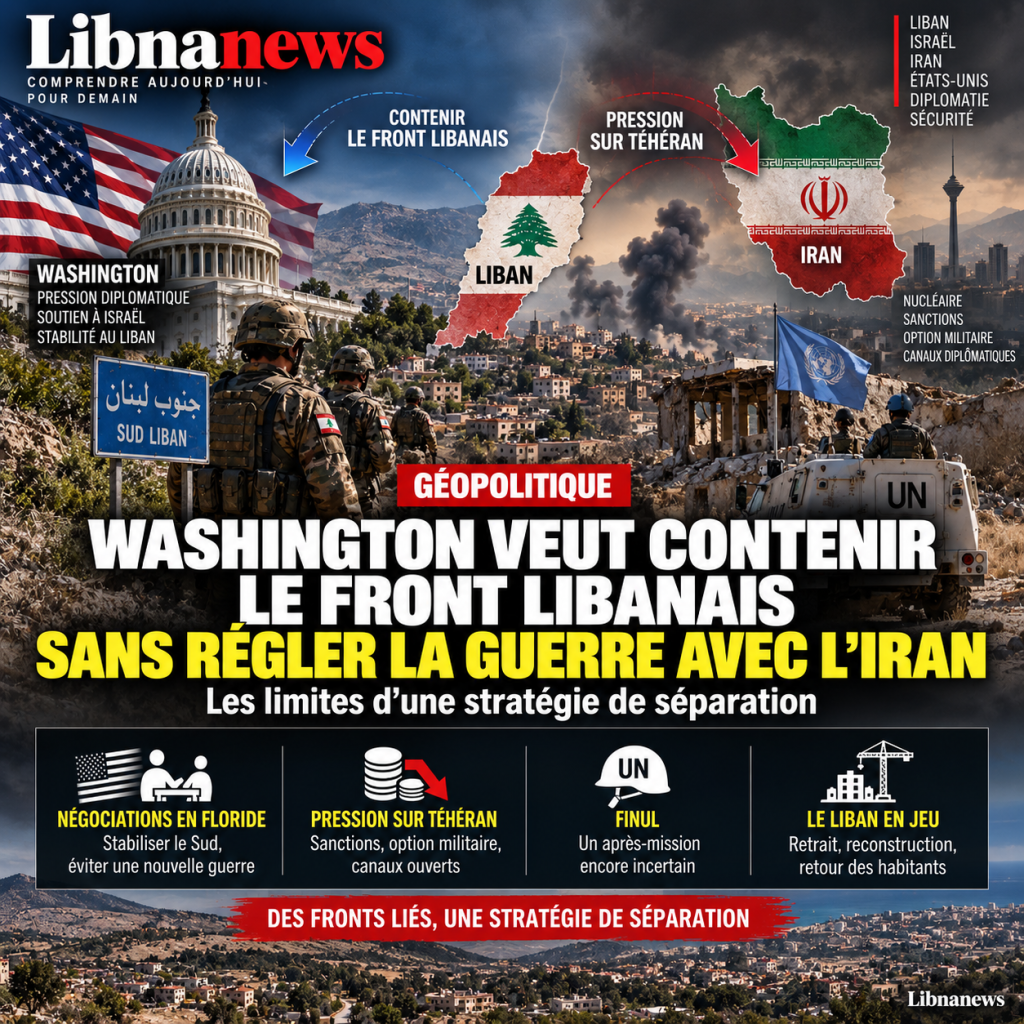
Two related wars, but Washington doesn’t want to handle in the same way
The regional confrontation of 2026 made Lebanon and Iran much more difficult to dissociate than they were before. The American and Israeli strikes against Iran, the Tehran response, the resumption of clashes in Lebanon and the role of Hezbollah have created a system of fronts that communicate with each other. However, political information available in Beirut describes an American approach seeking to deal with the Lebanese issue separately from the war with Tehran. This separation does not mean that Washington considers both crises to be independent. Rather, it means that he does not wish to apply to Lebanon the same military logic as that used against Iran.
This reading should be presented with caution. It is based on political sources cited in the corpus, not on an American doctrine officially published in this form. On the contrary, other analyses of the same corpus argue that Lebanon cannot be completely separated from the confrontation between Iran, the United States and Israel. The two proposals are not necessarily contradictory. Strategically, the fronts are linked by Hezbollah, Iranian capabilities and regional power relations. At the operational level, however, Washington can seek to prevent any escalation with Tehran automatically leading to a new general war in Lebanon.
The American goal in Lebanon: to stabilize the South rather than open a new war
The available information describes a relatively clear American priority for the Lebanese front: to consolidate the ceasefire, to maintain negotiations between Lebanon and Israel and to bring about security arrangements that can limit the resumption of hostilities. This approach does not correspond to a comprehensive political settlement of the regional conflict. It aims at a narrower goal: to prevent the South from automatically returning to an open theatre of war every time tension rises with Iran. The planned military negotiations in Florida are precisely in line with this logic. They must address the issues of withdrawal, deployment, security and control without waiting for an agreement between Washington and Tehran to resolve the entire region.
American interest is also practical. A new general war in Lebanon would have hard to predict. It could broaden the conflict, cause further destruction and complicate the negotiations already under way. The political sources examined believe that Donald Trump does not necessarily want an extension of the Lebanese war before the American elections, because its effects might be contrary to his interests and those of Israel. This assessment remains an analysis of political sources and not an official White House statement. It is, however, part of a context where the economic cost of regional war, especially fuel, itself becomes a political issue in the United States.
Trump keeps pressure on Tehran while looking for an exit that he can present as a victory
On the Iranian file, the logic described is different. Washington continues to increase financial pressure on Tehran. The United States authorities have warned foreign financial institutions that they may be targeted if they continue certain transactions with sanctioned Iranian institutions. This pressure is in addition to military operations since 28 February and sanctions that already existed before the war. At the same time, communication channels remain. Qatar states that contacts and exchanges of messages between Washington and Tehran are continuing, with the aim of achieving progress that could be developed.
Trump’s line therefore appears double. The political sources describe it as favourable to an agreement if it can present it as a success meeting its conditions, while maintaining the option of a further escalation if these conditions are not met. Iranian President Massoud Pezeshkian, for his part, expressed deep mistrust and maintained that previous exchanges had not prevented attacks, assassinations and sanctions. This context explains why Washington may have an interest in not immediately making Lebanon’s calm dependent on an agreement with Iran: the Iran-American channel remains uncertain, while the Lebanese front demands faster mechanisms.
The US electoral factor weighs on the calculation
The war with Iran now has an internal American dimension. Political sources refer to pressure within the Republican Party itself to reduce or end the war before the elections, because of its effect on fuel prices and the burden it represents for some candidates. Vice-President J.D. Vance was presented as more favourable to reducing escalation and as stressing that the interests of the United States and Israel did not necessarily coincide on all issues. These factors do not make it possible to affirm the existence of a formal institutional divide at the top of the US executive. However, they show that the indefinite pursuit of a regional war has a political cost to Washington.
In this perspective, simultaneously opening a wider war in Lebanon would increase that cost even further. The Lebanese front has its own military dynamics, an exposed civilian population, a national army that Washington supports and a negotiating process that has already begun. An uncontrolled expansion could also jeopardize the US objective of strengthening the Lebanese state in the face of Hezbollah weapons. If the institutions collapsed in a new war, the strategy of consolidating the army and the government would lose much of its meaning. The operational separation of the fronts then becomes a means of preserving the Lebanese yard while the Iranian confrontation follows its own pace.
This separation does not amount to protecting Hezbollah
Yet it would be wrong to read this strategy as an American will to preserve Hezbollah. The same sources that describe Washington as reluctant to extend the war believe that the United States continues to give Israel an important margin to hit the party’s infrastructure and reduce its capabilities. The difference is between a campaign of pressure and a total war. Washington can seek to contain the front while accepting Israeli operations which it considers compatible with the goal of reducing Hezbollah’s military capabilities. This is precisely one of the contradictions of the current strategy.
For Beirut, this distinction is far from reassuring. A front may remain officially under ceasefire while experiencing regular strikes, destruction and operations. The Lebanese leaders therefore ask for something other than a simple absence of general war: they want an Israeli withdrawal, an end to the attacks, the return of the inhabitants and reconstruction. The US separation strategy does not automatically deliver these results. It can prevent wider conflagration while leaving a level of violence high enough to prevent the normalization of the South.
The real American lever is the pressure on Israel
This is where Lebanese expectations are concentrated. Several officials and sources involved in the negotiation process stress that Lebanon cannot compel Israel alone to comply with the negotiated commitments. Washington therefore has a role that goes beyond that of a neutral mediator. It is the power capable of exerting real pressure on the Israeli government. As long as this pressure remains limited, the negotiating process risks turning into a vacuum: Beirut reaffirms its availability, while Israeli operations continue and every incident reduces the political value of the diplomatic channel.
The separation of the Lebanese issue from Iran thus becomes useful in Lebanon only if it produces an autonomous American policy towards Israel. If Washington says that the Lebanese front must be stabilized but continues to tolerate operations that prevent the return of the inhabitants, separation remains theoretical. Conversely, if the United States uses its influence to obtain withdrawals and establish verifiable rules, it can demonstrate that Lebanon is not simply an extension of confrontation with Tehran. It is this test, more than statements, that will measure the reality of the American strategy.
Tampa must precisely transform the separation of the fronts into a mechanism
The discussions planned in Florida represent the laboratory for this approach. The military and security component should address specific Lebanese issues: Israeli withdrawal, Lebanese army deployment, disputed areas, cessation of destruction and mechanisms to prevent further escalation. Lebanon seeks to broaden this logic towards a more sustainable political horizon. Israel places greater emphasis on security assurances before any political progress. Washington is therefore at the centre of a negotiation where it must prevent discussions from remaining limited to managing incidents without ever dealing with the causes that make the front explosive.
If the meeting succeeds in producing verifiable milestones, it will strengthen the idea that a Lebanese dossier can progress independently of the Iranian-American conflict. If it fails because each decision depends on the evolution of the war with Iran, the claimed separation will appear much more fragile. The calendar is all the more delicate as Israeli electoral deadlines can reduce the margin of compromise of Benjamin Netanyahu’s government. Thus, a technically Lebanese negotiation remains subject to political calculations outside Lebanon.
The departure of the Finul forces Washington to think post-war, not just the ceasefire
The upcoming end of the Finul’s mandate further complicates the strategy. Lebanon is concerned that a departure without an alternative would create a security vacuum in an area where Israeli positions, destruction and sovereignty issues are not resolved. A UN official warned that time was shrinking to design an alternative framework. Several countries participating in the force would be willing to retain units in the South under another formula, but discussions have not yet produced an agreed arrangement. The available sources indicate, inter alia, that it is not yet possible to consider the United States as acquired under this option.
This is another test of the American will to treat Lebanon for itself. If Washington really wants to prevent the South from being aspired by confrontation with Iran, it must support an architecture capable of functioning after the Final. A simple military pressure on Hezbollah does not fulfil this function. A mechanism is needed to monitor commitments, defuse incidents, accompany the Lebanese army and verify withdrawals. Without such a framework, the vacuum created by the end of the international mission could instead facilitate the return of a logic of direct confrontation.
Paris tries to maintain a canal with Tehran around Lebanon
France also seeks to maintain a dialogue with Iran on the Lebanese situation. International contacts with Tehran focus on the stabilization of the South, the ceasefire and the future of security architecture. Iran publicly reaffirms its support for Lebanon and condemns US and Israeli operations. For Paris and other actors, speaking in Tehran responds to a reality: even if Washington wants to dissociate files, the Iranian influence on Hezbollah remains a factor in Lebanese calculation. A security architecture that completely ignores this dimension may not be applicable.
So there is a difference between separating folders and denying their connections. Washington can seek to prevent Lebanon from being used as a mere front of war with Iran. This does not remove the political and military links between Tehran and Hezbollah. French diplomacy seems to place greater emphasis on this interdependence, while the US strategy described in the sources seeks to create a separate operational treatment. These approaches can be complementary if the objective is to stabilize Lebanon without waiting for a major regional agreement. They can also enter tension if one requires Teheran to be included in the equation and the other wants to reduce its influence.
Hezbollah specifically refuses separation when it is used to impose concessions
From the Hezbollah point of view, separation of the fronts has another meaning. Naim Kassem argues that the solution begins with the Israeli withdrawal and refuses the idea that his party must present a concession in order to obtain this withdrawal. This position directly links the issue of weapons to the Israeli occupation and attacks. It makes it difficult for Washington to stabilize Lebanon by first demanding unilateral Hezbollah measures, while the war with Iran would continue elsewhere. For the party, such a formula would be to isolate the Lebanese front at a time when the regional power ratio is unfavourable to it.
This divergence explains why the US strategy cannot succeed only through pressure. It must produce visible compensation for the Lebanese State: withdrawals, reduction of operations, return of inhabitants and possibility of rebuilding. Without such results, Hezbollah will be able to argue that the process is only aimed at reducing its capabilities without removing the Israeli threat. The question then becomes internal. The government of Nawaf Salam must demonstrate that the institutional path and the negotiation get more than the logic of confrontation.
The American paradox: contain the war while maintaining strong pressure
The policy described in the sources is therefore based on a difficult balance. Washington wants to maintain high pressure on Iran. He accepts continued military pressure on Hezbollah’s capabilities. However, he wished to avoid Lebanon falling into a general war and seeking to advance a negotiated security framework. These three objectives may coexist for a limited period. They become contradictory if the strikes make stabilization impossible or if Tehran decides to respond to American pressure by reactivating its regional allies more strongly.
The separation of fronts is thus less an acquired reality than a crisis management objective. It depends on the ability of the United States to prevent chain reactions. A strike in Iran should not automatically produce an escalation in Lebanon. An Israeli operation against Hezbollah must not cause the negotiations to collapse. An incident in the South should not be transformed into another episode of the Iran-American war. Each of these conditions requires communication channels and pressure capacity that Washington will have to use consistently.
Lebanon has an interest in this separation, but only if it restores its margin of decision
For Lebanon, the interest of separate treatment is obvious. The country has already paid the price for military decisions related to conflicts that exceed it. An architecture in which Lebanese institutions negotiate directly the terms of withdrawal, army deployment and reconstruction can reduce this dependency. It can also enable Beirut to address its priorities without waiting for the outcome of a strategic confrontation between Washington and Tehran whose timetable is impossible to control.
But separation must not simply mean that the United States and Israel define the Lebanese issue independently of Iran. To have sovereign value, it must make more decisions to the Lebanese State. The criterion is therefore concrete: territorial control of the army, Israeli withdrawal, cessation of unilateral operations, return of populations and international or bilateral mechanism capable of dealing with incidents. Without these elements, Lebanon would remain linked to regional confrontation even though Washington claims administratively to separate files. True decoupling is not decreed; It appears when events in Iran stop automatically determining what is happening in South Lebanon.





Comments