

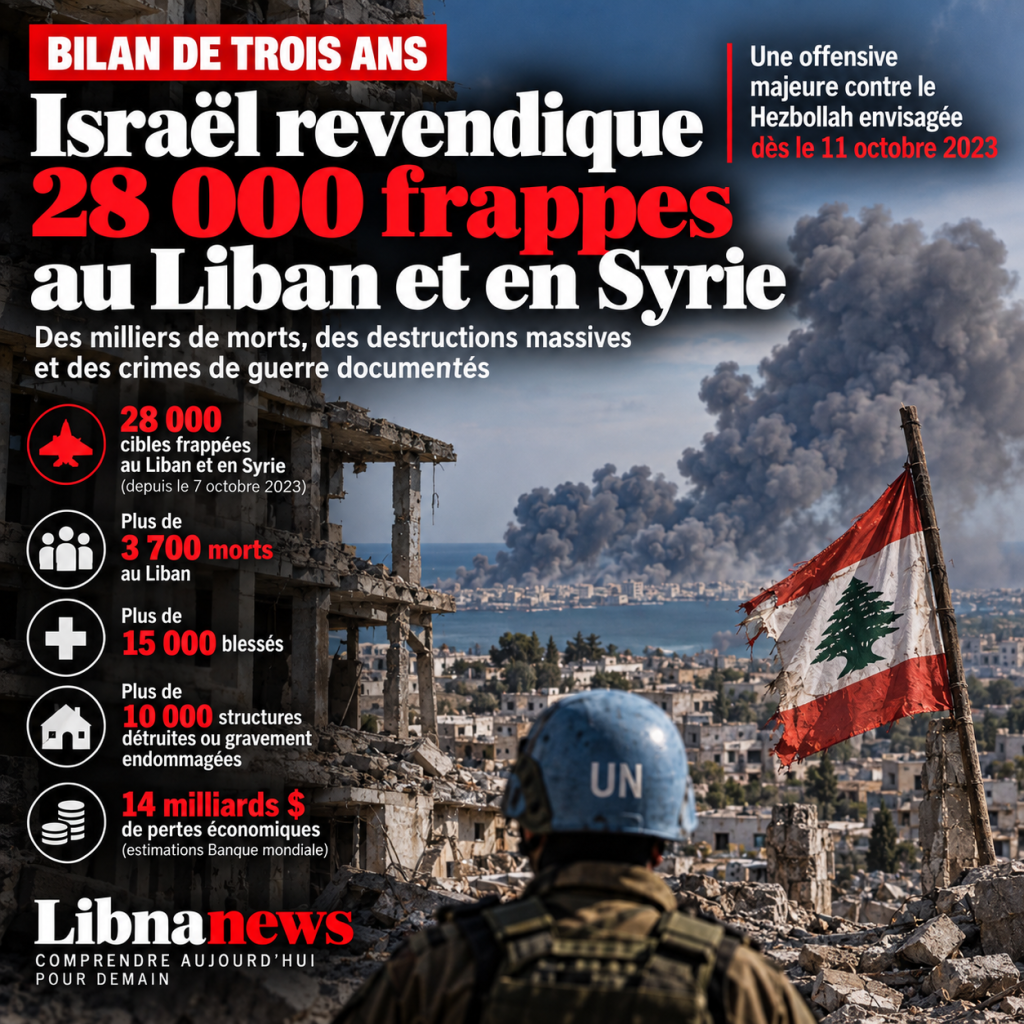
The Israeli army claimed on Wednesday 7 October 2026 that it had hit 28,000 targets in Lebanon and Syria since 7 October 2023, out of nearly 100,000 targets throughout the region. In Lebanon, the military record covers three years of shelling, destruction and operations, resulting in several thousand deaths and tens of thousands of injuries. International organizations have documented Israeli attacks that could constitute war crimes. Evidence from former Israeli leaders also established that a major offensive against Hezbollah in Lebanon had been seriously considered since 11 October 2023.
The Israeli army delivered on Wednesday its record of three years of military operations in the Middle East. It claims to have hit nearly 100,000 targets in the region since 7 October 2023, including 28,000 in Lebanon and Syria. It also claims that 20,000 projectiles were launched from Lebanon to Israeli territory during this period. These figures are those of the Israeli army, which did not specify in its announcement the distribution of the 28,000 targets between the Lebanese and Syrian territories.
Given Lebanon, this figure is mainly a reflection of a military campaign that hit the country for three years. According to available cumulative reports from the Lebanese Ministry of Health, Israeli operations have resulted in several thousand deaths and tens of thousands of injuries since October 2023. The conflict has also displaced the population massively, destroyed neighbourhoods and villages, damaged civilian infrastructure and aggravated an economic crisis that had already affected the country before the war.
28 000 strikes in Lebanon and Syria since 2023
The figure announced on Wednesday shows the intensity of Israeli operations since the beginning of the regional war. Lebanon was directly trained in this sequence from October 8, 2023, when Hezbollah began attacking Israeli positions from the South, following Hamas’ operation. The Lebanese movement then presented its actions as a « support front » in Gaza intended, inter alia, to establish Israeli forces at the border.
The clashes remained mainly concentrated around the border for several months, although the attacks gradually spread deep into Lebanon. Israel has carried out targeted assassinations and has hit Hezbollah positions, as well as vehicles, homes and towns far from the border line. The confrontation changed in scale from September 2024, when the Israeli army launched a much larger campaign against Hezbollah and intensified its bombings in the South, the Bekaa and the southern suburbs of Beirut.
The open war of 2024 caused a sharp increase in the number of casualties and displaced more than one million people at the height of the bombing. Hezbollah lost a significant part of its command, including its Secretary-General Hassan Nasrallah, who was killed on 27 September 2024 in an Israeli strike on the southern suburbs of Beirut. Israel then launched land operations in southern Lebanon before a cessation of hostilities came into force on 27 November.
Israel planned a major offensive as early as October 2023
The chronology of the first days of the conflict, however, shows that the assumption of a much larger war in Lebanon had been considered early by Israeli leaders. Hezbollah’s fire began on 8 October 2023, but three days later, on 11 October, part of the Israeli government and command was already planning a major preventive offensive against the movement in Lebanon.
Former Israeli Defense Minister Yoav Gallant confirmed after leaving the government that he had supported the launch of such an operation. According to his account, the project was not simply a response to the exchanges of fire at the border. Israel was planning to strike a part of Hezbollah’s command and military capabilities simultaneously in order to bring a major blow to the movement from the first days of the war.
The existence of this debate at the Israeli state summit was also confirmed by Gadi Eisenkot, former Chief of Staff who became a member of the war cabinet after 7 October. Eisenkot explained that he and Benny Gantz had opposed the immediate opening of a major war against Lebanon. According to him, such a decision would have been a strategic mistake as Israel was already preparing its offensive against Gaza.
The United States had also intervened to avoid this immediate extension of the war. Information published by the end of 2023 reported an exchange between US President Joe Biden and Prime Minister Benjamin Netanyahu on 11 October. Israel then feared an imminent attack by Hezbollah, but Washington did not share this appreciation and asked Israeli officials not to launch an attack that could provoke a regional war.
Netanyahu’s office challenged part of this version and claimed that the Prime Minister had initially chosen to focus the military effort on Gaza. Subsequent statements by Gallant and Eisenkot nevertheless confirmed that a major attack on Hezbollah had been planned at the highest level in Israel since the first days of the confrontation. Gallant even presented retrospectively the abandonment of this option as a missed strategic opportunity for Israel.
A more complex chronology than a simple « reaction »
These elements are important in understanding the war in Lebanon. Hizbullah operations from 8 October contributed to the establishment of armed confrontation on the border and resulted in casualties and destruction in Israel. But to present the entire Israeli campaign which followed as a mere progressive occult response the fact that a much wider offensive against Lebanon was already discussed in Tel Aviv three days after the first exchanges.
This timeline also allows the 28 000 targets claimed today to be placed in a broader strategy. When the large-scale Israeli offensive was finally launched in September 2024, it pursued several objectives that Gallant claimed to have wanted to achieve as early as October 2023: to weaken Hezbollah’s command, to destroy a significant part of its military capabilities and to change the ratio of forces at the Lebanese border.
This does not remove Hezbollah’s responsibility for its own military operations or its obligations under international humanitarian law. But violations by one party do not give the other the right to target civilians, carry out disproportionate attacks or destroy civilian property without military necessity. Each attack must be assessed separately according to the rules applicable to armed conflict.
Thousands dead and tens of thousands injured
The human balance sheet is the main reality behind the military statistics published by Israel on Wednesday. Since October 2023, several thousand people have been killed in Lebanon and tens of thousands injured. Victims include combatants, but also civilians, including women, children, medical personnel, first aid workers and journalists.
The first open war of 2024 had already left an extremely heavy record. As the ceasefire of 27 November approached, the Lebanese authorities recorded more than 3,700 deaths and more than 15,000 injuries since October 2023. These figures continued to increase subsequently with Israeli attacks after the cessation of hostilities and with the new phases of confrontation.
The civilians paid an important price. The United Nations and human rights organisations have documented strikes on homes and civilian areas, as well as attacks on children, medical personnel and rescue workers. Even after the ceasefire of November 2024, civilians continued to be killed by Israeli operations in Lebanon.
Attacks likely to constitute war crimes
Several Israeli operations have been specifically investigated by international organizations. Human Rights Watch and Amnesty International documented attacks on civilians, first aid workers, medical personnel, journalists and civilian property. Some have been described as apparently illegal attacks or possible war crimes.
Relief services were particularly affected. Ambulances, medical centres and post-bombing teams were struck during the conflict. Investigations have concluded that some of these attacks raise serious issues with regard to the protection of medical personnel and relief workers under international humanitarian law.
Journalists were also targeted or killed in several attacks. The photojournalist of Reuters Issam Abdallah was killed on 13 October 2023 by Israeli fire in southern Lebanon, while six other journalists were wounded. In October 2024, an Israeli strike on a journalist-friendly compound in Hasbaya killed three media professionals. International investigations have challenged the military justification of several of these attacks.
Israel’s use of white phosphorus in Lebanon has also been documented. Ammunition containing this substance has been used in or near inhabited areas. White phosphorus can cause deep burns and its use in populated areas exposes civilians to particularly high risks.
Not all Israeli strikes can be described as war crimes. Such a qualification depends on the circumstances of each attack and must take into account the target, the distinction between civilians and combatants, proportionality and precautions taken. On the other hand, several international organizations have concluded that certain Israeli operations in Lebanon have the characteristics of illegal attacks or apparent war crimes.
More than 10,000 structures destroyed or severely damaged
The destruction in South Lebanon far exceeds military installations. Amnesty International analysed the damage caused in border localities between October 2024 and January 2025 and identified over 10,000 structures that were heavily damaged or completely destroyed. These included housing, mosques, roads, cemeteries, parks and other civilian facilities.
In some municipalities studied, more than 70 per cent of the structures had been destroyed. Part of the destruction was carried out while Israeli forces were already controlling the sectors concerned. Some even took place after the cessation of hostilities on 27 November 2024 entered into force.
Human rights organizations have particularly examined the destruction by explosives or bulldozers in areas where immediate fighting had ceased. Where civilian property is destroyed without imperative military necessity, such acts may constitute violations of international humanitarian law and, depending on the circumstances, war crimes.
The destruction also explains why the return of the inhabitants to several villages in the South was difficult or impossible for many months. For many families, the end of major military operations did not mean a return to the previous situation: destroyed housing, damaged agricultural land, unusable infrastructure and the Israeli military presence extended the consequences of the war.
An economic bill already valued in billions of dollars
The war also imposed a considerable economic cost on Lebanon. The World Bank had estimated the economic consequences of the conflict for the period from October 2023 to December 2024 at approximately $14 billion. This estimate included physical damage and loss of activity and income from war.
Reconstruction and rehabilitation needs were then estimated at approximately $11 billion. These figures preceded the subsequent destruction and therefore do not represent the total cost of the three years covered by the balance sheet published by the Israeli army on Wednesday.
Housing, agriculture, trade and infrastructure were among the sectors most affected. In the South, destruction has hit a local economy already weakened by several years of national crisis. Population displacement also interrupted economic activity in many localities for long months.
Israel also reports 20,000 shots fired from Lebanon
The Israeli army claims to have recorded 20,000 shots from Lebanon to its territory since October 2023. These attacks resulted in deaths among Israeli civilians and military personnel, evacuations to northern Israel and material damage. International organizations have also documented unguided Hezbollah rocket fire into inhabited areas and recalled that they could violate international humanitarian law.
However, this assessment does not exempt Israel from its own obligations to Lebanese civilians. The law of war does not operate on the basis of reciprocity: a violation committed by an opponent does not legalize an attack on civilians or a disproportionate operation. It is precisely on this distinction that the investigations opened or published on several Israeli strikes in Lebanon are based.
The figure of 28,000 targets in Lebanon and Syria claimed by the Israeli army on Wednesday is a military statistic, but it also summarizes three years that have profoundly transformed Lebanon. Behind this number are thousands of deaths, tens of thousands of injuries, destroyed villages, massive displacements and billions of dollars in losses. He also recalls that a much larger Israeli offensive against Hezbollah had been envisaged since 11 October 2023, long before the confrontation finally changed into the open war of September 2024.





Comments