

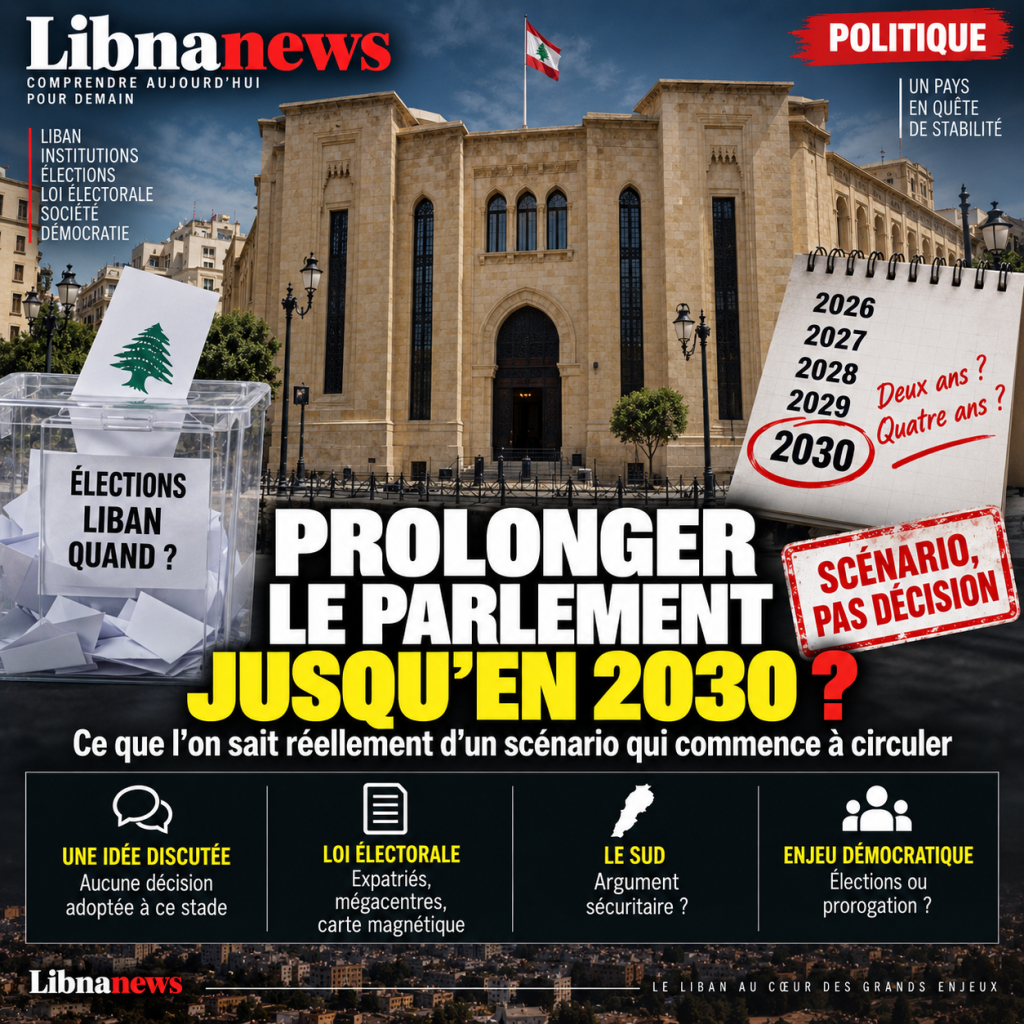
An explosive hypothesis, but still much less advanced than it looks
The idea of a further extension of the mandate of the Chamber of Deputies broke into the political debate with a spectacular figure: 2030. The scenario is to postpone the elections and extend the current term by two years or even four years. However, the evidence available on 7 October 2026 makes an essential distinction. They establish that the idea is discussed and criticized. They do not make it possible to state that a law of extension until 2030 has already been adopted, that an agreement exists between the main forces or that an institutional decision is reached. The scenario must therefore be treated as a political hypothesis in circulation, not as an extension already planned.
This caution is all the more important as the real electoral debate is concrete. A parliamentary subcommittee is working on the electoral law. The government presented its position on several changes. Interior Minister Ahmad Hajjar recalled that the executive proposed, inter alia, to abolish the provision on magnetic cards for the benefit of large voting centres with prior registration, and to allow expatriates to vote from abroad in a formula similar to previous experiences. Two dynamics coexist: the institutions are still working on voting procedures, while the long-term delay scenario is beginning to be mentioned.
Why the 2030 figure so shockes
An extension until 2030 would not be a mere technical adjustment. Under the option chosen, it would add two or four years to the mandate without consulting the electors. The democratic problem is immediate: Members would have to decide for themselves how long they would retain their mandate. A forum in the corpus describes as shameful the idea of an extension of two or four years in the present circumstances. It is an editorial judgment, not an institutional fact, but it illustrates the political violence that the scenario can provoke.
The context reinforces this sensitivity. Lebanon faces the consequences of the war in the South, negotiations with Israel, the issue of arms, reconstruction and strong pressure on purchasing power. Wages, electricity and public services fuel social tensions. In this climate, extending the mandate of MPs could be seen as a priority disconnected from the emergencies of the population. Potential promoters of a postponement should therefore demonstrate an objective obstacle to voting, not a mere interest in preserving existing power relations.
The real current deadlock is in the electoral law
Before we talk about prorogation, we must look at the conflict over voting rules. Ahmad Hajjar attended a meeting of the parliamentary sub-committee on the file and recalled the government project. Two changes are highlighted. The first concerns article 84 and magnetic card: the executive proposes to delete this provision and to use megacentres with prior registration. The second concerns expatriates: the government wishes to allow them to vote abroad on a model similar to previous consultations.
These issues are politically sensitive. The diaspora vote can change the balance of some constituencies. The megacentres affect the possibility of voting without returning to the locality of origin. The government claims to remain open to parliamentary proposals. On 7 October, therefore, the institutional process is not that of officially abandoning the elections, but of negotiating their modalities. A possible extension would appear to be a break with this work, unless the differences became impossible to resolve in time.
Two or four years: the absence of a fixed formula is revealing
The fact that the discussions mentioned oscillate between a two-year extension and a four-year extension shows that the scenario is not yet in the form of a stabilized project. The two options do not have the same consequences. A limited deferral can be defended as a temporary response to material or security impossibility. An extension until 2030 is more like a new parliamentary cycle without elections. The available sources do not specify who would legally carry each of these options, which text would be used or which forces would already be ready to vote for either.
This lack of detail should not be filled by assumptions. She indicated that the debate remained at the scenario and balance of power stage. The 2030 figure now works more as a political indicator than as a fixed deadline. It tests the reactions of parties, opinion and institutions. Real change will occur if an identifiable bill appears with signatories and a potential majority.
Can the South become the decisive argument for a postponement?
The security situation is the most serious argument that could be put forward in favour of a postponement. Several areas of the South remain affected by Israeli operations, destruction and displacement. Organizing an election involves polling stations, staff, travel and the possibility for electors to access the election. If part of the territory remains in an unstable military situation, the problem cannot be ruled out.
But a safe argument should be clearly demonstrated. It should identify constituencies where voting is physically impossible, explain why alternative solutions cannot be put in place and set a time limit proportionate to the obstacle. A four-year extension would be difficult to justify by a situation which may change in a few months. Megacentres and other organizational mechanisms could reduce the impact of population displacement.
Expatriate voting may weigh more than technical issues
The expat file is one of the most sensitive points of the electoral law. The government wants to allow them to vote from their country of residence as in previous experiences. Behind this question are important electoral calculations. Parties do not assess the effect of diaspora voting on their results in the same way. However, the available evidence does not allow a specific force to be assigned responsibility for a possible blockage or to establish a reliable coalition of supporters and opponents of each formula.
It is on this type of file that a technical problem can become a political justification for the postponement. If no rules are adopted in time, officials can argue that the legal conditions for voting are not met. The question then becomes that of responsibility: was the impasse inevitable or was it produced by the inability of the parties to accept a rule they did not know in advance the result? An extension cannot be analysed separately from the path leading to it.
The revival of decentralization adds another paradox
At the same time, parliamentary committees re-launched a sub-committee on administrative decentralization, based on a proposal by Sami Gemayel. This information does not directly concern the duration of the mandate, but it shows that institutional discussions remain active. Decentralisation has long been linked to the implementation of the Taif Agreement and the reform of the State. It may change the relationship between national representation, local authorities and public services.
A long extension would therefore freeze the composition of the House at a time when it was working on reforms that could change the organization of the State over time. Possible promoters should explain why an elected assembly in an earlier context would be best placed to lead several more years of institutional transformation without returning to the electorate.
The Lebanese precedent makes any extension politically toxic
The weight of Lebanese political history makes the word « prorogation » particularly sensitive. The problem is not only the possible legality of a law passed by the House. It concerns elected political legitimacy, which would prolong their own presence. In a system where trust in institutions remains fragile, an extension justified by exceptional urgency can be seen differently from an extension suspected of preserving existing power relations.
Transparency would therefore be crucial. The promoters of a postponement should make public concrete obstacles, alternatives studied, the necessary duration and conditions for returning to the polls. Without these guarantees, the suspicion of self-prorogation will dominate. The 2030 figure is particularly difficult to defend without detailed justification, as it transforms an exceptional measure into a political horizon of several years.
The three Presidencies would face different responsibilities
If a formal proposal were to emerge, it would not remain an internal matter for the parliamentary blocs. Nabih Berri, as Speaker of the House, would be at the centre of the legislative process. The Government of Nawaf Salam should define its position, notably through the Ministry of Interior responsible for preparing the elections. Joseph Aoun would face the presidential prerogatives of the legislative process and the defence of the regular functioning of the institutions. The sources examined do not indicate that these three officials have already agreed to an extension until 2030.
This lack of documented agreement is essential. The current debate should not be transformed into a decision by the three Presidencies. Instead, the available positions show that the electoral administration continues to work and that the government advocates concrete changes to the law. As long as an extension text is not tabled and supported by an identifiable majority, the battle is still about the conditions of the election more than about its cancellation.
The real warning signal will be the passage of rumors to a text
The file will change in nature when a specific bill or bill appears. It will then have to look at its duration, its justification, its signatures and the majority likely to vote. A two-year text cannot be analysed as a four-year text. An extension motivated by the impossibility of voting in certain constituencies should be compared with alternative solutions. A postponement related to the lack of agreement on expat voting will ask a different question. At present, these parameters are not sufficiently established in available sources.
It is therefore a mistake to present Parliament as of now as having decided to remain until 2030. Important information is more subtle: this possibility is now sufficiently present to be discussed and publicly denounced, while work on electoral law continues. The transition from scenario to decision would be a major institutional event. It should be documented by official text and positions, not by the mere circulation of a date.
An extension can only be defended by demonstrating the impossibility of doing otherwise
The political test can be formulated simply. An election is the rule; the extension is the exception. The longer the exception, the stronger the demonstration required. Security tensions in the South are real. Disagreements over the electoral law are also so. But the institutions still have the means to act: legislative amendments, megacentres, prior registration, organisation of the vote abroad and parliamentary compromises. Until these options are exhausted, a multi-year extension may appear less as a necessity than as a political choice.
The 2030 figure must therefore be monitored without being overinterpreted. It reveals that scenarios far beyond a calendar adjustment are already circulating. However, the corpus of 7 October does not establish that an extension agreement exists. The real issue is today in the election commission, in the choices of the government and in the ability of the parties to accept rules that do not guarantee their results. If this work fails and an extension text appears, the question will no longer be just how many years Members want to add to their mandate. It will be necessary to determine who made the elections impossible, and why.





Comments