





Eight new aircraft and an ambition beyond fleet renewal
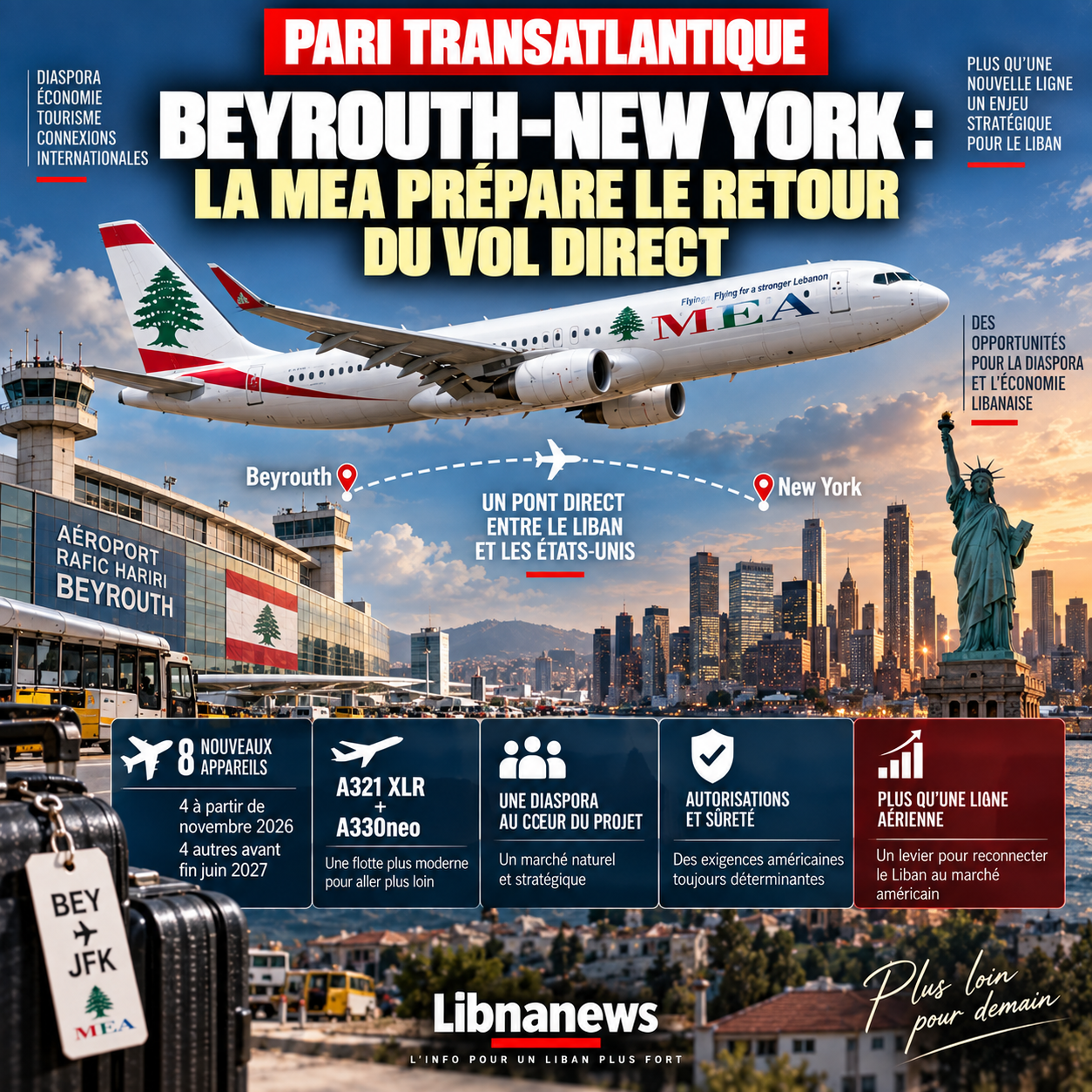
Middle East Airlines is preparing a new stage in its development as Lebanese air transport continues to evolve in an unstable regional environment. Its President and CEO, Mohammad El-Hout, announced the arrival of a first instalment of four new aircraft from November 2026 and four more before the end of the first half of 2027. The fleet must include Airbus A321 XLR and Airbus A330neo. Behind this renewal appears a much more symbolic project: re-establishing a direct link between Beirut and New York. Long-haul aircraft must contribute to this ambition, for which preparations are already under way. The case was also reported to have been discussed during the Lebanese-American exchanges during President Joseph Aoun’s visit to Washington. However, this is not yet a launch announcement with a firm commercial date. Between political will, aircraft availability and the effective opening of a regular line are several regulatory, security and economic steps. This is precisely what makes the project interesting. A Beirut-New York flight does not depend solely on the technical capability of an aircraft to cross the Atlantic. It assumes that Beirut airport, the company and the entire security chain meet the requirements for direct service to the United States.
The choice of new aircraft illuminates the strategy. The Airbus A330neo belongs to the category of long-haul aircraft capable of serving intercontinental markets. A321 XLR responds to another logic. This very long-range mono-conveyor allows us to envisage long connections on which a large carrier would sometimes be too expensive. For a company the size of the MEA, this combination can offer more flexibility. High demand lines can be operated with a larger unit. Finer destinations can be tested with a cheaper aircraft. This flexibility is particularly important for Beirut. The Lebanese market has a considerable diaspora, but its traffic is very seasonal. Summer, holidays and certain holiday periods produce peaks. Outside these periods, filling a long-haul machine daily becomes more difficult. The renewal of the fleet should therefore not only be seen as a prestigious investment. It can allow the company to better adapt capacity to demand. But the commercial relevance of a flight to New York will depend on parameters that are not yet detailed in the corpus: proposed frequency, aircraft configuration, pricing policy and precise timing. These elements will need to be known before measuring the actual viability of the line.
The memory of an interrupted connection and an American obstacle that is not only commercial
The idea of a direct flight to the United States has a strong symbolic load in Lebanon. Much of the diaspora resides in North America. Yet travellers between Beirut and the United States have for years had to make connections at another airport. The reopening of a direct link would shorten the journey and give the national company access to a market that is now largely captured by foreign carriers. But the main historical obstacle is not the absence of potential passengers. It is based on the United States security framework applicable to Beirut airport and flights from Lebanon. The United States has maintained restrictions on direct air links to Lebanon for several decades. Their lifting therefore requires more than a commercial decision by the MEA. It presupposes an evolution of the American system itself.
The fact that the issue is now being addressed at the highest political level indicates that the issue is being treated as part of the bilateral relationship. The Lebanese authorities seek to demonstrate that the security and control conditions can meet American expectations. Airport security does not only concern visible controls performed before boarding. It covers baggage, cargo, access to sensitive areas, identification of personnel, aircraft protection and the complete processing chain of a passenger. A US service therefore requires a high level of trust between the competent authorities of the two countries. A fault in a link may be sufficient to prevent launch. That is also why the current declarations must be read with precision. The project is moving forward and preparations are discussed. This does not yet mean that all authorizations have been obtained. The distinction is important to avoid turning a serious political perspective into an already acquired online one. The real indicator will be the US regulatory evolution and then the opening of reservations on a confirmed calendar.
A large diaspora does not automatically guarantee profitability
The most obvious commercial argument in favour of Beirut-New York is the diaspora. Family travel between Lebanon and North America is a natural market. A direct flight would offer a considerable advantage to seniors, families with children, and travellers carrying many baggage. It would eliminate the risks associated with missed connections and reduce the total journey time. It could also attract some travellers from other areas near Beirut, if regional conditions permit. But an important diaspora is not enough to ensure that a long-haul daily or regular is profitable. Airlines reason in filling, in average recipe per seat and in balance between different travel classes. A plane can be nearly full and yet generate an insufficient margin if tickets are sold too low. Conversely, the presence of business or premium customers can greatly improve the economy of a link.
Seasonality is one of the main challenges. Traffic to Lebanon increased sharply during certain periods. However, a company must bear the costs of its fleet all year round. An intercontinental line must therefore find passengers in February as well as in August. That’s where the connections become strategic. MEA cannot think of New York solely as a journey between two cities. It must be able to feed the flight with travellers from its regional network and redistribute passengers arriving from the United States to other destinations. Beirut could then regain a platform function. But this strategy depends on the stability of the schedules and the attractiveness of the network. A passenger who has a multitude of connections via Istanbul, Doha, Dubai, Abu Dhabi or European platforms will compare duration, price, comfort and above all reliability. Direct connection offers a powerful advantage. However, it must be regular enough to become a travel habit and not a seasonal option.
Competition will not only come from American companies
The Lebanese transatlantic market is already heavily contested, even without direct flight from Beirut. European airlines capture part of the passengers through their platforms. Gulf carriers offer highly developed networks and a recognized long-haul product. Turkish Airlines also has a geographical advantage with Istanbul. For the MEA, opening a direct link would therefore not create a new market. It would try to recover part of an existing traffic that is now transiting through foreign hubs. His main advantage would be time and simplicity. Its main handicap would be the size of its network and its ability to absorb disturbances.
When a large international airline cancels a flight, it can often place its passengers on another frequency or transport them through another hub. A smaller company has fewer alternatives. This difference is particularly important in Lebanon, where security crises can cause rapid changes in the air program. The MEA has repeatedly demonstrated its ability to maintain a portion of its operations in difficult times. But a flight to New York engages an aircraft for long hours and requires a specific organization of crews, maintenance and rotations. A prolonged interruption becomes expensive. The company will therefore have to build its program with sufficient margin to absorb the disturbances. Reliability will be crucial to convince the diaspora to favour direct theft. Patriotism or attachment to the national company can support the initial application. They will not replace punctuality, price and quality of service on a sustainable basis.
A direct flight could change the economy of Beirut airport
The potential impact exceeds the MEA. A direct link with New York would increase the international visibility of Rafic Hariri Airport and could encourage other long-haul projects. It would generate additional requirements for ground assistance, catering, handling, freight and technical services. It could also stimulate correspondence traffic. For Lebanon, air transport is of particular importance because the country depends heavily on its diaspora. Arrivals are not just tourism. They feed consumption, hotels, restaurants, rentals and transfers to families. Facilitating travel between the United States and Beirut can therefore produce effects that exceed the price of a ticket.
Freight also deserves to be examined. A long-haul flight usually carries goods in its holds in addition to passengers’ baggage. For some high-value or time sensitive products, a direct link can reduce delays. Lebanon might find it interesting for specialized exports. But the potential will depend on the health, customs and security rules applicable to the US market. Again, the existence of an air route is not enough. Exporters must have volumes, certifications and a logistics organisation capable of regularly using the available capacity. However, freight can contribute to the economy of the line by providing an additional source of revenue. A complete analysis of Beirut-New York will therefore have to look simultaneously at passengers, diaspora, correspondence and cargo.
The project also becomes a test for the Washington-Beirut relationship
The diplomatic dimension is impossible to separate from the economy. A direct air link is a concrete indicator of the level of confidence between two States. In the Lebanese context of 2026, this dimension is even stronger. The discussions with Washington deal simultaneously with sovereignty, the army, financial reforms and security. Getting the chance of a direct flight would give the government a visible result in an area immediately understandable by the population and diaspora. Unlike a technical negotiation with a financial institution, an aircraft directly connecting Beirut to New York would be a daily symbol of rapprochement.
But this symbolic character can also complicate the file. American demands will not disappear to produce diplomatic success. Safety must be demonstrated. The US authorities will have to be convinced that the procedures are sustainable and do not depend on an ad hoc mobilisation before the opening of the line. Lebanon will therefore have to consider the adjustments requested not as a temporary condition imposed by Washington, but as a permanent modernization of its main airport. This improvement would also benefit all flights, not just those to the United States. The New York project can thus become a lever for strengthening procedures that should have been improved independently of that destination.
New aircraft arrive before the political context is fully stabilized
The delivery schedule shows that the company cannot wait for the resolution of all crises to invest. The first new aircraft were announced in November 2026. Four more must follow before mid-2027. An aircraft order is being prepared several years in advance. It responds to the need to renew the fleet and plan the future on a much longer horizon than political crises. This temporality creates a contrast. Lebanon can experience a major security development within a few weeks. An airline buys a plane to operate it for decades.
This difference explains why fleet renewal must maintain a logic independent of the American route alone. If Beirut-New York is delayed, the aircraft must be able to be used elsewhere. It is precisely in the interest of a relatively flexible fleet. The A330neo can serve other long-haul markets. A321 XLRs can open or strengthen more distant destinations without requiring the capacity of a large carrier. The strategy therefore reduces the risk of being dependent on a single US authorization. The success of the investment will be measured by the overall use of the aircraft, not just the launch of a prestigious road.
The future low cost company completes a two-storey strategy
The renewal of the MEA comes in parallel with another project announced: the launch in June 2027 of a company with reduced rates. Three aircraft had already been mobilized for the new structure and three others were being prepared. This project will be analysed separately, as its economic model raises different questions. But its coexistence with the long-haul expansion of MEA already makes it possible to understand the general direction: Lebanese air transport seeks to cover two markets at once. The historic company would maintain a network positioning, with regional and potentially intercontinental connections. A low-cost structure would target more price sensitive travellers.
This architecture can be complementary if the roles are clearly separated. It can also create internal competition if both airlines compete with the same passengers on the same destinations. The distribution of aircraft, slots and markets will therefore be decisive. In any case, the Beirut-New York project represents the most ambitious part of this new phase. It engages the national company in a demanding long-haul market while obliging the airport to cross a regulatory and safe threshold.
The real issue is not whether an Airbus with Lebanese colours can technically reach New York. Modern appliances can make this connection. The challenge is to build everything that must exist around the aircraft: U.S. authorizations, airport security, regular demand, network of connections, crew organization, maintenance, freight and ability to maintain operations in an unstable regional environment. The arrival of the eight new devices provides the MEA the tool. Political discussions can open the door. Between the two remains the most difficult work: to transform an ambition that has long been mentioned into an online sufficiently secure, regular and profitable to last.