

A military discovery that reveals a much wider circuit
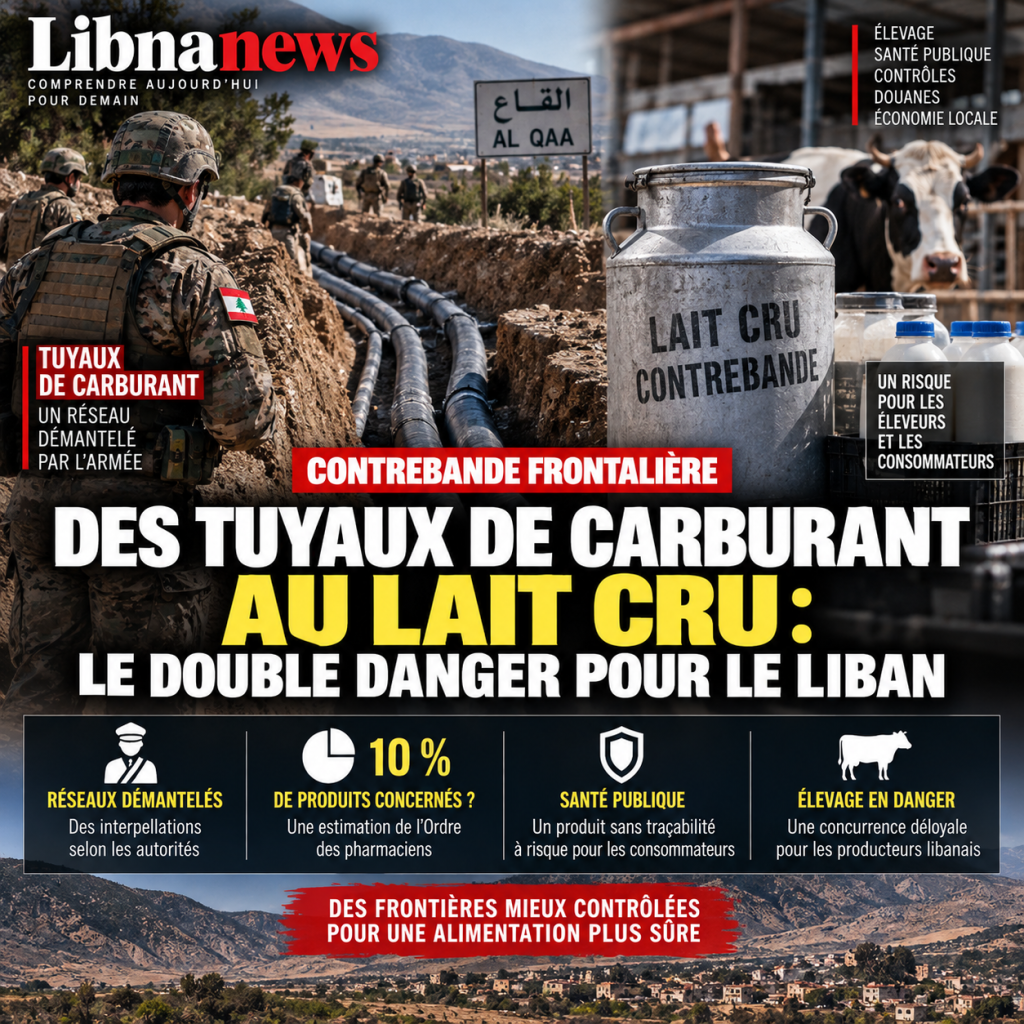
The discovery of smuggling pipes in the Al Qaa Project area, near the Lebanese-Syrian border, has reopened a case that far exceeds fuel traffic. The army’s intelligence office in Hermel has uncovered pipelines in the area of Al Joura, east of Jussieh on the Syrian side. The device refers first to the circuits used to pass petroleum products across the border. But the testimonies gathered in the region describe a much more diversified underground economy. Traders would also bring raw milk from Syria to Lebanon under conditions beyond veterinary, health and customs controls. The president of Al Qaa municipality, Bachir Matar, describes this trafficking as a « complete crime », because of its simultaneous impact on public health and on Lebanese farmers.
A distinction must be made between what is directly established and what is denounced by local actors. The discovery of conduct by military intelligence is reported. The use of the border for the smuggling of milk and the charges concerning its quality are mainly based on statements by local officials and actors in the sector. The available evidence does not provide an official inventory of seized volumes, names of traffickers, laboratories that analysed each shipment or judicial convictions related to all reported practices. This caution does not weaken the subject. On the contrary, it allows us to ask the central question: how can a product as sensitive as raw milk circulate outside the regulated circuits in a region where the border remains permeable?
Raw milk is a much more fragile product than an ordinary commodity
Smuggling of milk presents a particular risk because the product does not carry the same conditions of transport as dry goods. Raw milk requires a controlled health chain, from milking to processing. Local officials are precisely denouncing the lack of guarantees on the origin, quality and conditions under which the clandestine product crosses the border. Where the circuit escapes official controls, the Lebanese authorities no longer have the same means to verify the holding of origin, the conditions for collection, transport or final destination of the milk.
The sources of the file use a very alarming vocabulary and speak of « poison » risks to consumers. This formulation is part of the denunciation of the respondents and should not be transformed into a laboratory report. No detailed analysis results are provided in the corpus to assert that all the milk smuggled into the body would be contaminated or toxic. The documentable risk is more precise: a perishable food product that enters without official control deprives the consumer of normal guarantees of traceability and safety. The health issue therefore arises from the lack of control as well as the actual quality of each cargo.
Why Lebanese farmers talk about impossible competition
For Bekaa producers, the problem is also economic. A Lebanese farmer bears the cost of feeding livestock, care, labour, energy, transport and sanitary requirements. A product that smuggles in may escape some of the regulatory, customs and tax costs that are imposed on official production. It can therefore be offered at a lower price to intermediaries or processors. Competition is no longer between two farms subject to the same rules, but between declared production and a flow whose real costs and entry conditions are not known.
It is this mechanism that local officials describe as a direct threat to livestock. If buyers have a cheaper source of raw milk, the price paid to the local producer is subject to pressure. The farmer can then reduce his herd, delay his investments or leave the business. The available information does not provide statistical data to measure precisely the share of clandestine milk in the national market or its quantitative effect on the price paid to farms. It would therefore be excessive to attribute to smuggling all the difficulties of the dairy sector. But it adds unregulated competition to a sector already exposed to high production costs.
Al Qaa, a geography that facilitates underground circuits
The Al Qaa projects sector is located in a border area where agricultural land and crossings between Lebanon and Syria have long been creating a control challenge. The discovery of pipelines in the Al Joura area shows that an underground network does not necessarily need to use an official border post. A hose can transfer a liquid by avoiding the visible passage of vehicles. For fuels, this method has an obvious advantage: the product can circulate continuously or split through a discrete point. The army’s discovery indicates that these infrastructures are not limited to small improvised passages.
Milk, on the other hand, cannot be automatically assimilated to fuel and the available evidence does not indicate that it is passing through the same pipes discovered. The file title plays on the transition from « oil pipes » to clandestine milk to show the diversity of border traffic. This distinction is important to avoid an unsubstantiated statement. The documented fact is the existence of conduct used in smuggling in the area. At the same time, local actors denounce the passage of milk from Syria by traffickers. The two phenomena illustrate the same weakness: economic circuits operate outside official checkpoints.
The real advantage of the trader: erase the origin of the product
Once milk is smuggled into Lebanon, the most important issue becomes its destination. The available evidence denounces the role of traders and intermediaries, but does not provide a complete mapping of final buyers. It would therefore be unjustified to designate specific dairies or undertakings without any additional elements. The risk lies precisely in the loss of traceability: when the origin is not registered at the border and the product then joins a collection circuit, it becomes more difficult for the consumer to know where the raw material used in a dairy product comes from.
This opacity also protects traffic. A truck or batch seized at the border can be identified. A product already mixed with other volumes becomes much more difficult to trace. The struggle cannot therefore be limited to intercepting the physical passage. It also has to climb the commercial circuits: who buys, who transports, who stores and who transforms? The available sources do not provide these answers for the cases mentioned. On the other hand, they show why local producers are asking for intervention that does not stop at the military control of the border alone.
An economic and security border
The Al Qaa file recalls that border control is not just a matter of weapons, people or military security. It also determines the conditions of competition within the country. Every product that enters without a declaration may escape the rules applied to its legal equivalent. For an agricultural sector, this difference can be decisive. Farm margins are often narrow. Some variations in the purchase price are sufficient to make production profitable or in deficit. A clandestine flow, even a minority, can therefore affect the local market if it is concentrated in a particular region or period.
The same reasoning applies to public health. An official border is used to verify documents and to apply the procedures. An underground passage removes this first barrier. The checks must then be carried out later, on the roads, in the warehouses or in the purchasers. The more the product advances in the chain, the more difficult it becomes to establish its origin. In the case of perishable food, the time available for intervention is also reduced. Therefore, the fight against such smuggling requires coordination between the army, customs, veterinary and health authorities.
The legal producer also pays the cost of the lack of control
Illegal competition has a perverse effect: the producer who respects the rules finances costs that his illegal competitor avoids. It must maintain its operation, comply with sanitary obligations, transport its production and negotiate with buyers in a market where undeclared volumes may appear. If prices fall, it cannot simply remove these costs. The risk is then a gradual exit from the most fragile farms. The market would lose identifiable and controllable producers to more opaque flows, further weakening the state’s ability to monitor the sector.
Bachir Matar expressed this concern in a particularly severe way by believing that smuggling « kills » the producer and threatens the consumer. The vocabulary is that of a local elected representative defending his territory and must be attributed to his position. But the economic mechanism it describes is understandable: an artificial drop in the purchase price caused by an underground supply reduces the income of local farmers. In the long run, food security itself can be affected if the country becomes more dependent on products of which it controls less well the origin.
The findings raise the question of complicity and duration
A smuggling infrastructure does not appear spontaneously. Installing and operating pipelines in a border area requires a knowledge of the land, a starting point, a point of arrival and an organization capable of benefiting from the transfer. The available evidence does not identify those responsible for the network discovered by military intelligence or establish possible complicity. It would therefore be incorrect to appoint officials without a judicial record. However, the discovery raises a legitimate question as to the duration of the operation of such a device and the quantities likely to have passed before its dismantling.
This is one of the aspects on which an official survey should provide answers. The number of pipelines, their length, capacity, seniority and the properties they connect would make it possible to estimate the size of the network. The corpus does not provide these data in sufficient detail to quantify them. Their absence prevents the estimation of the economic value of traffic. It does not change the main observation: clandestine passage is not necessarily limited to individuals carrying small quantities through trails; It can be built on a dedicated infrastructure.
Controlling the border will not be enough if the internal market continues to buy
The closure of one passage often moves traffic to another if the demand remains intact. For this reason, internal market control is as important as border control. An underground product is of value only because a buyer is ready to receive it. In the case of milk, it is therefore necessary to monitor collection circuits, storage capacities and consistency between officially produced or imported volumes and those actually processed. Available sources do not report the existence of a comprehensive public mechanism to track these discrepancies in real time. They show above all the call of local officials for more firm intervention.
An effective strategy should be able to trace the product back to its source. If a lot is found, the investigation must identify its supplier and buyer. If a processor receives volumes whose origin is not documented, the question of traceability must be asked. This approach would reduce traffic profitability. As long as the risk mainly affects the border crossing, the intermediary may consider a seizure as a cost among others. If the entire chain becomes exposed to controls and sanctions, the economic model of smuggling becomes weakened.
A file that requires public figures rather than ad hoc alerts
One of the problems in the file is the lack of consolidated data. Local officials launch the alert, the army discovers infrastructure and producers denounce competition, but the public does not yet have a complete picture of the volumes of clandestine milk, seizures, prices or estimated losses for farmers. This gap facilitates two opposing excesses: minimizing the phenomenon due to lack of statistics, or assigning it all the difficulties of the sector without quantitative proof.
Regular publication of data would enable this alternative to be removed. How many dairy seizures are made? Which points of the border? What volumes? What results of analysis? What prosecution? What price difference with local milk? These indicators would give producers and consumers a real measure of the phenomenon. They would also check whether safety operations reduce traffic or simply move it to other routes.
Milk finally reveals the daily cost of a porous border
The discovery of Al Qaa’s pipes is spectacular because it makes an underground infrastructure visible. Milk trafficking is more discreet, but it shows how the same border weakness can affect daily life. An uncontrolled passage does not only affect customs revenues. It can influence the price paid to a farmer, the decision of a farm to continue its business and the ability of a consumer to know the origin of what he or she buys. It is this combination of economy and health that gives the dossier its gravity.
The facts available nevertheless impose a clear limit: they establish the discovery of smuggling lines and report specific accusations by local actors about the clandestine entry of milk from Syria. They do not make it possible to say that any Syrian milk would be dangerous, that the same lines carry milk, nor to designate without proof companies that would buy the clandestine volumes. The next step must therefore be judicial, health and economic: dismantling infrastructure, identifying networks, analysing seized products and tracking their destination. Without this work, every new discovery will remain a spectacular episode of a system that no one can measure completely.





Comments