

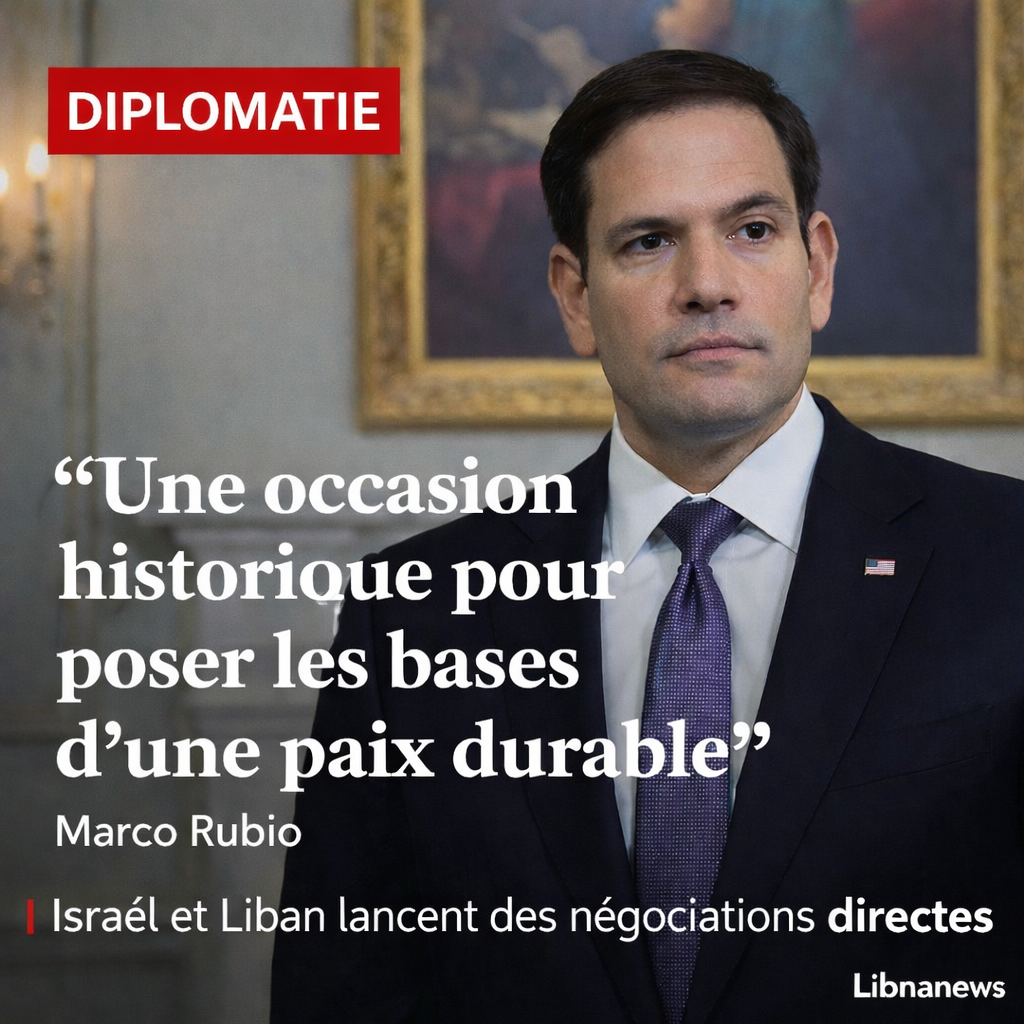
In the evening of 14 April, after more than two hours of discussions at the State Department in Washington, Israel and Lebanon agreed to launch formal direct negotiations, the first of its kind since 1993. US Secretary of State Marco Rubio described this meeting as a « historic gathering » and a « historical opportunity » to lay the foundations for lasting peace. Israeli ambassadors Yechiel Leiter and Lebanese Nada Hamadeh Moawad, accompanied by American ambassador to Lebanon Michel Issa, described the discussions as « productive » and agreed on the continuation of the process at a mutually agreed date and place, without setting a specific timetable for the next round.
These talks take place as the Israeli military offensive against Hezbollah continues in southern Lebanon, without the ceasefire between Washington and Tehran on 8 April being extended to that front. For Israel, negotiations are primarily aimed at dismantling the military capabilities of the Shiite movement and the full implementation of United Nations Security Council resolution 1701, which requires the withdrawal of all non-State forces south of the Litani River and the exclusive deployment of the Lebanese army in that area. Prime Minister Benjamin Netanyahu has repeatedly reiterated that continued operations are a prerequisite for any significant diplomatic progress.
A first direct encounter after more than thirty years of breakup
The meeting on 14 April marked an unprecedented diplomatic turning point. Participants discussed the principles of a future agreement, with a focus on securing the border and ending Hezbollah’s armed influence in the south of the country. Yechiel Leiter stressed an unexpected convergence with the Lebanese delegation: « We have discovered today that we are on the same side of the equation ». He added that the Lebanese government had made it clear that Hezbollah would no longer tolerate the « occupation » of the south. On the Lebanese side, the authorities insisted on the urgency of a ceasefire to relieve the civilian population, while welcoming the « productive » nature of the discussions.
No concrete progress was announced on an immediate ceasefire. Israel maintains that the disarmament of Hezbollah and the strict implementation of resolution 1701 must take precedence over any temporary truce. Secretary of State Marco Rubio stressed the objective of a « permanent peace » that would end « twenty or thirty years of Hezbollah influence in this part of the world ».
Israeli position on France’s exclusion: preserving the effectiveness of the process
Following the discussions, Ambassador Yechiel Leiter firmly excluded any involvement of France in the negotiations. « It is certain that we do not want the French to interfere in these negotiations, » he said to the press. He continued in direct terms: « We would like to keep the French as far as possible from virtually everything, but especially when it comes to peace negotiations. » Asked about a possible concerted effort to remove Paris, he replied: « They are not necessary. They have no positive influence, especially not in Lebanon. »
This position reflects Jerusalem’s ancient and profound distrust of the role of Paris in Lebanon. Israel considers that France, through its historic commitment to the Lebanese institutions and its significant contribution to the Finul (United Nations Interim Force in Lebanon), no longer offers the neutrality required for effective mediation. In particular, Tel Aviv blames Paris for its past initiatives to limit Israeli action against Iranian threats and its lack of concrete commitment to support the Lebanese government’s disarmament of Hezbollah. For Israel, any European and French involvement in particular could dilute the necessary pressure on the Shiite movement, complicate the rigorous implementation of resolution 1701 and introduce balances that would favour the status quo rather than structural change in border security.
By opting for exclusively American mediation, Israel intends to maintain a direct bilateral framework and dynamic focus on its security priorities. Washington, Jerusalem’s main ally, is seen as the only actor able to exert decisive influence while understanding the Israeli imperatives of dismantling Hezbollah’s military infrastructure.
Reactions to Lebanon and Hezbollah’s firm rejection
In Lebanon, the authorities welcomed these talks with caution. Prime Minister Nawaf Salam reiterated the need to preserve national sovereignty and to secure a rapid ceasefire to protect civilians. President Joseph Aoun expressed hope that the discussions would pave the way for a de-escalation. However, the very holding of negotiations has provoked anger in several cities, including Beirut, where protesters accused the government of weakness in the face of the Israeli offensive.
Hezbollah, the main absent from the negotiating table, categorically rejected the process. His leader Naïm Qassem called on the Lebanese government to cancel the talks, calling any discussion without his endorsement of « capitulation ». The movement continues to claim response operations against Israeli positions and maintains that only an agreement including its participation could be viable.
The military and humanitarian situation on the ground
Despite the diplomatic opening, there was no significant interruption in Israeli operations. Targeted strikes and troop movements have been reported in southern Lebanon, where the Israeli army is seeking to consolidate a buffer zone. The Israeli army reported recent casualties, including one soldier killed and ten wounded in the Bint Jbeil area. The Lebanese army maintains a defensive posture, ready to deploy more forces if an agreement was reached. The negotiating session between Lebanon and Israel ended after more than two hours, during which Israel bombed 23 southern Lebanese localities, some on several occasions.
The humanitarian crisis remains acute. More than one million people have been displaced since the beginning of the escalation on 2 March 2026. The most intense strikes, including the one of 8 April, which concentrated about 100 attacks in about 10 minutes on densely populated areas, caused, according to the Lebanese authorities, more than 2,000 deaths and heavy damage to civilian infrastructure: hospitals, schools, water and electricity networks. The relief services had to manage collective funerals, including 13 internal security officers killed on 10 April in Nabatiyah.
Incidents were also recorded between Israeli forces and the Finul peacekeepers, resulting in restrictions on the freedom of movement of United Nations observers. The Secretary-General of the United Nations urged the parties to make progress towards the full implementation of resolution 1701 and to protect civilians.
Update on the morning of 15 April
At dawn this Wednesday, April 15, no major strike was reported within hours of the Washington discussions. Israeli forces, however, continue to strengthen their presence along the border, with active patrols in several southern villages. The Lebanese army and the Finul contingents are continuing their monitoring activities in their respective areas. The Lebanese Ministry of Health continues to identify victims of the past weeks, while clearance teams remain mobilized in the most affected localities.
The direct negotiations between Israel and Lebanon, which have now been officially launched under exclusive American mediation, are part of a landscape where the realities of the ground – military, humanitarian and security – are evolving at the pace of diplomatic exchanges, without the concrete effects of the 14 April discussions being reflected in a visible change in the daily situation of the border populations.




