

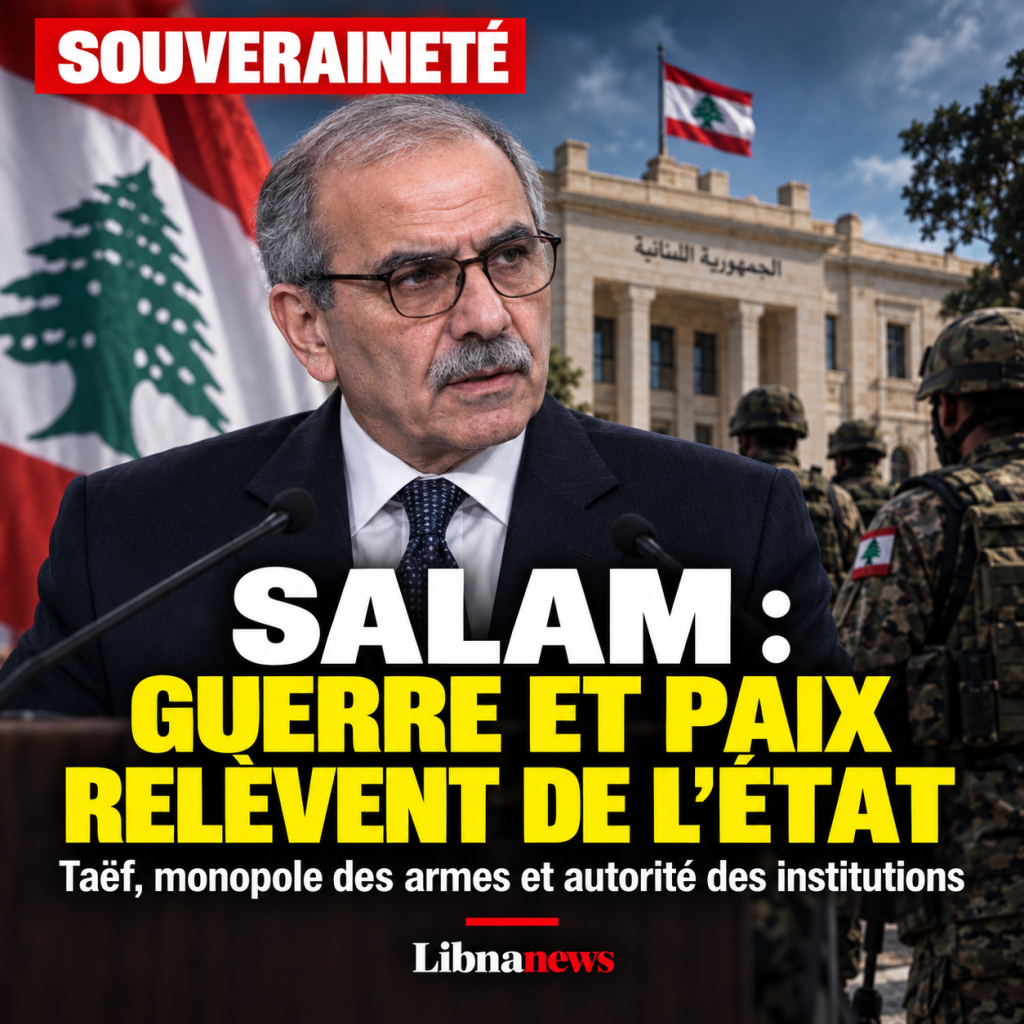
Prime Minister Nawaf Salam stated Wednesday, October 7, 2026 that decisions on war, peace and national security could not be taken outside the constitutional institutions. Speaking on the occasion of the centenary of the Lebanese Constitution, he attached this principle to the Taif Agreement and the extension of State authority throughout the country. His remarks come at a time when the issue of arms monopoly and military decision has become one of the main political and institutional issues in Lebanon.
Prime Minister Nawaf Salam reaffirmed on Wednesday that the decisions on war and peace are exclusively the responsibility of the Lebanese State. At a centennial ceremony, he considered that sovereignty remained incomplete when decisions on war, peace or national security were taken outside constitutional institutions. He presented this issue as an essential condition for the existence of a genuine State, not as a separate issue from the political reforms planned since the end of the civil war.
The statement comes in a context directly related to the debate on Hezbollah’s weapons. Since the outbreak of war on the Lebanese-Israeli border after 7 October 2023, the question of who can decide to engage Lebanon in a military confrontation occupies a central place in political life. The Government of Nawaf Salam has since placed the State’s arms monopoly among its priorities and has repeatedly affirmed that strategic military decisions must be taken by legal institutions.
Salam binds Taif to the exclusive authority of the State
Nawaf Salam based his argument on the Taif Agreement concluded in 1989 to end the civil war and reorganize the country’s institutional functioning. According to him, Taef did not separate political reforms from the restoration of public authority. The text also provided for the extension of this authority throughout the country, the dissolution of militias and the return of armed force within the framework of legal institutions.
For the Prime Minister, these principles are the foundation without which no effective State can function. He considered that popular sovereignty was meaningless when several centres of authority existed alongside the institutions representing the population. Similarly, he continued, the rule of law cannot function unless the law applies to all under the same rules.
It was in this context that Salam addressed the decisions of war, peace and national security. His message, therefore, was not only about possession of weapons outside the regular forces. It also concerned the ability to decide on their use and, more broadly, the question of which institution could engage the country in conflict.
Without directly citing Hezbollah in this passage, the Prime Minister has thus taken up one of the principles that structure the action of his government for several months. It considers that the State must exercise military authority alone and that the strategic decision cannot belong to an organization independent of constitutional institutions.
War since 2023 has put the issue at the forefront
This issue took on a new dimension in Lebanon after 8 October 2023. In the aftermath of Hamas’ attack on Israel, Hezbollah had opened a front from South Lebanon, which was described as supporting Gaza. Exchanges of fire with Israel continued for almost a year, leading to a much greater confrontation from September 2024.
The war then caused heavy loss of life, displacement and destruction in several parts of the country, particularly in southern Lebanon, the Bekaa and the southern suburbs of Beirut. Hezbollah also lost a significant part of its command. His secretary-general Hassan Nasrallah was killed on 27 September 2024 in an Israeli strike on the southern suburbs.
The entry into force of a cessation of hostilities on 27 November 2024 did not close the political debate opened by this sequence. On the contrary, the issue of the decision on war and peace has become inseparable from that of Hezbollah weapons, the deployment of the Lebanese army and the implementation of resolution 1701 in the South.
It is in this context that Salam’s remarks take on their present significance. Invoking Taif, the Prime Minister puts the issue in the institutional functioning of Lebanon rather than in the only balance of forces between parties. His argument is that the State’s exclusive military authority was already one of the principles on which institutional reconstruction should be based after the civil war.
The government has already committed the weapons file
Wednesday’s statements extend decisions already taken by the government. In 2026, the Council of Ministers repeatedly reaffirmed the principle of State monopoly of arms and entrusted the army with a central role in its implementation. The file is therefore no longer confined to the political statements of the various Lebanese forces: it is now part of the official executive decisions.
On 2 March 2026, the government had taken an additional step after new shots claimed by Hezbollah. The Council of Ministers had reaffirmed that the decision on war and peace belonged exclusively to the State. He also banned Hezbollah’s military and security activities outside legal institutions and called on the movement to hand over its weapons to the State.
This approach, however, is accompanied by another aspect that the Lebanese authorities constantly put forward: the Israeli withdrawal from Lebanese territories, the cessation of attacks against the country and respect for Lebanese sovereignty. Salam defended these demands in parallel with the arms monopoly, considering that the State must be able to exercise its authority without Israel intervening militarily in Lebanese territory.
The Government therefore presents both requirements as being subject to the same principle of sovereignty. He claims control of weapons and military decisions within the country while rejecting Israeli operations in Lebanese territory and calling for Israel to withdraw from the positions he still occupies.
Salam asks if Taef has actually been applied
The Prime Minister expanded his speech to cover the entire implementation of the Taif Agreement, without making this aspect the focus of his intervention on sovereignty. He asked whether Lebanon had actually implemented the agreement or whether it had limited itself to provisions that had redistributed powers among the various components of the political system.
Salam recalled that parity between Christians and Muslims had been enshrined, but that the Senate envisaged by Taif had never been created. It also noted that the abolition of political confessionalism had been declared a national objective without a concrete path being established to achieve it. Administrative decentralization, another reform planned for several decades, also remains pending.
For the Head of Government, these delays show that the application of Taif has remained partial. The power-sharing provisions have been implemented, while several reforms to transform the functioning of the State have remained incomplete. Salam places in this same logic the complete restoration of state authority and the exclusive control of legitimate force.
The centennial of the Constitution as an institutional reminder
The framework chosen for this intervention gives the message additional scope. Nawaf Salam spoke on the occasion of the centenary of the Lebanese Constitution, promulgated in 1926. He used this anniversary to revisit the gap between the principles enshrined in the texts and their effective application in institutional life.
His intervention thus goes beyond Hezbollah’s only question, even if the weapons file today gives an immediate resonance to his remarks. More broadly, Salam raised the question of the existence of decision-making centres outside constitutional institutions, uniform respect for the law and the State’s capacity to exercise its authority throughout the country.
The reference to Taëf also allows the Prime Minister to put the current debate in a context prior to the clashes that broke out in October 2023. The principle of State control over weapons and the dissolution of militias is not only the result of the last war with Israel. It belongs to the political arrangements drawn up at the end of the civil war, although its application and interpretation have been the subject of profound differences since 1989.
Wednesday’s remarks, however, come at a time when this question is no longer theoretical. The government has initiated the arms monopoly, while the army is called upon to strengthen its authority in the areas where it deploys. At the same time, Lebanon continues to call for an end to the Israeli attacks and the withdrawal of Israel from the positions still occupied in its territory.
By claiming that sovereignty remains incomplete when war, peace or national security decide outside the institutions, Nawaf Salam directly links one of the main political issues of 2026 to the Taif principles. Now the question of their implementation remains, while the arms monopoly, the deployment of the army, Israeli positions and unfinished institutional reforms continue to weigh on the state agenda.





Comments