In Washington, two separate files have joined
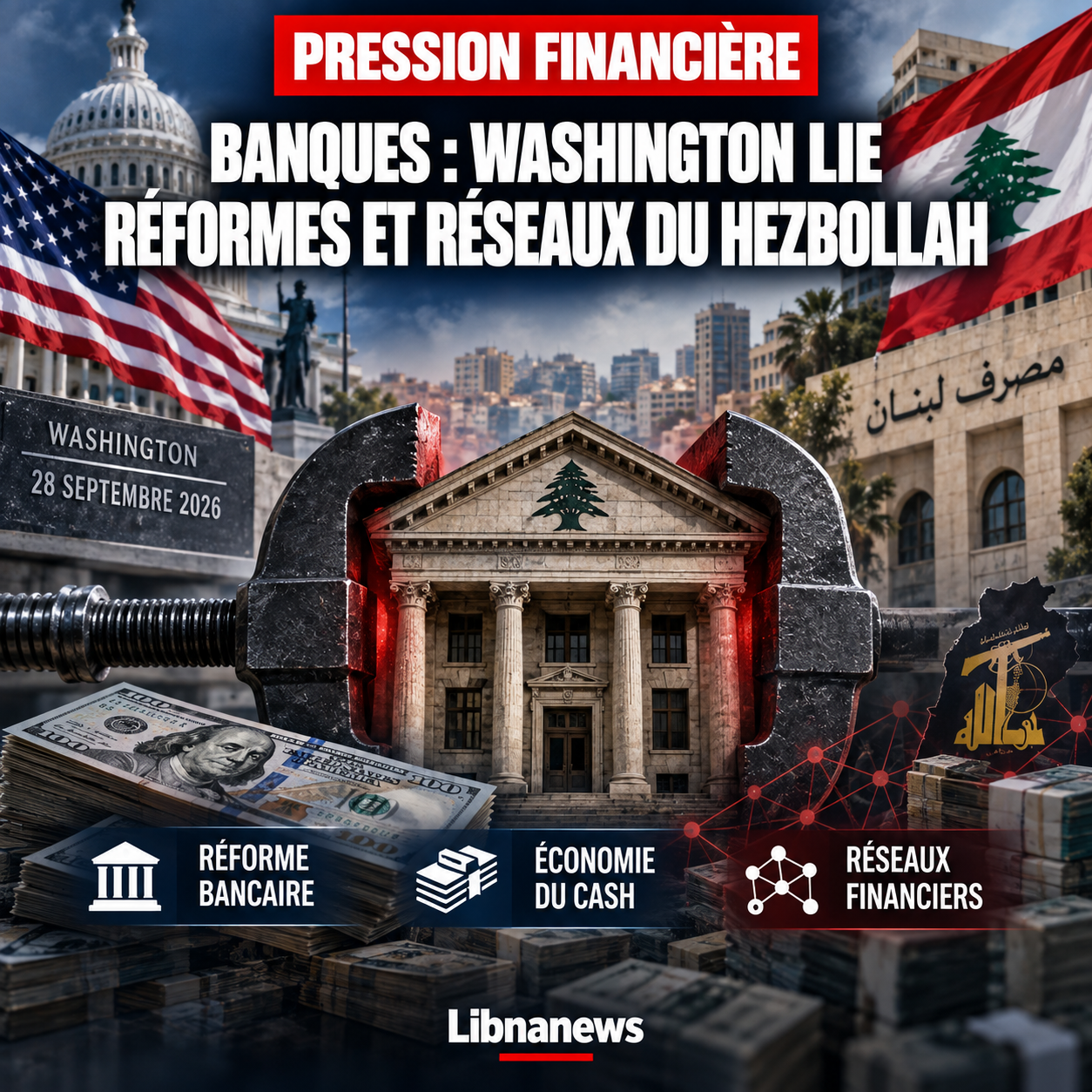
Nawaf Salam’s visit to Washington highlighted an important development in the relationship between Lebanon and the United States. Banking sector reform, recovery of international confidence and negotiations with financial institutions are no longer dealt with separately from security and sovereignty issues. The US discussions now show a direct link between the recovery of the Lebanese financial system and the fight against the financial circuits attributed to Iran and Hezbollah. This reconciliation changes the nature of the file. For several years, the banking crisis was mainly addressed through accumulated losses, institutional restructuring, the fate of deposits, the Bank of Lebanon and the reforms required to reach an agreement with the International Monetary Fund. Now a second strand is needed. Washington asks Beirut to show that its financial system can no longer serve as a bridge to networks beyond state control.
The message was expressed during the talks between Nawaf Salam and Finance Minister Yassine Jaber with US Treasury Secretary Scott Bessent. Discussions focused on key reforms in the financial sector, but also on the need to take decisive action against financial networks linked to Iran and Hezbollah. In parallel, the Lebanese delegation presented the progress claimed by the Government in financial and banking reforms. It called for US support to advance negotiations with the International Monetary Fund and to strengthen cooperation with the World Bank. The same interview therefore brought together two subjects which could have been discussed separately in the past: on the one hand, to rebuild banks; on the other, to strengthen State control over financial flows.
This convergence is one of the most important elements of the Washington discussions. It reveals a broader American view of Lebanese recovery. Restoring confidence in banks would no longer be merely about dealing with past losses. It should also be ensured that the system emerging from the crisis can identify the origin of the funds, monitor transactions and limit channels beyond the traditional control mechanisms. For Lebanon, the difficulty is considerable. The bank collapse has precisely accelerated the development of a cash-based economy. This cash economy makes it more difficult to trace transactions that Washington wants to strengthen.
Cash economy becomes a strategic issue
The generalisation of cash payment is not a marginal phenomenon arising from clandestine practices. It is one of the direct consequences of the financial crisis. When depositors lost normal access to their accounts and banking restrictions became established, a significant part of economic activity moved outside banks. Companies have had to adapt. Households also favoured species. Payments in physical dollars have increased. Part of the economy was organised around much less visible circuits for financial institutions.
The government specifically presented to Washington its efforts to reduce the use of species outside the financial system. It also highlighted transparency, banking compliance, the fight against money laundering and the fight against the financing of terrorism. These different elements are not accessories. They condition Lebanon’s ability to regain a normal relationship with foreign correspondent banks and, more broadly, with the international financial system.
The problem lies in the vicious circle created by the crisis. The more Lebanese distrust banks, the more cash they use. The greater the importance of species, the greater the concern of foreign partners about financial traceability. And the more severe international controls become, the more difficult it is for Lebanese banks to operate normally with abroad. The restoration of the banking system must therefore simultaneously resolve a solvency crisis, a crisis of confidence and a crisis of compliance.
In this context, US demands for Iran- and Hezbollah-related financial networks are becoming much broader. It is not enough to target a few bank accounts. Some of the financial movements likely to be of interest to the US authorities may be outside the traditional banking system. Combating these circuits therefore requires a transformation of control methods and, above all, a gradual reduction in the size of the cash economy.
Banking reform faced with a new political condition
Lebanon is also seeking to move forward with the International Monetary Fund. The government puts banking restructuring, dealing with the consequences of the crisis and restoring a viable financial system as a priority. Cooperation with the World Bank is also being sought, including financing projects in energy, water, infrastructure, digital transformation and social protection schemes.
Washington thus has several means of influence. The United States does not decide alone on the programmes of the International Monetary Fund or the World Bank. However, their weight in the international financial architecture remains considerable. US political support is therefore sought by Beirut at a time when the country is trying to mobilize external financing to emerge from a crisis that has lasted for several years.
It is at this level that a more complex form of conditionality emerges. International partners have long called for fiscal, banking and institutional reforms. The current discussions add a security and geopolitical dimension. The Lebanese financial system must not only become solvent and transparent. It must also demonstrate its ability to prevent networks linked to sanctioned actors from bypassing monitoring mechanisms.
However, it would be excessive to state, on the sole basis of available evidence, that an international financial agreement is formally conditional on the disarmament of Hezbollah. The sources do not allow such a direct legal condition to be established. On the other hand, they clearly show that US interlocutors are now placing financial reform, banking confidence and the need to disrupt Iran- and Hezbollah-related financial networks in the same conversation. This juxtaposition is politically significant.
Hezbollah in the face of pressure that no longer passes only through weapons
The American pressure on Hezbollah is no longer limited to the issue of its arsenal. It also aims at its ability to operate in a financial environment where transactions would be more closely monitored. This dimension is all the more important given that the debate on arms faces many political and security obstacles. Financial control offers the United States another lever, potentially more progressive and less directly military.
This strategy can act on several levels. It can target already sanctioned individuals or structures. It may also seek to prevent the use of intermediaries to circumvent restrictions. Finally, it can push the Lebanese state to develop mechanisms that can more closely monitor money movements that are currently outside banks.
But such a policy faces a practical difficulty. A widely dollarized cash-based economy does not make it easy to distinguish ordinary transactions from those considered suspicious. Hundreds of thousands of Lebanese people use physical dollars daily without engaging in illegal activity. Companies settle their suppliers in cash because the banking system has not recovered its normal functioning. Any policy of too brutal control could therefore further disrupt an already fragile economy.
The challenge for the State is to restore sufficient confidence for money to gradually return to the banking system. Financial supervision cannot be sustainable if citizens refuse to deposit their funds in banks. The question of Hezbollah thus unexpectedly joins that of depositors. Without a credible solution for savers, banking standardization will remain incomplete. And without banking normalization, reducing the cash economy will remain difficult.
Applicants at the centre of the credibility of the new system
The deposit crisis is therefore the meeting point between domestic financial requirements and international applications. A restructured banking system that is unable to convince depositors to entrust their money to it again will not be able to play its full role. The return of confidence will depend on how the losses will be distributed and on the ability of the authorities to present a credible path of repayment.
The reflections in the corpus evoke a comprehensive audit of the Bank of Lebanon and commercial banks, the precise identification of commitments and a distribution of losses regulated by law. Special protection for small and medium-sized applicants is also envisaged. The aim would be to put the issue of deposits at the heart of the national recovery rather than to consider it merely as a dispute between banks and customers.
This dimension is of direct interest to Washington. If depositors gradually regain confidence in the system, cash can return to banks. Transactions become more traceable. Monitoring institutions have more information. Conversely, if depositors consider banks to be dangerous, they will keep their assets out of the system. The fight against opaque financial networks will then become much more difficult.
Banking reform and the fight against illegal financing are therefore not two parallel programmes. They depend on each other. A reliable financial system facilitates control. A more controlled system facilitates the return of relations with international banks. But the whole works only if the depositors agree to return.
Pressure that could reach the banking sector itself
The most sensitive issue concerns the responsibility of financial institutions. Lebanese banks already face the problem of loss-sharing. Some may also experience increased pressure on their compliance procedures. Establishments able to demonstrate compliance with the new requirements could more easily find normal relationships with their foreign partners. Those who fail to do so could find themselves more isolated.
This may accelerate the restructuring of the sector. Not all banks will likely have the same financial and technical capacity to meet the new requirements. Some will need to strengthen their internal controls. Others may need additional capital. The most fragile establishments could be absorbed, restructured or left the market.
Control of beneficial owners, identification of suspicious movements and traceability of payments should then become more important. The digital transformation referred to in several reform projects is part of this logic. The more public and private transactions can be tracked electronically, the more difficult it becomes to hide certain flows in intermediary chains.
However, this transformation will not be without resistance. The Lebanese economic system has long been accompanied by a strong circulation of species and informal structures. Increased transparency threatens not only Hezbollah-related networks, but also other economic, political or client-elitist interests. Reform can therefore encounter oppositions from very different backgrounds.
Washington links financial sovereignty with military sovereignty
The most significant rapprochement appears when the banking file is placed in all the Lebanese-American discussions. In the military field, Washington calls for the state to exercise exclusive authority. On the financial front, the logic is comparable: circuits beyond institutional control must be reduced.
This symmetry illuminates the American strategy. The concept of sovereignty is no longer limited to territorial control. It also concerns the circulation of money. A State that claims a monopoly on arms but does not know how to control financial flows operating in its territory would remain, in this reading, partially sovereign.
The government of Nawaf Salam is thus confronted with two projects that are advancing simultaneously. It must strengthen the army and extend state authority, while restructuring banks and bringing the economy back into controllable circuits. Both operations require significant external funding. They also require internal decisions that can cause strong resistance.
The schedule further increases the difficulty. The government does not have decades to gradually restore confidence. Discussions on reconstruction, the South, the International Monetary Fund and bank restructuring are proceeding in parallel. Foreign partners want visible results before committing significant resources.
The risk of a gearbox for the Lebanese economy
This new pressure architecture also carries risks. If financial requirements become too fast while banks remain weakened, the cash economy could simply move towards even less visible circuits. The actors concerned may seek new intermediaries, make greater use of informal transfers or increase operations outside Lebanese territory.
Effective monitoring must therefore be accompanied by a credible financial offer. Companies must be able to use banks without fear of losing access to their money. Households must have reliable means of payment. Expatriate transfers must be able to join the banking system without creating mistrust among beneficiaries.
The real test will therefore not be the number of measures announced. It will be the capacity to rebuild a system in which the normal use of a bank becomes simpler, safer and more advantageous than the permanent use of cash.
That is precisely what gives Washington’s discussions their scope. The Lebanese financial record is no longer just that of the losses accumulated since the crisis. It becomes part of the country’s political and security recomposition. The restructuring of banks, the fate of depositors, the fight against the cash economy and the control of financial networks linked to Iran and Hezbollah are now converging on the same question: how far can the Lebanese State regain control of a financial system, a large part of which has developed outside its institutional channels?