






Perhaps the biggest event of the consequences of Nawaf Salam’s visit to Washington is not the one that produced the most political images. Accompanied by Finance Minister Yassine Jaber and Energy Minister Joe Saddi, Prime Minister met with the Executive Director of the International Monetary Fund, Kristalina Georgieva. Following the discussions, he announced that a delegation from the Fund would visit Lebanon after the annual meetings of the IMF and the World Bank to resume negotiations and move towards an agreement.
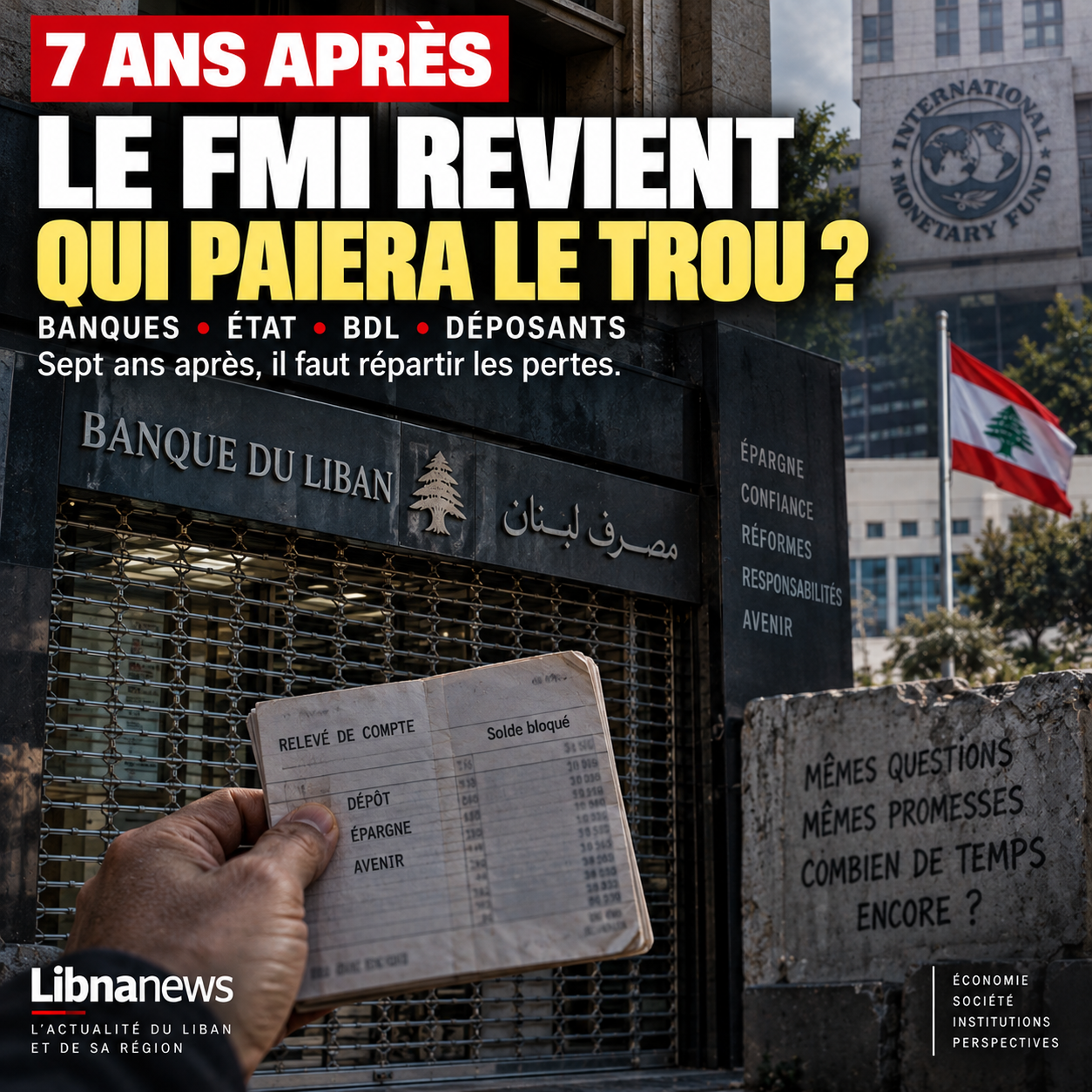
The wording is conservative. The question is to resume negotiations, not to announce that an agreement is imminent. This difference is essential, because behind the return of the IMF is always the same question, never definitively settled since the financial collapse:who will bear the accumulated losses in the lebanese banking system?
It is the « financial hole », an expression that has become almost banal while it covers a colossal conflict. Depositors hold claims on their banks. Banks have placed a considerable share of their resources with the Bank of Lebanon. The central bank itself bears liabilities and losses. The State participated in this process through its debt and financing needs. When the system collapsed, the money promised to depositors did not disappear from a single accounting box: it was this whole chain that found itself unable to meet its commitments normally.
Seven years later, the question is no longer whether there are losses. The Lebanese have already taken part. The real battle is to decidehow to recognize what remains, who must pay first and how much depositors can actually recover.
IMF returns, but the problem has changed since the beginning of the crisis
The announced return of a Fund mission is an important opening. It means that the dialogue is not broken and that the government considers that it has made sufficient progress on some reforms to put a programme on the table.
However, it would be premature to infer that the path is clear. An economic assessment published at the same time even argues that an agreement with the IMF would no longer be possible under current conditions. This is an analysis, not an official position of the Fund. But this divergence perfectly illustrates the situation: the government is talking about a resumption of negotiations, while economists are asking about the very possibility of rebuilding today the programme imagined several years earlier.
Because the financial Lebanon of 2026 is no longer that of 2019.
A largely dollarized economy has developed. Fresh dollars are treated differently from old deposits. Cash payments are central. Diaspora transfers directly feed consumption. Depositors used some of their accounts in different ways. Others sold their receivables at a loss. While the formal system remained unresolved, an economy parallel to the old banking model learned to function.
The delay did not freeze the crisis. He turned it.
The IMF is now facing a two-speed system: the old one, full of losses and blocked deposits, and the new one, based on fresh money and the constant search for ways to avoid the risks of the former.
The danger would be to charge applicants twice
This is the most sensitive issue in any future law on the financial hole.
The depositors have already paid. They lost the free disposal of their savings. They suffered inflation, the fall of the pound and successive withdrawal mechanisms. Some have accepted significant losses to obtain liquidity. Many saw their purchasing power collapse while their money remained in accounts to which they no longer had normal access.
A restructuring that would now absorb most of the remaining losses would therefore be seen as a second confiscation, this time enshrined in law.
Everything will be done in the order of responsibility.
What loss will have to absorb bank shareholders before depositors? Which institutions still have sufficient capital? Which ones can be recapitalized? What about those who are no longer viable? What assets of the Bank of Lebanon can actually contribute to the settlement? What part can the state recognize without transferring the bill to several generations of taxpayers?
No definitive formula to answer all these questions appears in the available information. And that’s precisely the problem:lebanon returns to negotiate with the IMF while the political compromise on the distribution of losses remains to be built.
Karim Souaid must first make the balance sheet readable
The governor of the Bank of Lebanon, Karim Suaid, is at the centre of this equation.
It can change governance, improve controls and help clarify accounts. It cannot reappear the lost billions. The priority therefore is to determine what still has real value.
This work is essential because bank restructuring cannot be built on theoretical assets. A bank needs to know what its claims on the Bank of Lebanon are really worth. Depositors must be aware of the resources that could finance their reimbursement. Future investors need to know what they buy when they inject capital into an institution.
Accounting transparency is therefore not an exercise for experts. It will directly determine the amount of losses attributed to each actor.
It will also help answer a long-avoided question: can all banks really be saved?
Probably not according to a classic restructuring logic. Institutions have neither the same balance sheets nor the same recapitalisation capacity. Credible reform must necessarily distinguish viable banks from those that are no longer viable.
That’s where the battle becomes political. Artificially saving all establishments would mean preserving insolvent structures. Closing them without a strong depositor protection mechanism would create a new shock wave. Recapitalizing them requires fresh money and immediately raises the question of the contribution of existing shareholders.
Why the agreement with the IMF is worth much more than the amount of a loan
Lebanon is not only seeking money from the Fund.
An agreement would be a form of certification. It would inform other donors, investors and international institutions that losses have been recognized, that a restructuring framework exists and that the country’s financial policy is based again on data deemed credible.
That is precisely why an agreement is difficult.
The IMF cannot restore confidence in a system that continues to mask its losses. In order to obtain such validation, Lebanon must agree to show the reality of its accounts and to build a mechanism for allocating costs.
The paradox is brutal:to regain access to finance, the country must first officially recognise how much it has lost.
This international certification is all the more important because the need for financing far exceeds banks. Lebanon is also seeking investments in electricity and infrastructure. The presence of Joe Saddi in Washington’s discussions recalls this link.
An investor planning to finance a power plant eventually raises questions similar to those of a depositor: will the contracts be respected? Will payments be able to circulate normally? Is the State capable of fulfilling its commitments? Is the financial system reliable?
The resolution of the financial hole therefore conditions part of the general economic recovery.
Washington also looks at banks from a financial network perspective
Another dimension complicates the file.
At the same time, the United States is calling for stronger control of Iran and Hezbollah-related financial channels, as well as measures against money laundering and unauthorized financial transactions. Banking reform is therefore between two objectives: restoring international confidence and strengthening flow monitoring.
For the Lebanese government, the distinction is politically important.
The modernization of the banking sector cannot be described as a reform aimed at a community or party. First, it responds to a national need. Without banks capable of meeting international standards, Lebanese companies will find it more difficult to work with abroad, investors will hesitate and transfers will be subject to increasing controls.
Financial compliance is therefore not a luxury imposed by Washington. It becomes a condition for the survival of a sector that wants to regain its place in the global system.
But the context of confrontation with Hezbollah makes every measure more sensitive. The government must avoid economic reform being completely absorbed by the political battle around the party.
The real scandal: the losses have already been distributed, but without law
Lebanon never completely decided how to allocate the financial hole. Yet the population has been paying the cost for years.
Perhaps this is the most striking paradox of the entire crisis.
The loss was distributed by devaluation. By inflation. By banking restrictions. By the different rates applied to withdrawals. By the distinction between old deposits and fresh dollars. By declining purchasing power. Time.
The absence of legislation therefore did not prevent the distribution of losses. She made it opaque.
And this opacity has fostered inequalities. Those who had foreign liquidity, income in dollars or ability to move their assets did not experience the crisis in the same way as an employee who had spent a lifetime saving in a Lebanese bank.
Future reform cannot ignore this reality. It does not leave a white leaf. Some of the losses have already been absorbed by households.
If the law now merely formalizes the remaining balance without taking into account what has already been suffered, it risks turning de facto injustice into legal injustice.
Deposits have become a matter of confidence in the state
The return of savings now exceeds the relationship between a bank and its customer.
It directly affects the credibility of the State.
A family that gradually recovers its money through a transparent mechanism can see that institutions are able to repair, at least partially, a crisis that they have allowed to settle. A family that discovers on the contrary that its savings are permanently amputated while the main economic leaders retain their positions will draw an exact opposite conclusion.
This dimension is all the more important as applicants cross all communities.
The banking crisis hit Christian, Sunni, Shiite and Druze families. It hit Beirut, Tripoli, Mount Lebanon, Bekaa and the South. It also hit expatriates who had retained their economies in the country.
The file thus has a rare feature in Lebanon: it can be understood without a confessional translation.
Everyone knows what it means not to be able to freely dispose of their own money.
The next battle will take place in Beirut, not Washington
The meeting with Kristalina Georgieva reopened the door. The difficult work will begin with the arrival of the Fund’s mission.
At that time, general statements on depositor protection and banking reform will have to face the figures.
What amount of loss will be officially recognized? What assets will absorb some of them? What contribution will be required from shareholders? How to deal with small and medium-sized applicants? What method will be used for the most important accounts? How to recapitalize viable institutions? How can we deal with those who are not? What responsibility will the State accept? And over how long can a credible refund be organized?
That’s where the real test is.
Lebanon does not need a formula promising everyone that it will lose nothing. Such a promise would hardly be compatible with the very existence of the financial hole. It needs a formula capable of publicly explaining what has been lost, what can be recovered, which will contribute and in what order.
This transparency will be painful.
However, it is less dangerous than the indefinite extension of the current system.
For the country has already experienced the alternative: to postpone the decision, to allow depositors to gradually absorb losses and to keep banks in an intermediate state between operation and restructuring.
Seven years later, this method reached its limits.
The return of the IMF therefore does not guarantee anything. It does not guarantee quick agreement, immediate repayment or general rescue of banks. It simply obliges Lebanon to come back to the question that it has pushed back since the beginning of the collapse.
And this time, the question cannot be summed up by a number.
It is much simpler and much more political:after losing billions, is Lebanon finally able to decide fairly who should bear the cost?