






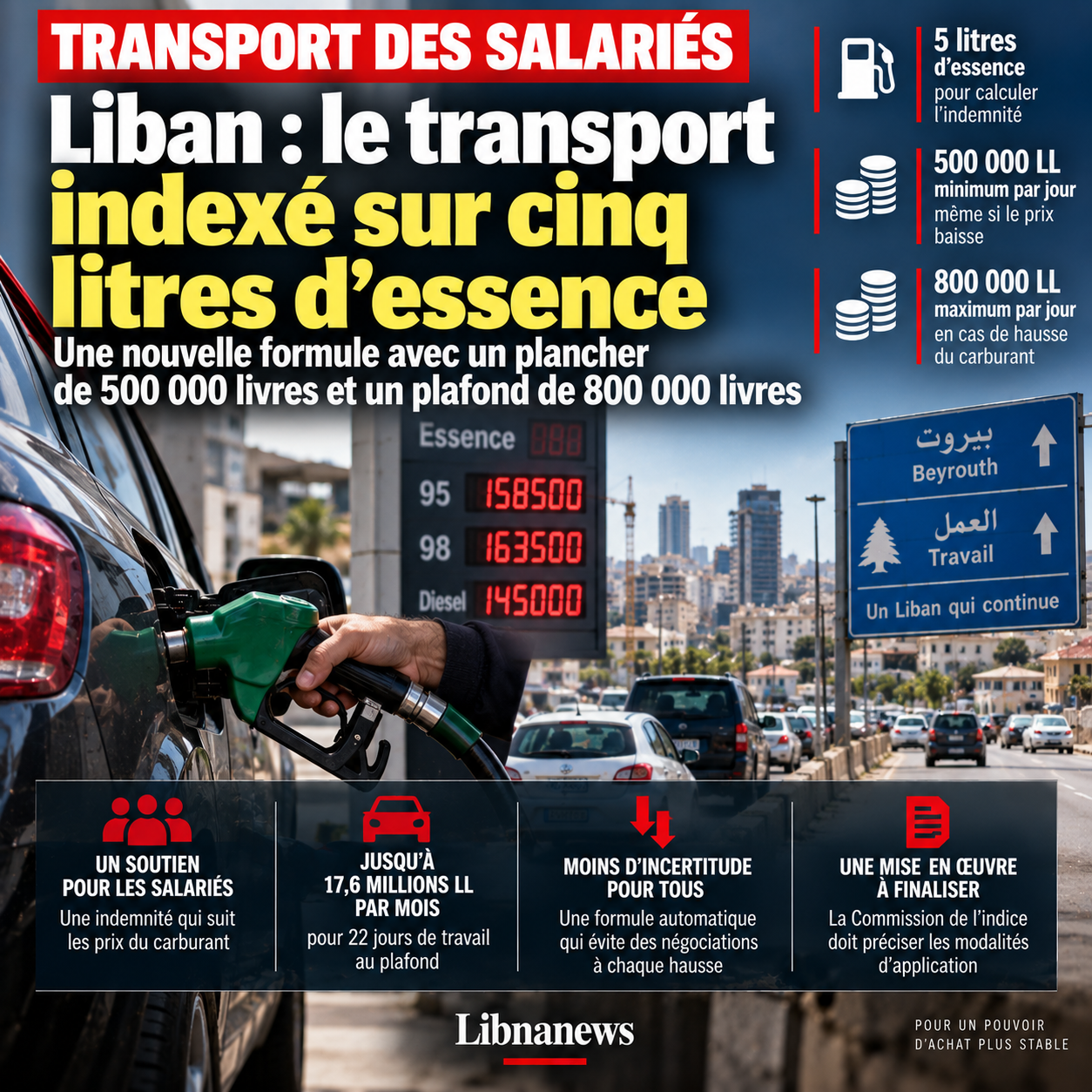
The Lebanese Minister of Labour,Mohammad Haidarannounced an agreement to calculate the daily transport allowance for employees on the basis of thefive litres of petrol. However, the new mechanism provides for two safeguards:lebanese pounds 500,000 per day, even in the event of a decrease in fuels, or exceeding£800,000. This formula must allow the amount paid to employees to be automatically adjusted to the fluctuations in the price of petrol.
Five litres of gasoline to calculate transport
The principle adopted breaks with the fixed amount system which is regularly exceeded by price developments.
According to Mohammad Haidar, the partners concerned agreed on a reference corresponding tofive litres of fuel per day at work. The value of these five litres will be used to determine the transportation allowance.
The Minister indicated that the mechanism would be framed by a floor and ceiling.
Even if the price of petrol falls sharply, the employee will have to receive at leastlebanese pounds 500,000 per day. On the other hand, an increase in fuel will not be able to pay the allowance beyond£800,000 per dayunder the announced formula.
This provision is important. Without a floor, a temporary reduction in the price of gasoline would automatically have resulted in a reduction in the allowance. The 500 000 pound threshold therefore guarantees a minimum amount.
At the same time, the limit of £800,000 limits companies’ exposure to a new surge in fuel prices.
Transportation allowance: between £500,000 and £800,000
The formula can be simply summarized.
When the value of five litres of gasoline is between 500,000 and 800,000 pounds,the transport allowance will follow this valueprotection caps (if present).
If five litres cost less than 500,000 pounds, the employee will continue to receive 500,000 pounds.
If the price exceeds £800,000, the allowance will remain capped at £800,000.
The scheme thus creates a corridor in which the allowance can evolve according to fuel, rather than an amount to be renegotiated after each major change.
This development has been in preparation for several weeks. On 7 September 2026, theIndex Commissionhad already considered the establishment of a permanent mechanism linking the transport allowance with fuel prices. A specialized commission was then appointed to study the formula.
The principle announced by Mohammad Haidar reflects this direction.
A response to rising gasoline prices
The case came to the fore with the increase in the cost of employee travel.
The daily allowance for transport in the private sector was so far fixed at450,000 lebanese pounds. Discussions over the past few days between the government, workers’ representatives and employers’ representatives have sought to replace this amount with a more flexible formula.
In particular, a meeting was held on25 septemberunder the chairmanship of the Vice-President of the Council,Tarek Mitri, with representatives of workers and employers.
The Ministers of Finance, Labour, Public Works and the Economy had participated in the discussions.
The possibility of retaining four or five litres of gasoline per day was then examined. The five-litre formula is finally the one announced by the Minister of Labour.
This also represents an increase in the floor over the 450,000 pounds currently withheld. Even in the event of a fall in fuel, the new minimum reference would therefore be higher than the£50,000 per day, about 11%.
For an employee accounting for 22 days in a month, a daily floor of £500,000 would correspond to11 million pounds of monthly transport allowancesprotection caps (if present).
At a maximum of £800,000, the same number of days would representpound17.6 million per monthprotection caps (if present).
These amounts naturally depend on the actual number of days of attendance eligible for the allowance.
Why linking transport to fuel prices
The change of method responds to a problem that has become recurring since the economic and monetary crisis.
With a fixed amount in Lebanese pounds, each major increase in fuel quickly reduces the purchasing power of the allowance. A new negotiation becomes necessary between employee representatives, employers and the authorities.
The five-litre mechanism seeks to avoid this succession of revisions.
When gasoline increases, the allowance will increase automatically, up to £800,000. When it declines, the allowance may also decline, but never under £500,000.
The formula therefore maintains a direct link between the cost of energy and part of the cost incurred by the employee to travel to the workplace.
However, it does not mean that the employer will physically supply the employee with five litres of petrol. The reference to the five litres is used forcalculation of the monetary value of the daily allowanceprotection caps (if present).
The payment remains in Lebanese pounds.
A significant monthly impact for employees
For workers who visit their workplace daily, the difference can become significant over a full month.
With 22 days of attendance, the former £450,000 represents£9.9 million per monthprotection caps (if present).
With the new £500,000 floor, the amount would reach £11 million, i.e1.1 million additional poundsprotection caps (if present).
If the price of five litres leads to an allowance of £600,000, the monthly total would be £13.2 million.
At £700,000, it would increase to $15.4 million.
And at the limit of £800,000, it would reach £17.6 million for 22 days actually taken into account.
These calculations measure the stakes of the new mechanism, but they do not constitute a fixed salary supplement. The transportation allowance depends on the number of days of attendance and the applicable regulatory arrangements.
Gasoline price becomes an automatic reference
The main change is therefore less in the initial amount than in the method.
At the beginning of September, the Commission had already adopted the principle of a formula capable of evolving with energy prices. Mohammad Haidar had then explained that he wanted to leave the transport allowance on an ad hoc basis.
The five-litre mechanism responds to this logic.
The employee is protected against an excessive fall thanks to the 500 000 pound threshold. The employer has a ceiling of £800,000.
Between these two points, the price of fuel becomes the determining variable.
The measure comes at a time when the question of purchasing power remains at the centre of the discussions of the Index Commission. Minimum wage, family allowances and social benefits are also part of the cases examined by representatives of employees, employers and the State.
Theminimum wagehowever, it remains a separate record of the transport allowance. The five-litre agreement, therefore, does not in itself mean an automatic change in the basic wage.
Implementation which still needs to be formalized
The announcement by the Minister of Labour marks a decisive step, but the agreement still needs to follow the process necessary for its regulatory implementation.
The previous discussions provided that the Index Commission would formalise the formula adopted before the adoption of the measures enabling its application.
In particular, it will be necessary to specify the exact reference used to calculate the value of the five litres and the modalities for updating the amount when the official price of fuels changes.
The scheme should also allow employers and employees to know unambiguously the amount applicable for each period.
The principle is now clearly laid down:5 litres of petrol per daywith a transport allowance between500,000 and 800,000 lebanese pounds. The next step will be its formal translation into the provisions applicable to the employees concerned.