





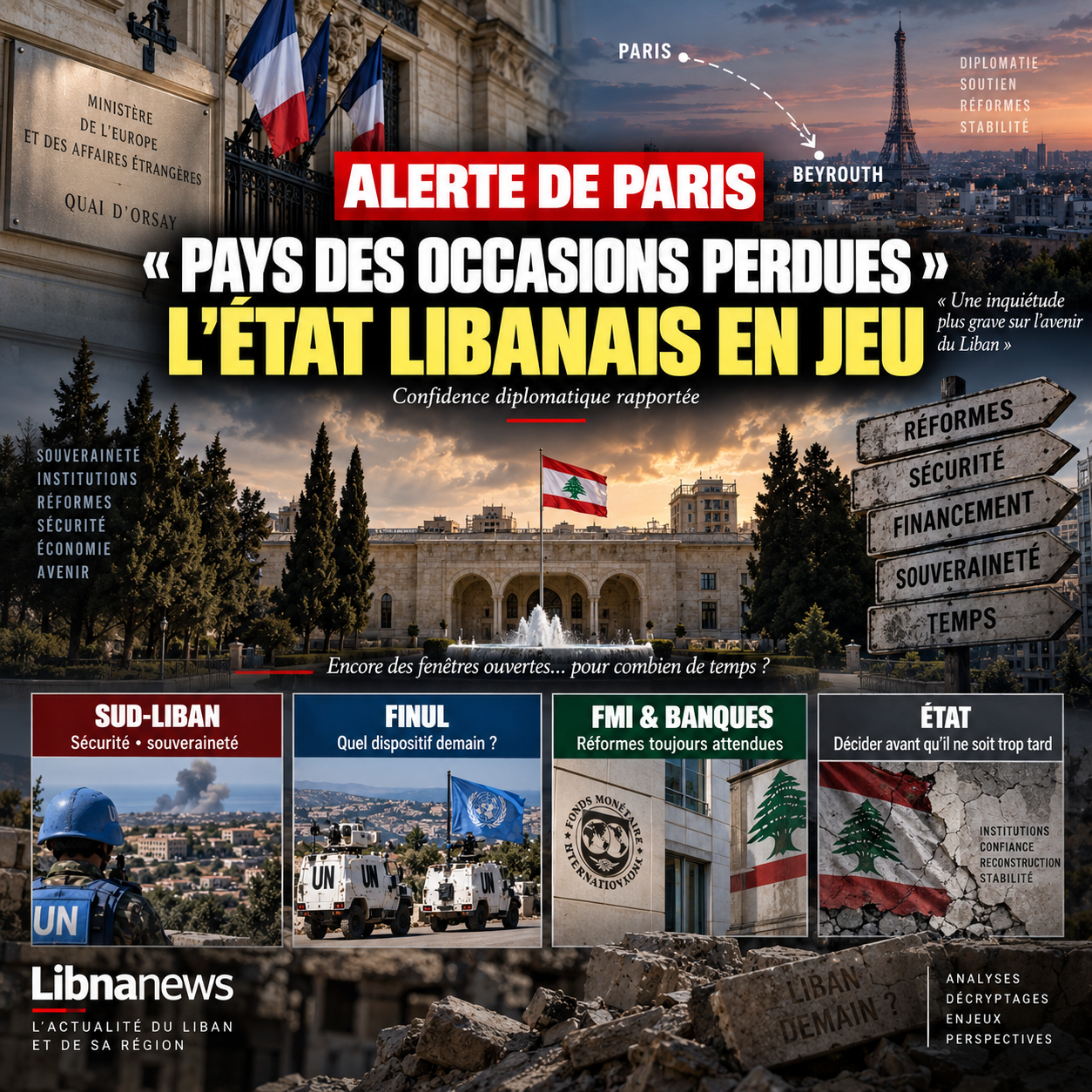
The formula was reportedly pronounced at the Quai d’Orsay in front of a prominent Lebanese personality. It is in four words, but it is much more severe than just a diplomatic comment:lebanon would have become the « land of lost opportunities ».
The confidence doesn’t stop there. The French official would have expressed a deeper fear: if he allowed the opportunity to put his institutions in order, Lebanon could end up losing either a reform, a financing or a favourable diplomatic sequence, butstate itself.
It is this second part that gives all its weight to the first.
Paris would therefore not only describe a slow country to decide. The concern would be about the accumulation of missed opportunities, at a time when several issues are simultaneously reaching a critical point: the South remains under fire, negotiations with Israel are seeking a new breath, the issue of arms monopoly is at the forefront, the banking system is still waiting for a settlement of its losses, discussions with the International Monetary Fund must resume and the future of the international presence in the South must be prepared.
Taken separately, each of these files could still be postponed. Their convergence changes the nature of the problem. Lebanon no longer necessarily has the same luxury of time.
French confidence then takes on another dimension. It looks less like a brilliant formula than a warning:the risk is no longer only that Beirut lacks an additional opportunity. It is that the others begin to organize after Lebanon without waiting for the Lebanese to choose their own direction.
The important word may not be « opportunities », but « lost »
Lebanon has often turned waiting into a political method. A decision is different because a balance of power can evolve. Reform is postponed because an internal compromise is not ripe. We expect foreign mediation, an election, a new US administration, a change in Syria, an evolution in Iran or a French initiative. This ability to defer has sometimes prevented sudden ruptures.
It also eventually produced a culture of the provisional.
However, the current sequence contains several windows that will not necessarily remain open.
At the diplomatic level, the government of Nawaf Salam is still receiving sustained interlocution with Washington and the international financial institutions. His visit to the United States allowed high-level meetings on political, military and financial issues. A delegation from the International Monetary Fund will return after the annual meetings of the Fund and the World Bank to resume negotiations. France, for its part, continues to be involved in Lebanese cases. An economic envoy of President Emmanuel Macron, Jacques de Lajugie, met with Nabih Berri to discuss in particular the reform texts adopted by Parliament and financial and economic issues.
These are open channels. They’re not blank checks.
It is precisely there that the notion of « lost opportunity » becomes meaningful. A foreign capital can support a government, send an emissary, assist the army or encourage an agreement. It cannot be a long-term substitute for the Lebanese political decision.
The danger signalled by the French confidence would therefore be that of a country which would still confuse international availability with unlimited availability.
Paris sees several clocks coming to zero at the same time
The Lebanese problem of 2026 no longer exactly resembles that of previous years. Several deadlines overlap.
The first one is safe. Israeli attacks continue in the South. The Lebanese army is itself exposed in areas where it accompanies the return or displacement of the inhabitants. One soldier and three civilians were injured in Nabatiyah al-Fawqa during the explosion of a suspicious object, while other strikes and operations were reported in the area.
The second clock concerns negotiations. A new Lebanese-Israeli military meeting is planned around 20 October in Tampa, under American mediation. Beirut is seeking Israeli withdrawal and a reduction in operations. Washington also insists on the practical application of the state monopoly on arms.
The third is international. The Final is approaching the end of its mission. Behind the question of the departure of peacekeepers is a much larger problem: who will observe the Blue Line tomorrow, document violations, ensure liaison mechanisms and support the army in this area?
The fourth is financial. The Government is seeking to relaunch negotiations with the International Monetary Fund, while the settlement of losses in the financial system remains essential.
Finally, a fifth clock is internal: that of the power’s ability to take advantage of the current period to gradually restore state authority.
These calendars are not identical, but they cross. And it’s probably this cross that feeds French anxiety.
Lebanon can still save time on a case. It becomes much more difficult to win at the same time out of five.
The French concern first concerns the state
The strongest part of the confidence is the fear of a « loss of the Lebanese State ».
It would be excessive to interpret this expression as the announcement of Lebanon’s disappearance. Nothing in the available elements allows such a literal reading. Rather, the formula refers to the risk of a State maintaining its formal institutions while gradually losing its capacity to decide, finance, control and protect.
A State may continue to have a President, a Parliament, a Government and administrations while seeing an increasing part of its functions elude it.
Safety is the most obvious example. If the decision on war and peace is not fully held by the institutions, the state remains incomplete. But the same question arises for finance. When a banking system collapses for years without a definitive mechanism for the allocation of losses and the repayment of depositors, it is also the State’s ability to arbitrate which is at issue.
It still exists for electricity, waste, water, public education or infrastructure.
It is therefore accumulation that becomes dangerous. A country can survive a sectoral crisis for a long time. It resists much less when the exception becomes the normal mode of operation of almost all sectors.
The French formula seems to point precisely to this accumulation.
The South concentrates all the contradictions
It is in the South that the question of the state becomes the most concrete.
Beirut claims to want to extend its authority and make the army the legitimate force throughout the territory. At the same time, Israel maintains positions and continues operations. Hezbollah retains its arsenal. The Finul approaches a transformation or departure. The inhabitants want to come back, rebuild their homes and resume normal life.
These four realities overlap over the same space.
The difficulty for Joseph Aoun and Nawaf Salam is obvious. They must strengthen the state without giving the impression of executing a foreign demand. They must address the issue of weapons without causing internal confrontation. They must obtain Israeli withdrawal without themselves having the military leverage to impose it. Finally, they must convince foreign partners to invest in reconstruction while the security environment remains unstable.
France knows this equation perfectly.
This is probably why the notion of opportunity becomes central. If an agreement simultaneously allowed a reduction in attacks, an Israeli withdrawal, an extension of the army’s authority and an international guarantee mechanism, Lebanon would have a rare window to transform the situation in the South.
But a window is not a result.
It can also close.
The precedent of financial reforms weighs heavily
External anxiety is not only born out of war. It feeds on a much older experience: that of the reforms announced and then delayed.
Since the financial collapse, the Lebanese authorities have faced a question that no government can circumvent: who will absorb the accumulated losses in the banking system?
The answer conditions everything else.
It determines the fate of depositors, the future of banks, the credibility of the Bank of Lebanon, the ability to attract new capital and relations with international financial institutions. However, the case remains politically explosive because any solution necessarily distributes losses between different actors.
Nawaf Salam’s American visit shows that this issue has again come to the fore. With Finance Minister Yassine Jaber and Energy Minister Joe Saddi, Prime Minister met with the Executive Director of the International Monetary Fund, Kristalina Georgieva. It was agreed that a delegation of the Fund would visit Lebanon after the annual meetings to resume negotiations.
In other words, a new window opens.
The French reading of « lost opportunities » resonates particularly here. Lebanon has already experienced times when international aid, support conferences and donor availability were real. The promises of reform have not always been followed by the expected implementation.
The risk would be that international partners would now look at the announcements with much more skepticism and demand results before mobilizing their resources.
Paris doesn’t just want to be the firefighter of a permanent fire
France has a relationship with Lebanon that goes beyond crisis management. This proximity also explains a particular form of impatience.
Paris has been a regular mediator, facilitator or supporter. But the logic of permanent rescue reaches its limits when each exit prepares the next.
The visit to Beirut by an economic envoy of the French President reveals this development. Discussions are not just about diplomacy or security. They concern reform laws, finance and the economy. The implicit message is clear: Lebanon’s political survival cannot be separated from the reconstruction of its economic institutions.
This also explains why France can look with concern at the risk of state fragmentation.
A Lebanon unable to restore its institutions is not only a problem for the Lebanese. It became a permanent home of instability in the eastern Mediterranean, in a region already shaken by wars, population displacements and confrontations between powers.
The French interest is therefore not only historical or emotional. He’s also strategic.
« Lost opportunity » does not mean that Paris considers the game over
The severity of the formula should not be overinterpreted.
If French diplomacy considered that Lebanon was definitively lost, it would have little reason to continue to invest politically in its institutions, to send representatives, to discuss reforms or to participate in the reflections on the future of the South.
The warning means precisely the opposite: there is still something to save.
But Paris seems to fear that Lebanese officials will continue to treat every problem as if they had unlimited time.
Nuance is fundamental.
A lost opportunity presupposes that an opportunity existed. And Lebanon still has several: rebuild a functional relationship with the international financial institutions; reform its banking system; strengthen its army; get a solution on the South; reorganize the international presence after the Finul; restart its infrastructure; restore more normal relations with Arab countries and attract investment.
What worries is their simultaneousity.
Missing a window is bad news. Missing several at the same time can permanently change the country’s perception.
The real risk: foreign partners stop waiting for Beirut
This is probably the most serious consequence.
Lebanon has long enjoyed a form of international patience. Its community complexity, the fragility of its balances and its exposure to regional conflicts served to explain the slowness of its decisions. Foreign partners could accept that reform takes longer or that a compromise requires several steps.
This patience is not necessarily infinite.
When partners consider that a State cannot make a decision, they end up building solutions that reduce the role of that State. In the humanitarian field, funding is more channelled through international agencies. In the area of security, external mechanisms are becoming more important. In the economic field, investors seek guarantees that circumvent sovereign risk.
This is where the fear of « losing the state » becomes concrete.
Institutions need not disappear. It is enough for major decisions to be taken gradually elsewhere, financing to be conditioned elsewhere and security guarantees to be designed elsewhere.
Lebanon would then continue to exist legally while seeing its real sovereignty reduced.
The danger of a country run by crises
There is another symptom of lost opportunities: the policy ends up not producing a project, but only responding to the emergency.
A strike calls for a safe meeting. A shortage requires a temporary measure. A banking crisis calls for a circular. A road closure calls for mediation. A threat of war calls for a diplomatic tour. Each problem gets an immediate response, but rarely a sustainable architecture.
This method can keep the system alive.
It does not rebuild the state.
The French confidence seems to be aiming at exactly this difference. Paris would not simply demand more government activity. He would be concerned about a country that could multiply initiatives without being able to turn those initiatives into irreversible decisions.
However, the current period offers precisely the opportunity to test this capacity.
Joseph Aoun is President of the Republic. Nawaf Salam runs the government. Karim Suaid is head of the Bank of Lebanon. Dialogue with Washington is open. The International Monetary Fund must return. France remains committed. Arab partners reassess their relations with Beirut. Even the military record with Israel has a negotiating channel.
Rarely so many doors have been opened at the same time.
That is precisely why losing them would have such a high cost.
The sentence of the Quai d’Orsay is also a warning to Lebanese officials
The private nature of the remark gives it special value. It is not a calibrated diplomatic communiqué, where each word must avoid frying. It was reportedly addressed to an important Lebanese personality in an exchange where frankness was possible.
« Country of Lost Opportunities » is therefore not a formula intended for the French public. It is a message addressed indirectly to the Lebanese ruling class.
The message can be summed up as follows: external support still exists, but it cannot produce in place of Lebanon the decisions that the State needs.
Paris can talk to Washington. He can send emissaries. He can support the army. It can encourage investment and reform. He can participate in the search for a formula for the South. But no foreign capital can decide on the distribution of bank losses, restore administrative authority, settle political rivalries or fabricate Lebanese sovereignty against the will of Lebanese actors themselves.
At one point, foreign policy reaches its limit.
This limit begins where domestic responsibility should begin.
What if the current opportunity was exactly the last before a change of model?
We must be careful: there is nothing in the available evidence to suggest that a French ultimatum would have been sent to Lebanon or that Paris would have set a deadline for its disengagement. Confidence does not say that.
However, it reveals a change of tone.
The concern is no longer limited to a particular crisis. It focuses on the state’s ability to take advantage of the openings before the context changes again.
Because the context will change.
American priorities can change. The Israeli elections can change the calculation in Tel Aviv. Negotiations with Iran can lead to an arrangement or a further escalation. The conditions for international financing can be tightened. Investors can choose other markets. The Southern security system can be redesigned.
None of these developments will wait until Beirut has completed its internal discussions.
This is probably what makes the French phrase so biting. Lebanon has long survived while waiting for history to give it a new opportunity after letting pass the previous one. The diagnosis emerging in Paris is that this method becomes dangerous.
This time, by losing opportunities,this is perhaps no longer just the next opportunity that may disappear. It is the ability of the Lebanese State to decide for itself what will come next.