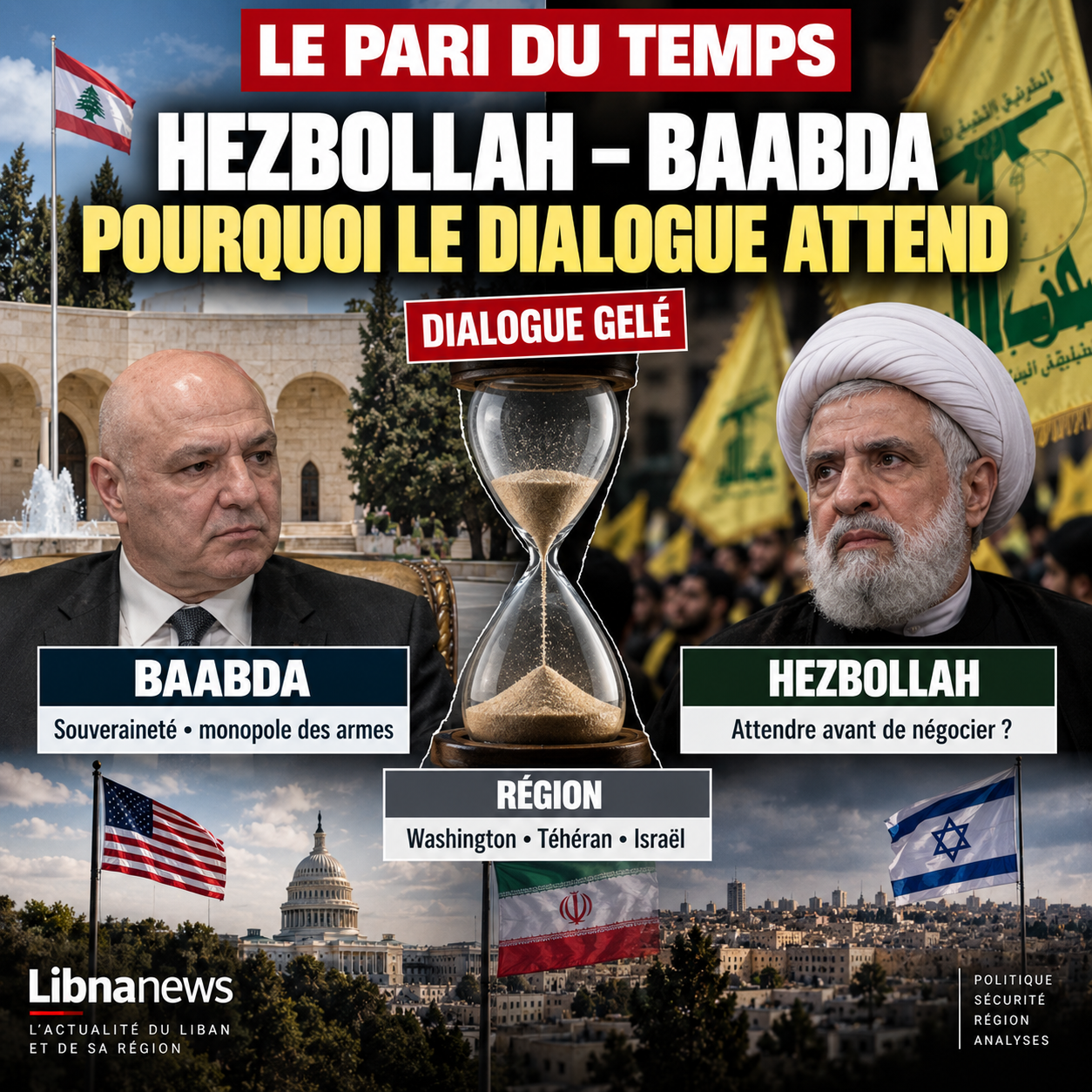
The doors of Baabda can remain open. For Hezbollah, the problem would no longer be the door, but the time chosen to cross it.
Behind the current refusal to resume a genuine dialogue with President Joseph Aoun appears a strategic reading much more elaborate than just a rejection of the presidency. According to information from circles aware of the party’s internal reasoning, its leadership would not consider dialogue unnecessary in principle. Rather, it would consider that a dialogue now under way would be likely to fail and that this failure would be more dangerous than the temporary absence of dialogue.
Distinction is essential. Hezbollah would not permanently close the way for a discussion of its weapons, the relationship with the State or the new security architecture in Lebanon. He believes that the conditions for real negotiations are not yet in place. Neither Baabda, nor the government of Nawaf Salam, nor the party itself would now have the necessary margin to change their positions sufficiently. Washington also maintains high demands. Israel continues its operations. Tehran remains engaged in its own confrontation and uncertain negotiations with the United States.
In this reading, sitting around a table today would therefore amount to negotiating positions that no one can yet give up.
But one element makes this strategy much more interesting. Hezbollah does not necessarily think that time is playing against him. Despite the considerable losses suffered over the past two years, despite Hassan Nasrallah’s death and his replacement by Naim Kassem, despite Israeli military pressure and American demands on his disarmament, a conviction would be in the process of settling in his circles:the phase where we just had to survive the blows would be over. The party would now seek to transform this survival into a political, popular and organizational rebound.
It is this bet on time that explains much of his refusal to engage in immediate dialogue.
Baabda proposes dialogue, Hezbollah first looks at the calendar
Since Baabda, Joseph Aoun suggests that discussion channels remain available. The idea of a dialogue with Hezbollah retains an obvious institutional logic: to avoid that the arms issue is dealt with exclusively by external pressure or by military confrontation, and to seek a Lebanese formula that can place strategic decisions within the framework of the State.
However, the offer does not currently meet the expected echo.
The reasoning reported on the Hezbollah side begins with the calendar, even before the content. For a negotiation to be useful, actors must have something to negotiate. However, according to this reading, the main parties are now locked in positions that have become too rigid.
Joseph Aoun placed state sovereignty at the centre of his mandate. The government of Nawaf Salam also took responsibility for the arms monopoly and the extension of state authority. After adopting this trajectory, the executive could hardly suddenly return to a formula that would be perceived as a step backward.
Hezbollah faces the opposite constraint. To accept today a profound revision of its military strategy, without complete Israeli withdrawal, without lasting cessation of attacks and without alternative defence architecture, would be presented in its environment as a concession made under fire.
The dialogue table would therefore bring together actors who can speak, but none can really move.
That is precisely what the party would like to avoid.
The dreaded scenario: entering Baabda to get out with a record of failure
The calculation attributed to Hezbollah is unusual:a bad dialogue could be worse than no dialogue at all.
Why? Because a formal negotiation creates expectations. As soon as the President of the Republic and Hezbollah engage in a public or semi-public process, each meeting must produce something. A calendar. A formula. A concession. A second step. For lack of results, failure itself becomes a political event.
In the current climate, this failure could be used by each camp to harden its position. Hezbollah’s opponents would say that dialogue has proved that it is impossible to voluntarily obtain a monopoly on weapons. The party could reply that the state had not come to negotiate, but only to pass on to it requirements decided elsewhere. External pressure would increase. The possibility of a subsequent compromise would become even weaker.
Hezbollah would therefore prefer to preserve the canal rather than use it.
This also explains why indirect contacts remain important. Messages can continue to circulate between different parties without a large dialogue table being formally convened. Internal tensions can be contained politically and mediaically. Red lines can be communicated. Misconceptions can be limited.
This minimal dialogue is not intended to solve the problem of weapons. It serves to prevent the conflict over weapons itself from becoming a Lebanese confrontation.
This is much less spectacular than a conference in Baabda. But in the reasoning attributed to the party, it would be much more useful.
Washington changed the nature of the problem
The main obstacle, however, is not only between Baabda and Hezbollah.
He is also in Washington.
Nawaf Salam’s visit to the United States showed the magnitude of the gap. In particular, the Prime Minister wanted to defend banking reforms, the resumption of discussions with the International Monetary Fund, support for the state and the search for a solution to the tensions in the South. The US interlocutors have put the Iran and Hezbollah financial networks and arms monopoly at the forefront.
The public message sent by Secretary of State Marco Rubio reinforced this impression: the deployment of the Lebanese army in the South is considered important, but it would not be sufficient without effective measures leading to the disarmament of Hezbollah and the state monopoly on weapons.
It is here that the perception of Hezbollah becomes decisive.
In his circles Washington would be accused of reasoning from a premise: the party would have been defeated and should therefore accept the conditions of the winner. In this reading, Israeli operations would constitute the military side of pressure to turn the losses suffered by Hezbollah into political capitulation.
The party precisely challenges this premise.
He does not deny the magnitude of the blows received. It cannot, of course, ignore the accumulated human, military, territorial and organizational losses. But its officials would not draw from these losses the conclusion that Washington lends them.
They would believe that the United States and Israel confuse weakening and collapse.
And this difference explains almost everything.
The central bet: « we survived »
In the information from the Hezbollah environment, a sentence stands out:exceeding the phase of resistance to blowsand have entered the « investment » of this resistance.
The term deserves serious consideration.
It does not mean that Hezbollah believes that it has recovered the situation that preceded the wars of the last two years. The available sources do not make such a claim. The reasoning is different: since the party did not disappear despite the intensity of the strikes and the losses recorded, the mere fact that it was still an actor capable of organising its base, maintaining its political structure and influencing national decisions would become an asset to it.
The aim would now be to rebuild its hard core, both popular and organizational.
This strategy necessarily involves time.
Rebuilding an organization hit in its hierarchy is not done in a few weeks. Building a social base after considerable destruction requires presence, resources and networks. Reorganizing relations with allies, absorbing management changes and regaining internal coherence also require a period of stabilization.
An immediate arms negotiation would force Hezbollah to discuss at the same time as it considers that its own reconstruction is not complete.
Waiting then becomes rational from his point of view.
The longer the time goes by without internal collapse, the more the party can argue that the scenario of a rapid disappearance was wrong. The more he rebuilds his political capacity, the more he hopes to negotiate tomorrow in better conditions than today.
It’s a bet. There is no guarantee that he will succeed. But it is the bet that illuminates its current strategy.
Iran is the second Hezbollah clock
The first clock is Lebanese. The second is regional.
Hezbollah closely observes the negotiations between Washington and Tehran. On 1 October, the Iranian case remains extremely moving. Tehran received the American response to its proposal, including a seven-day sequence. In particular, the disagreement would concern the order of measures to be implemented. At the same time, confrontation continues around the Strait of Ormuz and Donald Trump’s statements remain very harsh.
For Hezbollah, it is not only important to know whether the United States and Iran will soon reach an agreement.
The important thing is that Iran remains at the table.
As long as Washington negotiates with Tehran, even under military threat, regional architecture remains open. And as long as this architecture is not stabilized, Hezbollah believes that it would be premature to settle definitively in Lebanon a case that could be part of, directly or indirectly, the regional power ratio.
Iran considers the Lebanese issue important in any regional recomposition. But Hezbollah’s calculations go even further: its circles believe that, in the course of a much broader negotiation with Tehran, Lebanon could eventually become less priority for Washington.
It’s a hypothesis, not an acquired fact.
However, it explains why the party prefers to wait.
Today, Hezbollah is at the centre of American demands in Lebanon. Tomorrow, as part of a broader regional arrangement on Iran’s nuclear, Ormuz Strait, Gulf security and several regional fronts, Washington could choose to prioritize its priorities differently.
That’s exactly what the party hopes for.
The Yemeni precedent feeds this calculation
In the reasoning reported, Yemen serves as a comparison.
Hezbollah is observing how the United States adapts its priorities to regional circumstances. The party believes that Donald Trump has already shown that he could avoid or reduce certain direct commitments even when important interests are involved.
This comparison obviously does not mean that Lebanon and Yemen are two identical cases. They are neither politically nor militarily nor geographically. Rather, it reveals how Hezbollah reads American politics: positions presented today as absolute can become negotiable when strategic priorities change.
In this logic, accepting Washington’s maximum conditions now would be a mistake.
Why give up in October 2026 on requests that could be reformulated a few months later if the confrontation with Iran evolves?
This is probably one of the most important points in the party’s strategy. He doesn’t necessarily bet on a spectacular Iranian victory. He bets on something more modest and perhaps more realistic in his eyes:the evolution of us priorities.
Therefore, time would not need to make Hezbollah stronger than before. It would be enough if he made his opponents less demanding.
The problem: Washington bets exactly on the opposite
This is where the situation becomes particularly dangerous.
Hezbollah believes that time can improve its position. On the contrary, Washington and Israel seem to rely on the idea that time will increase the cost of refusing it.
Pressures are no longer purely military. They become financial, institutional and diplomatic. Financing networks linked to Iran and Hezbollah are explicitly targeted. The Lebanese banking system is subject to increased demands for supervision. Economic aid and financial reintegration in Lebanon are increasingly linked to measurable reforms.
Another approach attributed to some American circles goes even further: rebuilding the Lebanese State and the affected areas while gradually reducing the social, financial and security functions that allowed Hezbollah to consolidate its influence.
In this conception, reconstruction itself becomes an instrument of balance of power.
The state would rebuild. The State would compensate. The State would provide the services. The State would guarantee security. And as he resumes these functions, dependence on Hezbollah would decrease.
The party therefore bets on its ability to hold long enough to see the regional environment change.
Its opponents bet on their ability to make this expectation more and more expensive.
Two time strategies clash.
Joseph Aoun finds himself caught between two calendars
The position of the President of the Republic is particularly delicate.
Joseph Aoun cannot simply wait for a great regional compromise to resolve the Lebanese problem. Its mandate includes the restoration of the State, the functioning of institutions and the exercise of sovereignty. The weapons file cannot therefore be postponed indefinitely.
But Baabda cannot also ignore the risks of an inner confrontation.
If the dialogue is convened too early and fails, the President loses a tool. If he is never summoned, the resolution of the case may move even further to Washington, Tel Aviv and Tehran. If the pressure becomes exclusively external, the Lebanese compromise becomes more difficult to build.
That’s the whole paradox.
Hezbollah says in essence: wait for the conditions to allow for real negotiation.
The state can answer: waiting also changes the conditions, and not necessarily to your advantage.
The dialogue is therefore blocked not because no one understands its usefulness, but because everyone wants to choose when it will begin.
The real battle is about what « alternative » means
Another element appears in Hezbollah’s reasoning: he would not want to review his military strategy in the absence of a « practical and logical » alternative.
This is a fundamental point.
Asking for arms is one thing. Defining what replaces the function that the party assigns to these weapons is another. Who’s protecting the South? What guarantee exists against new incursions? How to respond to Israeli strikes? What becomes of the deterrent balance claimed by Hezbollah? What exact role should the army play? What international guarantees would be credible?
The party’s opponents say that the state must be the only military authority and that the existence of an autonomous force weakens the construction of a national defence.
Hezbollah reverses the argument: disarming before a credible defence exists would create a vacuum.
This contradiction cannot be solved by a simple formula on « dialogue ».
It requires a project.
However, the information available does not yet show the existence of a national defence architecture sufficiently detailed to answer all these questions. The post-Final debate, military negotiations with Israel and the strengthening of the army could gradually contribute to this architecture. But it’s not finished yet.
Hezbollah uses this vacuum to justify the wait.
His adversaries accuse him of contributing himself to preventing the construction of the alternative he is demanding.
It is one of the most difficult circles to break.
While waiting for the great dialogue, the messages continue to circulate
The absence of a formal table therefore does not mean total absence of communication.
On the contrary, indirect exchanges become essential. They serve to keep confrontation within political and media boundaries, to avoid misunderstandings and to prevent divergences from turning into internal incidents.
It is probably the only dialogue that Hezbollah currently considers to be truly functional.
It allows the party not to break up with Baabda. It allows the Presidency to retain a channel. It avoids turning every disagreement into an institutional crisis. Above all, it preserves the possibility of a more substantive dialogue once the power relations have evolved.
However, this strategy has an obvious limit: it manages the conflict, it does not resolve it.
Each month of waiting leaves the same questions open. Weapons. The Israeli withdrawal. Sovereignty. The role of the army. Security guarantees. Reconstruction. The relationship with Iran.
The difference is that the possible answers can change over time.
That’s exactly what Hezbollah expects.
The bet is huge: hold until the question asked changes
The reasoning attributed to the party can ultimately be summarized as follows:do not negotiate today a surrender that the balance of power of tomorrow could transform into a compromise.
That explains why Baabda’s calls are not enough. Why American statements reinforce prudence rather than speed up dialogue. Why the negotiations between Washington and Tehran are observed almost as closely as Lebanese developments. Why the organizational reconstruction of Hezbollah is becoming a priority. And why time is now treated as a political resource.
But this bet carries a considerable risk.
Time can actually change American priorities. It can also produce the opposite effect. Hits can continue. Financial pressure can increase. The state can make progress in building new security mechanisms. Hezbollah’s popular environment can face more destruction costs. Regional relations can evolve in an unfavourable direction to the party.
So no one really controls this clock.