





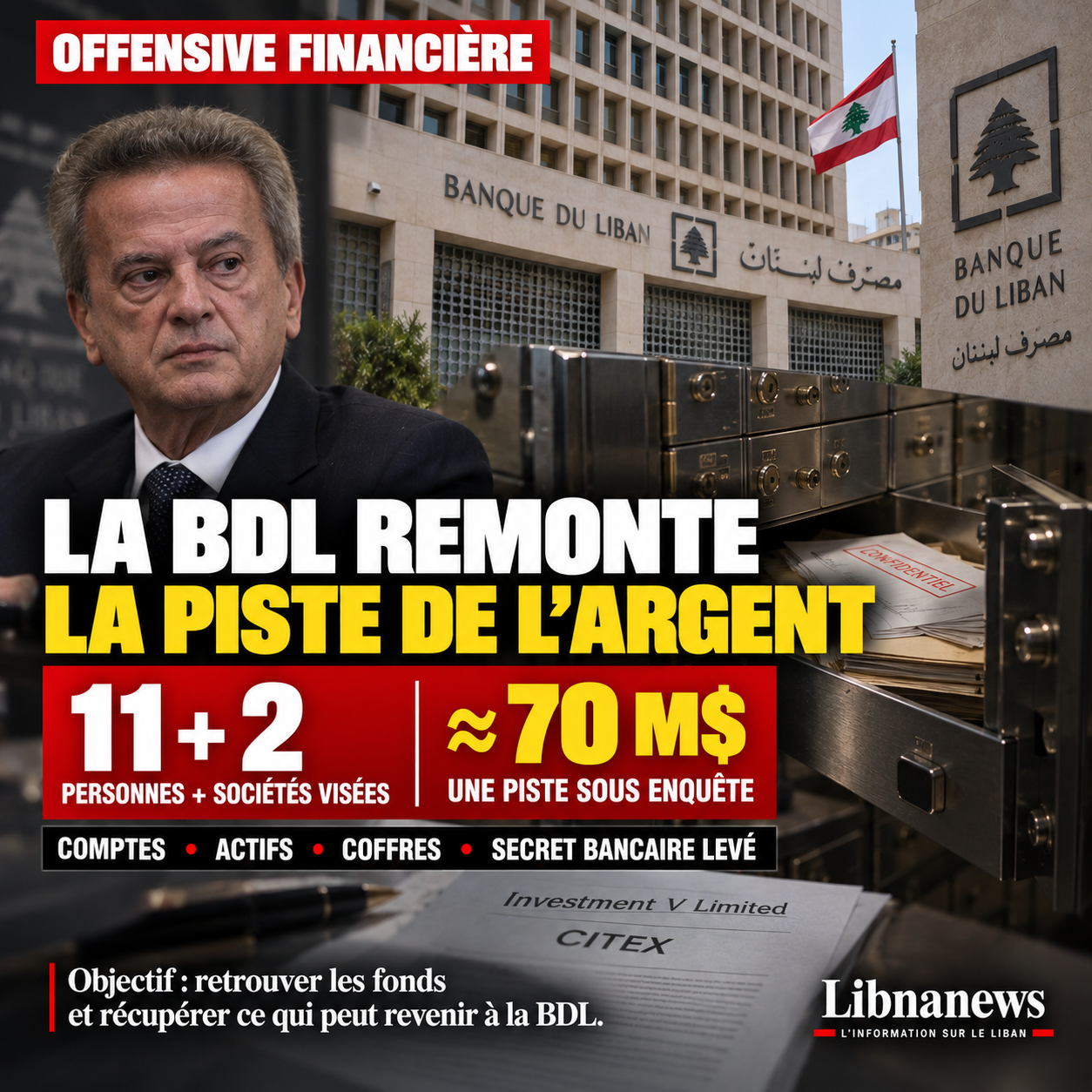
The decision is not only about bank accounts. It extends to assets, assets and safes held directly or indirectly by the persons and companies concerned. The Special Investigation Commission of the Bank of Lebanon has placed 11 persons and two companies under protective measures, while lifting bank secrecy. The names include former governor Riad Salamé, his brother Raja Salamé and his former assistant Marianne Hoayek. Two companies also appear at the centre of the scheme: Investment V Limited and the exchange company Citex. Behind this list, however, are several separate files, which it would be misleading to present as one case.
The measure comes at a time when the Governor of the Bank of Lebanon, Karim Suaid, has embarked on a broader strategy to recover money that the central bank considers to be diverted, misused or irregularly transferred. The principle is to seek assets both in Lebanon and abroad, and then to recover funds that may return to the Bank of Lebanon. The stated purpose therefore exceeds the punishment of suspects alone: the amounts recovered must contribute to the restoration of the resources necessary to settle the rights of depositors. But the scope of the decision requires an essential distinction. Freezing an account or prohibiting a safe is not a conviction. These are precautionary measures taken in the context of financial and judicial records whose responsibilities still need to be established in accordance with the applicable procedures.
Eleven people and two companies: a much wider measure than a simple freezing of accounts
The decision of the Special Investigation Commission covers eleven natural persons and two legal persons. It orders the freezing of accounts and assets and the prohibition of the disposal of assets and safes owned directly or indirectly by them. Bank secrecy is also lifted. This latter provision is particularly important since it allows the competent authorities to monitor financial movements and to search for links between accounts, beneficiaries, companies and transactions which would not be immediately visible from the sole nominal holder.
The list includes Riad Salamé, Raja Salamé and Marianne Hoayek, but also several individuals whose names have already been associated with financial investigations or foreign measures. Hassan Ahmad Mokalled, André Machentaf and Bachir Mansour appear in particular within the scope of the decision. Citex, a foreign exchange company, is also one of the two companies involved, alongside Investment V Limited. Other names are linked to financial records dating back to the period during which Riad Salamé was head of the central bank.
However, an important shortcut should be avoided. The fact that all these persons are on the same decision does not mean that they are suspected of the same transactions, for the same amounts or in the same case. On the contrary, the available information shows several branches. Investment V is associated with a procedure involving approximately $70 million. Citex appears in another context, linked in particular to liquidity received from the Bank of Lebanon. Some individuals are already subject to US sanctions, while Riad Salamé, his brother and Marianne Hoayek are involved in older financial investigations. The list therefore brings together several trajectories around the same conservatory objective: to prevent assets that might be of interest to investigations from being moved or removed.
Investment V: about $70 million at the centre of a new procedure
The most encrypted file concerns Investment V Limited. A new procedure is aimed at Riad Salamé, Raja Salamé and Marianne Hoayek on suspicions of about $70 million. The available information refers to suspicions of misappropriation, but no final decision at this stage allows this amount to be presented as a sum judicially recognized as misappropriated. The figure corresponds to the financial scope of the procedure as reported.
Raja Salamé served as Chairman of Investment V. This link explains why the company and its former manager are directly affected by the measures taken. For Salamé, the reasoning is based on another question: the facilities that could have been granted to the company while it was running the Bank of Lebanon. Investigators must therefore determine the exact nature of the financial relationship between the company and the central bank, the conditions under which certain transactions have been authorised and the possible existence of an undue advantage.
Marianne Hoayek appears in the same set of investigations. His former role as personal assistant to the governor is obviously not enough to establish criminal responsibility. It is the financial transactions assigned to it or the links identified by the investigators that must be examined. The freezing measure allows precisely to preserve the assets during this work.
The Investment V case thus shows the difference between a precautionary measure and the final result of a proceeding. The freeze prevents funds from moving. The lifting of bank secrecy facilitates their tracing. But justice still has to determine the origin of the sums, their destination, the role of everyone and whether or not a crime exists.
Citex: Central Bank liquidity under review
The second business case is that of Citex. The foreign exchange company reportedly received liquidity from the Bank of Lebanon. According to the financial analysis reported in the corpus, the current measure is intended in particular to allow the return to the central bank of sums from which it would claim restitution. The question is therefore not identical to that of Investment V.
Citex was founded by Hassan Ahmad Mokaled. André Machentaf and Bachir Mansour are also associated with the company’s file. These three individuals have already been affected by US sanctions related to this company. Their presence in the Lebanese decision therefore creates a intersection between previous foreign measures and a procedure led by the Lebanese financial institutions.
This crossing does not mean, however, that the Bank of Lebanon merely executes an American sanction. The information available relates the decision to the asset recovery strategy initiated by Governor Karim Suaid and the financial investigations conducted in Lebanon. The two levels must therefore be distinguished. American sanctions are part of the context and concern certain names. The Lebanese measure is based on the powers of the Special Investigation Commission and on the files examined locally.
Citex’s presence is particularly interesting because it shifts attention from the one question of personal fortunes to relations between the central bank and private operators. The issue then becomes to determine under what conditions liquidity has been provided, under what rules, with what guarantees and what part of these sums should now be recovered.
Safes become as important as accounts
One of the most significant aspects of the decision is its extension to safes. In complex financial cases, a freeze limited to bank accounts may lose some of its effectiveness if securities are held in another form. The prohibition on the disposal of the contents of the safes therefore extends the scope of the precautionary measures to goods which do not necessarily appear in the balance of an account.
It is precisely around this point that an indiscretion published in the press adds a sensitive dimension to the file. According to this note, the son of a former Shiite high magistrate is said to be associated with one of the companies whose accounts have been frozen. The same indiscretion states that the prohibition on the disposal of the contents of the safes linked to that company would also apply. No name is given and the documents available do not allow for a sufficiently secure identification of the person or company concerned.
This information must therefore remain at its exact level: that of a non-nominative backstage note. It does not allow for the identification of the magistrate, the appointment of his son or the conclusion of personal involvement in an offence. Being a member or shareholder of a company covered by a protective measure does not in itself establish criminal liability. The exact participation, the role in management, the period involved, and the transactions reviewed should be known before going further.
The interest of this indiscretion is elsewhere. It suggests that the ramifications of the companies concerned can go beyond those already known to the public and reach wider professional or family networks. The lifting of bank secrecy and the review of shareholdings can precisely make it possible to distinguish the passive partners from the managers, beneficial owners and those who participated in the contested transactions.
Karim Souaid wants to move from loss to asset recovery
The decision is part of a broader strategy announced by Karim Souaid. The Governor has taken steps in Lebanon and abroad to recover funds from the Bank of Lebanon that were allegedly misappropriated, misused or irregularly transferred. This approach changes the nature of the debate on the losses of the financial system. For several years, most of the discussion focused on the distribution of losses between the state, central bank, banks and depositors. The new approach adds another question: what sums can actually be recovered from individuals, companies or beneficiaries of contested transactions?
Karim Souaid has already announced a criminal complaint against Riad Salamé in the context of financial mechanisms, foreign companies and suspicions of illicit enrichment and laundering. The central bank no longer presents itself only as the institution on the balance sheet from which the losses appear. It is also trying to become an actor in recovery.
This distinction is important for applicants. An amount recovered does not mechanically erase losses accumulated since 2019. However, it can increase the available assets and even partially reduce the burden that should be borne elsewhere. The official speech directly links this policy with the rights of applicants. The effectiveness of this strategy will therefore be measured less by the number of frozen accounts than by the amounts actually recovered after legal proceedings.
At the same time, the Bank of Lebanon is working on another much larger project: assessing the sums it has made available to successive governments until the end of 2023. An initial estimate refers to an amount greater than three times the $16.5 billion that the State has recognized the transfer for its benefit. If this estimate is confirmed, the issue would far exceed the individual files currently under investigation.
More than $49.5 billion potentially affected by the state’s case
Three times $16.5 billion represents $49.5 billion. The preliminary amount announced would be above this threshold. This gives an idea of the scale of the problem. The $70 million associated with Investment V is important in a criminal investigation, but it is still well below what the central bank seeks to document in its financial relations with the state.
Karim Souaid announced the preparation of a report to identify and evaluate the funds made available to successive governments until the end of 2023. The Bank of Lebanon would then use the legal channels to claim the amounts it considers due and allocate them to the settlement of depositors’ rights.
However, these are two categories that should not be confused. On the one hand, there are public funds or advances whose legal relationship must be established between the State and the central bank. On the other hand, there are private assets suspected of misappropriation, abuse or irregular transfers. The method of recovery, potential managers and procedures are not the same.
This distinction also avoids another shortcut. The losses of the Bank of Lebanon cannot be explained by a few people on a freeze list. The Lebanese financial problem is much wider. The measures taken against eleven individuals and two companies constitute a part of the search for assets, not a complete explanation of the collapse.
Why lifting bank secrecy is decisive
The freeze prevents future movement. The lifting of bank secrecy makes it possible to look back. This is probably the most important aspect for investigators, as a complex financial transaction rarely involves a single account held directly on behalf of its final beneficiary.
The examination may cover transfers between companies, related accounts, beneficial owners and relations between natural and legal persons. It can also be used to check whether funds have passed through several jurisdictions or whether certain assets have changed form before being placed elsewhere.
This capacity is particularly important in cases relating to the Riad Salamé period, several of which are already being examined in Lebanon and abroad. The former governor’s accounts would themselves be frozen in Lebanon and outside the country. The presence of foreign companies or commercial structures in certain procedures therefore requires work beyond Lebanese borders.
The difficulty is that the lifting of bank secrecy does not automatically produce recovery. It produces information. It is then necessary to exploit this information, to establish the origin of the funds, to obtain judicial decisions and, when the assets are abroad, to convince the authorities of the country concerned to cooperate in their return.
It is often at this stage that recovery procedures become lengthy. A gel can be decided quickly. Final repatriation may take years.
The US list and the Lebanese list should not be confused
Several persons affected by the decision had already been subject to US sanctions. This overlap may give the impression that Lebanese institutions act late on cases already established abroad. However, the information available is not sufficient to reduce the new decision to a mere reproduction of US lists.
The criteria are not necessarily identical. A foreign sanction is an administrative or political measure taken under the law of the State imposing it. A decision of the Special Investigation Commission responds to the mechanisms of the Lebanese financial system. Finally, a criminal procedure is subject to a third framework and, where appropriate, a judicial decision is required.
The same person can therefore be punished in the United States, his or her accounts frozen in Lebanon and not yet finalized on the merits of a criminal charge. These situations are not contradictory. They correspond to different legal levels.
This is essential when names become public. The gravity of a financial measure must not lead to the presumption of innocence being erased. Conversely, the absence of a final conviction does not render a precautionary measure unnecessary when the authorities consider that there is a risk of asset displacement.
The real test: how much money will actually come back?
The apparent magnitude of the offensive can be measured by several figures: eleven people, two companies, about $70 million in one of the frozen files, accounts and safes, as well as amounts potentially greater than $49.5 billion in the separate yard for funds made available to the State. But none of these figures is yet the amount actually recovered.
The latter will determine the actual result.
For applicants, a list of names is limited if the procedures do not produce additional assets. For the Bank of Lebanon, the issue is also institutional. Karim Souaid wants to show that the central bank is no longer content with accounting for the consequences of the old system but is seeking to recover what may be.
Finally, the approach has an international dimension. Lebanon remains subject to enhanced anti-money laundering monitoring. Credible fund tracing, bank secrecy lifting and asset recovery can help demonstrate that financial institutions are effectively implementing their obligations. But again, the results will count more than the announcements.
The file therefore enters a phase where the ramifications must be precisely established. Investment V refers to a procedure of approximately $70 million. Citex refers to liquidity received from the central bank and persons related to its business. Riad Salamé, Raja Salamé and Marianne Hoayek are involved in broader investigations. A confidential note even indicates the presence in the ownership of one of the companies concerned of the son of a former high magistrate, without providing sufficient evidence to identify him.
The Bank of Lebanon list thus opens several doors. She doesn’t close them. The decisive question is no longer just what names are frozen, but how to reconstruct the circuits: who received what, on what basis, by which company, with which authorization, where the funds were then transferred and what share can legally be transferred to the central bank. Only when this chain is established can the offensive against the old financial circuits be measured by the number of accounts blocked.