





Two incompatible visions of the « after day »
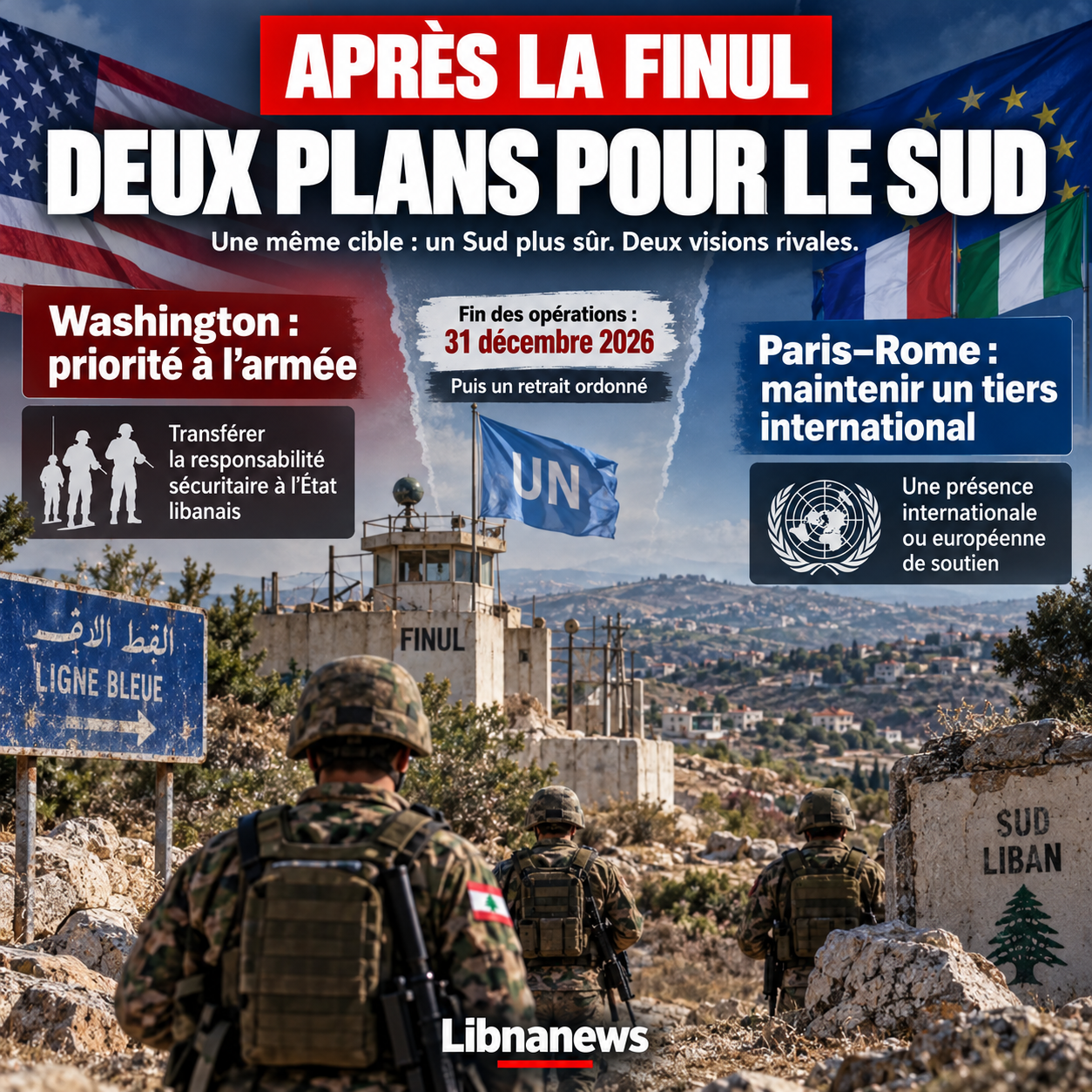
The announced end of the Finul mission opens a diplomatic battle that goes far beyond the question of replacing one international force with another. Behind the consultations between Beirut and several Western capitals appear two different conceptions of the security future of the South. They jointly want to strengthen the Lebanese army and avoid a return to the pre-war arrangements. But their logic, their means and their conception of the international role differ profoundly. On the one hand, there is an American approach that favours the transfer of security responsibility to the Lebanese State and its army. On the other hand, a Franco-Italian reflection seeks to preserve an international presence structured after the Final, even in a profoundly modified form.
This divergence is important. It determines who will monitor the South, who will see the violations, how the incidents with Israel will be managed, and who will act as an intermediary when bilateral mechanisms no longer function. It also directly affects the future of the army. In the most ambitious scenario, it is expected to increase its strength considerably in the South. Assessments referred to in the corpus estimate that between 10,000 and 15,000 additional troops may be required to allow for a much more dense and sustainable deployment. Such an effort requires equipment, infrastructure and billions of dollars.
The disagreement therefore does not oppose one side in favour of Lebanon against another which would be hostile to it. It’s about the method. The American approach tends towards a model in which the army would gradually become the main or even the only legitimate armed actor on the ground. European thinking is more about preserving an international layer between Lebanon and Israel. These two architectures may coexist during a transitional period. In the long run, however, they lead to two very different safety systems.
Washington favours direct state accountability
American logic starts from a simple observation. After decades of international presence, Lebanon’s sovereignty cannot remain dependent on an indefinitely deployed foreign force in the South. The disappearance of the Finul should therefore become an opportunity to transfer to the army the tasks that the State could not previously carry out alone.
This approach is part of a broader package. Washington now binds much more closely the security of the South, the strengthening of the army, the issue of Hezbollah weapons and reconstruction. Military deployment is no longer considered an isolated operation. It becomes one of the pieces of a political transformation designed to give the state the effective monopoly of security.
The principle would be that of simultaneous progression. Each Israeli withdrawal from an area should be accompanied by an immediate military takeover. The aim would be to prevent any vacuum. In this sense, waiting for full Israeli withdrawal before deploying the army would create precisely the space to which non-State forces could return.
The mechanism is therefore based on a sequence of closely coordinated steps. Israel is evacuating a position. The Lebanese army settles there. Verification mechanisms monitor the implementation of the commitment. Reconstruction can then begin. The population is gradually returning. The State installs its services. Security thus becomes the starting point for institutional reintegration in the South.
But this architecture immediately raises the question of control. Who will find a violation after the disappearance of the Finul? Who will arbitrate a charge between the Lebanese Army and Israel? Who can verify that an evacuated area no longer contains clandestine military infrastructure? And who will prevent a unilateral Israeli operation when Tel Aviv believes that its security requirements are not met?
It is precisely here that antagonism begins with European reflection.
Paris and Rome don’t want an international vacuum
France and Italy have a long experience in Finul. They hired troops, built relations with the army and developed operational knowledge of the field. For them, the disappearance of the mission does not necessarily mean that any international presence must disappear.
Several scenarios are discussed. The first would be to maintain a small United Nations presence, with fewer troops and more focused missions on military observation, liaison and support. This model would preserve the international legal framework while transferring a much larger part of operational responsibility to the Lebanese.
A second hypothesis would be based on a multinational force different from Finul. It could be mainly European. Its mission would be transitional and its mandate should be precisely defined. It would not necessarily duplicate the current structures of the Finul, but would retain a capacity for surveillance and diplomatic interference.
A third formula would be hybrid. International coverage would be maintained, while a smaller number of foreign military personnel would perform certain specialized functions. The army would exercise primary responsibility on the ground. The international component would focus more on monitoring, communication, verification and incident prevention.
These options are a matter of concern: removing the international third party too quickly could place directly face to face with the Lebanese army and Israel. Any incident would then take on a bilateral dimension. In a context of deep distrust, the absence of an external mechanism of observation could increase the risk of escalation.
A strategic divergence, not a simple technical difference
The opposition between the two approaches appears more clearly when examining their purpose. The American project sees the international presence as a transitional instrument that Lebanon must gradually learn to do without. The Franco-Italian approach considers that an external presence, even a reduced one, may remain necessary to secure this transition.
Washington thus emphasizes operational sovereignty. Paris and Rome place greater emphasis on the security of the transition. For Americans, extending an international arrangement for too long may delay the effective state ownership of the territory. For Europeans, removing this mechanism too quickly can create precisely the instability that will prevent the state from assuming this responsibility.
This difference also appears in the relationship with Israel. An architecture based primarily on the army requires effective communication mechanisms with the Israeli side. This prospect is politically sensitive in Lebanon. It can quickly be interpreted as the gradual installation of a bilateral security mechanism.
An international presence reduces this political risk. Operational exchanges can continue through an external structure. But Israel could, for its part, consider this formula too slow or insufficiently binding in the face of its security demands.
This difficulty adds a diplomatic dimension. France does not necessarily have the Israeli confidence to play a central role in a new architecture alone. Any European formula should therefore obtain minimum acceptance from the different parties. An international force without such acceptance could have a paper mandate while being unable to fulfil its mission on the ground.
Army at the heart of both scenarios
Despite their differences, the two projects lead to the same observation: the Lebanese army will have to become much more powerful. No serious post-Final scenario can work with current resources.
The estimates mentioned in the documents discussed indicate a need for an additional 10,000 to 15,000 troops to ensure a sustainable presence in the South. It would not simply be a matter of increasing military positions. Units should be able to patrol, monitor borders, secure villages, control roads and respond quickly to incidents.
Another difficulty is the rotation of units. The deployment of an additional 10,000 troops is not a mere 10,000 troops. A permanent presence requires personnel capable of providing respite, training, maintenance and rest periods. The real human effort would therefore be greater than the number of soldiers simultaneously present on the ground.
The material gaps are also considerable. The identified needs relate to armoured vehicles, night vision systems, secure communications, border surveillance capabilities and air defence capabilities. This last question is particularly sensitive. An army in charge of controlling the territory without significant capacity to monitor and protect its airspace would remain dependent on decisions taken elsewhere.
A modernization program valued at between $3 billion and $5 billion is discussed. The idea would be to provide the necessary capabilities quickly rather than spread their acquisition over a decade. Because the southern political calendar is much shorter than that of a conventional military programme.
Wages, the dead end of military reinforcement
Equipment is only part of the problem. An army can receive modern vehicles, surveillance systems and equipment while being unable to sustain its deployment on a sustainable basis if soldiers do not have sufficient income.
The discussions thus stress the need for sustainable funding of military remuneration throughout the transition period. One-time support to purchase equipment without financing its use would produce largely theoretical capacity.
This issue becomes even more important if the army is to replace some of the functions previously performed by thousands of international military personnel. Fuel, maintenance, infrastructure, communications and logistics costs would increase sharply.
So the real financial challenge is not just who will give arms to Lebanon. It involves determining who will fund a national security architecture that can operate daily for several years.
The question of Hezbollah behind that of Finul
The post-Final debate cannot be separated from the Hezbollah weapons file. The dominant international logic is to make the army the only armed actor with an autonomous operational capability in the South.
For Washington, this evolution is a central element of the transformation sought. Strengthening the army without changing the situation of non-State weapons would not be enough. The aim is that the extension of the military authority of the State will gradually accompany the reduction of parallel armed structures.
The European approach does not remove this question. It seeks more to prevent it from being settled in a context likely to provoke internal confrontation. A transitional international presence could thus provide time to organize the transition from one system to another.
The difficulty remains considerable. The army must strengthen its authority without being transformed into an instrument of community confrontation. It must control the territory without appearing to be carrying out a foreign strategy. And it must be able to guarantee the security of the people of the South at a time when they are called upon to accept a profound transformation of the defence system that has prevailed for decades.
The Israeli withdrawal schedule as a potential break point
All these architectures can fail if the Israeli withdrawal does not advance. For Beirut, the strengthening of the State must be accompanied by verifiable Israeli steps. The idea of parallel action therefore returns regularly in the discussions: withdrawal, deployment of the army, control, reconstruction.
An imbalance in this sequence would be politically explosive. If the State demanded a transformation of the armed apparatus in Lebanon without Israeli withdrawal, it would weaken its own legitimacy in the South. On the other hand, international partners are concerned that a withdrawal without a replacement mechanism would enable the rapid restoration of previous military structures.
This is also why the presence or absence of an international force is essential. In the European scenario, the latter could verify the synchronisation of commitments. In the US scenario, a different, probably lighter, and more military- and coordination-oriented control mechanism should be invented.
The choice now exceeds the renewal of the Finul
The question in Beirut is therefore no longer simply to defend the maintenance of Finul. The debate has moved. It concerns the safety system that will have to operate when it is gone.
The American model pushes Lebanon towards accelerated responsibility: strengthened army, exclusive state authority, security coordination and the gradual reduction of the need for an international military presence. The Franco-Italian model considers that such a brutal transition carries too many risks and that an international structure must remain present to accompany the transfer.
Between the two is the Lebanese army. Both sides want to strengthen it, but not necessarily to make it play exactly the same role at the same pace. In a scenario, it quickly becomes almost exclusive structure of the system. In the other, it gradually becomes the main actor while remaining surrounded by an international monitoring and guarantee mechanism.
The decision will determine much more than the fate of a UN mission. It will define how Lebanon will exercise its sovereignty in the South, the form of its security relations with Israel, the conditions for the return of its inhabitants, the pace of reconstruction and the place of Hezbollah’s weapons in the next national architecture.