





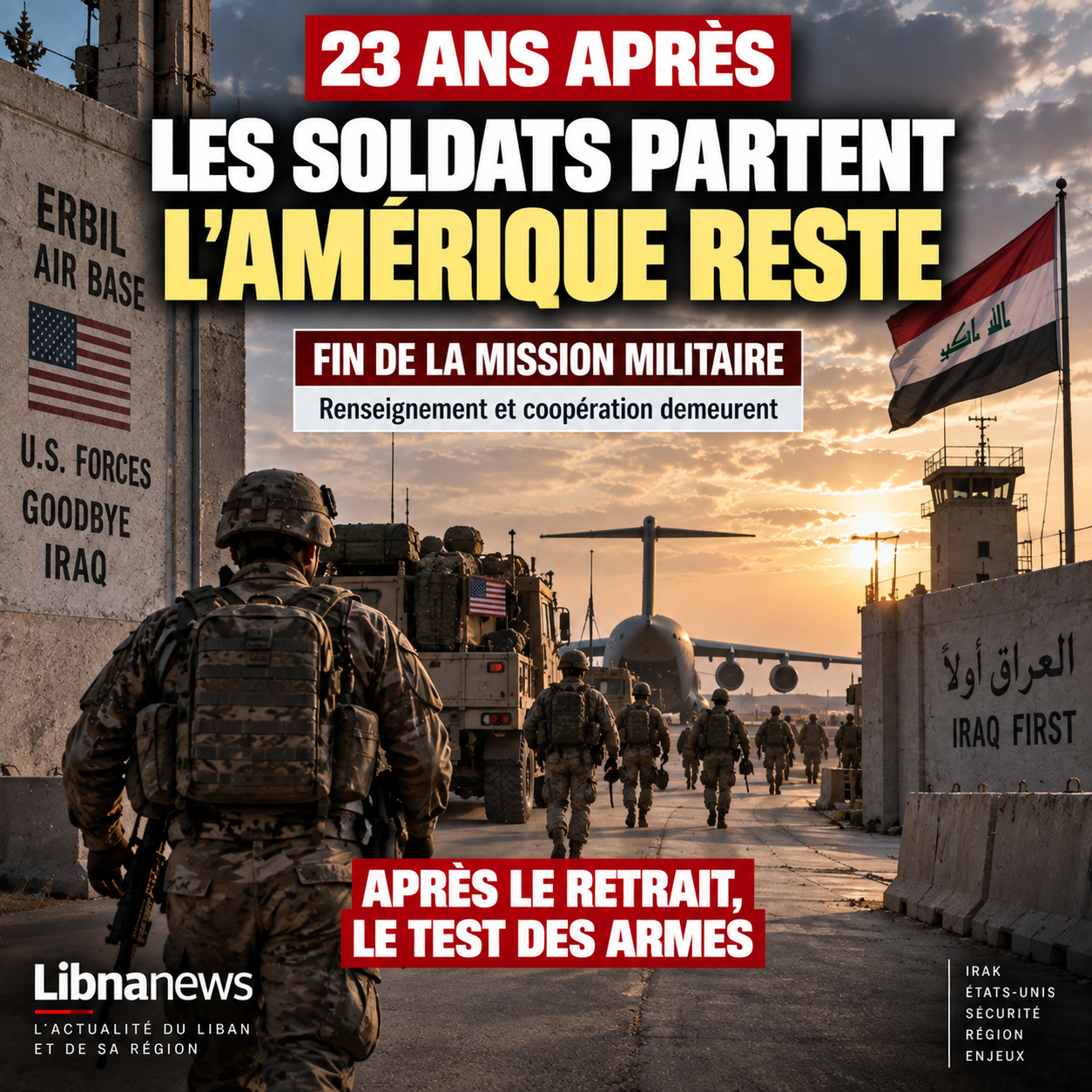
The last withdrawal ended where the American presence had become the most sensitive: in Erbil. The troops and equipment left the airbase, the international military operation launched against the Islamic State organization officially ended and Baghdad celebrated a « day of sovereignty ». On paper, the event is historic. Twenty-three years after the 2003 invasion, the Iraqi government can announce that the responsibility for the country’s security now lies entirely with national institutions.
But looking only at the soldiers leaving leads to missing the essential. The United States is abandoning neither its military cooperation with Baghdad nor its intelligence support nor its capacity for regional action. The headquarters of the international force was moved to Jordan. Targeted training and intelligence support must continue to be provided to Iraqi forces. Washington also wants to move the relationship towards a bilateral defence partnership. At the same time, US forces are continuing their operations against ISIS in Syria with their partners.
So September 30, 2026 marks an end. But not that of American influence in Iraq.
Rather, it marks the shift from one model to another: fewer visible bases, fewer soldiers exposed on Iraqi soil, but still considerable intelligence, training, military cooperation and financial pressure. This change is all the more important as the departure of troops withdraws from Baghdad the argument that several armed groups have been using for years to justify the maintenance of their arsenals.
Barely the Americans left, the question of Iraq becomes much more embarrassing:if the occupation is no longer there, against whom must the weapons escaping from the state now be preserved?
30 September 2003
The withdrawal was not improvised by Donald Trump. His principle had been agreed in 2024 under the administration of Joe Biden. The current administration has executed the timetable, despite the war against Iran and regional tensions.
This detail is important. The departure is therefore not a one-off gesture towards Tehran, nor does it reflect a sudden disappearance of American interests in Iraq. It corresponds to a transformation prepared for several years.
History also calls for caution when an American president announces that Iraq is now behind him.
US forces had already left the country by the end of 2011. Less than three years later, they returned after the bulwark offensive of the Islamic State organization, which had managed to seize about a third of Iraqi territory. The army and the security institutions had shown considerable weaknesses.
The precedent remains in all memories. This is precisely what explains the contrasting reactions at the beginning of 2026.
For the government, the situation is no longer comparable. The Iraqi security forces are presented as capable of assuming protection of the territory. Prime Minister Ali Falah al-Zaydi said that the end of the international mission did not mean the end of the fight against terrorism, but the transition to a phase in which Iraq fully assumed its security.
This is now a political commitment.
For if a new major crisis revealed weaknesses comparable to those of 2014, the symbol of the « day of sovereignty » would immediately turn against power.
Erbil evacuated, but the device does not disappear: it moves
Perhaps the most revealing detail of the withdrawal is outside Iraq.
International force does not disappear. Its headquarters are now located in Jordan. Cooperation continues in other forms, while the United States maintains a regional capacity for action against the Islamic State organization, particularly in Syria.
The logic is clear: Washington reduces the political and military footprint of its presence in Iraq without abandoning its instruments.
The transition to a bilateral defence relationship is officially assumed. The United States must continue to provide targeted training and intelligence to Iraqi partners. Relations between the armies are therefore not interrupted with the closure of the international mission.
This is where the word « retirement » becomes misleading if it is interpreted as a disappearance.
America withdraws its soldiers from part of the Iraqi landscape. It does not necessarily remove its eyes, its technical means, its military relations or its ability to exert pressure.
This also reflects a broader trend in US policy. Maintaining thousands of military personnel in a country for decades is expensive, exposes soldiers and produces a permanent political challenge. A lighter regional arrangement allows certain capacities to be maintained without the same cost.
Iraq then becomes less a territory occupied by foreign forces than a space monitored and influenced by a regional network.
The real battle begins now: the arms of the factions
The American departure mainly removes an argument from the Iraqi armed groups.
The government makes it clear that there must no longer be weapons outside the law or outside the institutions of the state. Baghdad considers that the end of the international military presence removes one of the main justifications used by factions to preserve their arsenals.
The problem is that these organizations are no longer mere clandestine groups that have emerged to combat an occupation.
Some were created or strengthened with Iranian support. They fought the American forces. Then, from 2014, the mobilization against the Islamic State organization considerably increased their power. Over the years, many have also developed political relays and become deeply rooted in institutions.
Disarming these groups therefore does not mean asking some fighters to drop their rifles.
Organizations with military structures, resources, a history of combat and, for some, political weight must be addressed. Some also consider themselves an integral part of Iraq’s defence and reject the idea that the disappearance of the American mission automatically renders their weapons useless.
The timetable set by Baghdad itself shows the difficulty. The Government had initially linked the handing over of arms to the end of the international mission by 30 September. This deadline did not meet. Ali al-Zaydi finally extended until June 2027 the deadline for placing weapons under State control.
The contrast is striking: the American withdrawal has kept its schedule; factional disarmament has already been rejected.
Some factions are already responding: our weapons remain
The problem is not theoretical.
Armed groups indicated that they did not consider themselves bound by a government timetable that would not meet their own conditions. One of the main structures claiming to be « Islamic resistance in Iraq » claims to have participated for more than a month in discussions on the organisation of weapons in exchange for Iraqi sovereignty, which it defines very broadly.
In this reading, the departure of American forces is not enough. The demands include the disappearance of all forms of foreign military presence and the maintenance of a right of response against any American or Israeli violation of Iraqi sovereignty.
The message is clear: withdrawal removes an opponent present in the territory, but it does not remove the doctrine of « resistance ».
This difference can become the heart of the upcoming political crisis.
For the government, sovereignty means that armed force belongs exclusively to the state.
For factions, sovereignty can instead be used to justify maintaining an independent military capability to respond to external threats.
Both sides therefore use the same word to defend two incompatible security architectures.
Washington still has a huge lever: oil dollars
It is here that the idea of a total American withdrawal meets its most spectacular limit.
Even without soldiers stationed on the old bases, Washington maintains a financial leverage capable of weighing heavily on Baghdad. Iraqi oil revenues go through a financial mechanism linked to the United States, which gives Washington an influence on the physical transfers of dollars required for the Iraqi system.
This capacity is not purely theoretical. Flows have already been subject to temporary restrictions.
In other words, a soldier can leave Erbil while an American official retains, thousands of kilometres away, an instrument that can directly affect the liquidity on which the Iraqi economy depends.
This is one of the strongest contradictions of the « day of sovereignty ».
Iraq regains more military sovereignty over its territory, but its economy remains deeply linked to the US-dominated international financial architecture.
Washington can thus replace part of military coercion with financial coercion.
For groups close to Tehran, this situation feeds the idea that independence is not yet complete. In the government’s view, it imposes a great deal of caution: a brutal confrontation with the United States could produce considerable economic effects.
Iran wins a symbol, but not necessarily the game
Tehran and its allies celebrated the withdrawal as a victory. The image is politically powerful: the American forces that entered Iraq in 2003 finally left their last bases twenty-three years later.
But the Iranian gain is more ambiguous than it seems.
For years, the US military presence has provided the factions close to Iran with a direct justification for their weapons. It allowed weapons to be presented as a response to foreign occupation or threat.
The departure deprives these organisations of part of this argument.
Baghdad can now tell them: the objective you invoked is achieved, the foreign army is gone, the force must return to the state.
That’s precisely why Washington can see a strategic interest in its own withdrawal. By reducing its visible presence, it diminishes one of the engines of anti-American mobilization while leaving the Iraqi government in front of the factions.
The paradox is remarkable: a decision celebrated as an Iranian victory can simultaneously facilitate American pressure for the disarmament of Tehran’s allies.
Everything will depend on Baghdad’s ability to turn this new situation into real authority.
Kurds watch 2011 and refuse to believe in insurance too easy
Erbil’s departure has a special charge for Iraqi Kurdistan.
The Kurdish leaders have long maintained a close security relationship with the United States. The Syrian precedent, where the American withdrawal from the north-east has brutally altered the balance, naturally feeds questions. The memory of 2011 is even heavier: American forces had left Iraq, then the Islamic State organization had emerged with sufficient power to upset the country.
Massoud Barzani therefore wanted to reassure the population. He claims that Kurdistan is not threatened and stresses the existence of good coordination with the federal government to respond to any threat, whether from the Islamic State organization or from another actor.
But this insurance coexists with real concern.
Kurdish officials recall that ISIS cells remain active near the borders of the region. They also believe that the fight against these networks may require capacity beyond Kurdistan alone and even, in certain circumstances, Iraq.
The question therefore is not whether the Islamic State organization still controls a third of the country. This is no longer the case. She asked whether a security vacuum, a political crisis or confrontation between Baghdad and the factions could provide her with new opportunities.
Iraqi history requires taking this risk seriously.
The most immediate danger could come not from outside, but from the settlement of internal accounts
The American withdrawal simplifies one part of the Iraqi equation and complicates another.
As long as foreign troops were present, the government could repel the confrontation on the arms of the factions by invoking the need to preserve unity against an external threat. Once the Americans left, this justification became much weaker.
Baghdad will therefore have to show whether its slogan on the monopoly of force has real content.
The challenge is formidable. The factions are not outside the political system. Some have institutional links and social bases. An attempt at forced disarmament could lead to a confrontation that the State is trying to avoid.
This is probably the reason for the postponement until June 2027.
The government is buying time to try to turn a military issue into a political process: integration, regulation, arms negotiations and institution-building.
But time can play in both directions.
It can allow a gradual transition. It can also allow factions to consolidate their position and make it even more difficult to implement the decision.
From Iraq to Syria, Washington is looking for a lighter presence
The Iraqi withdrawal takes on another dimension when it is close to American evolution in Syria.
The United States forces also reduced or reorganized their presence there, while some positions were transferred in the context of the new Syrian architecture. The regional headquarters in Jordan is therefore becoming more important.
This geography draws a method.
Washington no longer seems to consider that it must occupy a long-term basis in each country to safeguard its interests. It can concentrate some of its capabilities on regional points, maintain intelligence, cooperate with local armies and intervene when its interests so require.
It is less visible than a base filled with soldiers.
This is not necessarily less influential.
The shift from a direct presence to a network presence also allows the United States to reduce the political cost of its action. An Iraqi faction can hardly mobilize the population against an American base that no longer exists on its territory. However, it can continue to denounce a diffuse American influence, which is much more difficult to materialize.
Maybe that’s the goal.
Iraq will discover what sovereignty really means
For 23 years, the American presence has been a permanent element of almost all Iraqi debates. It could be denounced, used as justification, sought as protection or presented as the cause of some of the problems.
His disappearance from the ground removes this landmark.
From now on, the government will be much less able to attribute its weaknesses to the presence of a foreign force. It will have to assume security, control arms, manage relations with Iran, protect Kurdistan, prevent a resurgence of the Islamic State organization and maintain a functional relationship with Washington.
This is a major political change.
Sovereignty is no longer just a claim. It becomes a responsibility.
And that is precisely where the American withdrawal could have its deepest effect. The real test will not be how many American soldiers remain in Iraq. It will be a question of whether the Iraqi state can fill the space they leave behind.
The United States has not disappeared. They simply moved some of their instruments: headquarters in Jordan, bilateral military cooperation, intelligence, regional operations and financial weight.
The soldiers left Erbil. America remains close enough to observe what follows.