Draft budget 2027 in Lebanon puts taxation at the centre of the debate. Among the measures envisaged is a major change in the system of unoccupied immovable property, which is now exempt where there is no income due to the vacancy. The text also provides for several adjustments concerning real estate transactions, holding companies and offshore companies as well as other sources of revenue. However, these provisions may still be amended before the final adoption of the Finance Act.
The Lebanese Government is seeking new revenues to finance a state whose spending is increasing, while attempting to rebalance a tax system heavily dependent on indirect taxes. Draft budget 2027 thus introduces several provisions which may affect owners, investors and businesses.
The most notable is the vacant dwellings. Article 37 of the draft deals with an ancient feature of Lebanese property taxation: the possibility of suspending the tax on built properties when the property no longer generates income because of its lack of occupation.
The change would be significant. The vacancy of a dwelling would no longer allow this tax situation to be enjoyed indefinitely.
Budget 2027: Unoccupied housing tax
The current principle is based on the link between property income and taxation. When a building is declared vacant and ceases to generate revenue, the corresponding tax may be suspended.
Draft budget 2027 aims to limit this possibility over time.
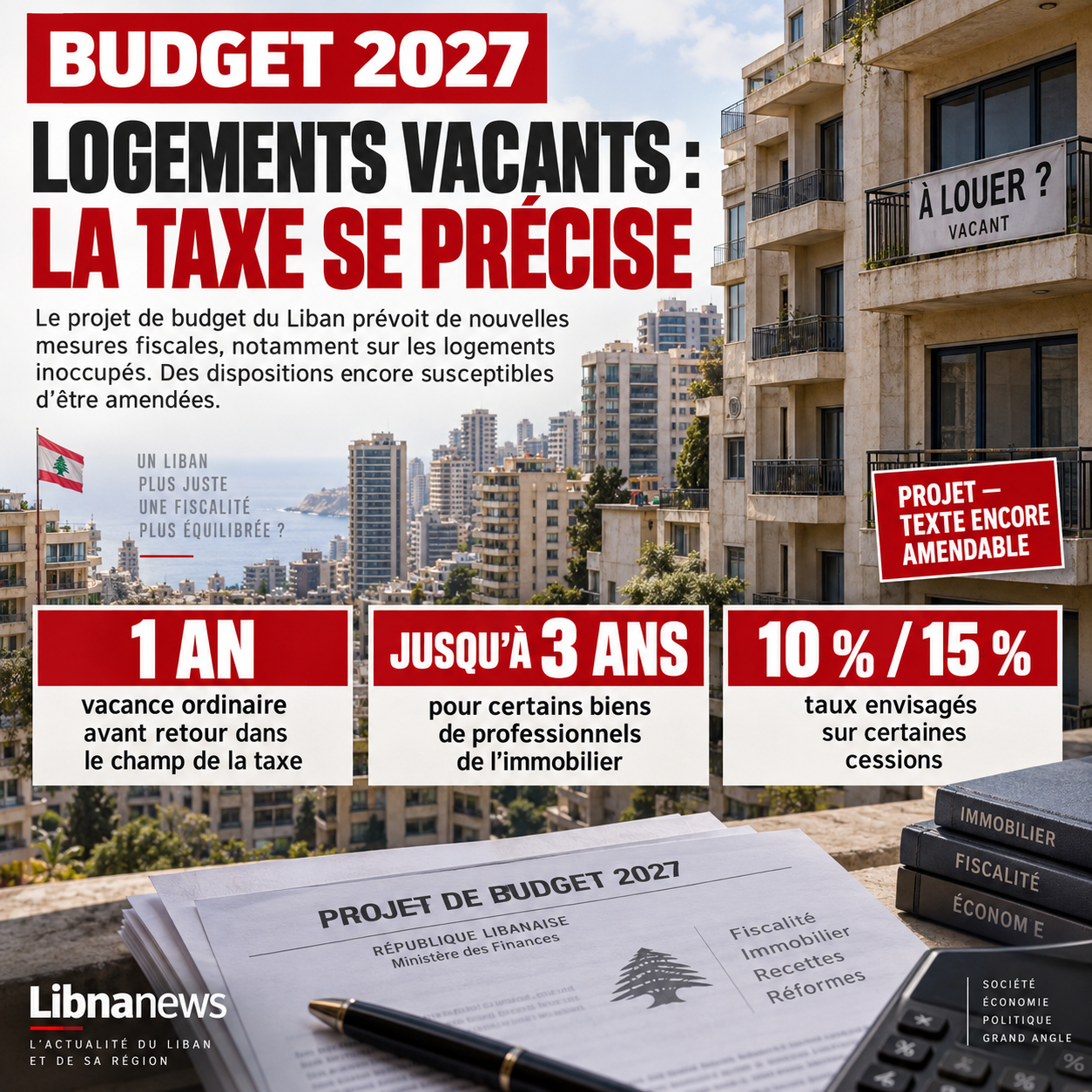
According to the current draft, ordinary residential buildings could benefit from a one-year vacancy period before returning to the tax area. A different period of up to three years would be granted to buildings built by real estate traders.
At the end of these periods, the owner may have to pay a tax even though his dwelling remains empty.
The calculation would be based on the estimated rental value of the property. Thus, it would not be a matter of taxing a rent actually collected, but of taxing the income that housing could theoretically generate.
This distinction is one of the main points of the debate.
Analyses of the project suggest a tax calculated on part of the estimated rental value. However, the precise arrangements will have to be assessed on the basis of the text which will eventually be adopted by Parliament, since the provisions of the draft may still be amended.
Why government wants to tax vacant housing
The measure pursues two objectives that are partially aligned.
The first is tax. The authorities are seeking to broaden the tax base on built properties and to limit the situations in which real estate remains permanently outside the scope of taxation.
The second concerns the housing market.
A significant portion of the Lebanese residential park remains unused. A recent press report from Beirut Urban Lab estimates the vacancy rate at around 23 per cent in Beirut, with significantly higher proportions for some high-end housing categories.
Such accommodation can be owned by expatriates, investors or developers who are waiting for an improvement in the market before selling. Others are retained as secondary residences or as long-term investments.
The taxation of the vacancy could change this economic calculation. An owner faced with an additional tax burden each year would be more interested in renting or selling his or her housing than in keeping it closed.
However, this consequence remains theoretical. It will depend on the actual amount of the tax, the market situation and, above all, the ability of the administration to identify housing actually vacant.
The problem of counting empty apartments
The application of the measure could be more complex than its inclusion in the law.
Lebanon does not have an up-to-date national inventory to simply identify each vacant dwelling, its duration of occupation and the status of its owner. Tax administrations, municipalities and land services have data, but their coverage and updating remain variable.
It will also be necessary to define exactly what constitutes vacant housing.
Should a residence used a few weeks a year be considered unoccupied? What about an apartment owned by an expatriate who regularly returns to Lebanon? A dwelling under construction, in dispute or temporarily impossible to rent?
These issues become essential when the vacancy triggers a tax obligation.
The system should also prevent artificial declarations of occupation. Without a sufficiently reliable control mechanism, some homeowners could seek to change the status of the dwelling administratively without its actual inhabitants.
A measure contested by owners
The draft also raises legal objections.
Owners’ representatives believe that taxes on built properties should remain linked to the existence of income. According to this reading, imposing an apartment that does not actually earn rent would be tantamount to creating a tax-based, theoretical income.
They also invoke the constitutional protection of property rights and contest the idea that an owner may be financially motivated to rent or sell his property.
The advocates of the measure reason differently. They consider that the legislator may amend the rules on the taxation of real estate, subject to compliance with the Constitution, and that taxation may be used to reduce the retention of unused housing.
The question could therefore go beyond the budgetary debate alone if the provision was retained in the Finance Act.
Real estate sales also concerned
Taxation of vacant housing is not the only real estate component of the project.
Budget 2027 also includes changes to the taxation of gains on certain real estate transfers.
According to the published provisions and the analysis of the text, the draft provides, inter alia, for a rate of 10 per cent for certain salespeople who are not subject to income tax. The rate would reach 15% for other categories.
The mechanism would, however, take into account the length of detention of the property.
The taxable profit would be gradually reduced by the number of years between acquisition and resale. A reduction of 8% in taxable earnings per full year of detention is foreseen in the project analyses. After 12 or more years of ownership by the same owner, the gain concerned could benefit from a full exemption.
The aim is therefore to distinguish real estate transactions more clearly according to their duration and nature, rather than applying uniform treatment to all divestitures.
Holding and offshore in the budget view
Companies are also affected by the proposed tax changes.
The project transmitted by the Ministry of Finance foresees, inter alia, a substantial increase in the flat rate tax applicable to holding companies and offshore companies. The first published versions of the text indicate a fourfold increase in this tax.
This is part of a broader search for additional revenue.
The project also contains measures on capital gains related to certain land transactions and seeks to strengthen several mechanisms for collection or tax compliance.
The exact scope of each of these provisions will nevertheless depend on the adopted text. In a draft budget, the presence of a measure does not mean that it will automatically enter into force in its original form.
Not just « new taxes »
This distinction is all the more important as the government itself challenged the idea of a widespread creation of new taxes.
In the government discussions of September 2026, the Council of Ministers indicated that part of the changes examined corresponded to an adjustment of existing taxes and charges to changes in the exchange rate, rather than the creation of entirely new levies.
Both realities can coexist.
Some provisions are to reassess amounts that became insignificant after the collapse of the Lebanese pound. Others change the base or the conditions for applying an existing tax more profoundly. The end of the unlimited exemption for vacant housing belongs to this second category.
The debate therefore covers both the structure of taxation and the overall level of levies.
Taxation still dependent on indirect taxes
This issue is of particular importance in a country where indirect taxes represent a significant part of government revenue.
Organizations that have considered draft budget 2027 note that the expected increase in tax revenues is still largely fuelled by VAT and fuel-related levies. These taxes affect consumption and may weigh more proportionally on households with low or medium incomes.
The taxation of vacant housing offers, on the other hand, an example of an attempt to extend direct taxation linked to wealth.
Its actual performance, however, remains difficult to anticipate.
It will depend on the number of housing units actually subject to tax, their rental value retained by the administration, the remaining exemptions and the level of compliance of the owners.
Final text remains decisive
The Department of Finance forwarded Budget 2027 to the government at the end of August 2026. The Council of Ministers then devoted several meetings to its consideration, notably in September.
The project must follow the institutional process before its tax provisions can be considered final.
For owners, the immediate challenge is to monitor the fate of article 37. Its continuation would remove the potentially unlimited nature of the exemption related to the vacancy of certain residential units.
For the state, the challenge will then be administrative. A tax on vacant housing can only work if the authorities are able to distinguish a real residence from an apartment that is permanently withdrawn from the market, identify its owner and establish a sufficiently reliable rental value.
The 2027 budget debate should thus determine not only the amount of levies, but also how Lebanon intends to tax the holding and circulation of real estate.
Exact number of body words:approximately 1,480 words, title and excluded SEO elements.
Keyword:budget 2027 Lebanon
Keywords Secondary SEO:new taxes Lebanon, vacant housing tax, property taxes Lebanon, unoccupied property, taxes Lebanon 2027, property tax, draft Lebanese budget
Description:The 2027 budget in Lebanon includes several tax measures, including a tax on vacant housing and changes for real estate and corporations.
Extract:Draft budget 2027 in Lebanon contains several tax changes that may affect owners, investors and businesses. One of the most notable measures is the limitation of the exemption granted to vacant housing. After a specified period, some unoccupied apartments could be taxed on the basis of their estimated rental value. The project also foresees changes in real estate gains as well as taxation of holding companies and offshore companies.
Five alternative titles:
- Budget 2027: new taxes envisaged in Lebanon
- Lebanon: Are vacant housing soon more taxed?
- Budget 2027: what could change for taxes
- Real estate: new taxation envisaged in Lebanon
- Lebanon: Budget 2027 reviews several taxes
References and links
The draft budget was forwarded to the Government on 31 August 2026 and was the subject of several review sessions. In particular, the Presidency of the Council of Ministers on 11 September clarified that part of the provisions discussed was the adjustment of existing taxes and charges to the exchange rate.
Article 37 and the taxation of vacant housing are documented by several recent analyses of the project. They confirm in particular the time limitation of the exemption and the debate on taxation based on an estimated rental value.
The data on the real estate vacancy in Beirut and the practical and legal difficulties surrounding the implementation of the scheme are detailed in a survey published on 24 September 2026.
Changes in real estate capital gains, including the 10% and 15% rates and the retention period mechanism, are reflected in the analysis of the budget proposal.
Finally, several analyses of the project point to both the increase in taxation for holding companies and offshore companies and the persistent weight of VAT and fuel in the expected increase in tax revenues.