





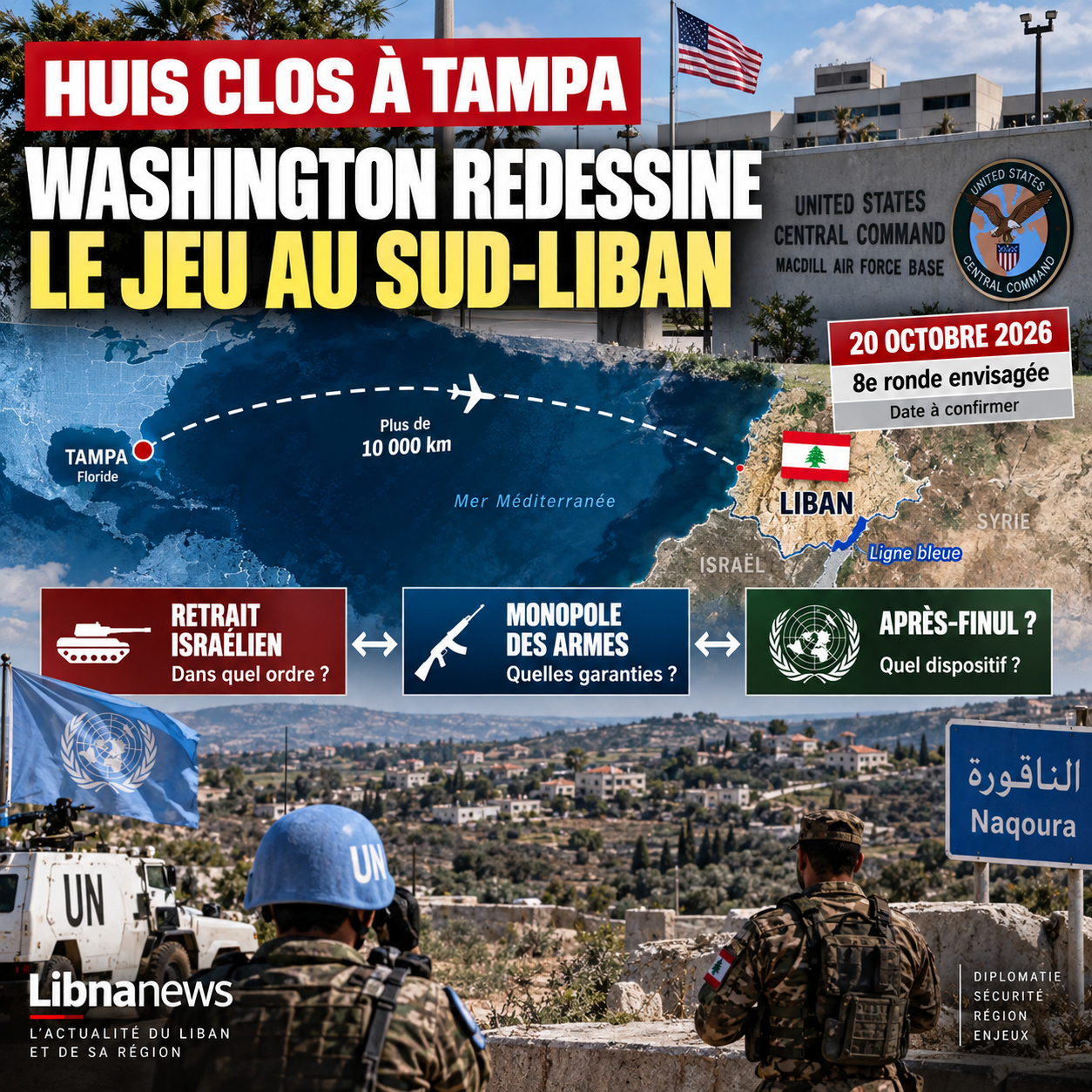
The appointment is almost a paradox. In an attempt to resolve part of the conflict in southern Lebanon, the Lebanese and Israeli delegations should find themselves more than 10,000 kilometres from the border in Florida, at the very heart of the United States military apparatus. The late date is October 20, 2026. The location is much more revealing: the headquarters of the United States Central Command in Tampa. Not a diplomatic capital. Not the United Nations. Not a border crossing. A staff.
This detail changes the reading of the next round. Officially, she will be strictly military. No negotiator specializing in civil, legal or economic matters should participate. Diplomat Simon Karam is to lead the Lebanese delegation in the presence of Lebanon’s Ambassador to Washington, Nada Hamada Muawad. Israeli attacks, incidents on the ground and coordination mechanisms should be among the topics discussed. But behind this apparently technical program is a far wider part.
Because the question is no longer just how to prevent the next strike or manage the next incident. It is a question of determining the order in which decisions should be taken that could transform the South in a lasting way. Should Israel first withdraw to allow the Lebanese State to consolidate its authority? Should Lebanon first move much further on the arms monopoly before we get a withdrawal? Who will check the commitments? And above all, what will replace a Finul who will gradually leave the field tomorrow?
That’s what gives Tampa its importance. The eighth round could be less than an additional meeting than a post-war laboratory.
The real result of Nawaf Salam’s visit may be there
Nawaf Salam went to the United States with several files under his arm. He returned without any public American commitment imposing an immediate withdrawal on Israel. But a lock seems to have jumped: the trading channel, frozen for several weeks, must resume.
The difference is important. Washington did not grant Beirut everything he asked. On the other hand, the US administration refuses to let the process die. Trade in the United States shows that the Framework Agreement remains the focus of the process. In other words, the Americans want to maintain an architecture that can negotiate even when the land continues to burn.
20 October remains to be confirmed. However, preparations were sufficiently advanced to ensure that the proposed composition of the delegation and the scope of the discussions had already been circulated. This recovery occurred mainly before the Israeli elections on 27 October. Washington does not seem to want to wait until the Israeli political landscape is stabilized to put the military around the table.
This calendar says something about the American method. The canal must be preserved before seeking agreement. Avoid that the absence of dialogue turns each strike into a possible starting point for a wider confrontation. Maintain Israel and Lebanon in a mechanism where Washington remains the indispensable intermediary. Then use this mechanism to gradually process the heavier files.
The problem is that Beirut and Washington do not enter this new sequence with exactly the same definition of the first stage.
The decisive disagreement lies in one question: who must move first?
Lebanon defends a logic of reciprocity. The State extends its authority, the army deploys, the weapons file advances and, at the same time, Israel withdraws from the occupied territories and stops its attacks. This synchronization is politically essential. It enables the Lebanese authorities to demonstrate that every state progress is matched.
Washington seems to push a more demanding logic. The deployment of the army to the South is considered necessary, but insufficient. The messages sent to Lebanese officials call for concrete measures regarding the arms monopoly. According to the information reported on the American discussions, this is no longer just the southern Litani. The requirement also concerns the north of the river and, more broadly, the whole territory.
This is where Tampa ceases to be a mere military meeting.
Hezbollah should not be around the table. Yet his armament will be one of the invisible actors in the room. American reasoning now closely links the issue of Israeli withdrawal to that of the state monopoly on arms. During another exchange in Washington, a senior American official even presented the two movements as elements of the same equation: surrender of Hezbollah weapons against Israeli withdrawal, with the need to determine a mechanism capable of verifying the application.
This formula seems simple on paper. On Lebanese ground, it is not.
The government has made the arms monopoly a sovereign decision. But the implementation of this decision affects the internal balance, the operational capacity of the army and the risk of civil confrontation. Beirut therefore wants to prevent a measure designed to strengthen the State from causing its stability to collapse.
The Americans are showing increasing impatience. Diplomatic interlocutors report dissatisfaction with what they consider to be a slow pace and an application that is still insufficiently legible. That’s where the knot is: Washington wants measurable actions; Beirut wants these actions to be accompanied by visible results on the Israeli side.
The negotiations therefore concern the territory. But it also deals with the timing of sovereignty.
A negotiation under fire, literally
The contrast is brutal. As a negotiating table is being prepared in Florida, the South continues to be bombed, destroyed and Israeli operations continued. Localities like Mansouri have been affected. Other areas around Nabatiyah, Jabal al-Rihan and several villages in the South remain under pressure.
Military developments deserve special attention. Israel seems, in some sectors, to combine a reduction in its human presence with a continued ability to control by fire. Units can be removed without necessarily meaning abandonment of the land in a strategic sense. Monitoring, striking and controlling certain axes can maintain a form of control without increasing the number of exposed soldiers.
This distinction is crucial for future negotiations. A military withdrawal may have several meanings. Removing a unit does not automatically amount to returning an area to the Lebanese authority. Reducing staff does not necessarily mean abandoning an intervention capacity. It is precisely for this reason that the question of verification mechanisms becomes central.
So Beirut is looking for more than an ad. He needs identifiable movements in the field. Areas effectively evacuated. A measurable reduction in attacks. A real possibility for the army and the inhabitants to regain possession of the spaces concerned.
Otherwise, political mechanics become almost impossible to defend.
How can we ask the Lebanese state more if the villages continue to be beaten? How can we convince a proven population that the arms monopoly is a more effective guarantee if the other side maintains its positions and freedom of action? On the other hand, Washington raises the question in the opposite direction: how can we ask Israel to leave if the state cannot guarantee that an autonomous military infrastructure will not be rebuilt after its departure?
All the difficulty lies in this circle.
Tampa will have to try to break it.
Hezbollah will not be in Tampa, but Tampa will talk about Hezbollah
This is probably the most important contradiction of this round. Discussions must be military and limited. Yet Lebanon’s biggest political issue will be everywhere in the room.
The messages reported from Washington do not stop at weapons. They also refer to Hezbollah-related financial networks and institutions. This shows that, in the American vision, the pressure is not compartmentalized. The military record, the reform of the financial system, the control of monetary channels and economic support in Lebanon are part of the same strategy of strengthening the State.
Nawaf Salam’s visit showed almost physically. While discussing security and sovereignty with US politicians, his team also addressed banking reforms, the International Monetary Fund and the restoration of financial confidence. The two universes seem distant. On the contrary, Washington tends to bring them closer together.
This approach puts the government before a formidable equation. It must simultaneously restore the State, secure Israeli withdrawal, prevent a new war, reform a damaged banking system and address the issue of arms. Each of these files would normally be sufficient to occupy a government for years. They are now interlocked.
That is why the Tampa meeting cannot be understood in isolation. It is a part of a much wider device.
Behind Tampa is already getting ready after Finul
This may be the most important and least visible element of the whole case.
The Final is approaching the end of its mission. Approximately 7,500 members of the force are gradually leaving Lebanon. However, no replacement architecture has yet been finalized. Several European countries have expressed their readiness to participate in a new formula. About ten would be willing to contribute to an alternative arrangement. But availability does not mean mandate, political agreement or deployment.
The problem is huge. The disappearance of the Finul not only means the departure of international soldiers. It raises the question of the monitoring of the Blue Line, the documentation of incidents, the liaison mechanisms and the presence of one third between two armies that remain technically enemy.
In this context, information deserves special attention: Washington would consider pushing Beirut towards a new security formula for the South, which could include a specific force or device after the Final. There is still no indication that a definitive model has been adopted. But the simple fact that this hypothesis is circulating changes Tampa’s perspective.
The meeting on 20 October could thus be used to discuss the present while preparing the system that will operate tomorrow.
And then the choice of the US central command takes on another dimension. The discussions would not only take place under American mediation; They would take place in the military institution that has the capacity to coordinate, monitor and support a regional security architecture.
The place becomes almost a message.
Washington no longer wants to negotiate a truce, but a mechanism
For years, Lebanon has been living at the pace of agreements that temporarily reduce violence without eliminating the causes of confrontation. The novelty of the current discussions lies in the place taken by the audit.
Who will say that Israel actually withdrew? Who will find that the weapons have been removed from an area? Who will verify that a military infrastructure is not rebuilding? Who will document a violation? Who will intervene when one party accuses the other of not complying with its commitments?
As long as the Finul was fully installed, part of these functions had a well-known, even imperfect, international framework. His announced disappearance opens a void.
The Americans seem to want to avoid this vacuum being filled only by the balance of power. Hence the search for a control mechanism. Hence the importance attached to the Lebanese army. Hence, too, the pressure for commitments to become verifiable.
The danger for Beirut would be that a mechanism designed to fill the void would end up imposing much more specific obligations on Lebanon than those imposed on Israel. That is where the question of reciprocity becomes essential. A mechanism is only valid through commitments that it verifies on both sides.
The next round will therefore have to answer a simple but heavy question: will the verification focus only on what Lebanon is doing, or what Israel is doing?
October 20, just before the Israeli ballot box
The calendar adds another layer of complexity. Israeli elections are scheduled for 27 October, only one week after the planned Tampa date.
This neighbourhood probably reduces the margin for spectacular decisions. A few days before an election, any territorial or security concession can become an electoral argument. At the same time, climbing can also be used politically. Several analyses published in recent days also link military tension to Israeli electoral calculations, without it being possible to establish that each operation meets this logic.
Washington nevertheless chose not to wait.
This can be read as a desire to sanctify the canal before the electoral campaign makes any discussion more difficult. The message would then be less: « find an agreement on October 20 » than: « no one leaves the table while the region remains at the edge of a new explosion ».
This nuance is essential. It would be excessive to expect a settlement from Tampa. But it would be equally wrong to reduce the meeting to formality.
If it is held under the announced conditions, it will set parameters for the next phase.
What Lebanon Can Really Get
For Beirut, success will not be measured by the number of press releases. It will be measured on the map.
A tangible step forward could take several forms: identification of areas from which Israel would agree to withdraw, mechanism preventing the expansion of strikes, military calendar, verification procedure or agreement on the future role of the Lebanese army. The information available does not indicate that one of these results is already acquired.
It is precisely here that we must separate the fact of waiting.
The meeting is in preparation. Its military character is clearly mentioned. The date of 20 October is privileged. Incidents and coordination mechanisms need to be discussed. On the other hand, no precise territorial withdrawal is still guaranteed in the available elements.
Lebanon thus arrives in Tampa with an obvious weakness: it negotiates as its territory continues to be hit. But he also has an argument that Washington cannot ignore. If the process never produces a visible Israeli counterpart, it will weaken the Lebanese actors who precisely defend the primacy of the state and the negotiation.
It’s a major paradox. The more Washington wants to strengthen the Lebanese state, the more it needs this state to show that it gets something.
Tampa could decide much more than the eighth round
So what’s getting ready in Florida far exceeds a military meeting. Several issues converge at the same time: Israeli withdrawal, arms monopoly, the future of Hezbollah, the role of the army, the gradual disappearance of the Final, the verification mechanism and American support for Lebanese institutions.
Taken separately, everyone seems known. Together, they draw a new architecture.
The most profound change could be there: the question of the South is changing from a system centred on the Finul and resolution 1701 to an undefined one where Washington would play a much more direct role in mediation, verification and possibly the post-Final security organization. This development has not yet been completed. It’s not even guaranteed. But the pieces are starting to appear.
And that is precisely what makes October 20 interesting.
Around the table, military, strikes, incidents and coordination will be officially discussed. In reality, three much heavier questions will be suspended over delegations: how far will Israel have to withdraw, how far can the Lebanese State impose the arms monopoly, and who will control the border tomorrow when the peacekeepers are gone?
Tampa may not give all the answers. But that’s where Washington now wants to ask questions.