






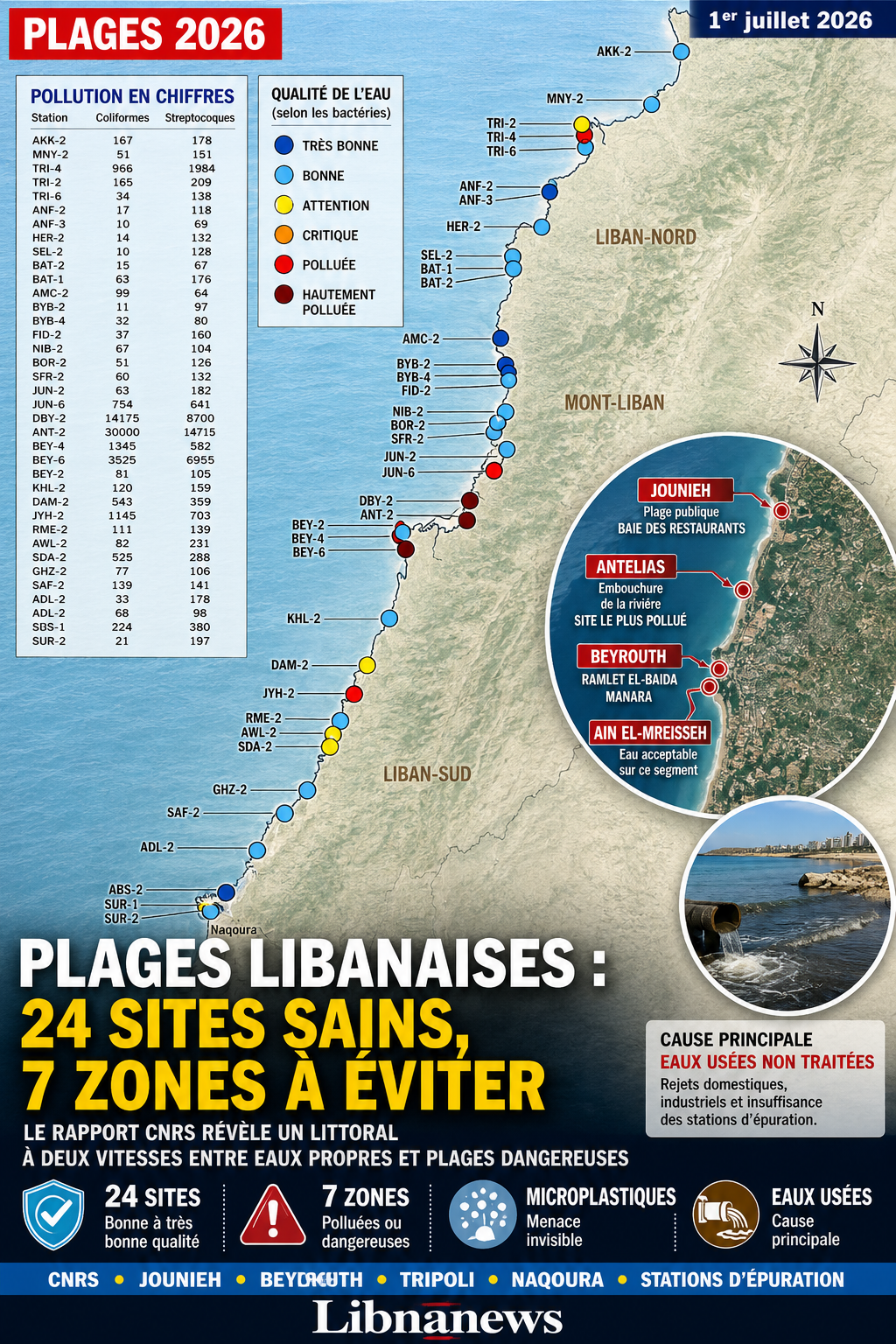
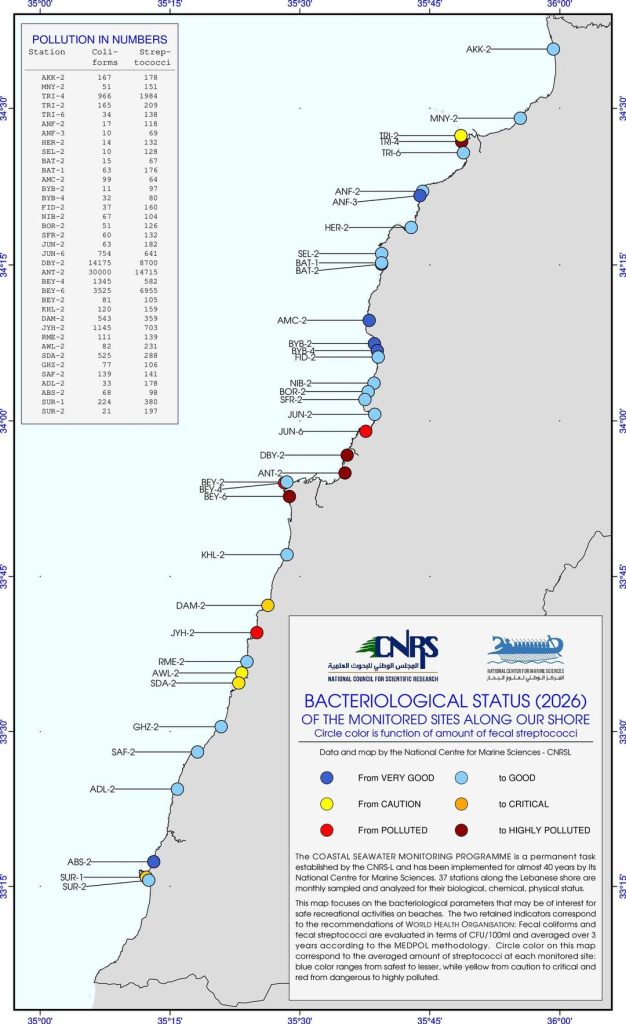
For several years, Lebanese people have become accustomed to scrutinizing each summer an infographic published by the National Centre for Scientific Research (CNRS) and its Marine Studies Centre. The 2026 survey identified 37 sites across the coast and classified their water quality into five categories, from « very good » to « highly polluted ». Blue pellets indicate that the water is clean and without health risk, yellows report caution, reds mark areas where it is not advisable to bathe. In total, according to the report, 24 sites are considered to be « good » to « very good » quality, six are classified as « attention » or « critical », and seven sites – especially in Jounieh Bay and around Beirut – are « hazardous » or « highly polluted ». Mapping 2026 shades the image of a completely degraded coastline: some beaches are still bathed, while others have become real open-air sewers.
A method that is intended to be scientific and transparent
Since 2011, the CNRS has been analyzing the presence of fecal coliform bacteria and fecal streptococci in seawater in public areas every summer. The team takes samples twice a month and then compares them to international standards. A contamination rate of less than 100 units of faecal coliform per 100 millilitres of water is considered « very good » or « good »; Over 1000 water is classified as « highly polluted ». These thresholds, identical to those of the World Health Organization, are simple to understand. The aim is to encourage local authorities and municipalities to monitor their discharges and invest in sewage treatment plants. The data are published in the form of infographics, tables and interactive maps to enable the public to identify places to avoid.
According to the CNRS, sampling covers the entire coastline, from the northern border with Syria (Nahr al-Kabir) to Naqurah in the south. However, the institution recalls that certain private sections, including marinas and tourist complexes, are not included in the monitoring. Similarly, the study focuses on public beaches and does not assess the presence of hydrocarbons or heavy metals in water. Despite these limitations, the report is the only scientific basis available to measure the health quality of Lebanese coastal waters. CNRS officials point out that their results are confirmed by independent analyses carried out by private universities and laboratories.
North: from the Syrian border to Tripoli, a mixed situation
In the northern governorate, the beaches are located at the mouth of the rivers and at the foot of green hills. But the proximity of rivers, which are heavily polluted by sewers and landfills, affects seawater quality. According to the report, the beaches of Akkar in Tripoli are rated as « medium to poor ». The beach of Chekka (Héri) is one of the few to get the « good » mention because of a favorable marine current and the initiative of the municipality, which built a canal to remove wastewater. In Anfeh, the situation is improving thanks to wind turbines and shoreline clean-up programs. In Batrun, on the other hand, Bahsa Creek remains polluted despite the efforts of the inhabitants. However, the city has a long seaside tradition and restaurants that attract the beyrouthine clientele. Local authorities promise to relaunch the work of a wastewater treatment plant, which has been blocked for years due to lack of funding.
Tripoli, the country’s second largest urban area, is the site of greatest concern. The public beach near the port is considered « highly polluted ». The reason is that hundreds of thousands of cubic metres of untreated wastewater discharge daily into the bay. According to environmental organizations, more than 50 per cent of Tripolitan homes are not connected to the sewerage system. The war in Syria and the arrival of hundreds of thousands of Syrian refugees have increased pressure on infrastructure. Despite the partial commissioning of a sewage treatment plant, discharges continue. Projects to rehabilitate the network exist but are slow to be implemented. The families who frequent the seafront of Tripoli say they no longer bathe: « We come only to see the sea and breathe fresh air. We know the water is dirty, » says a family father from Mina.
Between Jounieh and Beirut: the dark heart of the coast
The coastal section from Jounieh to the capital concentrates the worst sites. This is where the red areas of the infographic are located. The report cites the mouth of the Antelias River and the Ramlet al-Baida beach in Beirut as the most dangerous. These beaches, however popular, receive sewage and industrial waste directly. The CNRS notes that the flow of the Nahr Beirut River, diverted by makeshift pipes, occurs in the immediate vicinity of the bathers. In Ramlet al-Baida, the rate of faecal coliforms far exceeds standards. At the nearby beach of Manara, the situation is the same, except for a segment opposite Ain al-Mreisseh where water remains acceptable. The contrast is clear: children play a few metres away from black water pipes.
Further north, Jounieh Bay is a school case. According to the report, the public beach and restaurant bay are classified as « highly polluted ». Residues of oil from marinas and microplastics from water sports add to domestic releases. Similarly, the Antelias River site is presented as « the worst place on the coast », combining wastewater, slaughterhouse waste and hospital waste. The inhabitants of the region denounce the inertia of the authorities and point to the savage constructions and municipal corruption. A number of NGOs have brought legal proceedings against companies and hospitals.
The Beyrouthine metropolis illustrates the Lebanese paradox: the beachfront walk is a symbol of freedom, but the sea itself is unsuitable for swimming on much of the coast. The State claims to be working on a megaproject to expand the pre-treatment plant in Ghadir, which deals with part of the capital’s wastewater. This project, partly financed by the World Bank and the European Union, is to shift from primary to secondary water treatment. The construction site, which has been blocked for years, resumed in 2025 but progress is slow. Engineers explain that the collection network is outdated and that illegal connections continue to divert water to the sea.
Mont-Lebanon: shelters preserved despite pressure
Between Byblos (Jbeil) and Damour, the coastline has striking contrasts. Some areas are real havens, others are under tourist and urban pressure. The report highlights the « good » to « very good » quality of water in Anfeh, Chekka, most of the beaches of Batrun (except Bahsa), Amchit, Jbeil, Fidar, Bouar, Oqaibeh and Safra. These sites benefit from bedrock, a current that disperses pollutants, and the absence of significant streams. Municipalities have established primary treatment facilities or collective septic tanks. Some have signed partnerships with associations to install garbage bins, raise awareness among visitors and organize clean-up campaigns. The beach of Monsef, near Jbeil, is often cited as an example: associations of young people collect waste every morning and display signs explaining the importance of preserving the coastline.
The Amchit treatment plant, inaugurated in 2024, had a positive effect on water quality in the region. Connected to several villages, it filters the waters before releasing them at sea some distance from the shore. This investment, financed by European funds, could be replicated elsewhere. However, the proliferation of tourist complexes without permits and the lack of coordination with the Ministry of the Environment threaten these advances. The residents of Jbeil fear that the race for profit will destroy landscapes and deplete freshwater resources. Municipalities demand a strict coastal law that would prevent illegal construction and ensure public access to beaches.
South: Damour, Tyre and Naqurah, between clean beaches and vigilance
From Damour, water quality improves significantly. The CNRS classifies most sites between Damour and Naqoura as « good » to « very good ». Only the « restaurant range » in Sour (Tyr) is shown as an exception due to the concentration of food waste and oil discharges. The city of Tyre has a modern sewage treatment plant, but it does not cover all areas. The municipal authorities ensure that an extension project is under consideration. Elsewhere, from Saida to Naqoura, the absence of large streams and the low population density explain relatively low fecal coliform rates. The beaches of Naqoura, located near the border, remain among the wildest in the country. The Naqoura – Qlailee site is classified as « very good », but the presence of anti-personnel mines and barbed wire limits access.
Damour, on the eponymous river, is a special case. This beach, which is very popular with Beirut residents on weekends, is classified as « good ». Municipalities in the region have invested in septic tanks and visitor awareness, but waste abandoned after picnics remains a problem. NGOs regularly organize collective clean-ups, and some restaurateurs offer discounts to customers who bring waste bags. Campings bordering the beach claim that they install filters on their discharges, but the CNRS notes that water is sometimes affected after heavy rains.
In the coastal strip between the southern suburbs of Beirut and Damour, the situation is mixed. The mouth of the Ghadir, a river collecting sewage, remains a black dot. However, with the partial commissioning of the Choueifat station, water quality improved slightly. Experts point out that a simple illegal spill or pipeline rupture can destroy months of effort. The networking of the various treatment plants and the creation of a single control body are regularly discussed in Parliament.
Microplastics and macro-debris: a silent threat
If coliform bacteria are an immediate indicator of pollution, other contaminants threaten health and ecosystems. The report highlights the high presence of microplastics in the Lebanese sea. In Sour, researchers found 24 microplastic particles per cubic metre of water. In Ramlet al-Baida, Beirut, this figure reaches 40 particles per cubic metre. These levels are significantly higher than those in industrialized countries. Microplastics come from packaging, fishing nets, textile debris and tire debris. They fragment into particles invisible to the naked eye, ingested by fish and capable of integrating the food chain.
Researchers explain that the concentration of microplastics increases in areas where recycling is absent and rivers carry tons of waste. Sorting plants are rare, and selective collection concerns only a minority of neighbourhoods. NGOs run campaigns to reduce the use of single-use plastic and encourage alternatives. They organise collection activities on the beaches and raise awareness among children in schools. The government has announced its intention to progressively ban plastic bags, but the measure remains a dead letter.
Pollution from macro-debris is also of concern. On some sections of the coastline, researchers identified more than 20,000 plastic or metal objects per 100 metres of beach. International recommendations limit 20 objects per 100 metres. This waste comes from illegal landfills, marine landfills, fishing and tourism activities. They are dangerous to marine wildlife, which can ingest or entangle them. Marine turtles were found dead, strangled by plastic bags or fishing lines. Divers testify to a carpet of detritus covering the seabed in certain areas.
Heavy metals and consumer health: a contrasting situation
In addition to bacteria and plastic, the presence of heavy metals in water and wildlife is examined. In the past, several alerts have been issued on high levels of mercury and lead in some fish, particularly in areas close to landfills and industries. However, according to the CNRS report, fish caught in Lebanese waters have levels of heavy metals below the World Health Organization thresholds. Researchers point out that biomagnification is limited due to the low presence of heavy industries on the coast. However, they call for increased monitoring, including artisanal fisheries in ports and marine farms. Catering professionals reassure their customers: « Our fish are tested regularly and come from certified healthy areas, » says a Chief of Tyre.
Why pollution persists: between lack of infrastructure and poor governance
The causes of coastal degradation are multiple, but the main one is the failure of the sewage system. Lebanon has only a few stations capable of treating wastewater in accordance with international standards. The plans for the construction of dozens of works have remained in the cartons for years due to lack of funding or political will. Existing stations often operate only half-way, either because they lack fuel or because the collection network does not exist. In some areas, villages are not connected to the network, and septic tanks flow directly into the rivers. However, the World Bank and the European Union have funded several projects, but tendering procedures and corruption have slowed down their implementation.
The Lebanese legal framework is not left behind. Article 3 of the Environmental Law prohibits « the discharge of untreated wastewater into the natural environment ». Law 444/2002 recognizes the right to a healthy environment and requires the State to protect it. However, the multiplicity of responsible institutions (Ministries of the Environment, Energy and Water, municipalities, CNRS) and the superimposition of texts make it difficult to apply them. The CNRS report points out that « many laws overlap and make the assignment of responsibilities unclear ». Sanctions are rarely enforced and prosecutions remain exceptional. Polluters may be individuals who install underground pipes, companies that discharge their effluents, or even public authorities that do not connect infrastructure. The fight against corruption and the transparency of tenders are prerequisites for improving the situation.
Local and international initiatives to restore hope
In the face of the inaction of the State, citizen initiatives are emerging. Fishermen’s cooperatives are organizing themselves to collect floating waste and raise awareness among boaters. NGOs install filters in the rivers to trap plastics before they reach the sea. Architects offer ecological cleaning solutions based on aquatic plants. In Batrun, a group of surfers created a start-up that produces boards from recycled plastics. In Saida, the municipality transformed an old open-pit landfill into a public park, a symbol of possible conversion. Local universities are working with European laboratories to develop real-time water quality sensors. These initiatives, though modest, show that civil society is taking the issue.
At the international level, Lebanon is included in pollution control programmes in the Mediterranean basin. The European Union, through the Horizon programme, finances research on the impact of microplastics in the eastern Mediterranean and the evaluation of treatment plants. The World Bank approved a loan in 2024 to rehabilitate the Ghadir station and build more in Tyre, Tripoli and Byblos. The United Nations has called for donations to support the clean-up of the beaches of Naqoura in order to preserve biodiversity. However, this funding is conditional on structural reforms and independent audits. The Lebanese authorities must demonstrate their capacity to manage projects and combat corruption.
Infographic, an awareness and pressure tool
The infographic of 2026 does not merely provide an overview; it mobilises opinion. Social media seized the document and its interactive version. Internet users share photos, make calls for boycotts of polluted beaches and hold municipalities accountable. Boaters post posters at the entrance to the beaches recalling the colour attributed by the CNRS. Restaurateurs and hotels in « good » areas highlight these results to attract swimmers. On the contrary, those located in red areas try to minimize the alert by claiming that their beaches are private and therefore clean. The debates are lively, but they have the merit of raising public awareness of the importance of scientific analysis.
However, the CNRS stresses the need to read the infographic with caution. A « good » range can deteriorate rapidly after heavy rains or incidents. Similarly, a « polluted » range can improve if corrective action is taken. The institution calls for year-round updating of data, ongoing campaigns and coordination with the media to inform citizens in real time. It also calls on municipalities to publish their own measures and commit themselves to solving the problems identified.
Conclusion: between despair and ambition
The state of Lebanese beaches in 2026 reflects the country’s contradictions. On one side, exceptional sites such as Naquora, Jbeil or Anfeh offer crystal clear waters and preserved landscapes. On the other hand, large agglomerations and industrialised areas vomit their waste into the sea. CNRS infographic reveals that 24 sites are still batheable, but alert to seven areas where swimming is dangerous. The main responsibilities are known: lack of sanitation infrastructure, broken governance, lack of sanctions, and culture of impunity.
To overcome this impasse, Lebanon must first secure and maintain sustainable financing for sewage treatment plants. Secondly, it must adopt a coastal law that clarifies competences and protects public access to beaches. Municipalities and regional councils should have the capacity and competence to enforce the law and prosecute. The private sector has a role to play: marinas and hotels must comply with standards and participate in waste recycling. Finally, civil society must continue its awareness-raising and monitoring activities, in order to recall that the sea is a common good.
The 2026 infographic is a valuable tool for measuring progress or setbacks. It shows that hope exists, but that it is based on a collective commitment. Beyond the numbers and colorful pastilles, it also tells the story of a country that is struggling between a generous nature and failing institutions. The question remains: will the Lebanese succeed in saving their beaches? Pending the response, the CNRS maps serve as a compass, and the sea continues to arouse the same fascination mixed with concern.