

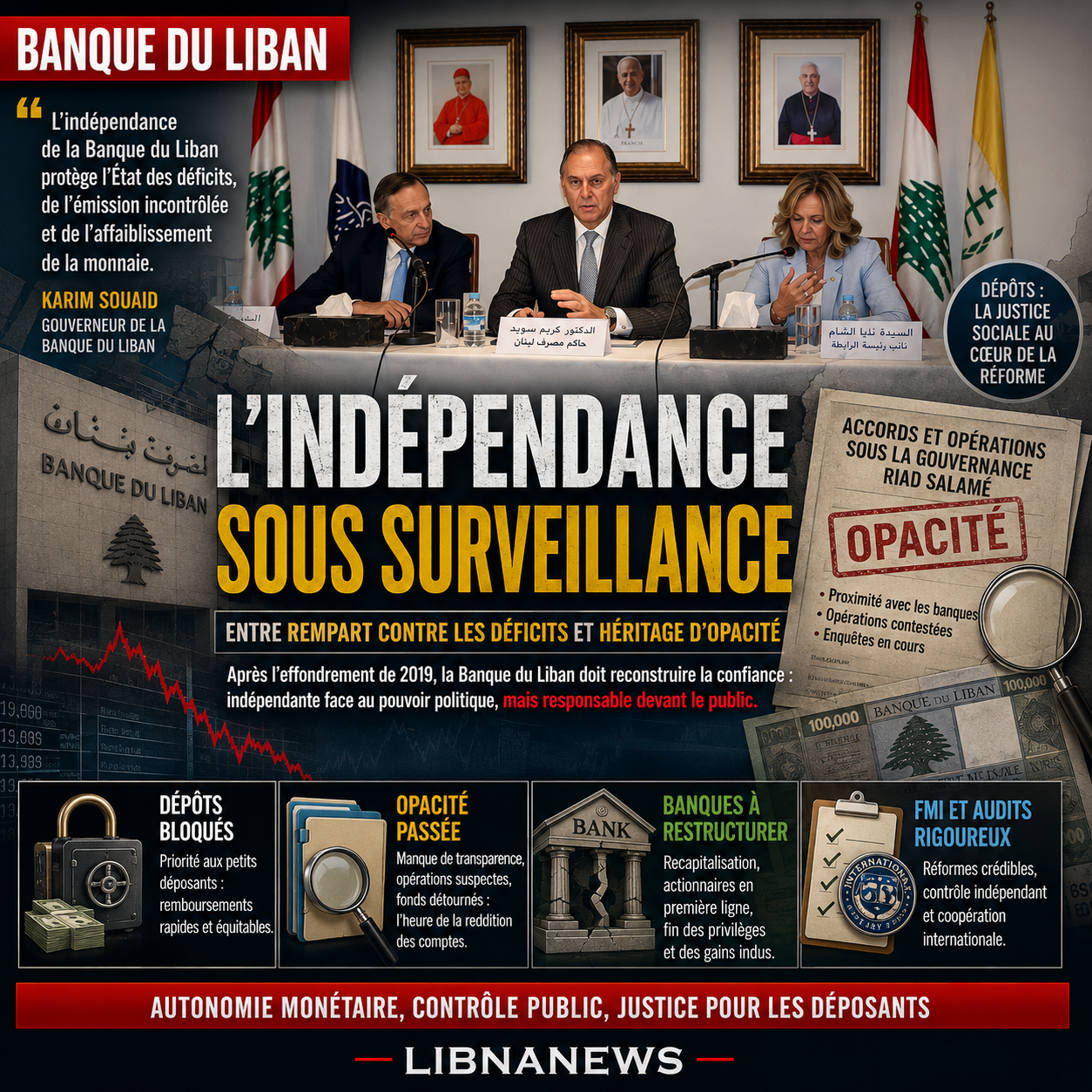
The Governor of the Bank of Lebanon, Karim Suaid, defended before the Maronite League the independence of the monetary institution, presenting it as a bulwark against public deficits, uncontrolled monetary issuance and weakening of the currency. His point comes as Lebanon tries to build a new financial architecture, after the collapse of 2019 and years of distrust towards banks, the Bank of Lebanon and the state.
This defence of monetary independence can no longer be accepted as a neutral principle. In Lebanon, the autonomy of the Bank of Lebanon has also been used under the old governance as a shield of opacity. It has accompanied an exceptional concentration of power, a lasting proximity to commercial banks and a lack of transparency on transactions that are still under investigation and controversy. Thus independence has not only protected the currency. It also helped to remove certain decisions from public scrutiny.
The debate opened by Karim Souaid must be put in this contradiction. The country needs a central bank that can say no to the government when public spending threatens stability. But it also needs a central bank to be held accountable, subject to rigorous audits, separate from the banking interests it supervises and requires real transparency. Without this second condition, independence may become the institutional name of secrecy.
Independence as State protection
Karim Suaid claimed that the Bank of Lebanon is neither the government’s adversary nor its instrument. It must protect monetary and financial balance when budgetary choices become dangerous. The governor stressed the role of an institution capable of refusing excessive debt, inflationary financing of deficits and advances to governments without conditions, without clear contracts and without safeguards.
This position responds to a structural weakness of the Lebanese State. For years, public deficits have accumulated. Debt has increased. Governments have postponed reforms. Commercial banks financed the State, while the Bank of Lebanon absorbed an increasing share of imbalances. In a normal system, the monetary institution should have identified risks sooner and limited the transformation of exceptional aid into permanent practice.
Suaid wants to restore this border. Being the state bank does not mean becoming the banker of successive governments. Nuance is essential. The Bank of Lebanon manages public accounts, facilitates certain cash operations and ensures monetary stability. It cannot, without danger, replace a sound fiscal policy or finance long-term deficits that political power refuses to deal with.
The Governor recalled that the loss of monetary discipline not only destroys the value of a currency. It weakens confidence, discourages investment, slows growth and reduces the value of savings. This chain of consequences summarizes the Lebanese experience since the crisis. The pound collapsed, the deposits were blocked, the banks stopped playing their normal role and the economy moved largely towards cash.
Previous Salamé weighs on speech
This defence of independence, however, runs counter to the legacy of the old governance. Riad Salamé led the Bank of Lebanon from 1993 to 2023. For a long time he was presented as the architect of monetary stability. After the collapse, its balance sheet was reviewed in the light of a system that became unsustainable, opaque financial engineering and judicial investigations into suspicions of embezzlement, money laundering and occult commissions. The former governor challenged the charges against him.
The problem goes beyond Riad Salamé’s personal case. It affects the way in which the Bank of Lebanon has been operating for years with little effective transparency. The proximity of the central bank to commercial establishments has created a circular relationship. The banks placed considerable amounts with the Bank of Lebanon. The Bank of Lebanon supported the apparent stability of the system. The state rejected the reforms. The depositors believed they would retain available assets.
This mechanism held as long as capital entered and confidence persisted. It dislocated when the flows dried up. Depositors then discovered that their accounts no longer represented freely available liquidity, but uncertain claims on a weakened banking and monetary system. The independence of the Bank of Lebanon did not prevent this shift. It has even delayed, to some extent, the complete disclosure of the losses.
That is why the speech of Karim Suaid must incorporate a stronger demand. Saying no to the government is not enough. The Bank of Lebanon must also be able to say no to banks, opaque arrangements, artificial returns and transactions that move risks to depositors. Independence can no longer mean freedom to act without control. It must become self-governing and accountable.
A crisis also arising from a lack of transparency
Karim Suaid claimed that Lebanon did not fail because it lacked laws, but because it ceased to respect them. This observation is correct, but it must be extended. The country also failed because the risk-control institutions did not provide clear, complete and verifiable information on time. Losses were masked, delayed or discussed in technical language inaccessible to the public.
The Bank of Lebanon should be the place for monetary clarity. It has long been seen as a difficult institution to audit, protected by complex balance sheets, bank secrecy and centralisation of information around a small number of decision makers. The result was a deep break between the citizens and the institution supposed to guarantee the currency.
Lack of transparency has also aggravated injustice. The banking restrictions were applied without formal capital control legislation for a long period of time. Some applicants were able to transfer funds or receive preferential treatment. Others were locked in their accounts, forced to accept capped withdrawals or conversions at disadvantageous rates. The crisis thus produced an invisible hierarchy between those who had information, access or influence, and those who did not.
In this context, the promise of reform cannot be limited to the adoption of new legislation. It must organise access to data, the publication of reliable information, the conduct of regular audits and cooperation with the judiciary. An independent but illegible central bank will not restore confidence. It will lead to a more cautious form of mistrust.
Deposits, the social heart of reform
The issue of filing remains the most sensitive issue. Since 2019, a large part of Lebanese savers can no longer normally dispose of their money. For many households, the amounts blocked are wages, pensions, end-of-service allowances or life savings. The banking crisis is therefore not an accounting abstraction. It directly affects social dignity and the relationship of citizens to the state.
Karim Suaid said that the future law on financial organization and repayment of deposits will not be supported by the Bank of Lebanon unless it is based on sound legal bases, a realistic economic approach and effective social justice. In particular, he placed small depositors first, referring to those whose assets were less than $100,000. These, according to him, must bear the lowest possible burden and benefit from the fastest repayments, depending on the available liquidity.
This priority is essential, but it does not resolve everything. The country still has to determine where the money will come from. The protection of small depositors requires a combination of sources: bank contributions, shareholder participation, recovery of improperly captured funds, mobilisation of public assets in a transparent framework, and State responsibility. Without identified funding, the promise of repayment may remain political.
The Governor requests that the State, the Bank of Lebanon and commercial banks each bear a share of the economic burdens of the crisis. This formula recognizes a shared responsibility. However, it must avoid a trap: turning collective responsibility into general dilution. If everyone is indistinctly responsible, no one really responds to the decisions made. The future law will therefore have to establish a clear hierarchy between misconduct, assumed risks, past benefits and contribution capabilities.
Banks face restructuring without complacency
Karim Souaid wants to give the banking sector a real chance of recapitalisation and restructuring. The principle can be defended. Lebanon cannot rebuild a productive economy with paralyzed banks, unable to finance businesses, restore normal payments and reconnect with foreign correspondents. A sustainable economy cannot work only with cash and transfers.
But this chance must not become a rescue without conditions. Commercial banks have benefited for years from a highly remunerative model. They financed the State, placed liquidity with the Bank of Lebanon and attracted deposits with high returns, often disconnected from the real capacity of the economy to support them. They helped to maintain an apparent stability based on continuous capital inflows.
Restructuring must therefore start with the shareholders and managers of the most exposed institutions. Sustainable banks must be recapitalised with new money under strict governance rules. Insolvent establishments must exit the market in accordance with ordered procedures. Preferential transactions must be examined. Suspicious transfers and arbitration before or during the crisis must be subject to judicial treatment when they raise serious evidence.
The Bank of Lebanon will not restore its authority if it gives the impression of protecting the banking sector first. Financial stability cannot be confused with the preservation of private interests. It implies a smaller banking sector, perhaps, but stronger, better controlled and less intertwined in political decisions. Trust will only come back if the depositors see that the losses are not distributed on a balance of power.
Money flow and financial justice
Suaid mentioned the need to continue suspicious transactions and to recover funds diverted or improperly captured. This point is central. Investigations into the former governance of the Bank of Lebanon have led to the conviction that part of the system has worked in an opacity favourable to insiders. Procedures in Lebanon and Europe mentioned disputed commissions, intermediary companies and financial flows. The persons concerned challenged the charges, but the institutional damage was already considerable.
Recovery of funds may not be sufficient to cover all losses. But it is a political condition for reform. Depositors cannot accept a law that imposes sacrifices without serious effort to identify diversion channels, unjustified enrichments and preferential operations. Financial justice therefore becomes a pillar of stability, not a mere moral complement.
To be credible, this must be done with a method. It implies the effective removal of banking secrecy barriers, cooperation between Lebanese and foreign authorities, the transmission of reliable data and the independence of the judiciary. It also involves distinguishing suspicions from established facts in order to prevent accountability from turning into a political campaign without any real impact.
The new governance of the Bank of Lebanon will be judged on this ground. It will have to show that it does not defend the institution against the truth, but that it protects its credibility by the truth. Independence cannot be used to close the archives. It should allow for the opening of cases without government pressure, without bank protection and without selection of responsibilities.
IMF as a lever, not as a substitute
The Governor recognizes the role of the International Monetary Fund and external partners in the reform process. He believes that their intervention can support confidence, encourage investors and create useful pressure on the Lebanese authorities. This recognition contrasts with speeches that present any international demand as an infringement of sovereignty.
Swaid, however, sets a limit. Reforms must be consistent with Lebanese law, the Constitution and the coherence of existing institutions. This argument is legitimate. A financial law poorly articulated with the local legal system can produce litigation, delay its application and weaken the reform it claims to be carrying.
But this requirement must not become an alibi to slow down decisions. Since 2019, Lebanon has lost considerable time. Laws on bank secrecy, bank restructuring and deposits were discussed, corrected, deferred and challenged. Meanwhile, depositors have seen the real value of their assets decrease. Companies have adapted to a dysfunctional banking system. The formal economy has declined.
The IMF stresses the need for realistic recognition of losses, credible bank restructuring, better central bank governance and fair treatment of depositors. These requests are not only technical. They aim to prevent the return of the model that produced the crisis. The Bank of Lebanon will therefore have to accept that its independence will be accompanied by enhanced surveillance.
The Maronite League, the platform for an institutional message
The meeting was held at the Maronite League headquarters, under the chairmanship of Maroun Hélou, in the presence of politicians, former ministers and deputies, representatives of liberal professions, economic leaders and members of the League. The framework gives the speech a particular dimension. The Maronite League is not a financial institution, but it remains a political and social forum that addresses issues of state, governance and stability.
Maroun Hélou praised the mission entrusted to Karim Souaid in an exceptional period. He mentioned the financial, monetary and economic crisis, the need to restore confidence and the priority given to deposits. He recalled that deposits are not mere figures, but the product of citizens’ work. This approach joins one of the major challenges of the moment: placing savers at the centre of a debate often dominated by balance sheets and technical negotiations.
Suaid’s presence before this assembly also responds to a need for pedagogy. The Governor seeks to explain that monetary stability depends on strong institutions. But he must at the same time convince an opinion marked by the opposite experience: that of a powerful institution, long respected, then brutally contested after the revelation of the magnitude of the losses. The discourse on institutions must therefore recognize their shortcomings.
This recognition would not weaken the Bank of Lebanon. On the contrary, it could help rebuild itself. Institutions do not regain their authority by denying their mistakes, but by showing that they have changed their rules, practices and relationship to the public. It is on this capacity to break with the old culture of secrecy that the new governance will be expected.
Independence under public control
The real challenge is not to choose between an independent Bank of Lebanon and a Bank of Lebanon subject to political power. This alternative is too simple. A central bank under the direct dependence of governments could finance deficits, boost inflation and sacrifice stability to electoral interests. But an independent central bank without transparency can concentrate considerable decisions without real control. The Lebanese crisis showed that this second risk was not theoretical.
The new doctrine should be based on a more demanding balance. The Bank of Lebanon must maintain operational independence in monetary conduct. It must be able to refuse dangerous requests from the State. She has to supervise the banks without complacency. But it must also publish understandable information, undergo regular audits, cooperate with the judiciary, report to Parliament and clarify its operations.
The Bank of Lebanon reform cannot therefore be separated from bank restructuring and deposit settlement. The three files form the same set. A more transparent central bank will strengthen the credibility of the financial plan. Serious banking restructuring will reduce future risks. Fair treatment of depositors will restore part of the social bond destroyed by the crisis.
Karim Souaid is right to recall that monetary independence protects the state from its excesses. But recent history imposes a major correction. Independence must now also protect citizens from the shadow zones of the central bank itself. The Bank of Lebanon will regain its authority when it proves that it can say no to the government, banks, interest networks and its own secret reflexes.




