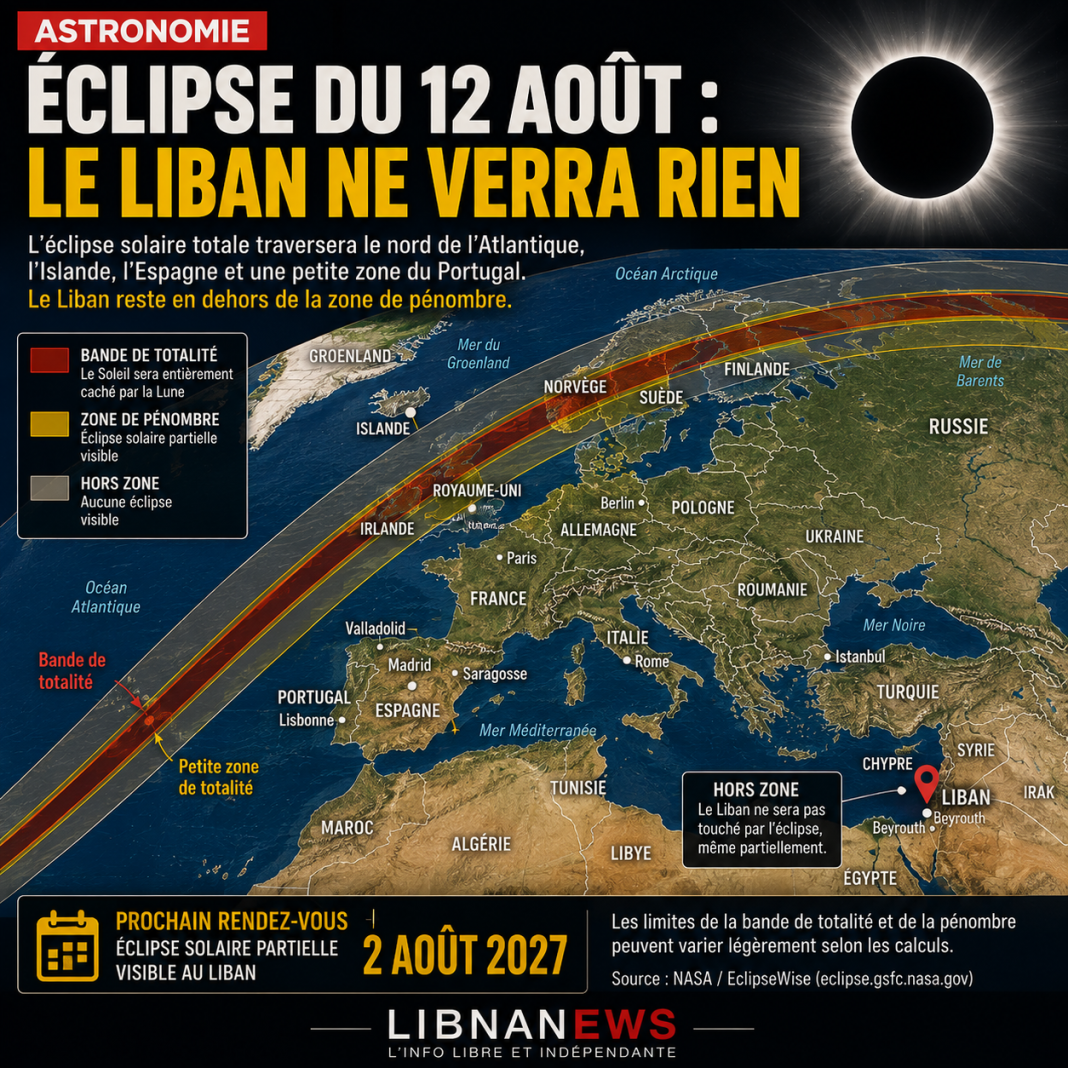






On Wednesday, August 12, 2026, a total solar eclipse will cross a part of the northern hemisphere, but it will not be visible from Lebanon, not even in partial form. The entire band will pass through the Arctic, Greenland, Iceland, part of northern Russia, the Atlantic, northern Spain and a small area of Portugal. A partial eclipse will be observed in much of Europe, northern North America and northwestern Africa. However, Lebanon will remain outside the shadow projected by the Moon on Earth. In Beirut, Tripoli, Zahlé, Saida or Tyre, the Sun will not be hidden on August 12. For Lebanese observers, the next direct solar event will be the eclipse of 2 August 2027, which will appear partially from the country. Wednesday’s event is nevertheless remarkable on an astronomical scale, as it will be the first total solar eclipse visible since continental Europe since 11 August 1999.
Lebanon will remain entirely outside the eclipse zone
The visibility maps published by NASA and the specialized astronomical calculations are unambiguous. The dark moon path will pass far north and then west of Lebanon. The shadow, which makes it possible to see a partial eclipse, will cover much of Europe and north-western Africa, but its eastern limit will not extend to Lebanese territory.
The consequence is simple: from Lebanon, the solar disk will retain its normal appearance for the duration of the phenomenon. No solar crescent will be visible, no direct decrease in luminosity will be caused by the eclipse and no specific observation schedule will apply to the country. People who will be in Beirut or other Lebanese regions will therefore not need to move to a high point or a clear horizon to try to see the phenomenon: the geometry of the eclipse completely excludes.
This lack of visibility may be surprising because the eclipse will be widely observed in Europe. The latter will include France, the United Kingdom, Ireland, Portugal and large parts of the continent. But a solar eclipse is not a visible event from all the enlightened hemisphere. The Moon casts a shadow on the Earth’s surface whose position depends with great precision on the alignment between the Sun, Moon and Earth.
Lebanon will simply be too far east and too far south of the area concerned. This situation is different from that of a lunar eclipse, which can be seen simultaneously from half the Earth as long as the Moon is above the horizon. On the contrary, a solar eclipse is highly localized.
Why Spain will see the eclipse and not Lebanon
A solar eclipse occurs when the Moon passes between the Earth and the Sun. When the alignment is sufficiently precise, its shadow reaches the Earth’s surface. This shadow has two main areas. The central shade, called shadow or umbra, is very narrow: an observer inside sees the Sun completely covered by the Moon. Around this band is the much wider darkness, where only part of the Sun is hidden.
On August 12, the central shadow will follow a path that will first cross the Arctic regions and Greenland, then Iceland and the Atlantic before reaching the Iberian peninsula at the end of the day. Northern Spain will be in a particularly favourable position. Several Spanish regions will see the Sun disappear completely during a short interval while it will be relatively low on the western horizon.
The darkness will extend far beyond this band. A large part of Europe will therefore observe a partial eclipse, with a fraction of the masked Sun that will depend on the distance to the entire band. The closer an observer will be to this band, the greater the occupancy. As we move south-east of the Mediterranean, the occult fraction will decrease to zero before Lebanon.
This geometry explains why two cities separated by a few thousand kilometers can experience radically different experiences on the same day. In Spain, some observers will see the solar crown appear around the moon’s black disk for the whole. In Lebanon, the event will have no visual manifestations.
Spain and Iceland at the heart of the show
The eclipse of August 12 draws special attention in Spain because the entire trajectory will cross part of the territory at the end of the day. Several regions of the north and north-east of the country will be in the strip where the Sun will be completely hidden. However, the spectacle will depend heavily on the weather and visibility to the west, with the Sun relatively low when the eclipse reaches the peninsula.
Iceland will also be an important destination. The entire band will cross the island and offer, if weather conditions permit, a very different spectacle from that observed in Spain. Greenland and the Arctic regions will also be fully accessible, but their accessibility is obviously more limited.
NASA also indicates that a small part of Portugal may be concerned with the whole, while large areas nearby will observe a very important partial eclipse. The spectacular character of the event comes precisely from this very narrow band: leaving a few tens or hundreds of kilometres from the central zone is enough to turn a total eclipse into a partial eclipse.
For Lebanese travellers who specifically want to see the whole, it will not be enough to travel anywhere in Europe. A person in Paris or Rome will see a partial eclipse, not the complete disappearance of the Sun. The whole band will have to be reached, especially in Spain, Iceland or other areas crossed by the central shadow.
A first in continental Europe since 1999
The event also has a strong historical dimension for Europe. The last total solar eclipse visible since a significant part of continental Europe dates back to 11 August 1999. This eclipse had crossed several European countries before continuing its journey towards the Middle East and Asia.
Twenty-seven years later, almost to the day, the eclipse of 2026 brought the whole of Europe back. Spain will be particularly favoured, and it will be even more so the following year: on 2 August 2027, another total eclipse will cross the south of the country before crossing North Africa and the Middle East.
For Lebanon, it is precisely the eclipse of 2027 that will be much more interesting. The astronomical visibility lists indicate that a partial solar eclipse will then be observable from Lebanese territory. The country will not be in the whole band, but a part of the Sun will actually be masked.
This proximity between two large eclipses also explains the possible confusion around the phenomenon of August 12, 2026. Europe has a particularly remarkable astronomical sequence in 2026 and 2027, but the visibility zones change considerably from one eclipse to another.
A total eclipse has nothing to do with a simple partial eclipse
During a partial eclipse, the sky generally remains much brighter than people who have never seen it. Even when a large fraction of the Sun is hidden, the remaining part continues to produce considerable brightness. Human eye adapts and may not immediately perceive the decrease.
The totality produces a much more dramatic change. When the last photosphere fragment disappears, the brightness falls abruptly. The solar crown, normally invisible because of the brightness of the Sun’s surface, becomes observable around the moon’s black disk. Stars and some planets may appear, while the temperature may decrease temporarily.
This phase only lasts a few moments for a given observer, as lunar shadow moves rapidly on the Earth’s surface. Its duration depends on the position in the entire band. People near the central line generally benefit from a whole longer than those near the limits.
However, the 2026 phenomenon should not be confused with the longest eclipses possible. The maximum duration of the whole will remain a few minutes. For the public, the interest lies less in the exceptional length than in the European location of the event and in the special conditions of observation at sunset in the Iberian peninsula.
In Beirut, the Sun will retain its normal appearance
In Beirut, the day of 12 August will therefore follow its ordinary astronomical course. The new moon will occur that day because a solar eclipse can only take place at this stage, but not all the new moons cause a declipse. Moon orbit is inclined in relation to the Earth orbit plane around the Sun. Most of the time, the Moon passes slightly above or below the necessary alignment.
When it passes sufficiently close to a node of its orbit at the time of the new Moon, an eclipse becomes possible. But even in this case, only part of the Earth is in shadow or darkness. This is what will happen on 12 August: alignment will exist at the scale of the Terre-Lune-Sun system, but the shadow projection will not concern the eastern Mediterranean.
An observer in Lebanon who would look at the Sun with a properly filtered instrument would therefore not see any lunar edge entering in front of the disc. It is not an eclipse too weak to be noticed; The eclipse simply does not exist since this geographical position.
The eclipse calendars for Beirut confirm this absence: after the lunar phenomena of 2026 and the beginning of 2027, the next solar eclipse indicated as visible in the Lebanese capital is that of 2 August 2027.
A lunar eclipse visible in Lebanon on August 28
The Lebanese sky will still offer another astronomical appointment at the end of the same month. On August 28, 2026, a partial lunar eclipse will be visible from Lebanon in the hours before sunrise.
Unlike the solar eclipse of 12 August, this will directly affect Lebanese observers. The moon’s entrance into the Earth’s darkness will begin at about 423 local time. The partial phase will begin around 6:12 a.m., but the Moon will then be extremely low and close to bedtime.
The observation conditions will therefore be difficult. A perfectly clear western horizon will be necessary to see the last phases before the Moon disappears. People on the coast or in some high points will have a better horizon than those surrounded by buildings or reliefs.
This lunar eclipse will, however, remain less spectacular since Lebanon than the total solar eclipse visible two weeks earlier from Western Europe. It nevertheless has the essential advantage of being observable without any eye protection device.
Mandatory glasses for travellers in Europe
Lebanese who go to an area where the solar eclipse will be visible must comply with strict rules. Watching the Sun directly without proper protection can cause serious retina damage. The danger is particular because the retina does not have pain receptors capable of warning immediately that a lesion is occurring.
Certified sunglasses for solar observation shall be used during all partial phases. Ordinary sunglasses, even very dark ones, do not provide sufficient protection. It is also not necessary to observe the Sun with binoculars, a telescope or the lens of a camera without a suitable solar filter placed in front of the instrument.
In the whole band, the situation changes only when the Sun is completely hidden. During this short phase, observers can watch the solar crown directly. Protection must be restored as soon as the photosphere reappears. A person outside the entire strip must never remove his sunglasses during the eclipse, as the Sun is never completely masked.
These rules are particularly important for photographers. A device can concentrate sunlight and damage both the sensor and the eyes if an optical viewfinder is used. Filters for solar observation shall be designed specifically for this purpose.
Lebanon must wait until 2 August 2027
For observers remaining in Lebanon, the relevant appointment will therefore be 2 August 2027. This total eclipse will follow a path much more southern than that of 2026. Its entire band will cross Spain, North Africa and some parts of the Middle East.
Lebanon will remain outside the entire band, but this time it will be within the partial eclipse zone. So the Sun will actually be partially masked from Beirut and other parts of the country. The exact conditions will depend on the location and can be accurately calculated as the date approaches.
The 2027 eclipse will be particularly spectacular elsewhere in the region. The entire band will go through Egypt, where certain areas will benefit from an exceptionally long total duration. This geographical proximity will make it a much more accessible event for Lebanese travellers than the Arctic and European eclipse of 2026.
It will also provide Lebanon with an opportunity to organize public observations, scientific activities and security awareness campaigns. Eclipses are often an effective means of bringing the general public closer to astronomy, provided that the visibility information is accurate and that the sun is properly framed.
A great world show, but not in the Lebanese sky
The total solar eclipse of Wednesday 12 August will be one of the great astronomical events of 2026, but not in the Lebanese sky. The whole will be reserved for a narrow trajectory linking the Arctic regions with Western Europe, while the shadow will cover a much wider area without reaching Lebanon.
Accuracy is important two days from the event. Images from Spain, Iceland or Greenland may give the impression of a phenomenon affecting the whole northern hemisphere. In reality, lunar shadow has very precise geographical boundaries. Beirut and all Lebanese territory will be outside these limits.
Those who will remain in Lebanon will be able to follow all international broadcasts, while those travelling to the central band will have to use solar protections certified during the partial phases. At the end of the month, on August 28, a partial lunar eclipse will offer the country its own astronomical phenomenon, before a much more direct solar appointment on August 2, 2027.
The next test for Lebanese observers will therefore not be held on Wednesday in the Beirut sky. It will come in 2027, when the southern shadow of a new solar eclipse finally reaches Lebanon in partial form and this time will place the country close to one of the largest astronomical shows visible from the Middle East.