






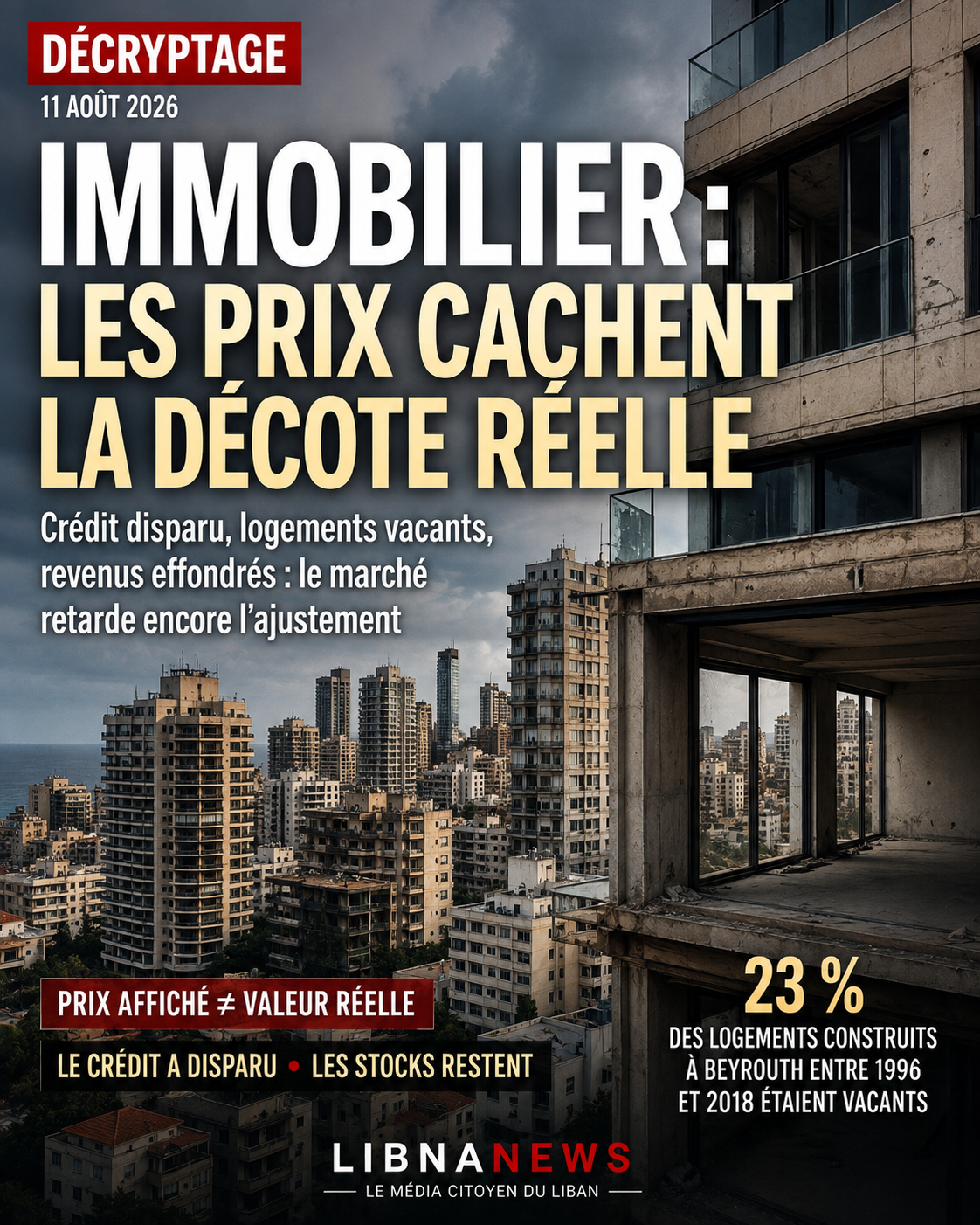
Lebanese real estate did not remain expensive because the country simply lacked land or because Lebanese would have an unsurpassable cultural preference for stone. It remained expensive because, for almost twenty years, a whole banking, monetary, fiscal and political system prevented housing prices from meeting the real income of those who were supposed to buy them.
The real estate crisis did not begin in October 2019. As early as 2011, sales were slowing down, inventory of unsold apartments was increasing and developers were finding it increasingly difficult to dispose of large areas built during the euphoria years. The banking crisis did not create this imbalance. It has removed the mechanisms to conceal it.
Even today, the correction remains difficult to measure. The prices displayed are often those that owners would like to get, not those to which they would actually agree to sell. Some of the transactions involve very special goods, in sought-after neighbourhoods, purchased by expatriates. Real estate credit is almost gone. Vacant housing is not routinely re-marketed. Banks and promoters in difficulty continue to defer recognition of their losses whenever they can.
The result is a strange market: volumes can return for a few months without the local purchasing power having recovered; prices may seem stable as their real value declines; and an apartment can maintain a high nominal price while remaining unsold and producing virtually no income.
The decade the bank made the demand
Between the early 2000s and the early 2010s, Lebanon experienced a dramatic real estate increase. According to available estimates, the price of housing is estimated to have tripled approximately between 2003 and 2013, while the price of land is estimated to have increased by almost seven times between 2005 and 2012. This increase did not correspond to a comparable increase in productivity, wages or population growth sufficiently strong to explain it.
It was first made possible by the apparent stability of the book. The rate of £1,507.5 per dollar gave the impression that income, savings and real estate prices in dollars were based on a solid basis. As long as banks attracted sufficient foreign exchange deposits, this parity could be defended. Households borrowed over fifteen, twenty or sometimes thirty years on the assumption that their future income would remain relatively predictable.
The banking system fed demand through two channels. He financed buyers, but also promoters. The projects could therefore be launched even before all the apartments were sold. When a dwelling remained on the market, the bank rarely had an interest in causing a rapid fall in its price: this would have devalued the loan guarantee granted to the promoter and forced the institution to recognize a loss.
The relationship between banks and promoters was not necessarily based on fraud. It was the result of a community of accounting interests. The developer needed time to sell without breaking prices; the bank needed the asset to keep a sufficiently high value in its accounts. As long as interest was paid, refinanced or restructured, the project could remain officially viable even if its economic profitability deteriorated.
The subsidized loans extended the movement. The Association of Banks of Lebanon estimated that more than 132,000 low- and middle-income households had received more than $13 billion in aided loans. The Public Corporation for Housing provided an average of approximately 5,000 loans per year and had financed some 76,000 families by the end of 2017. The ceiling for some loans was £270 million, or about $180,000 at the official rate, at an interest rate of 3.74 per cent.
The ceilings for other devices were raised much higher. In 2017, a circular from the Bank of Lebanon raised the ceiling for some subsidized housing loans distributed by commercial banks from £800 million to £1.2 billion, or almost $796,000 at the fixed rate of the time. Banks could finance up to 75% of the value of the property. It was no longer just a question of helping modest households to buy ordinary housing: part of the scheme also supported relatively expensive acquisitions.
In 2018, a new $500 million envelope made available by the Bank of Lebanon was consumed in about a month. When subsidies were suspended, the sector suddenly lost an essential component of its demand. The market did not discover a new difficulty. It revealed its dependence on a credit whose price was artificially reduced.
From 2015, the Bank of Lebanon’s so-called « financial engineering » operations further delayed the adjustment. They offered banks high returns and swaps to attract or retain the currencies needed for the system. They did not directly fund each site, but they supported the bank balance sheets, deposits and general liquidity on which loans to developers and purchasers depended. The real estate price was thus backed by a financial mechanism that was increasingly far removed from the productive capacity of the economy.
To this added the role of the diaspora. The transfer of expatriates, income earned in the Gulf countries and regional capital have long supported purchases in Beirut, Metn, Baabda, Kesrouan and some coastal and mountain areas. Part of this request was genuine: expatriates purchased family housing, prepared a return or sought to maintain a link with the country. But promoters eventually treated this clientele, more solvent than residents, as if it represented the ordinary demand.
The story of soil scarcity did the rest. Beirut is a dense city, the building plots are limited and land ownership is concentrated. This justifies a premium in some quarters. However, this is not enough to explain a 600 per cent increase in land prices in a few years, especially when thousands of completed dwellings remain empty. A terrain is rare in the physical sense; However, it does not have unlimited value. Its value depends on the income that housing built on it can produce or the price that a solvent buyer can pay.
Finally, taxation encouraged retention. An owner could keep an empty dwelling pending a future increase without having to bear an annual cost that was sufficiently high to force it to sell or rent. Exemptions and weaknesses in the taxation of vacant housing have transformed entire buildings into valuable reserves. An estimate for Beirut estimated the city’s loss of profits at over $33 million and the central state’s loss of nearly $100 million related to the historical exemption from declared vacant housing. Higher estimates exist, but they are partly based on excessive vacancy declarations in order to reduce taxes; They therefore also measure the extent of tax evasion.
An open crisis from 2011, hidden until 2019
The reversal was noticeable well before the bankruptcy of the banking system. The number of real estate transactions increased from approximately 82,984 in 2011 to 64,248 in 2016, a decrease of 22.5 per cent. The prices displayed resisted. This divergence between volumes and prices is classic in a market where sellers can wait: the correction begins with the disappearance of buyers, not by an immediate reduction of advertisements.
In 2015, the average price charged for a new apartment on the first floor in the municipality of Beirut was still estimated at $3,720 per square metre. The average surface area was 238 square metres, at a price close to $885,000. In the city centre, the average was $6,679 per square metre for 331 square metres, which placed the typical apartment above $2.2 million.
These dimensions show one of the errors of the period. The offer was oriented towards large areas and to the medium-high and luxurious segments, because the high price of the land and the financial cost pushed the promoters to maximize turnover per unit. However, the local clientele able to buy apartments from 250 to 350 square meters was already limited. When Gulf capital slowed down and subsidized loans were seized, the stock became impossible to dispose of normally.
In 2018, there were about 3,600 new unsold apartments in Beirut. Loans to developers and real estate buyers were estimated at almost $24 billion, or more than a third of private sector bank credit. The Legacy One project, with $250 million to buy over 200 unsold housing units, did not even account for 10% of the estimated stock in the capital. This type of initiative could temporarily identify some promoters; he could not restore the creditworthiness of the application.
The first five months of 2018 had 22,707 transactions, down 21% year-on-year. Their reported value, about $3.2 billion, had decreased by 15.6 per cent. Again, the contraction of volumes was clearer than that of values. The apartments that still sold were often the best located or those for which the seller accepted a discount not visible in the published prices.
Sayfco’s bankruptcy in May 2018 is one of the clearest symbols of this crisis before 2019. The group had developed projects with an estimated total value of approximately $2 billion. Some 600 buyers were exposed in several programs, including Panorama in Mar Roukoz, Suites Faqra and Saint Thomas in Nabay. Panorama had nearly 270 customers; Some had been waiting for their apartment for several years when the project was announced as approximately 90 per cent complete.
Buyers who have already paid much of the price have discovered that bank mortgages prevent the delivery of securities. In some proposed regulations, they would have been asked to pay an additional $10,000 to allow for the lifting of mortgages and registration. Charges of fraudulent bankruptcy were made by clients and their representatives; They must be reported as accusations, not as a definitive judicial qualification. But the case reveals the main economic problem: buyers’ advances, bank loans, mortgage guarantees and financing of other projects had created a tangle in which the paid apartment was not necessarily an asset free of any debt.
Sayfco was not an isolated accident in a healthy market. Its fall showed that a promoter could display high-value land and projects while lacking liquidity and being unable to deliver. It also showed that the book value of a project depended on prices that had not yet been tested for rapid sales.
The banks helped to postpone this test. When they recovered real property in settlement of claims, the law normally provided for resale within a short time. But the regulatory treatment has been relaxed. For certain assets acquired in settlement of unperforming loans from October 2015, the deadline could be extended to 20 years. Therefore, a bank was not necessarily obliged to immediately market the seized assets. The excess stock could remain out of the public’s sight, protecting prices but not economic value.
Bank collapses, real estate becomes safe
In 2019, informal banking controls changed the function of real estate. Housing was no longer merely an investment or a use property. It became one of the few ways to turn an inaccessible deposit into tangible assets.
Accuracy is essential. Lebanese real estate prices remained referenced in real dollars. Sellers continued to reason in dollar value, often comparing their property to what they thought was their cash price. What has changed is the means of settlement. Between 2019 and 2022, many transactions were paid through bank cheques drawn on blocked dollar deposits, the « lollars ».
The amount on the cheque was adjusted to the discount of the bank dollar. If a seller wanted to receive an economic value of $100,000 and if a bank dollar was worth only 25 cents in cash, he could request a cheque of $400,000. That didn’t mean the apartment was worth $400,000. Its economic reference price remained close to $100,000, possibly increased by a premium to compensate for risk, delays and difficulties in using the cheque.
This distinction is essential for interpreting statistics. In 2021, the nominal value of recorded sales approached $15 billion. It was not $15 billion fresh injected into the economy. A considerable proportion represented depreciated bank deposits converted to stone with coefficients of several times their value in cash.
For depositors who did so early enough, the transaction could limit the loss. For some borrowers, it also made it possible to repay debts using devalued bank dollars. Banks reduced their loan portfolio and sometimes recovered their debt. The real estate market was thus absorbing part of the banking crisis, but at the price of a complete confusion between bank amount, contract price and liquid dollar value.
From July 2022 onwards, the Bank of Lebanon imposed a requirement that the buildings held by banks be sold in fresh dollars or in pounds calculated at the applicable regulatory rate. More generally, the market has gradually shifted to regulations in « fresh dollars ». This has removed some of the illusion created by bank cheques. It neither restored credit nor made households more solvent.
The banking system remains deeply insolvent. Before the crisis, loans to the private sector exceeded $50 billion. At the end of 2024, the bank’s loan portfolio was only $5.5 billion, at 97.7 per cent. Deposits still reached about $88 billion and were $99.1 per cent dollarized, but the bulk did not correspond to freely available dollars. Market estimates in 2025 placed bank deposits blocked around $84 billion, compared to about four billion fresh deposits. This breakdown is not a uniform official series of the Bank of Lebanon, but it gives the order of magnitude of asymmetry.
The financial hole was already estimated at over $70 billion in 2022. It is likely to be higher today according to the method used, accumulated losses, retained liabilities and the value attributed to public assets. In February 2026, the International Monetary Fund still considered that the draft law on financial stabilization and recovery was only a first step and should be improved. In July 2026, Parliament was still discussing banking reform, financial regulation and the mechanism for recovering deposits.
This block directly affects real estate. As long as losses are not distributed between the State, the Bank of Lebanon, banks, their shareholders and depositors, institutions may defer the sale of part of their assets. As long as the overindebted promoters are not liquidated or restructured, unfinished or mortgaged buildings remain outside the normal market. The correction exists, but it remains partially enclosed in the balance sheets.
The banking collapse also reinforced an old Lebanese preference for stone. Many households no longer know how to save. The bank destroyed confidence; the book cannot serve as a reserve of long-term value; local financial investments are rare; keeping tickets at home is risky. The apartment then appears as a form of safe, even if it is empty and returns nothing.
This behaviour supports the price, but it does not create a demand for use. A person can buy an apartment to protect $200,000 without intent to live or rent it. The additional unit therefore does not respond to an increase in the number of households or to a rental shortage. It only withdraws cash from circulation.
The development of the cash economy has aggravated opacity. The World Bank estimated the size of the Lebanese economy in cash at about $6.05 billion in 2021, or 26.2 per cent of GDP, and then at $9.86 billion in 2022, almost 45.7 per cent of GDP. The more cash and non-banking payments are made, the more difficult it becomes to identify the origin of the funds, the true economic beneficiary and the price actually paid.
This is where the issue of money laundering comes into play. Real estate is obviously not financed solely by illicit funds. However, it is a vehicle particularly suited to their integration: amounts are high, transactions are infrequent, companies can hide the real beneficiary and the valuation of a property is subjective enough to explain significant differences.
The 2023 evaluation of FATF and MENAFATF classified the exposure of the Lebanese real estate sector at a moderate level, while noting several weaknesses. No suspicious transaction reports were reported by real estate brokers between 2017 and 2021, even though the country was going through an explosion of atypical settlements and a dollarization in cash. Notaries had made few reports and knowledge of beneficial owners remained incomplete.
Traditional bleaching signals include purchasing above the market, the buyer’s indifference to yield or price, successive resales and the use of structures that complicate the identification of the real owner. However, an already opaque market, in which the reported prices could be inflated by bank cheques, makes these signals even more difficult to isolate.
Lebanon was included on the FATF grey list in October 2024 and was still on the list in June 2026. The change in bank secrecy voted in April 2025, with 10 years of retroactive access under certain conditions, is a real change. However, it is not enough to instantly clean up decades of transactions and possessions via aliases or corporations. The change to fresh dollars has made the market more readable; The importance of cash may, on the other hand, make the origin of capital less legible.
Too many homes, less inhabitants
A price cannot be long-term understood without looking at those who are supposed to occupy the good. In this respect, the available indicators are unfavourable.
A study for the municipality of Beirut estimated that 23 per cent of the dwellings built between 1996 and 2018 were vacant, or more than 7,000 units. Approximately 65 per cent of these dwellings were still unsold and 35 per cent were voluntarily kept empty. At the top of the range, the proportion could approach one in two dwellings.
The situation has not been resolved with the closure of many construction sites. Of 6,792 dwellings completed between 2015 and 2018, approximately 32% were vacant in 2018. Of the 1,955 dwellings completed between 2019 and 2022, 43% were still vacant by 2023. New construction slowed sharply, but demand fell even faster. Large units of more than 240 square metres remain particularly exposed, as they concentrate a total price inaccessible to the majority of residents and significant maintenance costs.
The construction data confirm the abrupt shutdown. Building permits decreased by 32.6% in 2019 and again by 61% in early 2020. Cement deliveries decreased by 31.9% and then by 55.7%. A partial recovery followed: in the first half of 2025, authorized areas reached 2.827 million square metres, compared with 2.435 million a year earlier, an increase of 16.1%. Cement deliveries increased by 48.6% to 851,400 tonnes. But starting from a collapsed level does not mean that the market has regained its balance.
Demographics make adjustment even more difficult. Lebanon has not conducted a general census since 1932, which requires great caution. The World Bank estimates, which include refugees and other residents, nevertheless place the total population around 6.47 million in 2015, 5.81 million in 2024 and 5.85 million in 2025. The decline since the mid-2010s would therefore be close to 10%.
Fertility, around 2.2 children per woman according to available series, is now close to the replacement threshold. Above all, emigration affects the ages that usually form households and buy the first dwellings. In 2024, 38% of Lebanese interviewed by the Arab Barometer said they wanted to leave the country, compared to 26% in 2018. This figure was 58% for the 18-29 age group. It was 46 per cent among higher education graduates, compared with 33 per cent among the others, and 72 per cent of initial applicants cited economic conditions.
This means that the country is not just losing people. He loses part of his future real estate demand: young people, couples, engineers, doctors, executives and entrepreneurs. An apartment purchased by an expatriate does not necessarily compensate for this decline. It can remain empty eleven months out of twelve; it does not create the same local activity as a resident household, does not support the shops in a sustainable way and does not absorb the ordinary rental offer.
Diaspora transfers remain significant: about $6.7 billion in 2023 and $5.8 billion in 2024, a decrease of 13.4 per cent. But a large part of this money finances consumption, health, education and help for loved ones. Consolidating migration rebates and real estate demand leads to an overestimate of the number of expatriates ready to immobilize several hundred thousand dollars in a country where political, security, banking and legal risk remains high.
The diaspora is also observing the crisis. She knows that a property can remain unsold for a long time, that its security may be subject to a mortgage, that collective services are deficient and that rental returns are low. It no longer automatically pays the price charged on behalf of family attachment. Expatriates who buy often have liquidity, information and an international choice. They compare Beirut to Dubai, Athens, Larnaca, Paris or Montreal, where an asset can be more liquid, better funded and generate more predictable income.
The geography of the market is therefore becoming very fragmented. In the first quarter of 2026, Baabda concentrated about 20.9 per cent of recorded transactions, Metn 14 per cent, Kesrouan 13.5 per cent, Bekaa 11.7 per cent and Tripoli 11 per cent. These proportions reflect the price, accessibility and perception of safety as well as a sustainable residential preference. The resumption of the conflict from 2 March 2026 again interrupted certain decisions: in times of shock, it is first the volumes that disappear; nominal prices fall only then, when the seller can no longer wait.
What a square metre really is
The most visible problem is the difference between price per square metre and purchasing power.
At the beginning of 2025, prices observed or charged for housing in Beirut varied greatly: approximately $2,250 per square metre in Kaskas, $2,500 in Ras al-Nabeh, $3,400 to $4,300 in Mar Mikhail, nearly $3,500 in Ras Beirut and $5,000 to $6,000 in the city centre. Old apartments requiring major work could be negotiated around $1,000 to $1,500 per square metre.
The monthly minimum wage was increased to £28 million in August 2025, or approximately $313 at the market rate. Prior to the crisis, it represented about $450 at the official rate. One square metre in Kaskas is thus equivalent to more than seven months’ minimum wage. In Ras al-Nabeh, he represents eight. An apartment of 120 square metres to $2,250 per metre costs $270,000, or approximately 72 years of gross minimum wage, without any expenses for food, transportation or health. At $300,000, we’re approaching 80 years.
Even for better-paid households, the gap remains considerable. An apartment of $300,000 represents 25 years of gross income for a household earning $1,000 per month; 12.5 years for an income of $2,000; 8.3 years for $3,000; and another five years for $5,000 monthly.
International comparisons generally consider that a ratio of housing prices to annual income close to three corresponds to an affordable market. Above 5.1, it is described as severely unaffordable. Even a couple earning $5,000 a month reaches, for an apartment of $300,000, the upper limit of what international standards consider bearable. This household already belongs to a small minority in Lebanon.
The collapse of real GDP, close to 40% between 2018 and 2022, and the explosion of poverty widened this gap. In the five governorates covered by the World Bank survey, the poverty rate rose from about 12 per cent in 2012 to 44 per cent in 2022. Among the only Lebanese interviewed, it was 33%; in Akkar, almost 70%. These results do not cover the entire territory uniformly, but they make the idea of a rapid return of domestic demand capable of supporting the old prices absurd.
Credit no longer reduces the initial effort. The current ceiling of about $100,000 proposed by the Habitat Bank can help some households, but it only finances one third of an apartment of $300,000. The buyer must bring the remainder in cash and demonstrate a capacity to repay in dollars. The old mass market, in which a bank advanced three quarters of the price over a long period, no longer exists.
You must also look at the income generated by the good. Many Lebanese apartments do not generate any rent because they are empty, occupied a few weeks a year or kept pending resale. Yet they bear charges: maintenance, condominium, generator, elevator, guarding, repairs, deterioration and sometimes taxes. Their net return may be zero or negative.
In this case, the owner only earns money if another buyer later agrees to pay more. The gain is not related to a housing service or income flow; It is purely speculative. For unexploited land, the current yield is even zero. Its value depends entirely on the future resale price.
Let’s take an apartment offered at $300,000 and commendable $1,000 a month. Its annual gross rent would be $12,000. After periods of vacancy, maintenance, expenses and repairs, assume a net income of $9,000. An investor demanding a net return of 6% would value this flow to $150,000. At 8%, the value would fall to $112,500.
Another example is a $550,000 apartment that generates $1,500 in monthly rent, or $18,000 gross. With a net income of $14,000, its economic value would be approximately $233,000 at a rate of return of 6 per cent, or $175,000 at 8 per cent. These calculations are illustrations, not national averages. However, they show why a price based on the historical cost of the land can be much higher than the income-based value.
Proponents often say that the price cannot fall because the land, cement, energy and imported materials are expensive. This is true for the replacement cost; This does not determine the market price. A residence may have cost $400,000 per apartment and is worth only $250,000 if no solvent buyer or rent justifies it. The cost is borne by the person who built it. The value is set by the one who can buy.
So we can talk about several simultaneous values. There is the price charged, the price actually negotiated in fresh dollars, the liquidation value when a seller must divest quickly, and the return value deducted from the rent. They can be separated by several tens of percent.
There is no sufficiently reliable and continuous national index to state that all Lebanese real estate is overvalued by a single percentage. As analytical scenarios, ordinary and legally sound housing can be 20-40% less than its price when a sale is actually to be concluded. For a large high-end, vacant and unprofitable unit, the economic gap can reach 40-70%. A project that is incomplete, mortgaged or affected by a security risk may be worth only 20 to 50% of its theoretical value after the costs and risks have been deducted. These are not observed national declines; These are valuing ranges to measure what the illiquidity masks.
Real value must also include dollar inflation. The U.S. price index rose from about 255.7% in 2019 to 321.9 in 2025, an increase of almost 25.9%. In order to maintain the same purchasing power as a price of $300,000 in 2019, an apartment should have reached about $378,000 by 2025. While it is still nominally worth $300,000, its real value is only around $238,000 in 2019: the real decrease is approaching 20.6 per cent. If it sells $225,000 in 2025, its value in 2019 dollars is close to $179,000, a real correction of about 40%.
Thus, an owner can claim that he did not « lost nothing » because his apartment is still displayed $300,000. In reality, it has lost international purchasing power, several years of return and, if it finds no buyer, part of the liquidity of its assets. An asset that can only be sold after three years and with a confidential discount is not worth its ad price.
A correction already committed, but still incomplete
The market recovered in 2025. In the first half of the year, 33,297 transactions were recorded, compared with 16,390 transactions a year earlier. Over the year as a whole, they would have reached 70,981 at a value close to $6.16 billion. The number of transactions increased by 95.1% and their value by 112.9%. The average value was around $86,741.
These figures should be read with caution. Part of the progression is the processing of accumulated records. The average value remained much lower than the pre-crisis years and reflected more small transactions, land or property outside the most expensive neighbourhoods. In the first half of 2025, it was estimated at $85,735, which is 31% lower than in the first half of 2019 and 40.6% lower than in 2022.
Foreign purchases recorded over the whole of 2025 were only 1,485, about 2.09% of the total number of transactions. The international demand, which, according to the old discourse, was to absorb Lebanese production indefinitely, has become marginal. In the first quarter of 2026, the number of transactions decreased by 29.3% over one year and their value fell by 18.2%. The 2025 recovery did not therefore constitute a solid new bull cycle.
Professionals estimated in early 2025 that small and medium-sized areas often sold 20 to 30% below their level before October 2019 in fresh dollars, while some well-located high-end goods better defended their prices. Bank Audi’s observations indicated an increase of close to 10% in the first three months of 2025, followed by a market freeze starting in March. War and episodes of insecurity produce this kind of sequence: buyers withdraw immediately, while sellers keep their prices until a need for liquidity forces them to divest.
To assess the correction still possible, let us go back to purchasing power. Suppose a household earns $2,000 a month, or $24,000 a year. Even by accepting a price-to-income ratio of six — already classified as severely unaffordable — it can only justify a housing of $144,000. An apartment at $270,000 is expected to decrease by 47 per cent, an apartment at $300,000 by 52 per cent, and a property at $500,000 by 71 per cent.
With a monthly income of $3,000, the value compatible with the same ratio of six would be $216,000. The correction would be 20 per cent for an apartment of $270,000, 28 per cent for an apartment of 300,000 and 57 per cent for a property of $500,000. And this is still a generous scenario: without an abundant credit, a ratio of six is difficult to finance.
This does not mean that all prices will fall by 50% tomorrow. A real estate market can remain overvalued for a very long time when owners are not indebted, the vacancy tax is low and banks delay liquidations. The correction is then made differently: drop in sales, unpublished discounts, physical deterioration of buildings, inflation of the dollar and expectation that no income is received.
The comparison between the old and the new system allows us to understand what has already changed. Before 2019, fixed parity gave the appearance of stable incomes; banks provided long loans, sometimes subsidized; promoters were receiving funding; deposits could be mobilized to purchase; regional capital went largely through the banking system; the middle class was still a potential demand.
Today, the market operates mainly in fresh dollars and cash. Real estate credit is marginal. Old deposits remain blocked. Demand is based on a minority with liquidity, some expatriates and buyers seeking to put their savings out of the banking system. Banking secrecy was partially amended and international surveillance strengthened, but the cash economy expanded. The mechanism for distributing bank losses is still not complete, while tax incentives to keep empty housing have not fundamentally disappeared.
The final correction will therefore depend less on a specific date than on several triggers.
The first would be a real banking restructuring. If it requires banks to divest buildings, liquidate insolvent promoters’ guarantees and recognize losses, an offer that is now accepted will appear on the market. If the necessary texts begin to be applied in 2026 or 2027, their real estate effects could become visible between 2027 and 2029. This schedule is a conditional scenario, not a forecast: it assumes that laws are passed, assessments are credible and procedures are not blocked for years.
The second trigger would be effective taxation of vacant housing. A sufficiently costly annual tax would turn waiting into expenditure. Some owners would choose to rent; Others would sell. Rents and prices would converge more quickly to local incomes.
The third is demographic and acts slowly over ten to twenty years. If the emigration of young graduates continues, if the formation of new households remains weak and if expatriates do not return sustainably, the large areas and neighbourhoods designed for an easy clientele will experience a gradual economic obsolescence.
The fourth is security. Conflicts first reduce transactions. If insecurity persists, owners in need of liquidity end up accepting a nominal drop. Political stabilization, on the other hand, could lead to a rebound in certain sectors. However, it would not cancel the wage-price gap: security can restore confidence, it does not immediately recreate a solvent middle class.
The last trigger is time itself. An empty building is getting older. Electrical systems, elevators, facades and common areas are deteriorating. The owner loses the rents he could have collected and immobilizes a capital that could have produced a return elsewhere. Even without a drop in the figure written on the announcement, the economic value is consumed.
Lebanese real estate is therefore not a market that would have miraculously resisted one of the most serious contemporary financial crises. It is a contract in which the recognition of losses has been spread, moved or delayed. It was initially delayed by credit, subsidies and bank balances; then scrambled by cheques in lollars; Finally, because of the absence of forced sales, the weakness of the taxes on the vacancy and the use of stone as a safe.
The nominal value sometimes remains close to the old price. The real value has already declined as a result of dollar inflation, loss of yield, lack of liquidity and declining purchasing power. For ordinary housing, the real question is no longer whether a correction has started. She asked how long owners, developers and banks could still avoid listing it clearly in prices.