





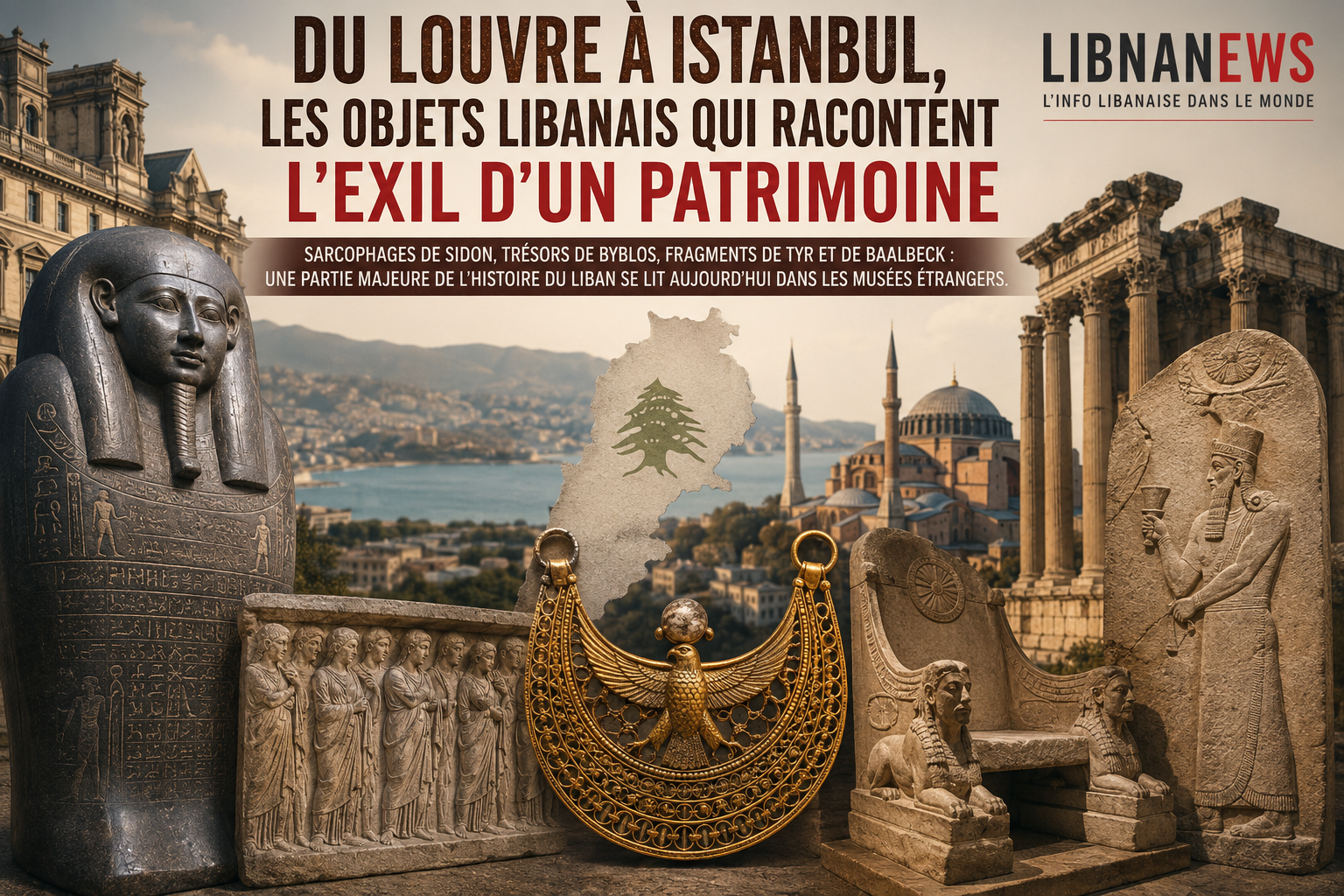
Sarcophagi of Sidon, treasures of Byblos, fragments of Tyre and Baalbeck: a major part of Lebanon’s history is today read in foreign museums.

There is a discrete geography of Lebanese heritage. It is not only in Baalbeck, Byblos, Tyre, Sidon or the Beirut National Museum. It also reads in Paris, Istanbul, London and Berlin. In these museums, often at the turn of a hall dedicated to the ancient East, the Mediterranean or the Roman Empire, objects from the present Lebanon appear. They’re not secondary. They are sometimes among the most important witnesses of Phoenician, Hellenistic or Roman history in the region.
These objects pose a sensitive question. Were they stolen? Were they given? Were they legally acquired? Have they left the country before Lebanon exists as a modern state? The answer is not unique. This is precisely what makes the subject interesting. Lebanese heritage held abroad is not the product of a single moment or a single mechanism. It is the result of several historical layers: the Ottoman Empire, the 19th century European scholarly missions, the antiquities market, the consular networks, then the excavations of the French Mandate and the sharing or donation of objects for the benefit of French institutions.
The facility must therefore be avoided. Not everything can be summed up by the word « vol ». But not everything can be neutralized behind the words The legality of an era does not always say much about the balance of power that produced. And the history of Lebanese heritage outside Lebanon tells this first: a very ancient territory, searched, described, admired, collected, but for a long time deprived of the political capacity to defend its own antiquities.
Sidon at the Louvre: the sarcophagus that prohibited it being moved
The most striking case is the sarcophagus of Eshmunazor II. Discovered in Sidon, in the necropolis of Magharat Tabloun, in 1855, it is now preserved at the Louvre. The object is spectacular. It is an Egyptian anthropoid sarcophagus, made of dark stone, bearing a long Phoenician inscription. This inscription is one of the most famous in the Phoenician world. It gives the name of the king, evokes his lineage, mentions his mother Amoashtart and recalls the shrines built at Sidon.
But it is also an almost cruel object in what it tells. The inscription contains a curse against those who would open the grave or move the sarcophagus. It explicitly prohibits the taking away from the place of rest. But that’s exactly what happened. The sarcophagus left Sidon in the 19th century to enter the French collections.
The tour of this piece illustrates the networks of the era: consuls, antique dealers, collectors, scholars, families of intermediaries and large museum institutions. Lebanon does not yet exist as an independent State. Sidon is in the Ottoman Empire. But the result, seen from contemporary Lebanon, is clear: one of Sidon’s most important royal Phoenician documents is preserved in Paris.
It’s not just a funeral object. It’s a political document. He speaks of Sidon as a kingdom, a dynasty, a local elite, temples, relations with neighbouring powers. Its departure to Paris must be read in the context of the nineteenth century Ottoman, when the major European oriental collections are formed through missions, purchases, donations and antique circuits whose countries of origin do not master the rules.
Sidon in Istanbul: The royal sarcophagi centralized by the Ottoman Empire

The other major Sidonian chapter is in Istanbul. In 1887 and 1888 Osman Hamdi Bey, director of the Ottoman Imperial Museum, conducted excavations of the Royal Necropolis of Sidon. From these excavations come some of the greatest sarcophagi of Mediterranean Antiquity: the so-called sarcophagus of Alexander, the sarcophagus of Tabnit, the sarcophagus of Crying, the sarcophagus of Satrape and the Lycian sarcophagus of Sidon.
Here, the case is different from the Louvre. The sarcophagi do not go to a competing European capital. They left for Istanbul, the capital of the Empire of which Sidon was then a member. It is therefore not a European colonial plunder in the classical sense. It is an Ottoman imperial centralization. But seen from the current Lebanon, the result remains brutal: the royal necropolis of Sidon has delivered masterpieces that have become the heart of a foreign museum.
The so-called sarcophagus of Alexander perfectly illustrates this ambiguity. It did not contain Alexander the Great. Its name comes from carved scenes where Alexander is recognized in scenes of battle and hunting. The object is probably related to the royal elite of Sidon in Hellenistic times. Its artistic value is immense. Its symbolic value is as much: a major Sidonian coin has become an emblem of Istanbul.
This transfer reveals a long forgotten reality: before being caught between the great European powers, the heritage of the present Lebanon was also integrated into the Ottoman administrative and museum logic. The sarcophagi of Sidon are therefore both Lebanese by their origin, Ottoman by their search frame, Turkish by their present conservation, and universal by their historical importance. It is precisely this superposition that makes any restitution debate complex.
London and the Sidonian sarcophagi: the imperial market of antiquities
The British Museum also preserves objects from Sidon, including an anthropoid coffin lid made of Sidonian white marble. This type of object refers to another mechanical: that of the imperial market of antiques. The objects circulate through searches, sales, acquisitions, intermediaries, collectors, consuls and merchants.
The British, French, German and other museums do not just receive isolated rooms. They are gradually organizing a world narrative in which the ancient East is exposed far from its original places. In this account, Sidon becomes a showcase of Phoenician funeral art. But Sidon herself loses some of his strongest witnesses.
The object held in London does not have the same fame as the sarcophagus of Eshmunazor or the sarcophagi of Istanbul. However, he recalls that dispersal does not concern only the most well-known masterpieces. It also affects intermediate pieces, fragments, inscriptions and objects that make it possible to understand a civilization as a whole.
Byblos and the Louvre: Heritage under Mandate

Byblos occupies a special place in French collections. The links between the Louvre and Byblos date back to the French archaeological research conducted in the region since the 19th century. They intensified mainly with the excavations of Pierre Montet in the 1920s, at the time of the French Mandate.
That is essential. This is not an underground extraction. The records refer to donations, searches, administrative decisions. But the political context cannot be ignored. The major excavations of Byblos take place within the framework of the French Mandate. Greater Lebanon exists, but it is not a fully sovereign state. Local institutions are placed in a relationship of dependence on proxy power.
Among the most famous objects is Byblos’s pectoral gold, found in 1923 in the royal necropolis. This Egyptian-inspired object illustrates the ancient ties between Byblos and Egypt. It’s not just a jewel. It tells the opening of Byblos on the eastern Mediterranean, the diplomatic, religious and artistic exchanges of the Middle Bronze, and the importance of a city that was one of the great ports of the Levant.
That such an object is today in the Louvre rather than in Lebanon obviously raises questions. The official answer is the donation after searches. Historical reading is more nuanced: this gift comes in a context where France holds political authority over the territory. It would be abusive to automatically talk about theft. It would be just as abusive to act as if the notion of gift, under Mandate, had exactly the same meaning as between two sovereign States.
In Byblos again, the Louvre preserves votive figures discovered in the temple of Baalat Gubal, sometimes associated with the so-called deposit of the golden calf. These pieces recall the importance of local cults and the Lady of Byblos. They also describe how the Mandate’s excavations fed both Lebanese and French collections.
Yehawmilk’s stele: Byblos cut in half

Another major piece is the statue of Yehawmilk, King of Byblos. It represents the king offering a cup to the Lady of Byblos, in an iconography mixing Phoenician, Egyptian and Persian influences. This type of object shows that Phoenician history is not a closed story on itself. It consists of exchanges, borrowing, traffic and adaptations.
But Yehawmilk’s stele also tells another story. A part of the object is outside Lebanon, while a fragment is kept in Beirut. This detail is striking. The same stele, the same royal memory, the same inscription are divided between two places. Paris retains the essentials of the play. Beirut keeps a fragment. This sums up, better than a long speech, the fragmentation of Lebanese heritage.
The stele is not only a religious object. It shows the King of Byblos in his role as mediator between the city and his guardian divinity. It recalls the importance of the Lady of Byblos, the permanence of local cults and the absorption of iconographic elements from Egypt and Persia. The ancient circulation of artistic forms is one thing. The modern circulation of objects to foreign museums is another.
The Louvre also has the statue of Osorkon I found in Byblos, in the temple of Baalat Gubal. It is an Egyptian statue, but its Lebanese history is essential because it bears an inscription linked to Byblos and his kings. Again, a complementary fragment is kept in Beirut. The memory is therefore cut between several institutions.
Tyre and Umm el-Amed: Renan mission and Phoenicia exhibited in Paris

The 19th century French played a central role in the scholarly construction of the Phoenicia. Ernest Renan, sent to the Levant as part of a scientific mission, helped to raise awareness of Phoenician sites, but also to transfer objects to France. Umm al-Amed, near Tyre, is a major example.
In particular, the Louvre retains a votive throne from Umm el-Amed, whose armrests are made of sphinxes and whose file bears a winged disc. Umm el-Amed is less known to the general public than Tyre or Byblos. Yet the site is fundamental to understanding late and Hellenistic Phoenicia. The inscriptions, architectural fragments and votive objects from them document the cults, elites and religious organization of a territory linked to Tyre.
Again, the question is not just that of the spectacular object. In archaeology, fragments, lintels, steles, inscriptions and pieces of architecture are essential. They allow us to read the names of dedicants, deities, institutions, religious practices, contacts with other worlds. Their dispersion weakens the overall understanding of the origin site.
For Tyre, the Louvre also maintains Phoenician inscriptions and fragments related to the city or its region. These objects are not curiosities. They are administrative, religious and political pieces of Tyrian history. They tell the institutions of the city, the sanctuaries, the deities, the relations with Hellenistic sovereigns.
In Paris, these objects interact with other collections in the ancient Middle East. But they have less dialogue with their original territory. This territory gives objects an important part of their meaning. A Tyre stele is not only a Phoenician text. It is a document related to a place, a city, a sacred and political geography.
Baalbeck between Berlin and Paris: attention to myths, but not silence

Baalbeck is the most spectacular case, and sometimes the most conducive to confusion. You have to be precise. It is sometimes said that a seventh column of Baalbeck would be in Berlin. The formula is attractive, but it probably simplifies things too much. The six remaining columns of the Jupiter temple are still in Baalbeck. On the other hand, Berlin retains many elements and reconstitutions related to the shrine of Jupiter Héliopolitain.
German research in Baalbeck was encouraged after the visit of Emperor William II in 1898. German archaeology then produced surveys, studies, publications and reconstructions that helped to bring Baalbeck into the European museum imagination. In Berlin, some elements related to the sanctuary give the visitor the impression of finding a piece of Baalbeck architecture away from the Bekaa.
Therefore, one approximation should not be replaced by another. To say that an entire column of Jupiter’s temple would simply have been ripped off and transported to Berlin would be too fast. But to say that there is nothing Baalbeck in the great foreign museums would be false. Baalbeck has also been integrated into this history of surveys, fragments, reconstructions, displacements and European staging of ancient monuments.
Baalbeck is also present in the Louvre by other objects, notably the bronze known as the Heliopolitan Jupiter, sometimes associated with the Sursock collection. This case is different from German searches or French missions. It goes through a private Lebanese collection. It recalls the role of large families and collectors in the circulation of antiques. Not all of the objects left from Lebanon went out through foreign searches. Some have circulated by purchase, sale, succession or private market.
Four dispersal mechanisms
The history of Lebanese objects in foreign museums is based on four main mechanisms.
The first is Ottoman imperial centralization. Sidon’s sarcophagi sent to Istanbul are the strongest example. At the time, Sidon was in the Ottoman Empire. Istanbul presents itself as a legitimate conservation capital. But this imperial logic deprives territories of their own founding objects.
The second is the 19th century European scientific mission. Renan, Clermont-Ganeau and others explore, document, publish, but also collect. Objects then enter European museums as mission results. Science and appropriation are moving forward together. It’s uncomfortable to say, but it’s historically accurate.
The third is the antique market. Items go through consuls, merchants, collectors, private families. Museum records sometimes give the names of sellers, former owners or donors, but not always the exact conditions of exit.
The fourth is the search system under Mandate. Byblos is the most sensitive case. Donations to the Louvre are documented. But they are made in a context of French political domination. The word « don » cannot therefore be read as an exchange between two fully sovereign states.
Should we ask for them back?
The question of restitution cannot be settled by slogan. Some objects came out before the creation of modern Lebanon. Some have been transferred to an old legal framework. Some were purchased. Some were given. Others may have left the country in less clear conditions. Each file must be reviewed separately.
But one thing is certain: the great foreign museums can no longer present these objects as mere oriental parts of their territory. They must clearly explain their provenance, the circumstances of their discovery, how they were acquired and the political context of their exit. The public has a right to know.
Lebanon, for its part, has a responsibility. It is not enough to denounce the dispersion of the heritage. There is a need to document, inventory, negotiate, strengthen the Office of Antiquities, protect sites, modernize museums, digitize archives and build a long-term strategy. A State that does not protect its living heritage will find it difficult to claim its scattered heritage.
Between full return and status quo, there are intermediate solutions: long-term loans, temporary exhibitions in Lebanon, digital copies in high definition, co-commissariat of exhibitions, more honest cartels, shared research programmes, restitution of isolated fragments when their complement is already in Beirut, and especially official recognition of the Lebanese origin of major pieces.
A memory outside the walls
These things are not silent. They talk about Sidon, Byblos, Tyre and Baalbeck. They speak of kings, temples, cults, exchanges with Egypt, Persian domination, Hellenistic world, Roman Empire. But they also talk about another story: that of a country whose objects were displaced before the Lebanese State could defend them.
The sarcophagus of Eshmunazor in Paris, the royal sarcophagus of Sidon in Istanbul, the Byblos pectoral gold in the Louvre, the Yehawmilk stele shared between Paris and Beirut, the votive throne of Umm el-Amed, the fragments of Tyre, the elements of Baalbeck in Berlin: all tell the same reality. Lebanese heritage is not only in Lebanon. It is scattered in the windows of the world.
The problem is not that these objects are admired elsewhere. The problem is that sometimes they are without their full story being told. Their origin is not a cartel detail. It is at the heart of their meaning.
In foreign museums, these pieces are often presented as masterpieces of Phoenicia, the Levant or the Ancient East. For Lebanon, they are something else: pieces of a national memory that precedes the nation itself. A memory taken, transferred, sometimes offered, sometimes bought, sometimes centralized by empire, sometimes absorbed by the major European institutions.
The debate is just beginning. He must not be caricatural. But it must not be avoided. For behind every window there is a simple question: what remains of a country when its stones, its kings, its gods and its inscriptions tell their story away from it?
Photo credits:the images included in this article come from Wikimedia Commons and are used under Creative Commons licenses, with attribution preserved in the legends. The photos are not modified.