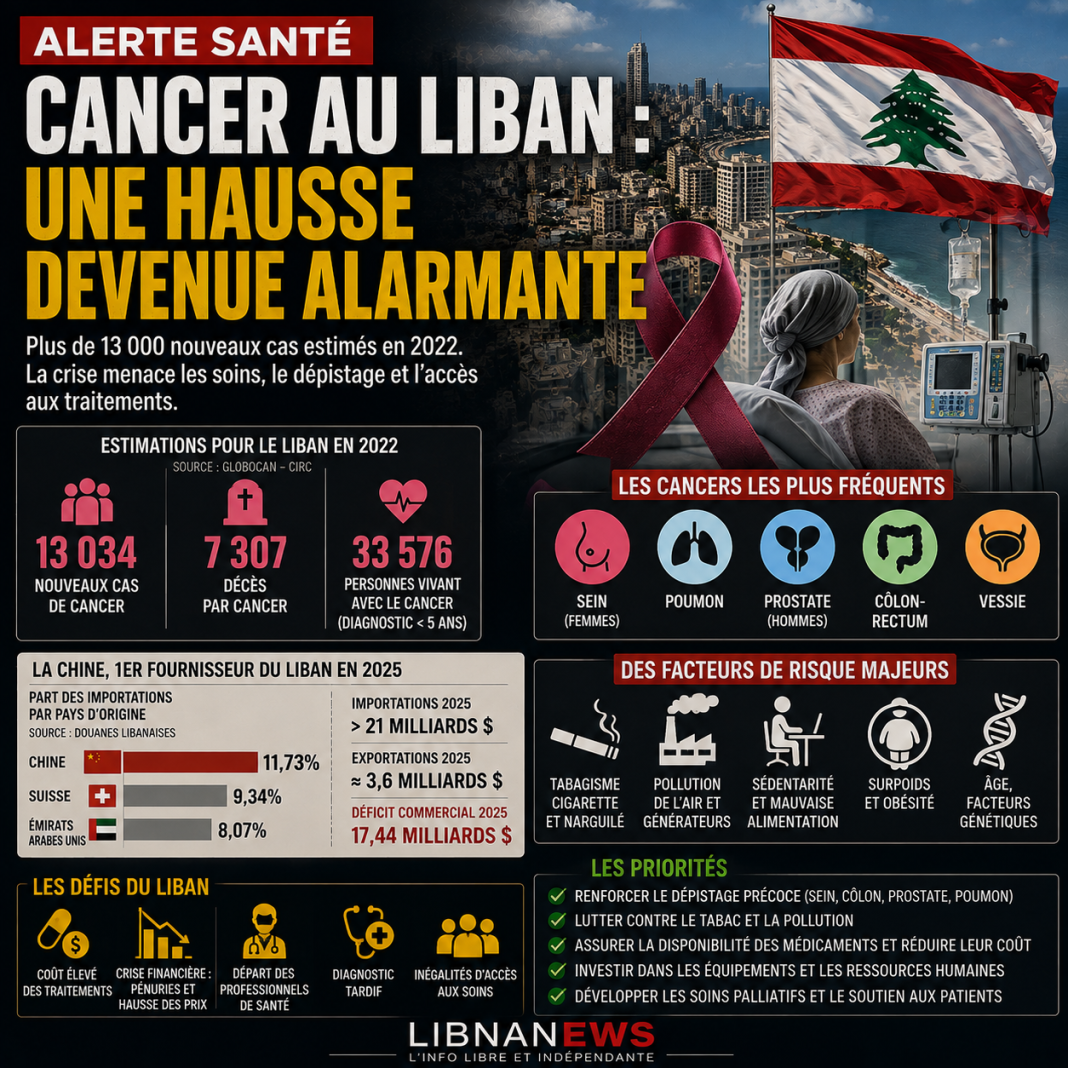






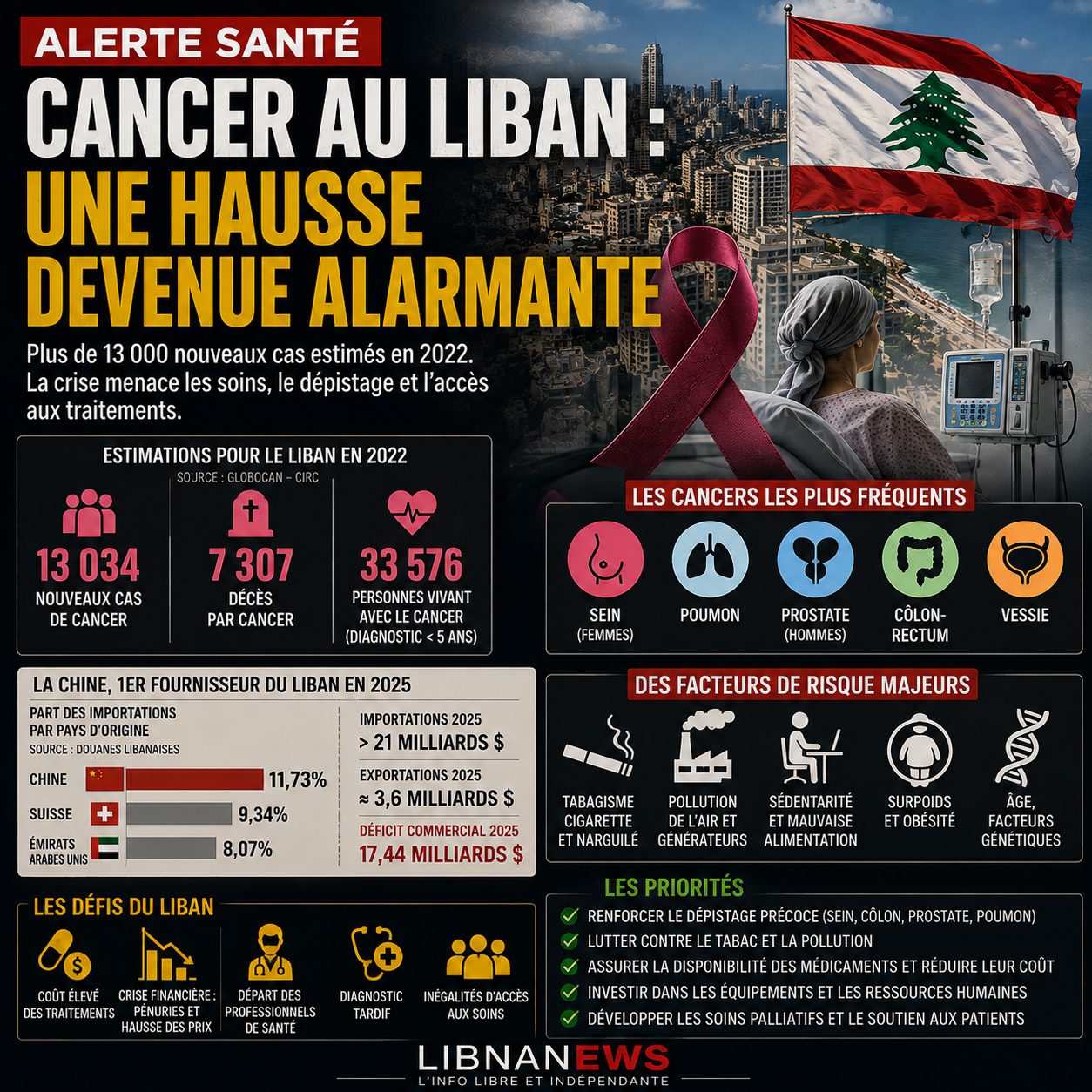
Lebanon faces an increase in cancer, which now places the disease among its main public health challenges. In 2022, international estimates reported approximately 13,034 new cases and 7,307 deaths, while 33,576 people were still living with a diagnosis made in the previous five years. Breast cancer, lung cancer, prostate cancer, colorectal cancer and bladder cancer are among the most common forms. The long-term data available show, above all, that the problem is not an unusually bad year: the number of new cases has grown rapidly since the 1990s and the Lebanese health authorities now call the situation alarming. This increase occurs in a country where the financial crisis has weakened medical coverage, caused shortages of medicines and accelerated the departure of health professionals. For the Ministry of Public Health, hospitals and families, therefore, the issue goes far beyond the treatment of new patients: tens of thousands of care routes must be financed while developing screening and acting on avoidable risk factors.
The 2022 figures must be interpreted accurately. The 13,034 new cases, 7,307 deaths and 33,576 people living with a recent diagnosis come from the International Centre for Cancer Research’s GLOBOCAN estimates. They are used to compare countries according to a harmonized methodology and do not correspond to a comprehensive administrative census of each patient treated in Lebanon. At the same time, the Ministry of Public Health has the National Register of Cancer, which is supported by medical declarations, data on anatomopathology, haematology and an active collection system. Both systems can therefore produce slightly different levels depending on the reference population and method used. However, they converge on one reality: cancer weighs heavily on mortality, health spending and hospital capacity.
The problem is all the more important because cancer does not only produce an annual flow of new patients. People diagnosed in previous years often remain in the care system for several years. Some are undergoing chemotherapy, hormone therapy, targeted therapy or immunotherapy. Others must perform regular reviews to monitor a recidivism. Others finally live for a long time with a metastatic disease that has become partially controllable thanks to modern treatments. Each new year, therefore, adds new patients to an already monitored population, which mechanically increases the need for consultations, drugs, imaging, radiotherapy, surgery and support care.
An increase in cancer over several decades
The evolution over several decades is one of the most worrying aspects. An international analysis published in 2025 covering the period 1990-2023 identified Lebanon as one of the fastest growing countries of new cancers. The average increase was estimated at around 4 per cent per year over this long period. This does not mean that the individual risk increases mechanically by 4% each year. Part of the evolution results from an ageing population, population growth and better detection. But the pace remains high enough to force the authorities to also examine the modifiable factors that can contribute to this burden.
The Ministry of Health itself reported in 2026 an incidence of 224 cases per 100,000 inhabitants in the data used in its public campaigns. This figure should not be compared directly, without precaution, with international standardized rates, as reference methods and populations differ. However, it confirms the importance of cancer in Lebanon’s health profile. At the same time, the Ministry recognizes a delay in awareness and early diagnosis, while the benefit of rapid detection is crucial for several frequent tumours.
The figure of 33,576 people living in 2022 with a diagnosis made in the previous five years makes it possible to measure pressure better. A woman treated for breast cancer may require hormonal treatment, radiological examinations and consultations for several years. A man treated for prostate cancer can be followed by regular biological tests. A patient with colorectal cancer may have to undergo several procedures, chemotherapy and endoscopic checks. A person with metastatic cancer can be treated for years. The system must therefore accompany very different patients, from initial diagnosis to long-term surveillance.
This accumulation transforms the organization of care. The number of beds available is not the same as the number of beds available. It involves day hospitals, specialized pharmacies, operating units, anatomopathology laboratories, molecular biology, imaging, radiotherapy and palliative care teams. It also requires trained nurses, medical physicists, manipulators, hospital pharmacists and technicians capable of maintaining complex equipment. A shortage of staff in one link can delay the entire journey.
Breast cancer remains at the forefront
Among women, breast cancer remains the first challenge. Lebanon has long had awareness and mammography campaigns, but their effectiveness depends on the continuity of the course. Abnormal mammography should be followed rapidly by ultrasound, biopsy and anatomopathological analysis, followed by appropriate treatment. A screening campaign loses some of its interest if a patient discovers an anomaly but abandons additional examinations for financial reasons.
The economic crisis has weakened this continuity. Many households saw their real income collapse after 2019, while medical and hospital rates were gradually getting worse. Low-cost mammography may remain accessible, but additional examinations, transportation, consultations and lost work days can become difficult to finance. The fight against breast cancer therefore involves thinking of screening as a complete chain, not as an isolated examination.
The stage at which the disease is detected remains decisive. Localized cancer can often be treated with much better prospects than a disease discovered after metastatic diffusion. Late diagnosis also leads to heavier treatments, more imaging and more expensive medication. Strengthening screening is thus both an issue of survival and control of health expenditures.
Lung reveals the weight of smoking
Another major signal is lung cancer. Lebanon maintains a high level of exposure to tobacco, whether cigarettes or nargile. The National Cancer Registry and work in Lebanon reported over 1,000 lung cancer diagnoses per year in recent series and a particularly high incidence at the regional level, especially among women. Smoking remains one of the best established risk factors and is therefore a priority target for prevention.
The nargile is a specific problem because it retains a social image often less negative than that of cigarettes. Exposure to smoke, carbon monoxide and various toxic substances can be significant. An effective policy should combine taxation, advertising restrictions, a real ban on smoking in the places concerned, prevention among adolescents and access to weaning. These measures can affect several cancers but also cardiovascular and respiratory diseases.
The question is also budgetary. Treating advanced lung cancer may require chemotherapy, immunotherapy, radiation therapy, molecular examinations and repeated imaging. A policy to reduce smoking acts much more upstream and on a much larger population. In a system with limited resources, therefore, prevention is not a secondary expenditure: it potentially avoids part of the future medical costs.
Pollution and generators add environmental concern
Air pollution adds additional concern. Road traffic, some industrial sites, fires and massive dependence on diesel generators have for years exposed a portion of the population to significant concentrations of pollutants. It would be scientifically incorrect to assign a precise proportion of Lebanese cancers to generators or pollution without any long-term specific studies. Cancer often has a significant latency period and several factors can work in the same patient.
But the reduction of fine particulates and pollutant emissions remains an independent health priority. Its potential benefits go far beyond oncology and include cardiovascular, respiratory and premature mortality. Improving the public supply of electricity and the diffusion of solar energy can therefore generate indirect health benefits if they reduce the use of generators in densely populated urban areas.
Successive conflicts add another unknown. Bombing, fire, destruction of buildings and accumulation of debris may expose populations to different pollutants. It would be premature to attribute the current increase in cancers to recent wars, as many tumours develop after long periods of latency. However, the absence of immediate evidence should not prevent environmental monitoring.
Prostate, colon and bladder complete the table
In men, prostate cancer is one of the most common locations. Its impact increases with age, which means that population ageing is expected to maintain significant pressure on the services of urology and oncology. The ministry also integrated this pathology into its awareness campaigns in 2026. The question of screening should be individualized according to age, family history and medical recommendations to avoid both late diagnosis and unnecessary testing.
Colorectal cancer affects both sexes and is another area where secondary prevention can have a significant effect. Some pre-cancerous lesions can be detected and removed before transformation. The Ministry has national recommendations on screening, including by searching for occult blood in stools followed, where indicated, by colonoscopy. The main issue remains the large-scale application. A recommendation becomes a public health policy only when a significant proportion of the target population actually has access to it.
The bladder cancer completes the table of frequent locations. Smoking is also a major risk factor for this disease. The simultaneous presence of lung cancer and bladder cancer among frequent diagnoses suggests that the same prevention policy can affect several pathologies. The cost of an anti-smoking campaign must therefore be compared not only with the oncological treatments avoided, but also with all cardiovascular and respiratory complications that it can help reduce.
More than 7,300 deaths highlight the urgency of early diagnosis
The 7,307 deaths estimated in 2022 also show that the problem is not limited to incidence. These deaths obviously do not correspond to the 13,034 people diagnosed in the same year: many patients who died in 2022 had previously been diagnosed. But the level of mortality shows the importance of the stage at which the disease is discovered and of rapid access to treatment. Two health systems with a comparable incidence can achieve very different results depending on their ability to identify cancers early.
Early diagnosis also has an economic dimension. Localized tumours can sometimes be treated with surgery with limited complementary treatment. Metastatic disease often requires several therapeutic lines, more imaging, hospitalizations and expensive drugs for a long time. Investing in screening is not only a preventive measure: it is also a way to reduce part of the future cost of oncology, although not all advanced cancers can be avoided.
Mortality must also be better documented. The Ministry has a hospital system for reporting causes of death, but full monitoring requires uniform certification and coverage as wide as possible. Knowing the number of new cases is not enough. It is necessary to determine which cancers kill the most, at what age, in which regions and after what path of care.
Modern treatments improve survival but exploding costs
Therapeutic advances have transformed the survival of some patients. Targeted therapies, monoclonal antibodies and immunotherapy opened up possibilities that did not exist twenty years ago. Some people with advanced cancers can now live several years with a controlled disease. This is a major medical development, but it also changes the structure of expenditures: treatment may have to be administered for many months and cost a lot.
The data published by the Ministry had already shown before the crisis the disproportionate budgetary burden of certain immunotherapy. Pembrolizumab and nivolumab accounted for a very large part of the cost of treating lung cancer, while they involved a limited fraction of the beneficiaries. Since then, the number of innovative molecules has increased further. The challenge for the state is therefore to finance innovation without making the system unsustainable.
This equation reinforces the importance of precision medicine. When treatment only works in patients with a particular mutation or biomarker, the diagnostic test becomes an economic as well as medical condition. Prescribing correctly avoids mobilizing tens of thousands of dollars for therapy that the patient is unlikely to benefit from. However, this requires laboratories, qualified personnel and reimbursement procedures for molecular examinations.
The use of biosimilars and generics where their effectiveness and safety are demonstrated is also a lever. The department can negotiate prices, consolidate purchases and use national protocols to avoid unjustified prescription deviations. A few points of reduction on very expensive treatments can represent large amounts when they are multiplied by several thousand patients.
The 2019 crisis turned cancer into a financial test
The 2019 financial crisis hit this system at the worst moment. The collapse of the pound, banking restrictions and the decline in public budgetary capacity have disrupted the import of medicines. Repeated shortages have affected cancer treatments. Families had to search for certain molecules from associations, relatives abroad or alternative circuits. For a disease treated with specific cycles, prolonged rupture can compromise the therapeutic strategy and cause considerable anxiety.
At the same time, hospital funding was disrupted. A significant part of the care was recompensated, while public agencies and insurers were gradually adjusting their rates. The result is an increase in direct payments by households. In oncology, this transformation is particularly heavy because the expenses accumulate: consultations, analyses, medicines, scanner, MRI, surgery, transportation, home care and sometimes temporary loss of income.
This reality creates inequality before the disease. A family with strong private insurance, dollar income or diaspora support can generally mobilize resources more quickly. A person dependent on a local salary or public cover may be forced to wait or seek associative assistance. The risk is that the medical prognosis will be influenced by financial capacity even before treatment begins.
The diaspora thus plays an important but difficult role to quantify. Families finance medicines, examinations or hospitalizations through transfers from the Gulf, Europe, North America, Africa or Australia. This solidarity cushions part of the crisis, but it cannot replace a national hedging mechanism. A health care system cannot depend on whether or not a parent can send dollars.
Ministry reports tripled drug distributions
However, the authorities claim to have improved supply. Rakan Nassereddine reported that the number of cans of cancer drugs distributed by the ministry had increased from approximately 65,000 in 2024 to nearly 200,000 in 2025. This increase shows a partial restoration of public capacity after the most severe years of shortage. It does not make it possible to conclude that all needs are covered, but it is an important development in a sector where continuity of treatment is essential.
However, the distribution must be accompanied by strict traceability. Anticancer drugs are expensive, rare and likely to fuel diversions when they are lacking in the market. Digital prescribing and tracking systems can limit double issuances, monitor indications and better predict stocks. More rigorous management can release resources without immediately increasing the budget.
Procurement planning must also be multi-year. The department cannot wait for each shortage to determine the amount of drugs required. The National Cancer Registry can be used to anticipate volumes depending on the number of new diagnoses, indications and therapeutic protocols. This articulation between epidemiology and public procurement is essential to reduce ruptures.
However, funding remains the core issue. The more the incidence increases and the longer patients live through the treatments, the more people need drugs. Medical progress is therefore paradoxically increasing budgetary pressure. New diagnoses and patients already stabilized under treatment must now be funded simultaneously.
Lebanese hospitals retain a major asset: their skills
Lebanon retains an important asset: its medical capital. Several university hospitals have teams capable of treating complex cancers, practicing modern radiotherapy, specialized surgery, haematology and precision medicine. Universities train doctors and researchers who also find their place in major international centres. This expertise is an essential basis for rebuilding a national oncological policy.
However, the crisis has accelerated the emigration of doctors, nurses, pharmacists, technicians and medical physicists. Technology does not replace staff. A radiotherapy accelerator requires a specialized team. A molecular biology laboratory requires specific skills. A paediatric oncology unit cannot function properly without experienced nurses and multidisciplinary coordination.
Preserving human resources must therefore become as important a goal as purchasing new equipment. Skilled professionals may leave the country when their income, working conditions or research opportunities become insufficient. Their replacement takes several years. The departure of a specialist is not limited to a vacancy: it may reduce the capacity of an entire service to handle certain cases.
Maintaining quality medicine also requires maintained equipment. Radiotherapy, imaging and laboratories depend on spare parts, maintenance contracts and often imported consumables. A prolonged breakdown may require patients to move to another facility or delay treatment.
The National Cancer Registry becomes a strategic tool
The National Cancer Registry is another essential tool. The Department indicates that the data are collected by passive physician reporting and active collection to identify incident cases confirmed by histopathology or haematology. Tables 2022, 2023 and 2024 now allow for improved observation after several years of delayed publication. This continuity must be preserved, as a public health policy cannot be driven with too old data.
The register must also be able to measure territorial and social differences. A national average may mask differences between Beirut, Mount Lebanon, the North, Bekaa or the South. Variations may result from age structure, behaviours, access to diagnosis or specific exposures. Identifying them would allow for more effective targeting of screening campaigns and hospital resources.
Finally, the data should be used to study trends by location. A progression of lung cancer does not require the same interventions as an increase in colorectal cancers. Prevention policies, screening campaigns and hospital investments must be adapted to the changes observed.
The Register can therefore become a financial planning tool. By estimating the number of new patients by cancer type and stage, the ministry can better predict the need for drugs, radiation therapy and surgery. The quality of the data becomes directly related to the ability to control spending.
Prevention can no longer remain secondary
Lebanon will not be able to finance indefinitely a strategy of waiting for advanced cancers and then buying the most expensive treatments available. Tobacco control, papillomavirus vaccination, breast and colorectal cancer screening, reduction of obesity and promotion of physical activity can prevent or identify some cancers earlier.
This does not mean that cancer would always be preventable by individual behaviours. Many patients develop the disease without clearly modifiable risk factors. Prevention must never become a means of making the sick feel guilty. Its goal is to reduce the exposure of the entire population to known risks when effective interventions exist.
The role of primary care is crucial here. A family doctor or health centre may identify a smoker who requires withdrawal assistance, remind a patient that she must perform a mammogram or propose a colorectal screening to a person in the age group concerned. Large hospitals cannot perform this function alone.
Finally, prevention requires political continuity. An annual campaign of a few weeks cannot permanently change behaviour if cigarettes remain readily available, if bans are not enforced or if screening disappears after the campaign is over. The department must therefore move from an event logic to an ongoing strategy.
Wars now require environmental monitoring
Successive conflicts add another question. Bombing, fire, destruction of buildings and debris deposits can expose populations to different pollutants. It would be premature to attribute a precise increase in cancer to recent wars, as many tumours develop after long periods of latency. On the other hand, lack of immediate evidence should not prevent surveillance.
Measuring air, water and soil in heavily affected areas would provide usable data in the coming years. This monitoring should identify the substances present, their concentration and duration of exposure. Cohorts could then be followed when scientific conditions permit.
This must remain rigorous and independent of political assertions. Standardized sampling, identified laboratories and published protocols are needed to establish a possible relationship between exposure and disease. Lebanon has universities capable of contributing to this work, but their funding must be stable enough to monitor the population for several years.
The objective is not just about cancer. Some exposures may also affect respiratory, cardiovascular, neurological or reproductive systems. Properly organised environmental monitoring can therefore serve several public health policies at the same time.
Aging announces lasting pressure on the system
Even if the main risk factors remained stable, the absolute number of cancers could continue to increase because an increasing proportion of the population reaches the ages when the disease becomes more common. Population ageing therefore requires planning at 10 or 15 years.
How many radiotherapy devices will be needed? How many oncologists and specialized surgeons will have to be trained? What amount of drugs should be funded each year? How many screening centres will be needed outside Beirut? These issues must be addressed before the demand exceeds existing capacity.
The same reasoning applies to palliative care. Not all patients can be cured and some will need pain control, psychological support and home care. Developing these services does not mean giving up treatment; The aim is to improve the quality of life when the disease is advanced.
Families must also be supported. Cancer can impose several months of work stoppage on a patient or accompanying relative. The economic impact therefore exceeds the hospital bill and affects the productivity, incomes and sometimes the schooling of children when a household has to reorganise all its expenditure.
The next challenge will be to measure whether the increase continues
Lebanon now has sufficient solid elements to consider cancer as a sustainable national priority. The 2022 estimates measure the burden: more than 13,000 new cases, more than 7,300 deaths and more than 33,000 people living with a recent diagnosis. Long-term data also indicate a rapid increase in the number of cancers, while the Department recognizes a high incidence and delay in early detection.
The answer cannot therefore be reduced to one measure. Increasing drug stocks without improving screening would mean treating more advanced diseases. Organizing screening campaigns without guaranteeing the following examinations and treatments would leave some of the patients in the middle of the journey. Investing in equipment without retaining doctors, nurses and technicians would not be enough.
The Ministry has increased the distribution of drugs and now has data from the National Register up to 2024. This information should enable us to verify whether the progress observed in recent decades is continuing and which locations are increasing most rapidly. The next step will therefore be less to see the extent of the problem than to link this data to measurable objectives of prevention, screening, financing and survival, while several tens of thousands of Lebanese already live with the direct consequences of a cancer diagnosis.