






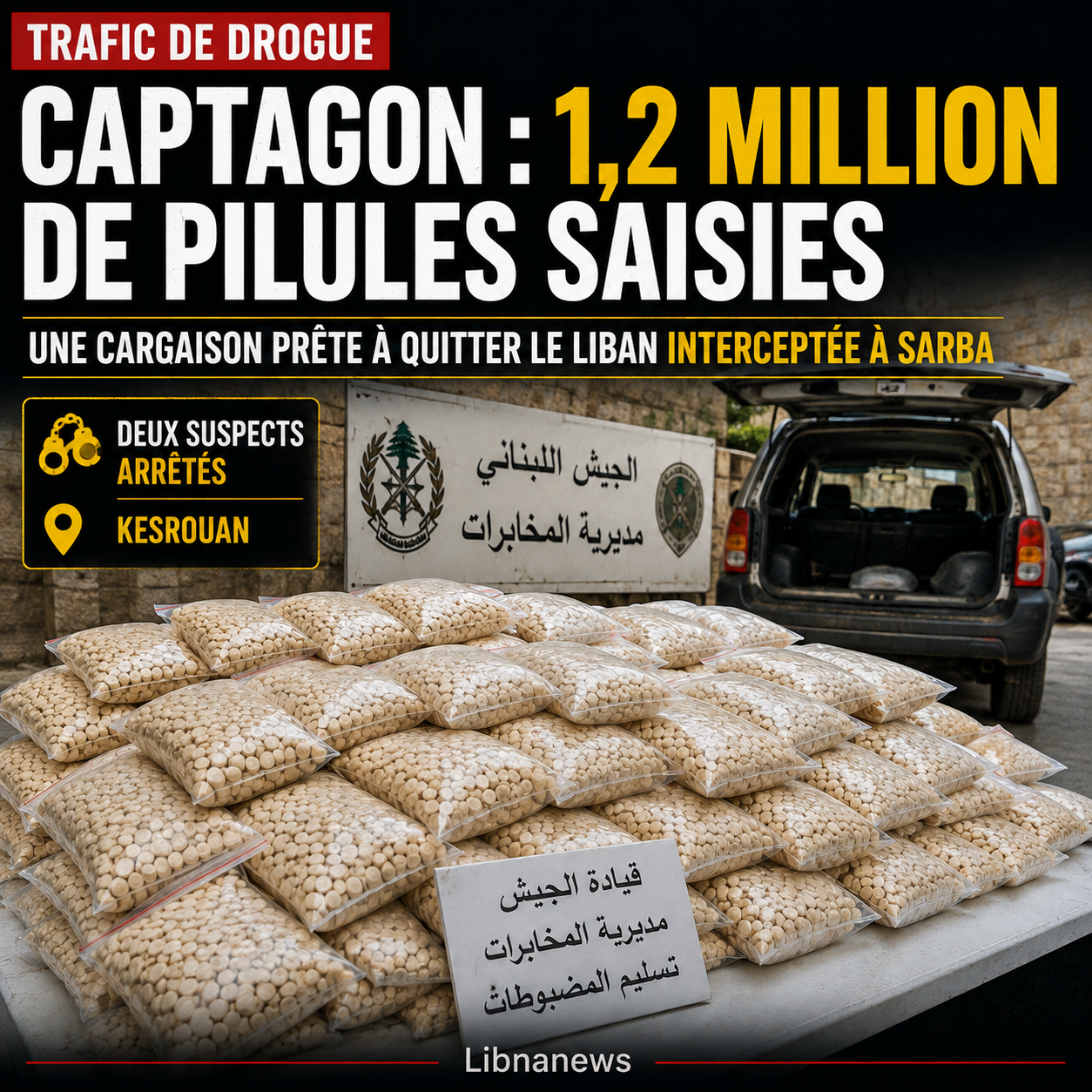
The Lebanese army seized about1.2 million captive tabletsa new operation against trafficking which had become one of the main security issues between Lebanon, Syria and the Gulf monarchies for more than a decade. Two people were arrested while packing the drug in a vehicle in theSarba, Kesrouan, north of BeirutAccording to information provided by the military institution on Tuesday, 11 August 2026. The operation is taking place at a particularly sensitive moment in Beirut: Saudi Arabia has only just lifted, in June, the restrictions imposed for almost five years on Lebanese imports, one of the main causes of which was precisely the increase in the number of captive shipments to the kingdom.
Seizure remains much lower than the record catches in Lebanon in recent years, but its importance lies as much in its destination as in its volume. The1.2 million pills were already hiding in a vehicleto be removed from the territory. The army did not publicly specify the country of destination or the market value of the cargo. She indicated that the two persons arrested had been handed over, along with the seized products, to the competent authorities in order to continue the investigation. The dossier must now be able to determine the origin of the tablets, their place of manufacture, the planned route and, above all, the identity of the network which was to take charge of their transport after leaving Lebanon.
In Sarba, a cargo already ready to leave
The operation took place away from the areas traditionally associated with drug production in Bekaa. It was in Sarba, Kesrouan, that army intelligence surprised the two suspects as they were preparing the tablets for transport. This location shows once again that the geography of the captagon is not limited to laboratories or production areas. After its manufacture, the goods cross logistic circuits that can pass through Beirut, Mount Lebanon, ports, airport or various land routes before reaching its final destination.
One million two hundred thousand tablets already represent a cargo requiring an organization. Pills must be manufactured or purchased, transported, stored, packaged and then hidden. There is then a need for a route and contacts to get them to the destination market. Seizure of a vehicle at the preparation stage can therefore provide investigators with more than just recovery of the drug: telephones, communications, financial movements and contacts of suspects can lead to a part of the chain.
Regional traffic has long been distinguished by particularly sophisticated methods of concealment. Cargoes were found in fake fruit, furniture, industrial machinery, construction materials or various products for export. By December 2021, the Lebanese authorities had discovered about9 million tabletshidden in false fruits destined for a Gulf country. By April 2023, another operation had seized approximately10 million pillswhich had to pass through Senegal before joining Saudi Arabia.
These indirect routes allow traffickers to mask the real origin of the shipments. For the Gulf countries, the question is therefore not limited to the control of a container coming directly from Lebanon or Syria. It requires the reconstitution of several logistical steps before the final finish.
One seizure after the record 64 million tablets
The catch announced this week is less than a year after a completely different operation. In September 2025, the Lebanese Armed Forces announced the seizure of64 million captive tabletsduring an operation in Bodai, Baalbek region. This was one of the most important discoveries made in Lebanon.
The search then revealed an infrastructure that was no longer simply storage or transit. The military also seized79 barrels of chemicalsused in the manufacture of narcotics and several production machines. The case had shown that industrial capacity still existed in Lebanese territory, even though the collapse of the Bashar al-Assad regime in December 2024 had upset the main regional production centre.
Comparison between the two operations makes it possible to distinguish two different fronts. In Bodai, the authorities had discovered a device associated with mass production. In Sarba, the suspects were at the packing stage of a foreign cargo. For the security forces, it is precisely at stake to intervene throughout the chain: laboratories, chemical precursors suppliers, warehouses, carriers, financiers and export networks.
The amount seized at Sarba should therefore not be interpreted as an indicator alone for measuring production trends. A decrease in the volume of a seizure can simply mean that a network was working with smaller lots. On the other hand, a record take may reflect a particularly successful operation without knowing what proportion of total production is still outside the control of the authorities.
Saudi Arabia has just reopened the door in Lebanon
The fight against captagon has a direct economic dimension for Beirut. Inapril 2021Saudi Arabia had banned the entry of Lebanese fruits and vegetables after the discovery of more than five million tablets hidden in a shipment of grenades. Riyadh then extended the restrictions to Lebanese imports, citing the authorities’ inability to prevent the use of the country as a trading platform.
The measure had hit the Lebanese producers hard. The Gulf has traditionally been one of the natural markets for domestic agriculture, particularly fruit and vegetables. The traffickers had produced a cost that far exceeded their own clandestine activity: perfectly legal exporters had lost access to an essential market because commercial shipments had been used to transport narcotics.
The context has changed since 2025. The Saudi authorities publicly welcomed the improvement of Lebanese efforts against trafficking. In November 2025, Riyadh announced its intention to strengthen its trade relations with Beirut because of the increased efficiency attributed to Lebanese services in combating drug exports. The10 june 2026Saudi Arabia finally lifted its ban on Lebanese imports, almost five years after its introduction.
Sarba was seized only two months after that decision. For the Lebanese authorities, each intercepted cargo also becomes a message to the Gulf partners: the restoration of exports can only take place if Lebanese territory ceases to be used as a point of production, transit or re-export of the captive.
The fall of Assad upset the captive economy
The most important transformation of the regional market occurred indecember 2024, with the fall of Bashar al-Assad’s regime. During the years of civil war and international sanctions, Syria had become the world centre for the production of illegal captives. International investigations had highlighted a large-scale industry, associated with officials and networks close to the former power.
After the fall of the regime, laboratories and warehouses were discovered in several regions. One of the most spectacular complexes was located west of Damascus and had been installed in an old chip factory. Discovery facilities allowed large-scale manufacturing. On-site evidence had linked the device to networks close to theMaher al-Assad, brother of the former president and former commander of the Fourth Division of the Syrian Army.
Before the fall of the regime, different estimates placed the annual value of the world’s captive trade around$10 billion. An estimate cited in the investigations conducted after December 2024 estimated that$2.4 billionthe revenues allegedly received by the networks associated with the Syrian power. These assessments necessarily remain approximate due to the clandestine nature of trafficking, but they give the measure of the economy that had developed around drugs.
The captive had become, in Syria at war, much more than a classic criminal market. Drug revenues had been presented by several Western and Arab governments as a major source of currency and funding for regime-related networks. Damascus had always rejected the accusations of the Syrian State as the organiser of the traffic.
New Syria tries to close laboratories
Since the overthrow of Bashar al-Assad, the new Syrian authorities have sought to demonstrate that they want to break with this economy. Production sites were dismantled and several large shipments intercepted. By June 2025, Syrian forces had announced, inter alia, the seizure of approximately3 million tabletsafter clashes with a network of traffickers near the lebanese border.
However, political change in Damascus does not mean the automatic disappearance of the market. The know-how, the machines, the distribution networks and especially the demand existed before Assad’s fall and continues to exist after him. The United Nations Office on Drugs and Crime still regards the Near and Middle East as the region most affected by trafficking and consumption of tablets smuggled under the name of captive.
The closure of former Syrian sites may even lead to a geographical recomposition. Producers can move small facilities, split volumes or rely more on Lebanon and other transit territories. The Beirut and Damascus authorities therefore have an interest in further coordinating their efforts, particularly on the common border.
A border of 330 kilometres difficult to control
Lebanon and Syria share about330 kilometres of border, some of which passes through mountainous regions and territories that have long been difficult to control. Official passages exist, but clandestine roads used for fuel, goods, weapons or narcotics are old.
This porosity facilitates movement in both directions. Substances or precursors can reach laboratories, tablets can be transported to Lebanon and cargo can then be redirected to international ports or roads. Control therefore does not depend solely on official border crossings.
Since 2025, the new authorities in both countries have shown their willingness to strengthen border coordination. The stakes go beyond captivity and include weapons, criminal networks and various trafficking. But drugs remain one of the issues on which the Gulf monarchies expect concrete results.
For Lebanon, the challenge is to regain control of areas where the State has long been competing with powerful local networks. Military operations in the Bekaa since 2025, arrests of several wanted traffickers and seizures of laboratories illustrate this renewed activity.
Hezbollah targeted by accusations he denies
Finally, the captagon issue has a particularly sensitive political dimension in Lebanon. American, Western and Arab officials have accused over the years of networks linked to theHezbollahhave participated in the production, protection or trafficking of captives between Syria and Lebanon. In particular, Washington has placed under sanctions several individuals identified as involved in the drug trade and linked simultaneously to networks close to the former Syrian regime and the Shiite movement.
Hezbollah still hasdenial of any involvement in the production or trafficking of narcotic drugs. He presents these accusations as a political campaign to discredit him. There is no information provided by the army concerning the seizure of Sarba at this stage that would allow the two arrested persons to be associated with Hezbollah or another political organization.
This distinction is essential. The existence of historical accusations on the captive networks does not allow for the automatic attribution of every cargo discovered to a political actor. The 1.2 million tablet survey will have to establish its own network, without extrapolation from previous cases.
The fall of the Assad regime nevertheless makes the issue particularly important. While the former Syrian structures have been dismantled, seizures since then show that drugs continue to circulate. The regional market did not disappear with the power which, according to many surveys, made it a considerable source of income.
The real test starts after the seizure
The capture of 1.2 million tablets prevents a shipment from reaching its market. It is not yet clear whether the network that produced or financed it has been dismantled. The two people arrested in Sarba can be the last links in a much wider chain.
The investigation will now have to determine where the pills came from and where they were to go. The answer will include whether Lebanon remains primarily a transit country for certain cargoes produced elsewhere or whether domestic production capacity continues to fuel the regional market despite operations since 2025.
For Beirut, the stakes go beyond the two suspects and their vehicle. After the record seizure of 64 million tablets in Bodai, the operations against traffickers and especially the lifting in June of the Saudi ban on Lebanese imports, the authorities seek to convince the Gulf countries that the change is sustainable. The seizure announced this week shows that networks are still active. The identity of those behind the1.2 million tablets of Sarbanow will tell whether these networks have simply adapted to the new regional reality or whether their infrastructure is actually beginning to decline.