






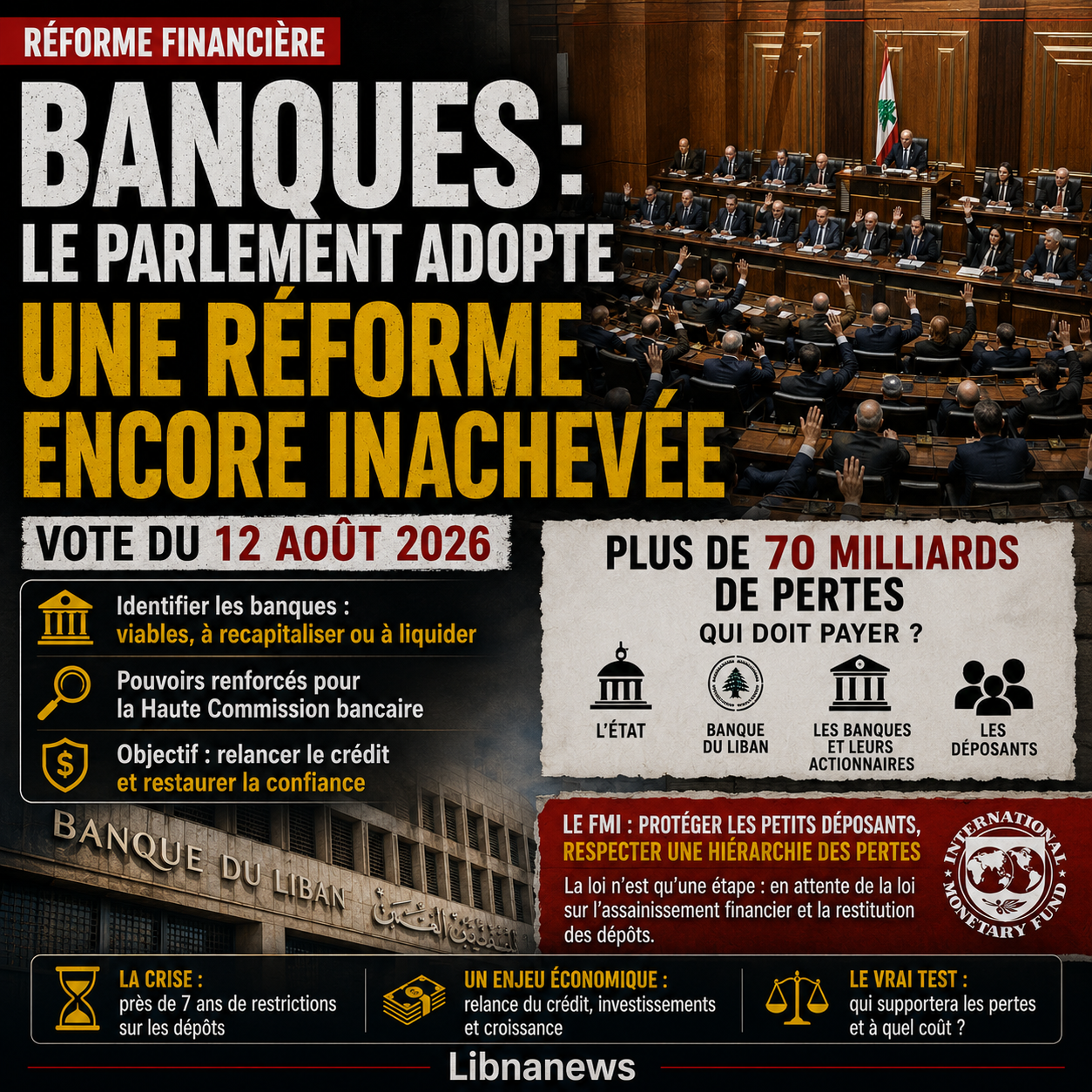
The Lebanese Parliament adopted on Wednesday 12 August 2026 the amendments to the Law on Banking Restructuring, a reform expected since the financial collapse of 2019 and considered essential for the resumption of negotiations with the International Monetary Fund. Voting is a real institutional step forward: for the first time, Lebanon has a more comprehensive framework for identifying viable banks, restructuring those that can be saved and liquidating those that can no longer be saved. But it still does not answer the question that has been a concern to depositors for seven years: who will bear the tens of billions of dollars of accumulated losses between the State, the Bank of Lebanon, commercial banks, their shareholders and depositors?
Parliament did not adopt an entirely new law on Wednesday. It amended the Bank Reform and Reorganization Act passed on 31 July 2025, after IMF had determined that several provisions still needed to be brought into line with international standards. The government had prepared new amendments in the spring of 2026, and the Finance and Budget Committee, in turn, revised them during seven meetings. The August 12 session finally re-established the government version on two sensitive issues, while maintaining against the advice of the Minister of Finance and the IMF a provision linking the treatment of certain deposits to the future « financial gap » law.
The latter remains the true core of the crisis. Banking restructuring determines how to deal with an insolvent bank; It does not create the tens of billions of dollars needed to return the deposits. Minister of Finance Yassine Jaber has recognized after the vote: the reform voted on Wednesday is just one element of a whole including the lifting of bank secrecy and above all the future law on financial consolidation and the return of deposits. Until the latter text is adopted, loss-sharing remains incomplete.
Seven years after the crisis, Lebanon is only starting to decide which banks can survive
Since October 2019, Lebanon has been living with an exceptional paradox: a banking system largely unable to return deposits, which continues to operate without general restructuring. Banks imposed informal restrictions on withdrawals and transfers, while the pound lost most of its value. The system’s losses had already been estimated at more than$70 billionin the first official assessments of the crisis. The exact amount now depends on how the Bank of Lebanon’s assets, government debt and banking sector liabilities are valued.
The law passed in 2025, now amended, must come out of this situation. It entrusts the supervisory authorities with the task of evaluating each institution. A sufficiently capitalised and functioning bank can be maintained. A deficient but still recoverable bank can be recapitalised, merged or restructured. A bank whose losses make any credible restoration impossible can be liquidated. In theory, this approach seems obvious. In Lebanese practice, it represents a break with almost seven years during which losses were socialized by devaluation, deposit restrictions and various circulars without the insolvency of each institution being definitively decided.
Restructuring must also help to boost credit. Since 2019, traditional banks have largely ceased to fulfil their fundamental function of intermediation between savings and investment. A growing part of the economy operates in cash or through the so-called « fresh » accounts, fed after the crisis and treated separately from the old deposits. This duality allows current payments to function, but it is not a normal banking system capable of financing long-term investment.
The IMF has been insisting on this issue for several years: a long-term cash-based Lebanon cannot rebuild a modern economy. Bank restructuring is therefore not only a matter of repayment of depositors. It must determine which institutions can receive new capital, regain confidence and start lending again.
What Parliament changed on 12 August
The most visible battle before the vote was over the respective powers of the High Banking Commission and the Central Council of the Bank of Lebanon. Governor Karim Souhaid wished explicitly to preserve the prerogatives granted to the central bank under the Currency and Credit Code, in particular article 70 thereof. The parliamentary committee had added a reference in Article 3 of the text that the restructuring should be carried out in accordance with this framework.
This formulation, however, concerned the Government and the IMF. The risk was that a general reference to the powers of the Central Council could be used to challenge or slow down decisions taken specifically in the context of the banking resolution. A law designed to give authority exceptional instruments to deal with insolvent banks could then be neutralized by a conflict of jurisdiction with the Bank of Lebanon.
On Wednesday, MPs finally deleted this reference to Rule 70 and returned to the formulation advocated by the government. The choice is to avoid the traditional powers of the Bank of Lebanon being used as a basis for challenging the powers entrusted to the High Banking Commission in the treatment of defaulting institutions.
A second change concerns article 13 of the original law. In particular, the High Banking Commission may impose recapitalisation, reduce the value of certain items of equity, convert certain claims into capital, organise a new issue of shares or transfer part of the assets and liabilities to another institution. The debate focused on the possibility of excluding shareholders from an increase in capital. The version finally chosen is aimed atmajority shareholders, not indistinctly all shareholders.
The distinction is economically important. The objective of a bank resolution is to absorb the losses as a priority by capital before reaching the protected creditors. But automatically excluding any existing shareholder, regardless of its responsibility or weight, could have created legal difficulties and discouraged certain capital inflows. The more targeted formulation seeks to maintain a capacity for sanction or eviction against dominant owners without treating all investors in the same way.
A third point remains in contradiction with the IMF
However, Parliament did not follow all the requests made by the Minister of Finance and supported by the IMF. In the article on the treatment of deposits in the event of liquidation, MPs maintained a reference to the future law on financial consolidation and return of deposits.
This decision may seem technical, but it affects the heart of the crisis. The IMF hopes that bank resolution rules will be as permanent, predictable and autonomous as possible. A bank that will go bankrupt in ten years will not necessarily have to be treated under the same exceptional rules as those already insolvent due to the collapse of 2019.
On the contrary, parliamentarians wanted to explicitly preserve the link with the law that must resolve the current crisis. Their argument is understandable: it would be difficult to restructure the Lebanese banks today without knowing how to deal with the old deposits, which are precisely a large part of their liabilities. The Finance Committee wants to prevent a liquidation before the adoption of the deposit text from reducing the rights of savers.
But this apparent protection also poses a risk. If the actual implementation of restructuring is constantly dependent on another law, then another regulation and then a new audit, Lebanon can continue to have legislation without effectively restructuring the banks. The country has already lost nearly seven years in this kind of chain.
What the IMF really wants
The positioning of the International Monetary Fund is often simplified in Lebanon as if it only required a series of laws to unlock billions of dollars. Its demand is more structural. The Fund wants an insolvent bank to be recognized as such, its losses to be recorded in a transparent manner and a clear hierarchy decides who to absorb them.
In a bank restructuring that complies with international standards, shareholders normally absorb losses before ordinary creditors. Leaders responsible for irregularities must be able to be prosecuted when responsibility is established. Certain categories of debt or debt can then contribute to the absorption of losses. Small depositors should be protected as far as possible, while the use of public money should be limited in order to avoid automatically transferring private losses to taxpayers.
It is this hierarchy that explains part of the disagreements between the IMF and several Lebanese economic forces. The Fund does not want a general promise to « protect deposits » to lead the state, already heavily indebted and in default since 2020, to take back tens of billions of dollars of impossible commitments to finance. Such a solution would turn a bank loss into a public debt and would then require current and future taxpayers to repay it.
IMF also emphasizes debt sustainability. Lebanon must already restructure about31 billion eurobondswhich the state failed in March 2020. Adding debt equivalent to the entire bank hole could make any economic program impossible. The Fund therefore calls for a solution that protects small depositors, recapitalizes viable banks and limits future government commitments.
This position is economically consistent on an essential point: a loss that has already occurred does not disappear because a law refuses to name it. The question is who supports it. But the IMF will also have to be judged on how the future architecture effectively protects households and avoids a balance sheet logic turning large ordinary depositors into decision makers they have never taken.
Banks want to bring more losses to the state
Since the beginning of the crisis, the Association of Banks of Lebanon has been defending another reading. For her, the collapse is firstsystembanks did not lose tens of billions of dollars following a classic accumulation of bad loans to private companies. They had placed a considerable share of the deposits with the Bank of Lebanon, which had itself financed the State and its deficits. The responsibility of the public authorities and the central bank must therefore be recognised before banks are restructured.
The argument contains an important part of truth. The Lebanese crisis is not that of an isolated bank that incorrectly evaluated a few borrowers. The State was accumulating deficits, the Bank of Lebanon was supporting an increasingly expensive exchange rate regime and commercial banks were placing massive liquidity with the central institution. When this architecture collapsed, the balance sheets of the three actors were intertwined.
The Association of Banks therefore stresses the need to recognise the obligations of the State and the Bank of Lebanon towards the sector. It refuses a restructuring that would erase the bank’s claims on the central bank before establishing public sector responsibility. It also defends the principle that deposits are rights which cannot be simply cancelled by an administrative decision.
In 2026, the Association increased its positions calling for « legal guarantees », the protection of deposits and a clear recognition of the systemic nature of the crisis. It also contests any solution that would use the remaining resources of banks or the Bank of Lebanon to finance current state expenditure to the detriment of depositors.
But banks cannot present themselves as mere victims
The criticism of the banking position begins precisely there. Recognizing the responsibility of the State and the Bank of Lebanon does not mean exempting commercial banks from their own decisions. For years, they have chosen to concentrate an extraordinarily high share of their resources in investments with the State and especially the Bank of Lebanon. These decisions provided significant returns. They also created extreme dependence on a single debtor and monetary system whose imbalances were gradually becoming visible.
A bank is not a simple safe for mechanically depositing deposits to the central bank. His job is precisely to assess the risk. The boards of directors and managers had a fiduciary responsibility to determine whether the proposed returns actually outweighed the danger with depositor money. To say today that the Bank of Lebanon must repay the banks in full cannot therefore be enough to erase this management issue.
The problem is even more obvious when examining the economic logic of the sector’s position. If the State were to recognize all losses, they would have to be financed by future taxes, the sale or mobilisation of public assets, new debts or a combination of such instruments. In other words, citizens would pay as taxpayers so that banks could be repaid as creditors.
Such a solution could nominally protect deposits, but it would also transfer part of the cost to Lebanese who sometimes had no significant deposits before the crisis. A modest employee, a young person entering the labour market after 2019, or a newly created company could contribute by their taxes to repay commitments made well before them. The question of economic justice does not disappear when the loss is moved to the state.
Should shareholders be protected before depositors?
The central principle of credible restructuring should be difficult to challenge: bank capital is the first buffer to absorb losses. A shareholder receives dividends during profitable periods precisely because he bears the risk of losing his investment in the event of bankruptcy. A depositor does not buy a stake in the bank.
This principle does not mean that shareholders must be arbitrarily expropriated. An independent valuation must determine the actual value and losses of each bank. Institutions that still have net worth can be recapitalised according to clear rules. However, those whose equity has been completely destroyed cannot claim that their owners be preserved while depositors absorb the loss.
It is on this point that the composition of the High Banking Commission remains sensitive. The law gives a major role to the Governor of the Bank of Lebanon and several actors close to financial institutions. Banking expertise is needed to restructure banks, but too much proximity to the sector creates a conflict of interest problem. Institutions that decide which bank survives, which shareholders are ousted and which claims are reduced must be credible to depositors as much as to bankers.
The Lebanese experience imposes a particularly strong requirement. For decades, the Bank of Lebanon, commercial banks and political power have operated in a system of mutual dependencies. Reproducing this architecture in the body responsible for distributing the consequences of the collapse could lead to a legally sophisticated but politically unbelieving restructuring.
The Salameh case recalls why independence counts
Judicial news reinforces this confidence problem. On 10 August, two days before the parliamentary vote, the former Governor of the Bank of Lebanon Riad Salameh and Samir Hanna, former head of Bank Audi, were charged in a new case of alleged financial crimes including misappropriation and illicit enrichment. Both men enjoy the presumption of innocence and charges must be established by the courts.
However, the chronological approximation is striking. For the first time, a case investigation involving Salameh directly reaches a former senior manager of a commercial bank. This recalls why bank restructuring cannot be limited to an accounting year. Access to the information allowed by the extended lifting of bank secrecy must also allow for the examination of operations carried out before and during the crisis.
Preferred transfers, relations between institutions and the Bank of Lebanon, exceptional remuneration and possible transactions contrary to the interests of banks must be audited where there are sufficient indices. The aim is not to criminalize the entire banking sector, but to avoid a situation in which collective losses would be distributed without ever identifying individual responsibilities where they exist.
The real battle remains that of $70 billion
The vote on 12 August does not solve the central problem. The financial « hole » remains above$70 billionbased on the orders of magnitude adopted since the beginning of the discussions, although its final measurement will depend on the valuation and recovery of certain assets. The old deposits are the political heart of this sum.
The draft law on financial consolidation discussed since the end of 2025 gives priority to small depositors. In the version adopted by the government in December, the accounts up to$100,000had to be able to be reimbursed gradually over several years. Prime Minister Nawaf Salam had indicated that this category represented approximately85% of applicants. Higher amounts would be treated according to a different architecture, with partial repayments and longer-term instruments.
The principle may seem socially defensible: first restore the savings of the majority rather than block any solution until they can fully pay each account. But everything depends on the real value of the instruments proposed to the largest depositors. Replace a blocked bank dollar with a very long-term bond whose debtor or underlying assets are uncertain may be tantamount to legally recognizing the receivable while significantly reducing its economic value.
The next text should therefore be much more precise than political promises. An applicant must know how much cash it will recover, on what schedule, with what guarantee and what market value for the remaining balance. Without these answers, talking about « restitution of deposits » will remain a formula.
Bank of Lebanon gold cannot become the magic solution
The high value of Lebanese gold reserves is regularly reflected in the debate. Their recent assessment has reinforced the temptation to present them as a possible guarantee for applicants. But the use of gold does not create more wealth; it transforms a strategic asset belonging to the community into a means of covering a past loss.
The same problem applies to real estate assets or state holdings. To allocate them to the reimbursement of losses may be justified in certain proportions if public liability is clearly established. However, using them fully to protect bank balance sheets would cost several generations of a system whose profits had previously been largely deprived.
The right question is therefore not whether the State should pay zero or all. It is necessary to establish precisely what part of the loss corresponds to its responsibility, what part of the Bank of Lebanon’s policy is involved and what part of the bank’s management decisions results. Without this ventilation, each actor will naturally continue to seek to transfer as much of the bill as possible to others.
IMF has not yet given a blank
The parliamentary vote brings Lebanon closer to an agreement with the IMF, but it would be premature to say that the Fund has now validated all the architecture. Following the adoption of the first law in 2025, the IMF had explicitly requested further amendments to align it with international standards. In February 2026, he still insisted on three requirements: restructuring in accordance with international principles, financially viable and compatible with the sustainability of public and external debt.
The text voted on Wednesday responds to some of these requests. The return to the Government’s wording on Article 3 and the treatment of majority shareholders is in line with the Fund’s wishes. On the other hand, the continued reference to the future Deposits Act in the liquidation article was retained despite its reservations.
The IMF will therefore probably judge the scheme as a whole. Above all, he is still waiting for the law on financial consolidation. Banking restructuring without credible treatment of aggregate loss is not enough to make banks solvent. The Fund has been repeating this from the beginning: losses must be recognized before they can be distributed.
This logic is sometimes unpopular because it destroys the illusion that all actors can be reimbursed in full without cost. But the alternative applied since 2019 has already distributed losses in a profoundly unequal way: some have been able to take out their money, others have received books at unfavourable rates, while the remaining depositors have borne the bulk of the adjustment.
The risk of eternally delayed restructuring
The adoption of 12 August is therefore a step forward, but only if it now triggers a real evaluation of the banks. The danger would be to celebrate the law as a completed reform and then to wait several months for the text on deposits, implementing regulations, audits and decisions of the High Commission.
Lebanon has already lost enough time. Each year without restructuring favours institutions with sufficient new liquidity to continue to operate, but leaves the question of their old balance sheets unanswered. Banks remain open, « fresh » accounts work and bank cards are gradually returning, while deposits prior to 2019 remain subject to another legal and economic universe.
This coexistence of two systems cannot become permanent. It destroys the very principle of bank confidence. A depositor places money in a bank only if he thinks the contract will be respected. If the State accepts on a lasting basis that the same institution distinguishes between « real » new dollars and old dollars that have become illiquid, the reconstruction of this confidence will remain difficult.
That is precisely why the banks’ argument that « the rights of depositors » should be protected must be judged on the results and not on the declarations. Institutions are right when they refuse to clear the debts administratively. They are much less so if this defence is used to protect shareholders simultaneously, to postpone the recognition of losses and to transfer the invoice to the State.
After the vote, everyone must finally accept their share of the loss
Lebanese bank restructuring can only succeed if it breaks with the logic followed since 2019: everyone recognizes the existence of a systemic crisis, but everyone seeks to make the other pay. The State highlights the errors of banks. The banks recall the debts of the State and the Bank of Lebanon. Central bank officials invoke political decisions. Large depositors refuse any reduction of their rights and small depositors legitimately demand access to savings from which they have been deprived for years.
All these positions contain some truth. None alone is a solution. Taxpayers cannot absorb $70 billion without limits; banks cannot regain a positive value if their shareholders are protected before their creditors; depositors cannot be reimbursed in full and immediately with dollars that no longer exist in the system; The Bank of Lebanon cannot recover its losses by printing books without once again threatening monetary stability.
The vote of 12 August finally gives Lebanon a tool to process bank by bank this reality. In principle, it allows for the separation of remaining viable establishments from those that are no longer viable and for the owners to recapitalize those that can survive. But the decisive measure will come after: the law on financial consolidation will have to say, in dollars and according to an explicit hierarchy, which bears each of the remaining losses.
Minister Yassine Jaber is therefore right on one point when he presents the vote as a « step » and not as the completion of the reform. The law makes it possible to build the operating room. It does not yet state how to allocate the cost of intervention. After almost seven years of deposit restrictions, the real test will no longer be the number of laws passed but the first restructured bank balance sheet, the first shareholder actually called to recapitalize or lose its capital, and especially the first credible calendar allowing depositors to know what they will actually recover.