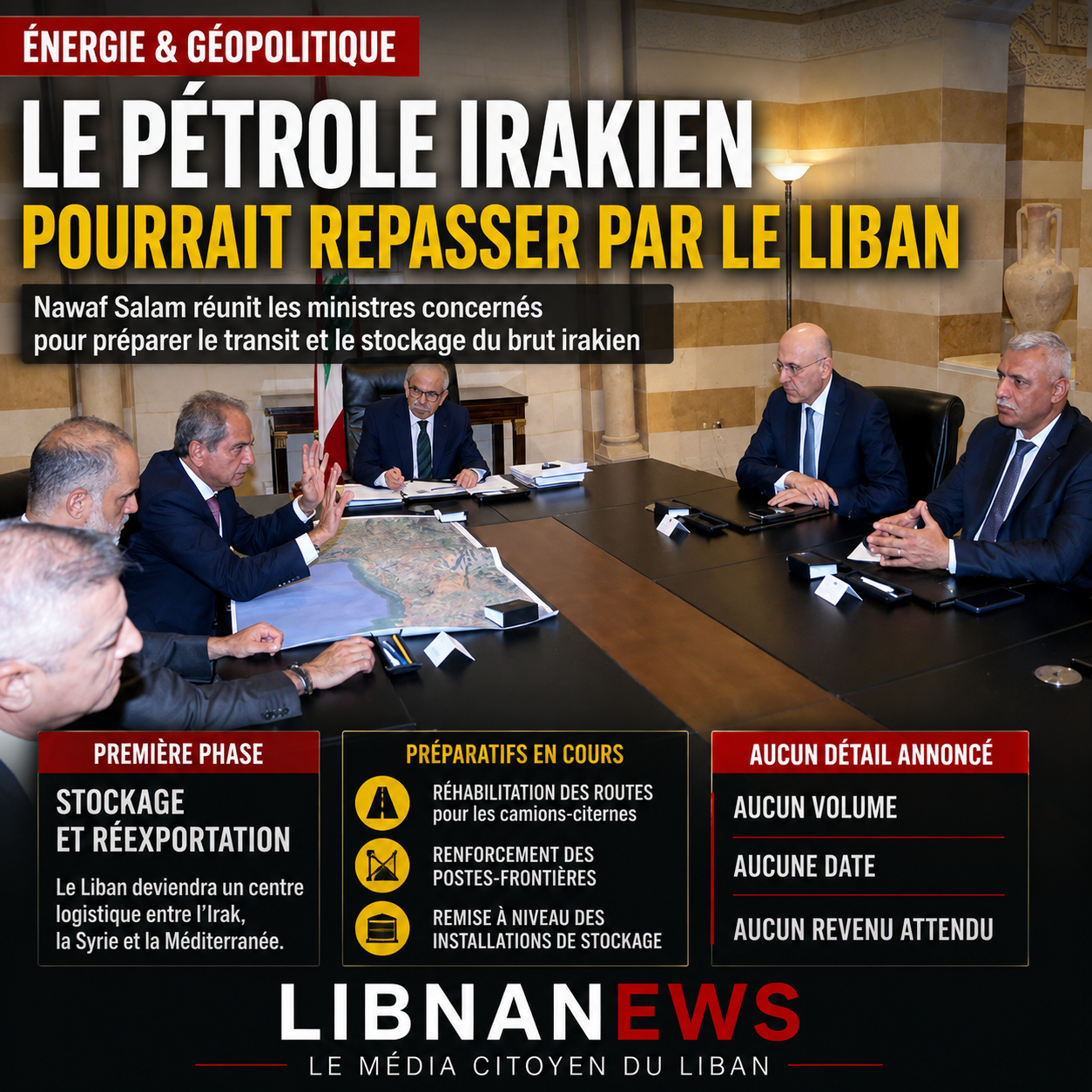
The Lebanese government is preparing for the return of Iraqi oil to its territory several decades after the closure of the corridor which made Tripoli one of the Mediterranean markets for Kirkuk crude. On Monday, August 10, 2026, Prime Minister Nawaf Salam gathered ministers and officials directly concerned to prepare for the transit of Iraqi crude oil and petroleum products through Lebanon. In the first phase, Beirut should serve as a storage and re-export centre. The government is already working on the rehabilitation of the roads necessary for the passage of tankers, the strengthening of border crossings, the organization of traffic and the upgrading of storage facilities. However, the project remains to be specified on three key points: no volumes, no start date and no expected income for Lebanon have yet been announced. Its interest is nevertheless strategic: Iraq seeks to diversify its export routes to the Mediterranean, while Lebanon is trying to restore Tripoli and its oil facilities to the centre of the energy exchanges between Iraq, Syria and the Mediterranean markets.
The meeting chaired by Nawaf Salam confirmed that the dossier had entered its technical phase. Minister of Energy and Water Joe Saddi, Minister of Interior and Municipalities Ahmad Hajjar and Minister of Public Works and Transport Fayez Rasamny participated. Also present were the Director General of General Security, Hassan Choucair, the President of the Higher Customs Council, Mesbah Khalil, and the Director General of Customs, Gracia Kazzi.
This composition clearly indicates the priorities. Oil will have to cross the border, be controlled by customs, travel on the road network, join reservoirs and be re-exported. The government must therefore coordinate several jurisdictions that usually operate separately.
The official communiqué does not yet mention pipeline transport. It explicitly refers to the preparation of roads and the circulation of tanks. The first phase must therefore be based on ground transport, probably from Iraq through Syria, before entering Lebanon.
Lebanon must first serve as a storage centre
For the time being, the government is defining a specific role: Lebanon must become, at first, a centre for the storage and re-export of Iraqi oil.
It is therefore not a new agreement to supply fuel directly to the Lebanese market. The oil would enter Lebanon for storage before returning to other destinations.
This distinction is important. Lebanon would not only buy energy, but also provide services. Revenue could come from transit, storage, handling and re-export.
However, the government did not communicate any tariffs. Nor did he indicate what quantities Baghdad was planning to transit through Lebanese territory. It is therefore impossible, at this stage, to seriously assess potential revenues.
The project is of economic interest only if the volumes allow to cover the necessary investments. Roads will have to be repaired and storage facilities prepared. Border administrations will also have to absorb additional traffic.
Roads to be rehabilitated before tanks arrive
The road issue occupies an important place in the preparations. The government has requested the identification and rehabilitation of several roads necessary for the movement of tankers.
Oil transport imposes particular constraints. Convoys of heavy vehicles cannot be added to already degraded roads on a sustainable basis without work. Itineraries must also limit as much as possible the passage in the busy urban areas.
The Department of Public Works must therefore determine which sections require priority action. At the same time, the government must organize traffic to storage sites.
The issue of cost will need to be resolved quickly. If the work is financed by the Lebanese State, the transit revenues will have to be sufficient to justify this investment. Part of the charges could also be allocated to the maintenance of the axes used.
Road transport has the advantage of being able to start quickly. It also has an obvious limit: its capacity remains much lower than that of an oil pipeline. It is therefore a launch solution rather than a response to very large volumes.
Border crossings will have to absorb new traffic
The second project concerns the border. The government wants to strengthen the capacity of the posts concerned in order to avoid that controls become an obstacle to transit.
Each shipment must be identified. The authorities must know its origin, quantity, product transported and destination. The formalities must be fast enough to avoid the accumulation of tanks.
The presence of the General Security and the two main customs officials at the meeting on 10 August met this requirement.
Control is also necessary to prevent some of the products intended for re-export from illegally entering the Lebanese market. The country has already experienced significant fuel smuggling, particularly in the years when oil products were subsidized.
The future system will therefore have to ensure traceability between the entry of the product, its arrival in the tanks and its exit from the territory.
Lebanese tanks must be rehabilitated
The government also reviewed the storage facilities and safety standards required for their operation.
Lebanon has significant public oil infrastructure in Tripoli and Zahrani. Some of these equipment remains underutilized after decades of low investment.
Preparation is not simply a matter of determining how many tanks are empty. Authorities must verify their condition, pipelines, pumps, loading facilities, measuring systems and firefighting equipment.
The different products must also be able to be separated. Storage of crude, diesel or other derivatives does not necessarily meet the same requirements.
The government has not yet indicated which facilities will receive the first shipments. Tripoli, however, appears to be the site most directly linked to the project because of its geography and oil history.
Tripoli regains lost function for decades
The interest of the file goes beyond the mere use of existing tanks. Tripoli has already been one of the main markets for Iraqi oil to the Mediterranean.
Iraq Petroleum Company’s historic network transported the Kirkuk crude oil to the Mediterranean coast. A branch led to Tripoli, giving northern Lebanon an important role in regional oil trade.
This function has disappeared with the political crises and wars that upset the Levant. Infrastructure has been ageing and the historic network cannot, of course, be considered operational today.
But geography has not changed. Tripoli remains a Mediterranean port located near Syria and still has oil facilities.
The return of Iraqi cargo would therefore constitute a partial reactivation of an old corridor, first by road and not by road.
Baghdad seeks several exits to the Mediterranean
The Iraqi interest is explained by its dependence on Gulf terminals. Oil exports account for the bulk of Iraqi government revenues and a very large portion of the crude oil leaves the country from the south.
Any disruption of shipping in the Gulf or the Strait of Ormuz thus becomes a direct risk to Iraqi finances.
The regional tensions of 2026 reinforced this vulnerability. Baghdad is now seeking to have several alternative routes rather than relying almost exclusively on its southern terminals.
The Mediterranean is the most obvious solution to the West. It would allow Iraqi oil to directly reach European and Mediterranean markets without going through Ormuz.
Syria naturally occupies a central place in this strategy. Lebanon is now seeking to integrate rather than remain outside the new corridors.
Syria remains indispensable
The Lebanese project depends directly on Syria. There is no common border between Iraq and Lebanon. Any ground transportation must therefore cross Syrian territory or take a much longer route.
The gradual normalization of economic relations between Beirut and Damascus in 2026 facilitates this perspective. The two governments are working on the revision of dozens of agreements on transit, trade, customs and transport.
Iraqi oil gives a concrete dimension to this project. It will be necessary to define the documents allowing the tanks to cross Syria and then enter Lebanon without different procedures at each stage.
The safety of the route will also need to be coordinated with Damascus.
The project is, therefore, in fact tripartite, even though the meeting on 10 August focused solely on Lebanese preparations.
Iraq is also working on a much more ambitious pipeline
Truck transport is only a small part of Iraq’s strategy. Baghdad is also working with Damascus on the reconstruction of a permanent oil corridor to the Mediterranean.
The discussions announced in July concern a pipeline with a capacity of up to 2 million barrels per day in its first configuration.
Such capacity completely changes the scale. No tank system can compete economically with several million barrels carried daily by pipeline.
The Lebanese project must therefore be read as an attempt to take a position before the future network is finally organised.
If Tripoli proves its usefulness as a storage and re-export centre, Beirut will be able to defend more firmly the idea of a permanent branch linking northern Lebanon to the Irak-Syrian network.
However, no such decision has yet been announced.
The risk for Lebanon is to stay away from the big pipeline
For Beirut, the strategic issue is precisely there. If the new Iraqi corridor only leads to a Syrian port, Lebanon will remain a secondary player in regional oil trade.
Syria will then receive the main transit revenues and concentrate the logistic activity related to the pipeline.
Tripoli offers Baghdad a second potential terminal and reduces its dependence on a single Mediterranean market. This diversification may be of interest to Iraq, but it must be economically competitive.
Lebanon must therefore quickly demonstrate the quality of its infrastructure and procedures.
The Nawaf Salam meeting is specifically aimed at preparing this demonstration. Roads, borders and storage must work before Beirut can claim a greater place in the permanent network.
Project completes energy relationship between Beirut and Baghdad
Iraq is already one of Lebanon’s main energy partners. Since 2021, Baghdad has been supplying fuel for electricity in Lebanon under a specific agreement.
This mechanism allowed the country to maintain part of its electricity production during the most serious years of the financial crisis.
The new project is different. Transit oil would not necessarily be purchased by Lebanon and would not be intended to feed directly EDL.
Beirut is seeking to earn money this time thanks to its geographical location and infrastructure.
This change changes the nature of the energy relationship: Lebanon no longer wants only to receive Iraqi fuel, but to provide Baghdad with commercial access to the Mediterranean.
Possible revenues, but no figures yet
The government must now specify the financial interest of the project.
Storage can be charged according to volume and duration. Facilities may charge for loading and unloading. Ports may receive fees. Customs and the Treasury may also benefit from the traffic according to the system chosen.
Lebanese transport companies can finally obtain part of the trucking contracts.
But no amount was announced on August 10. No number of barrels or tonnes was reported. It is therefore impossible to say that the project will raise tens or hundreds of millions of dollars.
This lack of figures will have to be corrected before implementation. Parliament and public opinion must know the trade conditions negotiated with Iraq.
Transparency will be all the more necessary as Lebanon itself will have to incur expenses to adapt its infrastructure.
Northern Lebanon could be the first beneficiary
If the project reaches a significant size, Tripoli and the north of the country could benefit directly from the activity.
Facilities will require operators, maintenance and security services. Transport will involve drivers and logistics companies. Re-export will increase port activity.
The road works needed for oil can also be used for the rest of trade with Syria and Iraq.
This effect is potentially more important than storage revenues alone. A rehabilitation infrastructure for a large customer can then attract other flows.
Tripoli has long sought to develop this logistics function. Its port and proximity to Syria give it an advantage that the Lebanese crisis has so far prevented it from exploiting fully.
Iraqi oil can provide a large first volume sufficient to relaunch this strategy.
Facility safety remains a prerequisite
However, the storage and transport of petroleum products requires strict standards. The government explicitly included safety requirements in the August 10 work.
Tanks shall have fire detection and control systems. Loading operations must be checked. Tanks shall meet standards adapted to the products transported.
The authorities will also need to have plans to respond to road accidents or leaks.
These requirements may increase the cost of preparing facilities, but they are not optional. Lebanon has a high population density around several roads and industrial installations.
A major accident would immediately undermine the political viability of the corridor.
The government will therefore have to integrate security expenditures into the calculation of expected revenues.
The project is only valid if it becomes regular
The main challenge is not to bring a few dozen trucks into Lebanon. It is necessary to obtain from Baghdad a flow sufficiently regular to justify the upgrading of infrastructure.
The government now has to publish four essential information: the volumes envisaged, the date of the first shipments, the facilities retained and the level of charges.
These figures will make it possible to distinguish a true economic project from a simple political agreement.
They will also help to measure the position of Baghdad in Lebanon relative to Syria and the other corridors studied.
However, the meeting on August 10 shows that Beirut no longer wants to wait for the reconstruction of an oil pipeline to enter the game. The government is preparing roads, borders and reservoirs to receive the first flows by truck.
The next step will therefore be very concrete: the arrival of Iraqi technicians, the validation of storage capacity and the fixing of the first volumes. Only then will it be known whether the return of Iraqi oil to Tripoli really marks the renaissance of a Mediterranean corridor or remains a limited logistical solution.