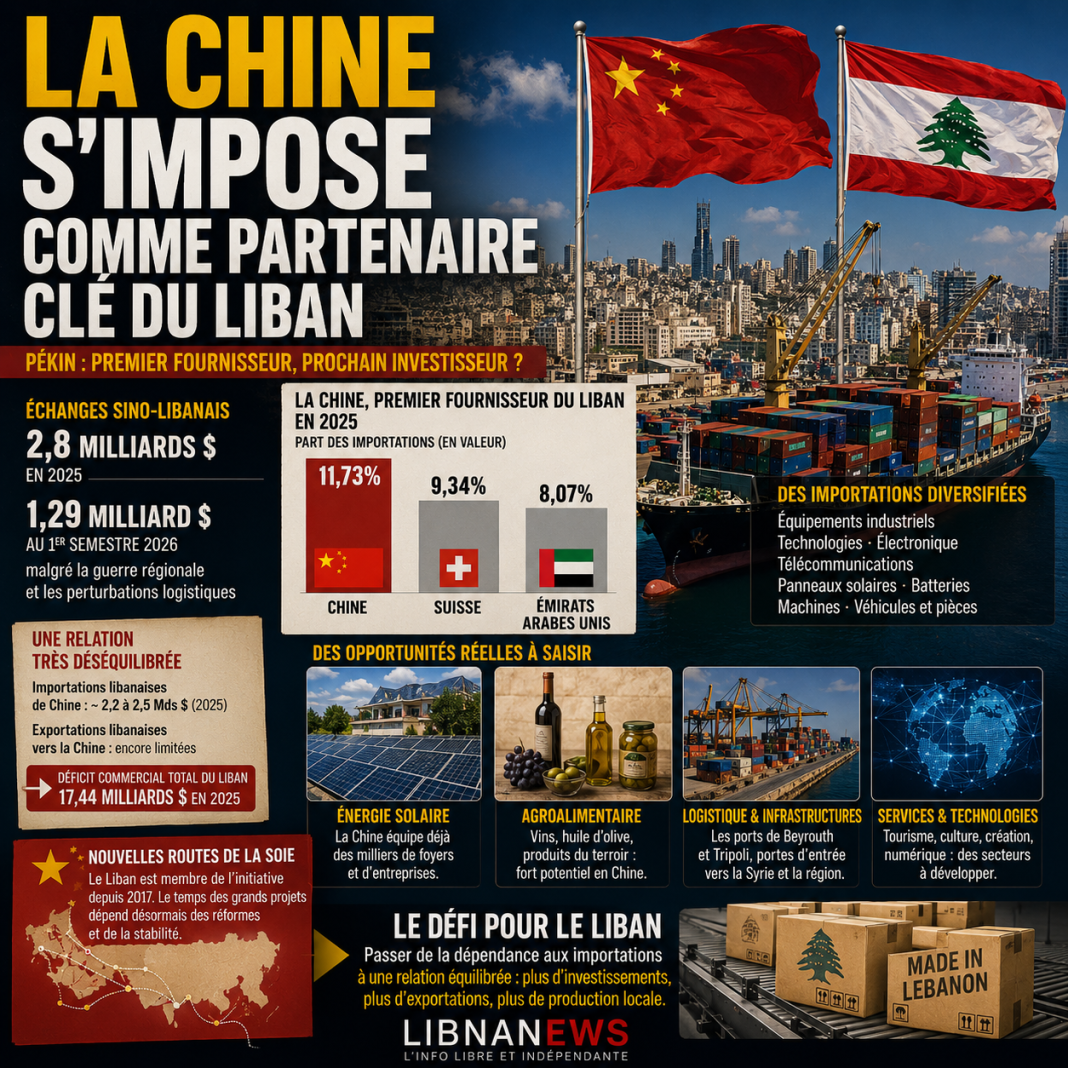






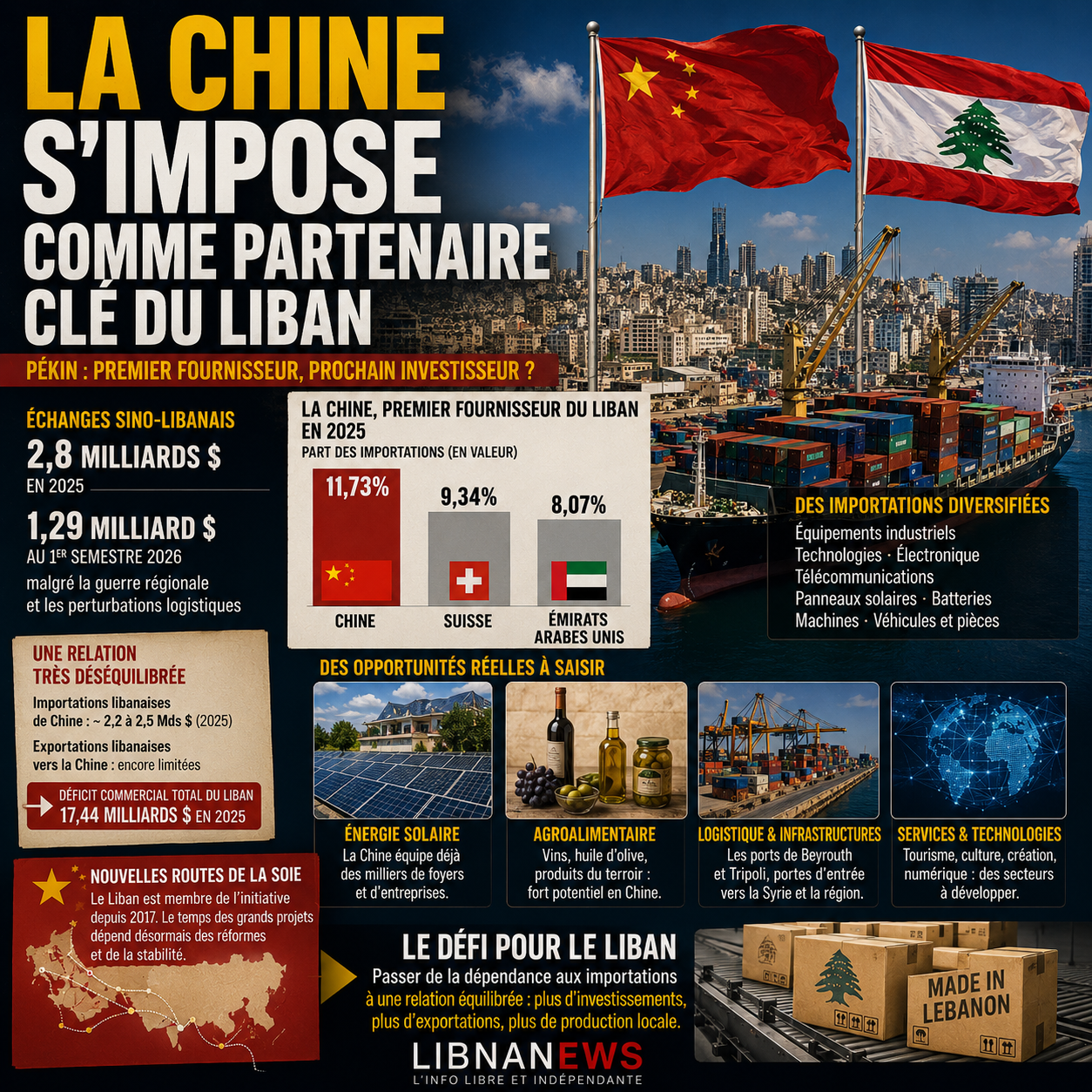
China is now Lebanon’s largest supplier and could already be ranked first among its individual trading partners by the statistical method. Sino-Lebanese trade reached $2.8 billion in 2025, compared to about $10 million when diplomatic relations were established in 1971, according to figures presented on 10 August 2026 by Chinese Ambassador Chen Chuandong in Beirut. In the first half of 2026, despite the regional war and logistical disruptions, trade was still $1.29 billion. The Lebanese customs data confirm above all an undeniable reality: China was the first source of Lebanese imports in 2025, ahead of Switzerland and the United Arab Emirates. This increase offers Lebanon industrial, technological and solar equipment at competitive prices, but it also reveals a structural weakness: the relationship remains largely unbalanced in favour of Chinese products. For Beirut, the real issue is no longer just importing more from China. It involves attracting Chinese investment and selling more Lebanese goods and services to the Chinese market.
China is already Lebanon’s leading supplier
The 2025 statistics measure transformation. Lebanon imported more than $21 billion worth of goods that year. China accounted for 11.73 per cent of this bill, ahead of Switzerland at 9.34%, and the United Arab Emirates at 8.07 per cent. Therefore, Beijing was clearly the leading supplier in the Lebanese market. Based on data from customs statistics, imports from China ranged from $2.2 billion to $2.5 billion, depending on the basis, consolidation dates and accounting methods used.
Ambassador Chen Chuandong advanced a total volume of Sino-Lebanese exchanges of $2.8 billion in 2025. This figure includes trade in both directions and is based on the data used by the Chinese side. It places the economic relationship with Beijing at a level comparable to, or even higher than, that of Lebanon’s main trading partners individually. However, the comparison requires caution, as Chinese and Lebanese statistics do not always account for goods in the same way, especially when they transit through intermediate trading platforms.
The trend is more important than a few hundred million statistical differences. China has taken a dominant position in the supply of Lebanon and this position no longer depends solely on cheap consumer products. Chinese goods are now present in telecommunications, electrical equipment, electronics, machinery, vehicles and spare parts, batteries, photovoltaic installations and a multitude of equipment used by companies.
This growth occurred as the Lebanese economy went through the most serious financial crisis in its contemporary history. Since 2019, bank credit has virtually collapsed, the pound has lost most of its value and businesses have had to operate in a largely dollarized economy and heavily dependent on liquidity. China has benefited from an essential feature of this new market: Lebanese businesses and households are looking more for equipment with a favourable price-capacity ratio than before.
$10 million to $2.8 billion
The evolution over long time is spectacular. When Lebanon and the People’s Republic of China established diplomatic relations in 1971, trade accounted for only about $10 million. The figure quoted today by Beijing is 2.8 billion. In nominal terms, bilateral trade has therefore been multiplied several hundred times in just over half a century.
This growth first reflects China’s transformation itself. The Chinese economy of the 1970s had neither industrial power nor export capacity nor integration into the global chains that characterize contemporary China. Over the decades, Chinese companies have conquered the markets for textiles, electronics, industrial equipment, telecommunications, infrastructure and, more recently, energy technologies.
The Lebanese market was particularly receptive to this offer. The country imports much of the goods it consumes and has a limited industrial base. Lebanese traders have historically played an important role in finding international suppliers capable of offering competitive prices. Chinese industrial cities and large wholesale markets have thus become a common destination for many Lebanese entrepreneurs.
This development did not stop with the banking crisis. It simply changed structure. The slowdown in purchasing power has favoured some cheaper Chinese products than their European or American equivalents, while the energy crisis has created a massive demand for a completely different category of goods: solar panels, inverters, batteries and equipment allowing households and businesses to produce part of their electricity themselves.
Solar has profoundly changed the nature of imports
Energy is probably the most visible example of the new economic relationship with China. The collapse of the public supply of electricity and the rise in the price of private generators have pushed tens of thousands of Lebanese households and companies to photovoltaics. China largely dominates the global production of solar panels, photovoltaic cells and some of the batteries used for storage.
The result is visible on the roofs of Lebanese buildings, houses, farms and businesses. Previously marginal installations have become a daily component of the energy landscape. In many cases, the equipment used comes directly from China or is assembled from Chinese components.
This relationship is important because it shows that Chinese imports can no longer be reduced to the caricature of low-value consumer goods. Lebanon now imports technologies that compensate for its own infrastructure failures. Solar panels produce electricity. Batteries provide storage. Telecommunications equipment supports networks that have become essential to the functioning of the economy.
The Chinese ambassador himself insisted on this sector on 10 August. Beijing seeks to present the energy transition as an area where cooperation can go beyond private trade. China has already provided solar equipment through aid programmes, including support for facilities for Ogero, the public telecommunications operator.
The distinction is important. Buying Chinese panels creates a commercial flow. Financing a plant, providing equipment to a public institution or participating in the modernisation of a network creates a more sustainable economic relationship. Lebanon is precisely faced with this choice: to remain a consumer market for Chinese exporters or to use the relationship with Beijing to rebuild part of its infrastructure.
But China-Lebanon trade remains deeply unbalanced
The weight of China in imports does not mean that Lebanon automatically benefits from this increase. An important trading partner can support the economy, but it can also increase a deficit if trade works almost exclusively in one direction. The Lebanese problem is precisely there.
The country buys much more Chinese goods than it sells to China. Data on flows in each direction vary according to statistical systems, but the overall structure is hardly open for discussion. China is a major supplier to Lebanon; Lebanon remains a marginal supplier to China.
This difference must be reflected in the overall trade deficit. In 2025, Lebanese imports exceeded $21 billion, while exports were about $3.6 billion. The trade deficit reached nearly $17.44 billion. It has grown by more than 22 per cent in one year despite a significant increase in exports.
This situation is obviously not created by China. The trade deficit is an old feature of the Lebanese economic model. The country consumes a lot of imported goods and produces too few exportable goods to balance these purchases. Diaspora transfers, tourism, services and capital inflows have historically offset part of this imbalance.
But China’s growing position makes the problem more visible. While $2 to $3 billion in trade is mainly translated into Lebanese purchases, the growth of bilateral trade increases the volume of transactions without necessarily improving domestic productive capacity.
The real challenge is to bring Lebanese products into China
Beijing seems aware of this weakness. Chen Chuandong indicated that the Chinese authorities were seeking to identify more Lebanese products that could find a market in China. It is probably on this ground that the future quality of the commercial relationship will be played.
Lebanon cannot compete with China in mass industrial production. Its population, market size, energy costs, lack of normal bank financing and logistical deficiencies make it impossible to achieve a strategy based on very large volumes of standardized products. On the other hand, it has niches where its image, its processed agricultural products, its gastronomy and certain high-value products can find their place.
Wine is an obvious example. Lebanon has an internationally recognized wine industry, but its location in China remains limited compared to major French, Australian, Chilean or Italian exporters. Olive oil, specialty food products, canned foods, pastries, certain alcohols and agricultural processing products could also benefit from a more structured access strategy.
The difficulty is not just finding a buyer. Sustainable entry into the Chinese market requires mastering health standards, labelling, customs procedures, distribution, brand protection and digital marketing. A small Lebanese company generally does not have the resources to build these networks alone.
The government can therefore intervene otherwise than through speeches on « opening east ». It can negotiate the necessary certifications, speed up sanitary protocols, organize coordinated participations at Chinese trade fairs and support companies looking for distributors.
Services have a greater potential than it seems
The Chinese ambassador does not limit Lebanese possibilities to goods. It also cites creation, tourism, culture and services. This dimension is essential because Lebanon traditionally has a greater comparative advantage in service activities than in heavy industry.
Before the crisis, Beirut retained a regional position in advertising, design, creation, architecture, finance, education, restoration and several cultural industries. Some of these skills have left the country since 2019, but professional networks remain in Lebanon and the diaspora.
China is a huge market for these sectors, but access is more complex than a regional Arab market. Language, investment rules, specific digital platforms and business habits are all barriers. Transforming China’s diplomatic interest into concrete opportunities will therefore require specialized intermediaries and a much more structured strategy than hitherto.
Tourism is another possibility. Prior to the pandemic and regional crises, the number of Chinese travellers worldwide had increased significantly. Lebanon has cultural, archaeological and natural assets that can interest this market. But it still lacks several essential elements: practical air links, Chinese language promotion, stable infrastructure and adequate security perception.
The sites of Baalbeck, Byblos, Tyre, Anjar, mountains, gastronomy and vineyards can be integrated into a specific offer. Still, Chinese agencies must consider Lebanon a reliable destination. In this area, political and military stability probably counts more than any promotion campaign.
New silk roads remain largely on paper
However, Sino-Lebanese relations already have a political framework that can go further. In 2017, Lebanon signed a cooperation protocol related to China’s New Silk Road Initiative, the Belt and Road Initiative. At the time, several projects had been mentioned around transport, ports, infrastructure and logistics.
Almost ten years later, the record remains modest. Lebanon has not become a major platform of the Belt and Road in the Mediterranean. Beijing has not built infrastructure in Lebanon comparable to major projects financed in some countries in Asia, Africa or the Middle East.
The reasons are largely Lebanese. The political deadlock, the financial collapse of 2019, the banking crisis, the explosion of the port of Beirut in August 2020, the changes of government and successive wars have created an environment that is not compatible with very long-term infrastructure commitments.
A foreign investor can accept a commercial risk. He will be more hesitant about the lack of stable regulation, uncertainty about payments, institutional weakness and the possibility of a public contract being challenged by political change.
However, Chen Chuandong believes that the gradual reconstruction of the country can reopen this case. China is observing Lebanese needs in electricity, telecommunications, transport, cultural infrastructure and possibly public facilities.
Beirut and Tripoli port give Lebanon geographical value
The Chinese potential is also due to geography. Lebanon has two major maritime outlets in Beirut and Tripoli and is in the immediate vicinity of Syria. If Syrian reconstruction accelerates, Lebanese ports could theoretically play a role in the movement of goods to the interior of the Levant.
However, this possibility depends on infrastructure and relations with Damascus. In 2026, Lebanon and Syria initiated a process to review more than forty bilateral agreements on trade, transit, investment, taxation and travel. The official trade between the two countries had fallen around $250 million after approaching 800 million.
The Lebanese Minister of Economy, Amer Bisat, estimates that eventually trade could reach several billions. Should such a development occur, Lebanon could regain part of its role as a maritime platform for Syria and, beyond that, for some Arab markets.
For Chinese companies, this geography can be interesting. An investment in Lebanese logistics would not necessarily be the sole objective of the internal market, too small to justify certain infrastructures. It could aim at a wider package including Syria and possibly other Levant markets.
But this perspective remains conditional. Road infrastructure needs to be modernised, customs streamlined and political relations with Syria stabilized. Without these changes, the location of Lebanon is not enough to create an economic advantage.
Beijing advances so far by limited and visible projects
China has adopted a conservative approach in Lebanon. Rather than immediately funding very large infrastructure, it focused on clearly identifiable aid projects, equipment and institutional achievements.
Solar aid for Ogero falls into this category. It responds to a concrete need and allows China to showcase one of its main industries. Beijing has also supported the construction of a higher music institute in Dbayeh, a project that illustrates cultural diplomacy more than a traditional business strategy.
In May 2026, the two governments again signed a development cooperation agreement. The Chinese Ambassador presented him as a new step in assisting Lebanon and in its willingness to participate in its reconstruction.
China also provided humanitarian assistance following the further destruction caused by the conflicts of 2026. These contributions remain limited to Lebanon’s needs, but they are part of a Chinese presence that combines trade, aid and diplomacy.
This caution contrasts with the image sometimes maintained in the Lebanese political debate of a China ready to finance immediately ports, power stations, railways and large infrastructure. Beijing never turned this speculation into a massive financial commitment.
The reason is simple: China is also looking for projects that can be financed, exploited and reimbursed. It has no interest in dealing with the consequences of Lebanese institutional dysfunction without sufficient guarantees.
Financing remains the main obstacle to an investment surge
Sino-Lebanese trade works because a Lebanese importer can buy a Chinese commodity and pay for it. An investment of several hundred million dollars follows a much more complex logic. It requires long-term contracts, a tariff framework, guarantees and visibility on future revenues.
This is where the banking crisis becomes directly linked to the relationship with China. Lebanese banks no longer normally fulfil their investment financing function. Companies work extensively with their own funds or with external financing. A large infrastructure project cannot operate sustainably in this environment without a specific financial mechanism.
The banking restructuring currently being discussed in Parliament is therefore also a condition for Chinese investment. A Chinese bank or a public company must be able to identify its interlocutors, transfer funds, repatriate income and have a legal system capable of enforcing a contract.
Another challenge is Lebanon’s exit from the Financial Action Task Force’s grey list. More robust compliance mechanisms would facilitate relations with all foreign banks, not only Chinese. The fight against money laundering, financial transparency and the control of flows thus become very concrete components of trade policy.
There is therefore a direct link between the reforms presented as financial and the country’s ability to attract productive investment from Beijing.
China will not replace Lebanon’s Arab partners
The Chinese increase does not mean that Lebanon must choose between Beijing and the Gulf countries. Relationships are different in nature. China is primarily a supplier of goods and a potential investment partner. The Gulf States are particularly important for Lebanese exports, tourism, capital transfers, employment of expatriates and certain investments.
The reopening of the Saudi market to Lebanese products in June 2026 illustrates this complementarity. Riyadh lifted a ban that had lasted for almost five years. For Lebanese agricultural and agri-food producers, access to the Saudi market can have a much more immediate effect than Chinese openness, as tastes, commercial networks and distances are more favourable.
The United Arab Emirates also plays a special role. In 2025 they were among the main destinations for Lebanese exports and among the country’s major suppliers. The presence of a large Lebanese diaspora facilitates trade and financial exchanges.
China therefore does not replace the Arab world in Lebanon’s economic strategy. It adds an axis that becomes too important to be treated as secondary.
A rational trade policy is precisely one of increasing opportunities. Lebanon has an interest in selling agri-food products in Saudi Arabia, developing its services with the Emirates, returning to land trade with Syria, trading with the European Union and simultaneously expanding its relationship with China.
Comparison with Switzerland reveals the limits of the rankings
To determine whether China is already Lebanon’s « first trading partner » requires a distinction between several indicators. In 2025 it was clearly the first country of origin for imports. Switzerland was the second largest supplier but the first destination of Lebanese exports, accounting for about 19.4 per cent of the total according to some customs statistics.
This Swiss position is largely related to the trade in precious metals and stones, a sector that is heavily influenced by Lebanese statistics. The Emirates was also a major export destination, accounting for more than 16 per cent of the total.
If imports and exports are simply added by country, the ranking can therefore vary according to the source and value of certain flows. The $2.8 billion advanced by the Chinese Ambassador suggests that China is now at the top or near the summit.
But the title of first partner ultimately matters less than the nature of the relationship. A country can be number one because it sells a lot in Lebanon while buying very little Lebanese production. A smaller but more balanced trade relationship can have more direct effects on employment and local industry.
This is why the government should monitor not only the total volume of trade with China, but also the share of Lebanese exports, their added value and the number of companies capable of entering this market on a sustainable basis.
The first half of 2026 shows remarkable trade resistance
The figure of $1.29 billion for the first six months of 2026 is also significant. It has been achieved in a particularly degraded regional context. Wars, disruptions of navigation and risks on trade routes have affected the entire Middle East.
If the pace of the first half of the year was simply repeated over the whole year, the Sino-Lebanese trade would be around 2.6 billion dollars. However, mechanical extrapolation would be imprudent as trade flows are not identical from one semester to another and may vary considerably.
However, trade resistance confirms that Chinese products are now deeply integrated into the Lebanese market. Even in a crisis environment, importers continue to supply in China and logistics circuits remain active.
This strength is both an advantage and a risk. A highly dependent economy of a supplier for essential categories may become vulnerable to maritime disruption, transport costs or international trade shock.
Lebanon therefore has an interest in maintaining a diversification of its suppliers, although Chinese competitiveness makes a strong presence of Beijing almost inevitable in several sectors.
A Chinese partnership must not become a new import economy
This is probably the main warning to draw from the August 10 figures. Lebanon can welcome a $2.8 billion trade with the second world economy. But this amount does not have the same meaning if it corresponds to machines used to produce in Lebanon or goods consumed without creating local productive capacity.
An import of solar panels can reduce a company’s energy bill and increase its competitiveness. An industrial machine can make exportable products. Telecommunications equipment can improve productivity. In these cases, the trade deficit indirectly finances an economic capacity.
The situation is different when imports only respond to consumption. Lebanon then regains its old model: import a lot, produce little and finance the difference through transfers, tourism or capital inflows.
The crisis of 2019 showed the fragility of this model. The recovery cannot be sustainable if it reproduces exactly the same structure with new suppliers.
The relationship with China must therefore be judged on the basis of an additional criterion: how many investments, production and exports can it create in Lebanon?
Lebanon must negotiate with Beijing according to its own priorities
An economic strategy towards China would finally require Beirut to determine precisely what it wants to achieve. So far, relations have greatly improved through private sector dynamism and ad hoc Chinese initiatives. An organized Lebanese strategy is still missing.
The country can select a few priority sectors. Solar energy and storage are an obvious first axis. Telecommunications and digital infrastructure are another. Port logistics, some transport, agro-industry and possibly the equipment needed for reconstruction can also be examined.
However, each project must be evaluated economically. Lebanon would benefit from replacing Western financial dependence with poorly negotiated or overly costly Chinese projects. Tendering, financing conditions, sovereign guarantees and technology transfer obligations must remain transparent.
Similarly, relations with Beijing should not be transformed into a geopolitical choice between China and the United States. Lebanon still largely depends on the dollar financial system, its relations with Washington, Europe and the Gulf monarchies. Its economic size imposes a diversification strategy rather than a block policy.
Beijing itself seems to favour a pragmatic approach. Ambassador Chen Chuandong insists on trade, concrete projects and the opportunities offered by reconstruction rather than on Lebanese political alignment.
Moving from first supplier to true partner
Thus, China has already taken a step that statistics show: it is Lebanon’s leading supplier. According to China’s bilateral trade data and the method used to add imports and exports, it can also claim first place or be in immediate contact with the largest global trading partner.
But this ranking still masks a very asymmetric relationship. Beijing sells a lot in Lebanon. Lebanon sells little in Beijing. Chinese investment remains modest compared to the amounts reported since Lebanon’s accession to the New Silk Roads in 2017. Major infrastructure projects have not yet followed the dramatic growth in trade.
This is precisely where the growth margin lies. Banking restructuring can restore financing channels. Monetary stabilization can improve the visibility of investors. The normalization of relations with Syria can give Lebanese ports a transit function. The reopening of Gulf markets can strengthen exports and allow producers to regain sufficient size to look for more distant markets.
In this scenario, China would no longer be the only country that provides Lebanon with solar panels, equipment, electronics and some of its consumer goods. It could become a source of capital, technology and opportunities for Lebanese businesses.
The figures presented by Chen Chuandong on 10 August show that the first part of this transformation has already taken place: China has become a must in Lebanese trade. The next step will depend much less on Beijing than on Beirut’s ability to turn $2.8 billion in trade into productive investment and to raise, in future statistics, the column of goods and services sold by Lebanon to China.