

A politically relaunched project, but not yet technically
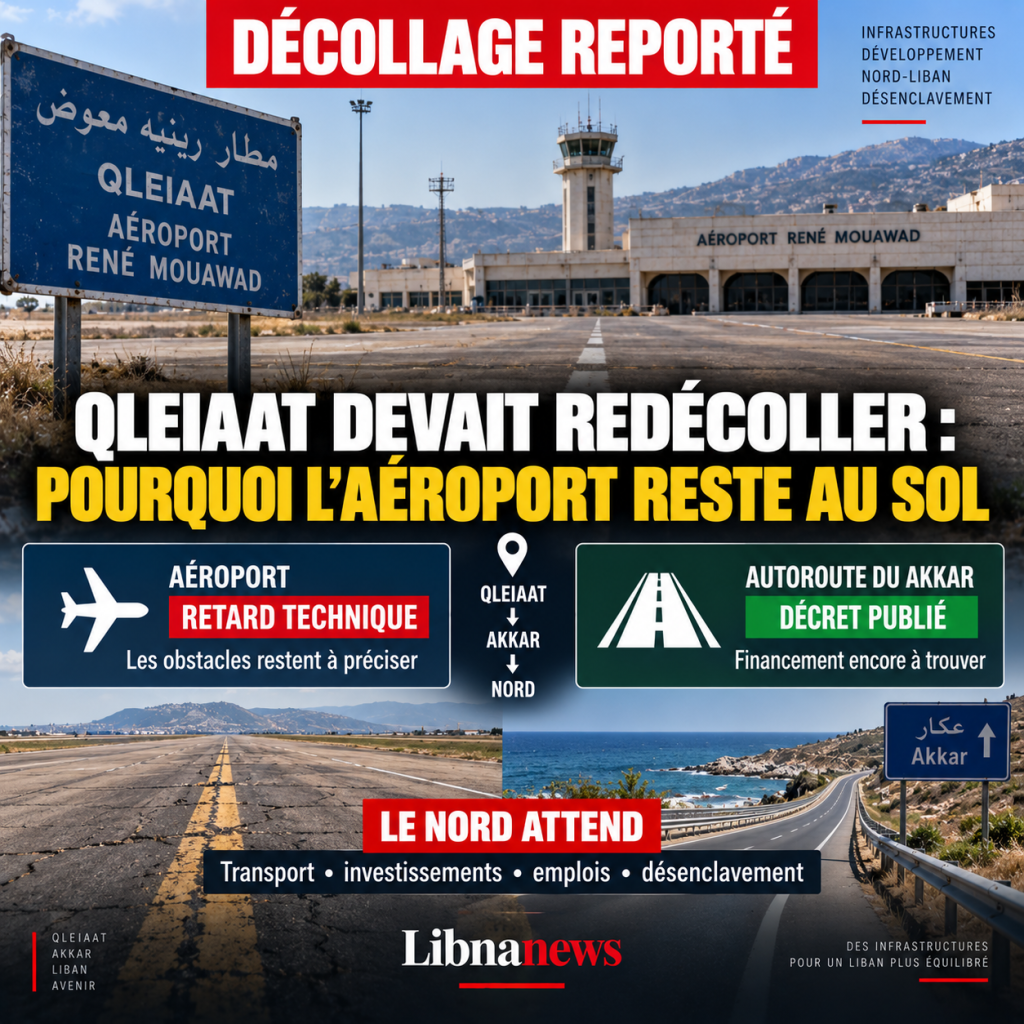
The airport of Qleiaat returned to the public discourse with a strong promise: to give the North and Akkar an infrastructure capable of breaking their economic isolation and completing the Lebanese airport system. However, the transition from political to construction remains delayed. The information available on 6 October 2026 indicates technical obstacles which still prevent the expected start. At the same time, another case directly linked to the airport advances on paper: the Akkar Sea Motorway now has its decree, but its financing still needs to be secured. Both projects end up asking the same question. Building or re-establishing an airport is not enough if the infrastructure to connect it to the rest of the country remains incomplete.
President Joseph Aoun discussed the issue with former MP Hadi Hobeich during a meeting in Baabda. Discussions focused on the need to complete the electricity issue, but also on the Akkar maritime motorway. His decree was issued. Funding for its implementation is now required. The project is presented as an essential axis for the Akkar and for the René Mouawad airport in Qleiaat. This association between road and airport is crucial. It shows that the reactivation of the platform cannot be considered independently of its accessibility.
The delay attributed to technical reasons does not mean that the project is abandoned. Rather, it shows that the political announcement is not enough to produce an operational infrastructure immediately. An airport imposes much wider requirements than the mere presence of a runway. The necessary work, equipment, safety features, accesses and conditions for regular operation must be determined. The sources provided do not at this stage detail the full range of technical barriers. Therefore, they do not allow the delay to be attributed to specific equipment or worksites without going beyond the available information.
This limit is important. The Qleiaat file has often been surrounded by considerable political and economic expectations. To avoid turning these expectations into certainty, it is necessary to distinguish what is acquired from what remains to be achieved. The project is politically supported. The motorway which must improve its access has a decree. But the financing of this route is not yet assured, while the airport itself is still delayed for technical reasons.
An infrastructure far beyond Akkar
Qleiaat is not just a local project. His interest lies precisely in his potential ability to change the economic geography of the North. Akkar remains one of the regions that has long been demanding more public investment. The return of the airport file makes it possible to link several claims: transport, roads, investments, jobs and territorial development.
René Mouawad Airport is located in Qleiaat, Akkar. Its return to service would open air infrastructure in the north of the country, while international civilian traffic is now based on Beirut. The potential economic interest is obvious. However, the available documents do not yet provide a complete operating plan to determine what share of passenger traffic, freight or other activities would actually be transferred to Qleiaat. It would therefore be premature to present the platform as a future second international airport fully defined in its functions.
The political importance of the project also comes from what it represents for the Akkar. The region’s sense of marginalization appears in several cases of the same day. The crisis in the Srar dump led elected officials and municipal officials to meet with Prime Minister Nawaf Salam. Local representatives refuse to allow Akkar to become a destination for waste from other regions. They demand that Srar be reserved for waste generated in the governorate. At the same time, the Mufti of the Republic Abdel Latif Derian himself insisted that the Akkar should not remain marginalized or deprived of development.
Qleiaat thus takes a value that goes beyond its transport function. For some of the northern leaders, the project must show that the state is capable of investing in Akkar other than managing social or environmental crises. An airport, highway and associated infrastructure would change the nature of the economic relationship between the region and the centre of the country.
However, this ambition can only work if the various investments advance together. An airport that is poorly connected to major urban areas loses some of its interest. A highway without funding remains an administrative route. The real difficulty is therefore to synchronize projects.
The maritime motorway has its decree, not yet its financing
The road record makes it possible to measure precisely the difference between decision and execution. The Decree on the Akkar Motorway was issued. This step gives the project a more concrete administrative existence. But the financial issue remains open. Hadi Hobeich insisted with Joseph Aoun on the need to secure the necessary funds for its realization.
The axis is presented as a real « lung » or main artery for the Akkar and for the airport of Qleiaat. The logic is simple: an air infrastructure needs a road network capable of absorbing passengers, employees, suppliers and possibly goods. Without efficient access, the airport’s geographical advantage is reduced.
The issue of funding becomes as important as the decision to reactivate Qleiaat. The information available does not yet give the name of a lessor who has made a definitive commitment to finance the motorway. They also do not provide an agreed amount or schedule of work. The decree must therefore not be confused with the beginning of the construction site.
This distinction is essential in a country where many infrastructure projects have taken several administrative steps before remaining blocked on funding. The challenge is not just to decide. Resources must be obtained, procedures must be initiated and work done.
The reactivation of Qleiaat can hardly escape this rule. Airport equipment and road access should be considered as an ecosystem. Financing one without the other could produce a partially functional infrastructure, unable to achieve the economic objectives that justify its cost.
Regional context reinforces the argument of a second aerial point
Qleiaat’s forwarding is also taking place at a time when air transport safety has again become a political issue. Nawaf Salam himself stressed the priority given to the security of Beirut airport and passengers when he addressed the Iranian flight file. His remarks directly concerned the capital’s platform, but he recalls Lebanon’s dependence on a central air entry point.
Regional tensions naturally give more weight to any reflection on infrastructure diversification. Military operations in the region, tensions with Israel and potential air traffic disruptions reinforce the strategic interest of a second platform. However, the available sources do not present Qleiaat as a formal emergency plan to replace Beirut in the event of closure. It would therefore be excessive to assign him this function as if it had already been decided.
The strategic interest nevertheless exists in the background. A country with several operational infrastructures has more options than a country with one major civilian airport. Such diversification may involve passengers, freight, relief operations or economic needs. The second platform still needs to be truly operational and linked to national networks.
The debate here joins that of economic sovereignty. An infrastructure has strategic value only if the State can operate it, protect it and ensure its access. Qleiaat cannot therefore be treated as a simple real estate project around an existing track. Its return to service involves a complete chain of infrastructures and institutions.
The North Expects Economic Benefits
Much of the local interest is based on the jobs and activity that the platform could generate. An airport mobilises personnel directly involved in the operation, but it can also support land transport, logistics, catering, hotels and other services. Construction or renovation of infrastructure also creates significant temporary activity.
However, the projections should be kept cautious. No consolidated figures for future employment are provided in the corpus of 6 October. No forecast volume of passengers or cargo is detailed. Producing thousands of specific jobs or a specified amount of economic benefits would therefore amount to inventing data lacking from sources.
However, the economic interest can be established without fictitious figures. The Akkar suffers from an infrastructure deficit. Improved connectivity reduces travel costs and can facilitate the installation of activities. If Qleiaat eventually develops a freight business, its influence could exceed travellers alone. But this orientation must be confirmed by the operating plans before being presented as acquired.
The project could also change the relationship between Akkar and Tripoli. The main northern city has its port and a distinct economic fabric. An air platform further north could complement this maritime infrastructure. Again, the documents examined do not refer to an integrated port-airport plan officially stopped. The idea is an economic possibility, not a decision already taken.
The main challenge is therefore not to overload Qleiaat with all the ambitions of the North even before it starts. The more the project is presented as the solution to all regional problems, the more the risk of disappointment increases. An infrastructure can stimulate a region. It does not replace a comprehensive development policy.
Akkar demands investment policy, not a succession of announcements
The local context shows precisely this expectation. The mobilisation around Srar reveals a region that refuses to be treated only through waste and emergency files. Municipal elected officials requested that the landfill be used exclusively for Akkar. Nawaf Salam brought together Environment Minister Tamara El Zein, MP Assaad Dergham, the Development and Reconstruction Council, the High Relief Committee, the Solid Waste Authority and several local officials.
At the same time, Abdel Latif Derian called for ending the marginalization of Akkar and mentioned the need for a specific development tool. These requests give Qleiaat an additional political dimension. The airport becomes one of the symbols for measuring whether the return of the state to the peripheral regions results in real investment.
Joseph Aoun is directly involved in this expectation. The President follows up on the maritime motorway and the need to ensure its financing. Its intervention gives the project high institutional visibility. But it also increases the pressure to achieve results.
The Government of Nawaf Salam faces the same demand in several regions. In the South, he wants to show that the projects announced in Nabatiyah are actually being implemented. In Akkar, municipalities request responses on waste and infrastructure. The question therefore becomes one of the state’s ability to move from emergency treatment to investment policy.
Qleiaat is a particularly visible test because the project has existed in the public debate for a long time. Every new delay revives the impression that the North is still waiting. Conversely, a concrete launch could be of greater political significance than the construction site alone.
The technical delay must now be explained
The main weakness of the case as at 6 October is the lack of public details on the technical reasons for the delay. The available information indicates that start-up is delayed for such reasons. It does not provide adequate ventilation to determine which component actually blocks the opening.
This lack of detail inevitably feeds questions. A technical obstacle may relate to physical work, equipment, standards, procedures or more. Without a more precise document, choosing one of these explanations would be speculative. The next step in transparency should therefore be to publish clearly the remaining conditions.
Such clarification would also make it possible to distinguish technical barriers from financial obstacles. Both files may overlap, but they are not identical. The maritime motorway, for example, has a decree but seeks its financing. For the airport, the delay is presented as a technique. Mixing the two problems would prevent understanding what needs to be resolved as a priority.
The government would also benefit from defining steps to measure progress. An airport project does not instantly shift from inactivity to full operation. In between are studies, works, equipment, procedures, tests and authorizations. A public calendar would transform the political debate into concrete follow-up.
This requirement is all the more important given the high economic expectations. Residents and investors cannot build their decisions on a moving date. The credibility of the project therefore depends less on a new opening announcement than on the publication of verifiable milestones.
Funding will be the real meeting point for projects
Even when technical difficulties are resolved, Qleiaat will have to be integrated into a set of investments. The maritime motorway is the most obvious example. Without financing the road axis, part of the expected benefits of the airport will be delayed.
This situation refers to a more general difficulty of the Lebanese State. Several major issues require simultaneous capital: electricity, reconstruction of the South, roads, public services and infrastructure. The Government is seeking international partners and mechanisms to mobilize investment without all the necessary resources.
The competition for financing will therefore be strong. Qleiaat will have to demonstrate its economic and strategic utility in the face of other equally urgent projects. External funding could speed up the process, but there is no specific announcement in the 6 October documents to identify a partner already committed to support the entire programme.
The airport is entering a phase where political support is no longer sufficient. The highway decree, the presidential statements and the return of the project in the news show that the idea is not buried. But the measure of its progress will now be in much more concrete terms: secured funding, technical obstacles removed, work initiated and published timetable.
Qleiaat no longer lacks reasons to be developed. The North is demanding infrastructure. The Akkar calls for development policy. The diversification of access to the country has an economic and strategic interest. What is still missing is the transformation of these reasons into a chain of executable decisions. The real take-off of Qleiaat will therefore begin well before the first plane: when the technical delay is precisely identified, the financing will be secured and the road to the airport will also cease to be a pending project.





Comments