

The crisis no longer only reduces consumption
Social degradation in Lebanon crosses a different threshold when families no longer reduce their spending but begin to sell the goods on which their future depends. The available data now describe this second phase. Some households reduce meals, postpone care, save on school and liquid household goods. Even more worrying, some sell assets that allowed them to generate income. Poverty then ceases to be only a lack of money available at the end of the month. It gradually destroys the means by which the household can regain economic autonomy.
Three United Nations data sets measure this development. They cover food security, family mechanisms to deal with the crisis and access to essential services. The indicators do not describe exactly the same population or the same dimension of insecurity. However, they converge on a finding that household adaptability is increasingly being sought. Some families have already reached the stage of ordinary economies.
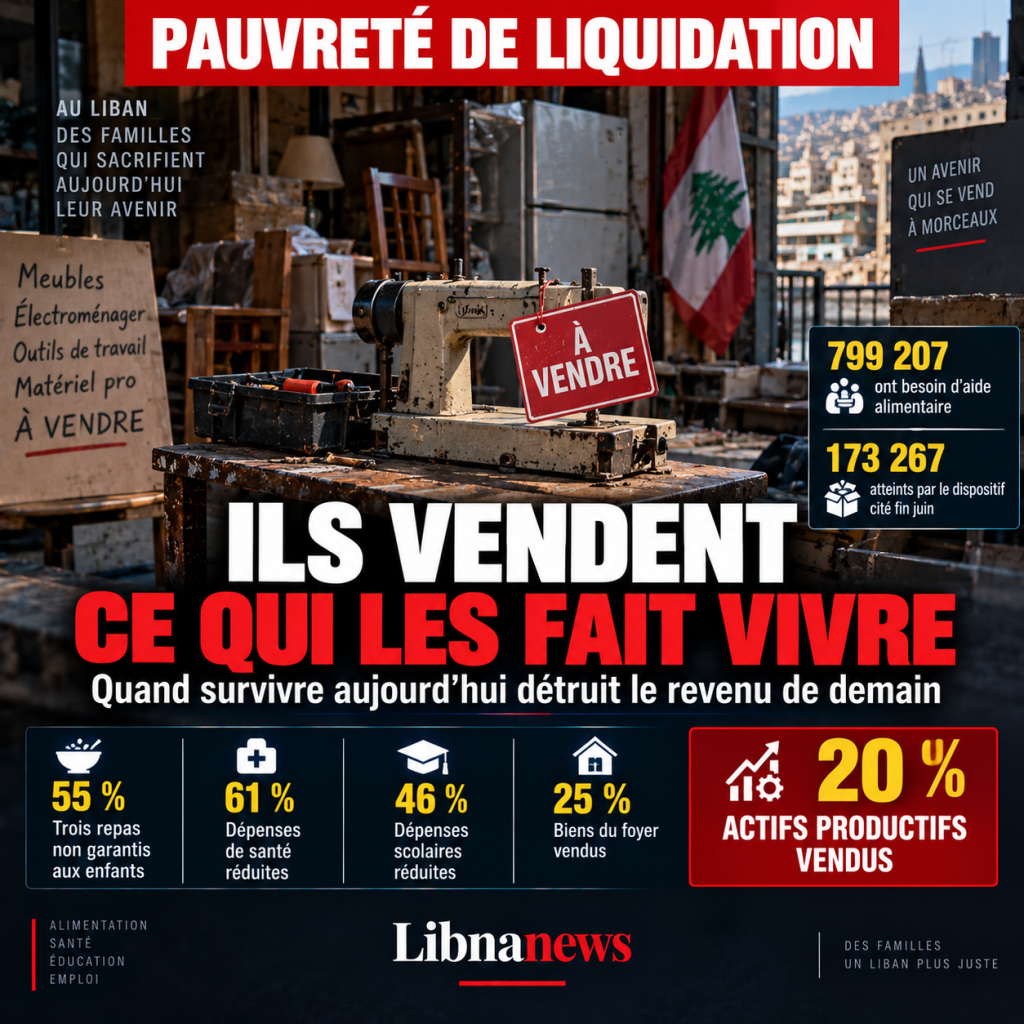
Among the households surveyed,55% say they cannot guarantee three daily meals for their children. This figure gives a first measure of the pressure on food expenditure. It does not mean that all the children concerned are deprived of food for a whole day. On the other hand, it shows that the family’s normal food model can no longer be ensured on a regular basis. Parents reduce quantities, modify purchased products or decrease the number of meals when resources become insufficient.
The problem takes on a more serious dimension when food competes with health and education.61% of households surveyed reduced their health expenditure, while38% say they are unable to provide essential medicines for their children. The economic crisis therefore no longer produces only a decline in living standards. It modifies decisions on needs that should not be allowed to be deferred.
46% reduce school expenditure
Education is another shock absorber used by families.46% of households concerned reduced their expenditure on education. More worrying,17% discontinued their children’s education. Behind these percentages is a simple economic mechanics. When an income no longer allows for the simultaneous financing of food, transport, medicine, energy and school, expenses that can be deferred begin to be sacrificed.
Reductions in school spending can take several forms. It does not necessarily mean immediate de-schooling. It may concern transport, supplies, activities, supplementary courses or other costs associated with teaching. But the transition to school interruption marks a much deeper break. Children no longer lose only certain educational resources. He left the system to improve his future situation.
This evolution gives the crisis an intergenerational dimension. A poor family can regain income if one of its members returns to work or economic activity resumes. A child who has left school for a long time may bear the consequences of the crisis for years. His access to qualifications is being reduced. His future career opportunities are becoming more limited. A decision to survive today can thus reduce the income of tomorrow’s household.
The same logic applies to health expenditure. If you report a treatment or give up a medicine, you can temporarily preserve some resources. However, a disease that is insufficiently managed can then cost more, prevent an adult from working or require hospitalization. Short-term survival mechanisms can therefore generate new spending in the medium term.
Poverty becomes particularly difficult to reverse when it forces the household to sacrifice its human and material capital simultaneously. This is precisely what the sales data suggest.
One in four households sells household goods
25% of households surveyed sold household propertyto meet their needs. This figure marks a change of nature. Reducing an expense involves changing its monthly behaviour. Selling a property means drawing on the accumulated wealth.
Of course, not all goods sold have the same economic value. Some may be relatively secondary. Others are equipment that improves living conditions. The available data do not allow an exhaustive list of what has been sold by each household. However, they show that the strategy is widespread enough to cover a quarter of the sample.
Sale has an immediate advantage: it turns an asset into available money. A family can then buy food, pay a bill, pay a medical fee or respond to another emergency. But this resource is not renewable. Once the good is sold, it disappears from the family’s heritage. If income does not rise, then the household must find another element to sacrifice.
It is this mechanism that distinguishes a temporary difficulty from a process of heritage impoverishment. A household whose income falls for a few months can reduce its spending and then return to its previous level when the situation improves. A home that gradually sells its property does not automatically return to its starting point. He will have to rebuild his heritage after restoring his income.
This silent destruction is difficult to perceive in conventional economic indicators. The household may continue to pay part of its expenses and may not immediately appear to be completely deprived of resources. Yet he finances his daily life by consuming his past. The longer this situation lasts, the fewer reserves left to absorb the next shock.
The most worrying threshold: selling the tools that produce income
The most revealing figure concerns the20% of households selling productive assets, i.e. property used to generate income. The exact nature of these assets necessarily varies by occupation and family, and the available data do not allow an individual inventory to be compiled here. The economic principle, however, is clear: a family begins to finance its survival by selling part of its ability to earn money.
It is at this stage that the expression « solvency poverty » has its meaning. The household no longer liquidates only objects that it can do without. He separates himself from what allowed him to work, produce or maintain an economic activity. The money obtained makes it possible to cross an emergency, but the ability to generate the next income decreases.
For self-employed workers, small traders, farmers or artisans, the loss of equipment can immediately reduce activity. A new capital is then needed to replace it. A family that had to sell this equipment precisely because it lacked liquidity is unlikely to be able to buy it quickly.
The circle then becomes particularly difficult to break. The decline in income leads to the sale of an asset. The sale of assets reduces the capacity to produce. This decline in capacity in turn leads to a decline in income. The next crisis therefore finds the household in a more fragile situation than the previous one.
This development also makes it possible to understand why a general recovery of the economy is not always enough to repair social damage. A company can start recruiting again. A request may come back. However, the household that lost its equipment, interrupted a child’s education or accumulated health problems does not immediately recover its previous situation. Macroeconomic recovery and the reconstruction of family capacities follow different timetables.
Nearly 800,000 Lebanese identified as in need of food aid
The gap between needs and available assistance is another central element. The data cited identify799 207 Lebanese in need of food intervention. At the end of June,173 267 personshad actually received the aid in question.
The difference between the two figures does not necessarily mean that all remaining persons have received absolutely no assistance from other circuits. The information available concerns the device concerned. However, they show a considerable gap between the population identified as needing intervention and the population actually affected by this response.
This gap obliges families to become their own social protection systems. They cut spending, borrow, solicit relatives, sell property or change choices about children. Where public or humanitarian aid covers only part of the need, the difference is absorbed within the home.
The ability to absorb this difference varies greatly. A family with savings can use its reserves. Another can count on a relative living abroad. A third has a dwelling or property that is likely to be sold. The most vulnerable households have fewer options. They thus arrive more quickly at strategies that threaten their future.
The figure for food aid must therefore be read together with data on the liquidation of property. Both phenomena are related. The further away from the real needs, the more households have to mobilize their own resources. When income and savings are exhausted, wealth becomes the last reserve.
Electricity and energy aggravate arbitration
Social pressure is reinforced by rising energy costs. In September, the price of private generators reached52 840 pounds per kilowatt hour, up 9.5% from the previous month and around 75% from February. The average price of fuel oil used in the pricing calculation has also increased sharply.
For a household that is already forced to reduce its health or food expenditure, the increase in energy leads to a new trade-off. Electricity is not easily suppressable. It is used for lighting, food conservation, the use of certain equipment and the normal operation of the dwelling. Households can reduce their consumption, but they cannot bring it down to zero without severely degrading their living conditions.
The situation also creates inequality between those who have been able to invest in alternative solutions and those who remain dependent on generators. Installing solar panels and batteries requires initial capital. Families who do not have this money continue to pay for energy each month, the cost of which depends heavily on fuel.
This mechanism illustrates a more general characteristic of poverty: lack of capital sometimes makes daily life more expensive. The household that can invest reduces its future costs. The person who cannot invest remains dependent on the most expensive service. The absence of savings is therefore not only a consequence of poverty. It becomes a factor that sustains it.
Energy expenditure thus joins food, medicine and education in the same budget envelope which has become insufficient. Each increase in one of these areas increases the likelihood of sacrifices in others.
Economic recovery does not yet protect families
However, some activity indicators show limited improvement. The purchasing manager index has reached50.5 points in septemberagainst 50.1 in August. This is the fourth consecutive month above the threshold between contraction and growth.
This may seem contradictory to social aggravation. She’s not. At the same time, firms report the largest increase in their input costs in about three and a half years. They reduce recruitment and procurement. Export orders remain low in the regional context. An economy can therefore record a slight increase in its activity without generating enough new income to rapidly improve the situation of households.
The gap is particularly important after a long crisis. Families do not start recovery with an intact heritage. Some have accumulated debts. Others sold goods. Some have delayed care or interrupted school paths. A limited increase in activity does not automatically restore what has been lost.
The quality of growth therefore becomes as important as its existence. An activity that increases without sufficient job creation or with high cost inflation can improve some indicators without reducing social vulnerability. Households need stable income, but also accessible services and lower uncertainty.
The regional situation complicates this perspective. The costs of fuel, shipping and insurance remain at risk. Companies are reluctant to recruit. Families must therefore continue to protect themselves against further shocks while their reserves are already diminished.
Food aid is no longer enough when wealth disappears
In this context, a social policy focused solely on food risks dealing with a consequence without stopping the impoverishment mechanism. Feeding a family in difficulty is obviously a priority. But if this same family continues to sell its work tools to pay for its medicines, its economic situation will deteriorate despite the help received.
Available figures show that the needs are multidimensional. Food, health, education, energy and income are now intertwined. Intervention in one sector can free resources for others, but it is not always enough when the crisis is advanced.
The sale of productive assets is a particularly useful warning indicator. It shows that some households no longer have temporary solutions. They are beginning to reduce their economic potential. Preserving these assets can therefore become as important as supporting immediate consumption.
The same logic applies to school. Preventing a child from dropping out of school is a form of long-term economic protection. Ensuring an essential drug can prevent a deterioration in health that would then deprive an adult of his or her income. An effective social protection policy must therefore measure the losses it prevents, not just the aid it distributes.
The challenge is considerable in a State with limited resources. But the absence of intervention also has a cost. Every asset sold, every interrupted school career and every aggravated medical problem makes it more difficult and expensive to return to self-sufficiency.
The danger is now in what cannot be redeemed
The figures finally describe several stages of the same crisis. At its first level, the household reduces its consumption. Secondly, it reduces its expenditure on health and education. Then he sells goods. Finally, some families begin to liquidate income-generating assets. Not all follow exactly this path and the data do not allow these categories to be transformed into a chronology valid for each household. However, they show an increase in the severity of the mechanisms used to survive.
The20% having sold productive assetsis probably the most worrying signal. A plate of food consumed today will have to be bought tomorrow. A working tool sold today can prevent precisely earning the money needed to buy this food tomorrow.
It is this difference that transforms the social crisis. Lebanon no longer only faces families with insufficient monthly income. Part of them are beginning to lose the material and human resources that could enable them to get out of poverty.
The answer cannot therefore be estimated solely by the number of food packages distributed or the one-time amount of aid. The real indicator will be the ability to prevent households from crossing the point where the survival of the present requires sacrifice of future income. From this threshold, poverty is no longer simply missing. It consists of selling, piece after piece, which would have allowed us to start over.





Comments