

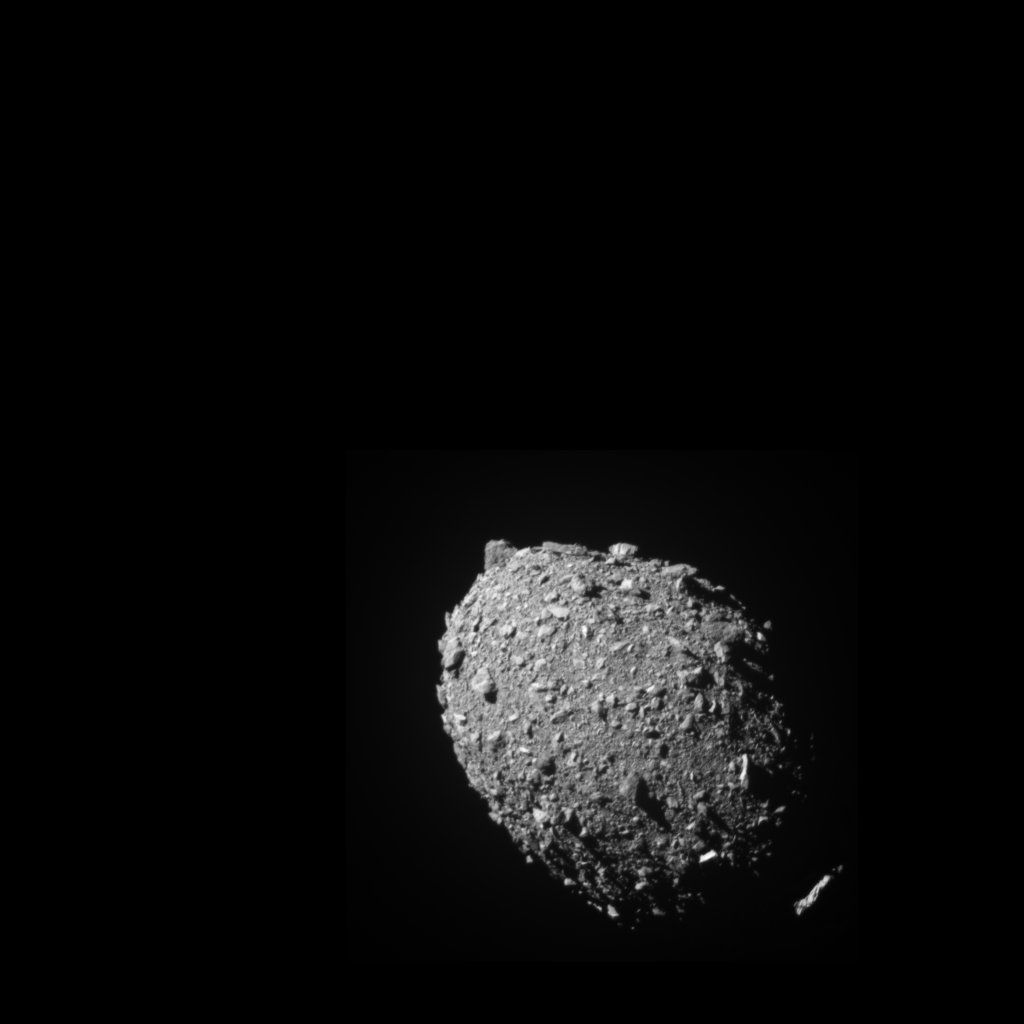
The European Space Agency presents Wednesday in Berlin its first close photographs of Dimorphos. It wants to measure the effects of the impact of DART, which shortened the orbit of this asteroid around Didymos by 33 minutes.
Four years after the voluntary collision of the American DART probe with Dimorphos, scientists will be able to examine closely what the impact has changed on the asteroid surface. The European Space Agency (ESA) is scheduled to present on Wednesday 25 November, from 7.45 p.m. in Paris and Berlin (8.45 p.m. in Beirut), the first close images of Dimorphos taken by its Hera probe. The presentation, organized at the Museum of Natural History in Berlin, will be broadcast on ESA Web TV and the agency’s YouTube channel.
A short orbit of 33 minutes
On September 26, 2022, NASA directed DART towards Dimorphos, a small asteroid about 150 metres in diameter that revolves around Didymos, a significantly larger body. Before the trial, Dimorphos took nearly twelve hours to go around. Observations from the Earth showed that the impact reduced this time by about 33 minutes. It is therefore Dimorphos’ orbit around his companion that was used to measure the effectiveness of the shock. Asteroid couple didn’t threaten Earth.
The collision threw debris into space, observed from Earth. Their ejection helped to alter Dimorphos’ movement. To determine the extent to which it is necessary to know the mass of the asteroid and to understand how its structure reacted to the shock. The first shots will compare the shape and surface of Dimorphos to the images sent by DART before the collision.
What can Hera measure on the spot?
On 11 November, ESA reported that Hera had started observations at a distance of approximately 25-30 kilometres from the two asteroids. Their gravity is too low for the probe to follow, at this stage, a classical circular orbit as around the Earth. Rather, it travels controlled trajectories around the centre of gravity of the torque at a typical speed of about 12 centimetres per second.
Hera has to get closer in the coming months. In early 2027, ESA plans to deploy two small satellites, Milani and Juventas, to examine the properties of the surface and probe inside Dimorphos. Mission measurements should help to understand the conditions under which the DART-tested method could operate on another asteroid with a different mass or structure.





Comments