

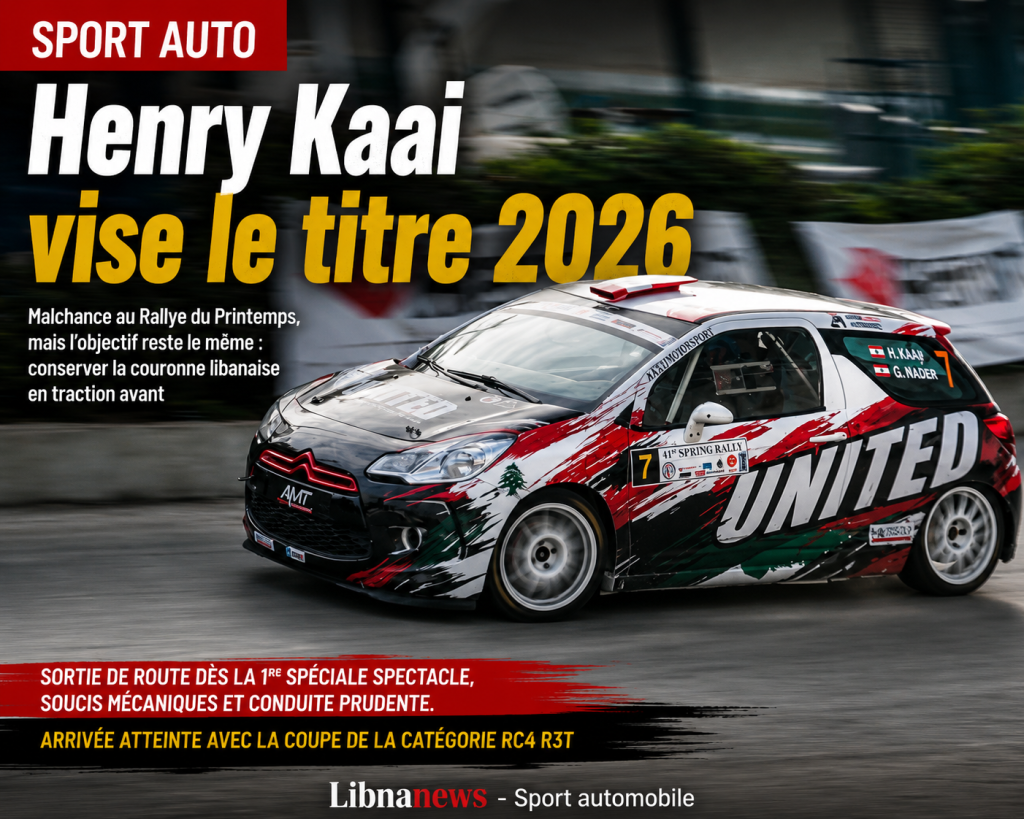
Spring Rally opened the Lebanese motorsport season on a contrasting note for Henry Kaai. The Lebanese driver, engaged with his co-driver Georges Nader on a Citroën DS3, was not spared the bad luck during this 41st edition organised by the Automobile and Touring Club of Lebanon. From the first special show, his car came out of the track, causing damage and mechanical problems that weighed on the rest of the event.
Despite these difficulties, the crew reached the finish and won the RC4 R3T Cup. This result saves a complicated weekend, but it does not change the target set before the launch of the 2026 season. Henry Kaai wants to keep his Lebanese title in front traction, both in rally and in coast racing. The challenge is high, as the driver remains in an exceptional 2025 season, marked by three national titles in rally, coast and speed disciplines.
So this first appointment did not deliver a simple reading. Kaai lost time, sustained damage and had to adapt his pilotage. But he also showed an essential quality in a long championship: know how to finish when maximum performance is no longer possible. In a sport where a road trip can erase a weekend in seconds, experience and calm count as much as pure speed. It is on this management capacity that the pilot intends to build the suite.
An upset Spring Rally
The Spring Rally occupies a special place in the Lebanese calendar. Placed at the opening of the season, it often serves as the first indicator. Pilots test their pace there, cars show their level of preparation and crews resume their automation after the break. For Henry Kaai, this edition quickly turned into a logic of limiting damage. The exit of the first special show damaged the Citroen DS3 and caused persistent mechanical worries.
The scenario was repeated in the second special. The car did not return to normal performance. In these circumstances, the Kaai-Nader crew had to abandon excessive risk taking. The pilot chose a slower, quieter and more rational ride, with a clear priority: to reach the finish. This decision may seem defensive. Yet it is often decisive in a national championship, where each point and each category ranking can count at the end of the season.
Upon arrival, the crew took the RC4 R3T class cut. This trophy does not reflect the rider’s ambition, but it confirms his ability to stay in the race even when conditions become unfavourable. It also shows the importance of the pair formed with Georges Nader. In an affected car and on demanding stages, the role of the co-pilot becomes even more central. Read the road, maintain the tempo, reassure and help the pilot avoid the error that would end the test.
Henry Kaai relies on experience
Henry Kaai did not attempt to mask his frustration after the rally. He acknowledged that luck had not accompanied him, while stressing the importance of having finished the event. According to him, the damage suffered on the car forced him to adopt a prudent driving and not put any more pressure on the mechanics. This choice allowed him to preserve the essentials. He also thanked Georges Nader for his work in the interior and confirmed that he would remain with him during the upcoming rallies.
This loyalty to the co-pilot is not a detail. In rallying, the confidence between driver and browser is built over time. It is especially true when the test becomes irregular. The speed depends on the steering wheel, but also on the quality of the notes, the accuracy of the rhythm and the ability to anticipate the traps. Georges Nader is presented as an experienced and experienced co-pilot. His presence in the right box reinforces Kaai’s chances in a season where regularity will count as much as the bursts.
Henry Kaai’s objective is clear: to retain the Lebanese title of the front traction category in rally and coast racing. The pilot does not leave a blank page. He came out of a year when he achieved a rare performance, winning the forward traction titles in three national championships: rallies, coast races and speed races. This triple success gives him a special status in Lebanese motorsport. It also creates new pressure. The title holder becomes the one others want to beat.
Front traction, precision discipline
Front traction imposes a specific style. She’s not flying like a four-wheel drive. Mass transfer, front train management, braking accuracy and the way out of turns play a decisive role. On Lebanese roads, often narrow, brittle and changing, this category requires clean driving. We must attack without damaging the car. Speed should be maintained in the chains, without excessive tire use or understeer. Kaai built part of his reputation on this balance.
The Lebanese pilot is recognized for his well-positioned, efficient and controlled driving style. The text transmitted emphasizes its ability to manage the most difficult steps and the most demanding tracks. This quality helped to quickly impose itself on the local and regional landscape. She also explains why, despite a troubled Spring Rally, her ambition remains intact. A championship is not only won on the perfect days. It also wins by limiting losses when mechanics, roads or luck turn against the crew.
Henry Kaai’s course began in motorsport in 2017. In less than a decade, he has settled among the important names of the discipline in Lebanon. Its progress was rapid, supported by local results and a notable regional presence. The pilot, born in 1980, turned his first seasons into a springboard. He gained experience, pace and maturity, until he became a regular competitor for the titles.
Three regional titles and a quick climb
Its record in the Middle East remains one of the strengths of this trajectory. Kaai won the title of the forward traction category of the Middle East Championship for three consecutive years, in 2018, 2019 and 2020. This series brought into another dimension. It confirmed its ability to adapt to different terrains, different formats and wider competition than the Lebanese championship alone. It also contributed to increasing the visibility of Lebanese motorsport in the region.
This regional passage gave Kaai a useful experience for the national seasons. The Middle East rally calls for fine surface reading, pressure resistance and constant mechanical discipline. Successful pilots often return with better risk management. In the case of Kaai, this experience can be seen in his approach to the Spring Rally. He’s not just holding back bad luck. He retained the need to finish, thank the team and prepare for the rest.
The technical team occupies an important place in its device. Henry Kaai thanked the IMT structure, led by former champion Doumit Bou Doumit, for the preparation of the Citroën DS3. In a rally season, performance never depends solely on the driver. It depends on the quality of assembly, mechanical monitoring, the management of repairs between specials and the ability to quickly understand the symptoms of a car. When problems arise in the early stages, the technical team becomes a central player in the result.
IMT, United Petroleum and Project Continuity
The Citroën DS3 remains a known base in front traction categories. It can allow a high pace, provided that it is well prepared and well exploited. In the case of Kaai, the damage to the Spring Rally limited the car’s potential. But this experience can also be used to strengthen the technical programme of the next rounds. A championship is built by successive adjustments. Each exit reveals a point to be corrected, a room to be monitored, an approach to be modified or a limit not to be crossed.
The support of United Petroleum, quoted by the pilot, complements this environment. Kaai thanked the Chairman of the Board, Jocelyne Tayaa, for the sponsorship. In Lebanese motorsport, the role of sponsors remains crucial. The costs of preparation, engagement, tyres, assistance and transport weigh heavily on the teams. Stable support allows to plan a season, maintain the car and approach the sleeves with better visibility. It can also help to maintain the continuity of a sport project.
Henry Kaai’s 2026 program is not limited to the rally. The pilot also aims for the coast race, a different but complementary discipline. The rise imposes a short intensity, without margin of error. It requires to find the right rhythm immediately, without time to adapt. The pilot must know the route, place the car accurately and operate every metre. The qualities developed during the rally help, but they are not always enough. The coast race rewards another form of concentration.
A Lebanese Season Under Pressure
By aiming for both championships, Kaai set a demanding goal. It will have to manage the timing, mechanical priorities and preparation between disciplines. The transition from a rally to a coast race requires different settings and a distinct mental approach. The pilot’s advantage lies in his recent experience. After winning the front traction titles in rally, coast and speed last year, he knows the constraints of a multidisciplinary season. He also knows that defending a title requires more consistency than its conquest.
The follow-up will depend on several factors. The reliability of the car will be decisive. Coordination with Georges Nader must remain solid. The technical team will have to correct the consequences of the Spring Rally and maintain a high level of preparation. Opponents will seek to take advantage of the slightest false step. The season is thus open, despite Kaai’s favorite status in the front traction category. His first rally recalled that the sports hierarchy can be shaken from the first stages.
Lebanon’s motor sport continues to have a faithful audience, despite the country’s economic and logistical difficulties. Rallies and coast races bring together experienced drivers, private teams, specialized mechanics and an audience committed to historical routes. In this context, each season requires a heavy organization. Budgets are tight, parts are not always easy to get and the preparation of a competitive car imposes constant discipline. The presence of pilots like Kaai helps maintain this level of requirement.
The Automobile and Touring Club of Lebanon also play a structuring role in this landscape. By organizing the Spring Rally, he gives the symbolic start of a sports year that must then continue on other formats. For crews, this first appointment is used to measure deviations, but also to send a message to competitors. Kaai did not send that of chronometric domination. He sent the resistance one. In a long season, this message can count.
The mental dimension remains central. A pilot who has just experienced an exit must immediately find his marks. He must distinguish the necessary caution from the fear that blocks. He must also listen to his co-pilot and trust his car, even when it has suffered. This invisible work often explains the difference between abandonment and arrival. In the case of Kaai, the experience gained since 2017 probably played in this ability to stay in the event.
The driver also suggested that he would compete next year with a new car. This announcement already opens up a perspective beyond 2026. The future mount could mark a new stage in its sport program. It could also change its ambitions, its driving style and its margin of progress. For the time being, priority remains the current season. Kaai has to defend his titles, manage the unexpected and confirm that the Spring Rally was only an upset start, not a sign of a step backwards.
In a discipline where the result is sometimes played on a puncture, a misheard note or too optimistic support, Henry Kaai knows that patience can become a weapon. Last weekend gave him little opportunity to express his speed. He allowed him to show his maturity. Joining the finish with a reduced car, thanking his co-driver, greeting his team and maintaining his title goal say something about his method. The rest of the season will tell whether this prudent management of the first appointment will become an advantage in the championship race.




