

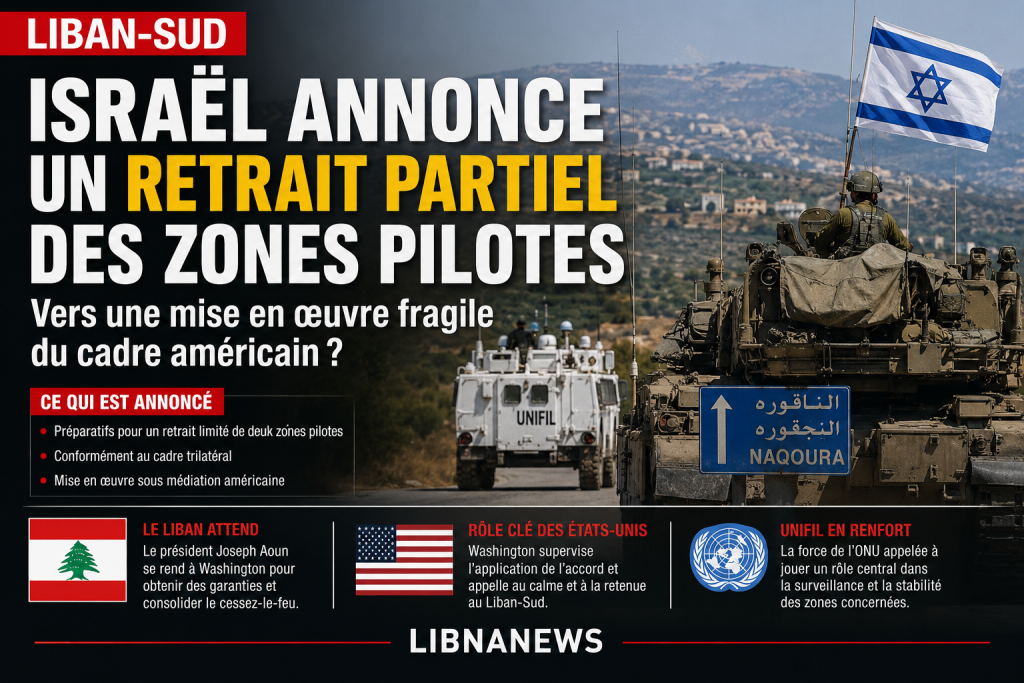
On 18 July 2026, at the end of the afternoon, the Israeli authorities confirmed preparations for a limited withdrawal of troops from two pilot areas in southern Lebanon, in accordance with the framework of the trilateral agreement signed in June with Beirut and Washington. This announcement, relayed by Israeli diplomatic and media sources, comes at the end of a day marked by intense discussions about the implementation of this agreement, while Lebanese President Joseph Aoun is about to visit the United States.
Partial withdrawal at the preparatory stage
At the end of the day, Israeli preparations to evacuate two pilot areas were reported. They do not yet make it possible to say that the troops have left the sectors concerned. The distinction remains essential. A military decision can be announced, prepared and delayed due to technical disagreement, security requirement or political change.
The Israeli authorities are said to have begun organizing the movement of their units. This phase normally includes the removal of equipment, the reduction of advanced posts, the securing of axes and the transmission of coordinates to mediators. The Lebanese army must then enter the areas evacuated according to a coordinated timetable.
No final map was released on Saturday. The precise names of the two zones therefore remain to be officially confirmed. Previous information referred to sectors around positions occupied since the resumption of fighting. They also referred to areas close to Beaufort Castle and other points in the Israel-controlled band.
The limited nature of the withdrawal should also be stressed. Israel does not at this stage plan to evacuate all occupied territories in southern Lebanon. The two pilot zones represent a first experiment. They should test the exclusive deployment of the Lebanese army and the absence of weapons belonging to non-State actors.
The announcement is therefore a political signal, but not yet a fully established territorial change. The first concrete indicator will be the visible entry of the Lebanese army into the sectors concerned. The second will be the possibility for displaced inhabitants to return under state protection.
The US Pilot Zone Mechanism
The principle of pilot zones appears in the framework negotiated in June between Lebanon, Israel and the United States. It provides for Israel to gradually withdraw from certain sectors, while the Lebanese army deploys its units there and assumes exclusive control. Weapons and combatants not belonging to State forces must be removed.
The first two areas were chosen jointly by the Lebanese and Israeli armies, with American coordination. Other sectors could be added if the first phase works. However, their selection must remain subject to the consent of the parties.
Washington presents the mechanism as a progressive method. Instead of waiting for a full agreement on the whole of the south, participants start with limited areas. This allows them to test procedures for withdrawal, military rotation, monitoring and return of populations.
This approach responds to operational logic. It reduces the risk of a security vacuum between the departure of Israeli forces and the arrival of the Lebanese army. It also allows mediators to check the commitments of each party before extending the scheme.
Lebanon accepts the principle of pilot zones as a step towards full withdrawal. However, it refuses that they become a definitive solution. Beirut calls for a comprehensive timetable and guarantees for all occupied territories. Israel, for its part, wants to examine each sector separately and maintain a margin of decision related to its security requirements.
This divergence remains at the heart of the process. The mechanism can pave the way for wider withdrawal. It can also produce some limited evacuations without regulating the status of the rest of the occupied area.
The discussions in Rome prepared the technical phase
The Lebanese and Israeli delegations met in Rome on 15 July under American mediation. The sixth round of discussions focused on the application of pilot zones. Participants worked on guidelines to organize the first operations.
The exchanges were described as positive and productive by an American official. The parties have reportedly made progress on the general principles. Discussions must now enter a technical phase. This includes maps, schedules, routes, means of communication and verification mechanisms.
But Rome did not produce immediate withdrawal. A Lebanese military source said again Saturday morning that no new site had been handed over to the army. Lebanese units continued their patrols in their usual areas.
A tripartite meeting by videoconference was intended to advance the details. It was postponed for technical reasons attributed to the United States and Israeli parties. No new date had been announced at the time the information on the withdrawal preparations began to circulate.
The Israeli announcement can therefore be interpreted as an extension of the discussions in Rome. It can also be used to show that the process is not blocked despite the postponement of the meeting. Only implementation will determine whether the preparations correspond to an agreed timetable.
American mediators will have to ensure continuity between political decisions and military orders. Poor coordination could result in delay or incident. The withdrawal must be sufficiently precise to prevent the two armies from meeting face to face without clear rules.
Israel seeks to limit the scope of evacuation
Israel presents the areas it controls in southern Lebanon as a safety belt to protect its border areas. Its forces occupy a band that reaches, in some areas, several kilometres deep. The Israeli government claims that it will not make a full withdrawal until Hezbollah maintains its military capabilities.
This position explains the limited nature of the announcement. Israel agrees to evacuate two areas, but does not give up its entire system. He wants to verify that the Lebanese army effectively controls the areas handed over and that no armed Hezbollah presence reappears there.
The Israeli Government is also seeking to retain control over implementation. He may request American warranties, inspections or reports. It can also condition the next steps to the results observed in the first areas.
For Beirut, this method is dangerous. Israel could use each incident or disagreement to suspend the schedule. It could also choose sectors outside the most strategic positions, while maintaining control over the dominant heights or axes.
The announcement of a partial withdrawal therefore responds only to part of Lebanese requests. It does not regulate the extent of the occupied area, the status of the remaining positions, or the final calendar. It only opens a first breach in the status quo.
The Lebanese reaction will depend on the actual content of the operation. A symbolic withdrawal, limited to peripheral areas, would be difficult to present as a major step forward. An evacuation involving militarily important positions would be more significant.




