

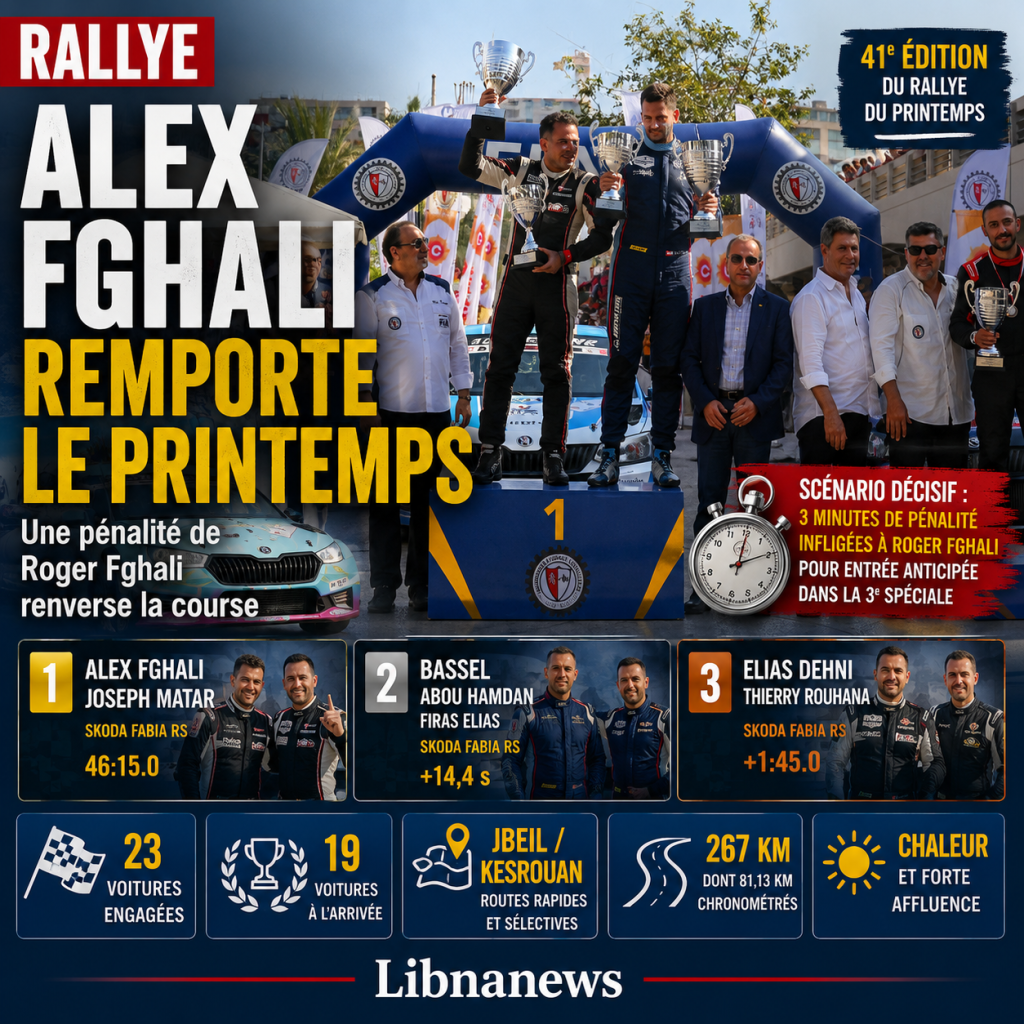
Alex Fghali won the 41st Spring Rally, organized by the Automobile and Touring Club of Lebanon on the roads of Jbeil and Kesrouan, after a weekend marked by heat, a strong influx and a sporting scenario reversed by a decisive penalty. Together with Joseph Matar on a Skoda Fabia RS, the Lebanese driver signed his second win in this event, after his success in 2024. He beat Bassel Abu Hamdan and his co-pilot Firas Elias, also on Skoda Fabia RS, by 14.4 seconds. Elias Dehni and Thierry Rouhana complete the podium at 1 minute and 45 seconds from the winner. The rally, the first round of the Lebanon Rally Championship, brought together 23 cars, 19 of which crossed the finish line.
Alex Fghali confirms at Spring Rally
Alex Fghali’s victory was built with regularity, but also with cold blood. However, the Spring Rally first seemed to smile at Roger Fghali, his father, who had the record in the event with eighteen wins and multiple champions from Lebanon. From the opening stage, played Saturday in the organizing club, Roger Fghali and his co-driver Louay Sakr signed the best time at the wheel of their Toyota GR Yaris.
The following day, on the asphalt roads of Jbeil and Kesrouan, the same rhythm was confirmed. Roger Fghali hit hard again in the first stages. His experience, his reading of the terrain and his ability to attack on fast roads were once again placed at the centre of the race. But the rally turned in the third stage. The Fghali-Sakr duo entered three minutes before their scheduled schedule to compete in the timed sector. The three-minute regulatory penalty changed the ranking.
This sanction paved the way for a tight fight between Alex Fghali, Bassel Abu Hamdan, Karl Rezk and Elias Dehni. In this new configuration, Alex Fghali managed to preserve his advantage. He didn’t necessarily sign all the best times, but he kept pace enough to keep his rivals from coming back. Its success illustrates an essential feature of the modern rally in Lebanon: pure speed counts, but race management, administrative accuracy and regularity can decide the final result.
This second title at the Spring Rally also confirms the installation of Alex Fghali among the references of the discipline. Winning this event two years in a row is not annoyance. The rally opens the national season. It attracts the best crews. It serves as a technical test after winter preparation. He often sets the tone of the championship. For Alex Fghali, this victory offers more than just a trophy. It is an ideal entry into the national race.
A penalty that changes the entire race
Sunday was played on five stages after the start from the ATCL headquarters in Kaslik. The summer heat accompanied the crews from morning until arrival. The roads, completely paved as in all Lebanese rallies, required precise driving, fine tyre management and permanent concentration. The total distance of the event was 267 kilometres, 81.13 kilometres of which were spread over six timed stages.
Roger Fghali scored the best time in the second stage, ahead of Karl Rezk and Bassel Abu Hamdan. In the third special, he again made the best performance, ahead of Alex Fghali and Abu Hamdan. But this special was also the sanction. The advance entry of the race leader relegated away from first place. Within minutes, the rally changed its face. The duel expected around the most titrated pilot of the event gave way to a more open battle.
In the fourth special, Roger Fghali was the fastest again. Alex Fghali placed behind him, followed by Abu Hamdan. In the general standings, Alex held the lead, ahead of Karl Rezk and Bassel Abu Hamdan. In the fifth stage, Roger continued to attack. He signed the best time before Alex and Abu Hamdan. The last special confirmed this hierarchy at the time: Roger Fghali ahead of Abu Hamdan and Alex Fghali.
But the overall classification is not a single acceleration. The three-minute penalty prevented Roger Fghali from turning his scratch time into a victory. He finished fourth in the general standings, two minutes away and a second away from his son. This result shows the paradox of his race: he dominated several stages, but a scoring error cost him the rally. For Alex Fghali, the situation called for another type of mastery. It was necessary to control the gap, resist pressure and avoid any false steps.
Abu Hamdan near, Dehni solid third
Bassel Abu Hamdan delivered one of the most consistent races of the weekend. With Firas Elias at his side, he maintained a high pace without making major mistakes. His 14.4 seconds final delay on Alex Fghali shows the density of the battle for victory. On such a short timed distance event, this gap remains small. It reflects constant pressure on the leader until the last kilometers.
Abu Hamdan thus confirms his status as a serious candidate in the championship. His result shows that he has the equipment, experience and speed to target the first places. The Skoda Fabia RS once again imposed itself as the reference car in the head category. The first three of the general rankings were based on this model, a sign of its effectiveness on Lebanese asphalt roads.
Elias Dehni, co-drived by Thierry Rouhana, finished the podium. His delay of 1 minute and 45 seconds on the winner allowed him to settle firmly in third place. In a race marked by a sudden change of hierarchy and the chronometric rise of Roger Fghali, Dehni managed to preserve his position. Its podium rewards a stable performance, without excesses and without costly mistakes.
Behind this trio, Roger Fghali took fourth place with Louay Sakr, ahead of Tarek Younes and Salim Jalilati on Skoda Fabia RS. Domit Bou Domit and Rami Mounem, on Renault Clio, finished sixth, just ahead of Ria Dagher and Nadim Abu Elias. The differences between these two crews were small, with only five tenths of a second between sixth and seventh place. This proximity gives an idea of the level of competition in the peloton.
A dense classification to the end
The unofficial general classification puts Alex Fghali and Joseph Matar ahead in 46 minutes and 15 seconds. Bassel Abu Hamdan and Firas Elias follow in 46 minutes and 30 seconds. Elias Dehni and Thierry Rouhana finished third in 48 minutes and 01 seconds. Roger Fghali and Louay Sakr close the event in 48 minutes and 16 seconds. Tarek Younes and Salim Jalilati complete the top five in 48 minutes and 45 seconds.
The rest of the ranking illustrates the diversity of the plateau. Domit Bou Domit and Rami Mounem rank sixth in 49 minutes 39.3 seconds. Ria Dagher and Nadim Abu Elias follow in 49 minutes 39.8 seconds. Joseph Hindi and Viken Kanledjian finished eighth, ahead of Jad Aawar and his Jordanian co-pilot Mousa Djiheirian on Mitsubishi Lancer Evo X. Houssam Tarabey and Youssef Saleh complete the top ten, also on Mitsubishi Lancer Evo X.
David Mezher and Chadi Nasr, on Ford Fiesta, took eleventh place. Robert Aaraj and Joseph Kmeid follow on Peugeot, ahead of Chadi Fakih and Samer Sfeir on Lancia. Rodrick El-Rahi and Gary Kondakjian placed fourteenth on Mitsubishi Lancer Evo X. Jason Wehbe and André Mehanna finished fifteenth on Renault Clio RS. Alex Sahnawi and Marvin Mezher take the sixteenth place on Peugeot 208. Joanna Hassoun and Naji Sfeir, Ahmad Khaled and Omar Mazkour, then Henry Kaai and Georges Nader complete the list of 19 crews on arrival.
Out of 23 cars engaged, 19 joined the final closed park. This rate of arrival confirms a demanding but controlled test. The roads of Jbeil and Kesrouan, known for their rapid chaining, rhythm changes and technical areas, have again offered selective terrain. The public, numerous on the specials, accompanied the race in a great day atmosphere of mechanical sport.
Categories devote several winners
Beyond the general classification, the categories distributed several important titles. Domit Bou Domit and Rami Mounem won the RC4 R3 class. Ria Dagher and Nadim Abu Elias won the RC3 Rally3 title. The driver also won the Women’s Cup, confirming her place among the most followed figures in Lebanese motorsport. In the same category, Joseph Hindi and Viken Kanledjian finished second, ahead of David Mezher and Chadi Nasr.
Jad Aawar and Mousa Djiheirian won the RC2 NR4 class. Rodrick El-Rahi and Gary Kondakjian took second place in this category. Houssam Tarabey and Youssef Saleh won in NRC NS4. Robert Aaraj and Joseph Kmeid finished first in RC4 Rally4, ahead of Chadi Fakih and Samer Sfeir. Jason Wehbe and André Mehanna won the RC5 Rally 5 Cup, as well as the trophies of the young rider and the young co-driver.
Alex Sahnawi and Marvin Mezher won the NRC class NS3. Joanna Hassoun and Naji Sfeir placed second, ahead of Ahmad Khaled and Omar Mazkour. Henry Kaai and Georges Nader received the RC4 R3T Cup. These results show the importance of the Spring Rally as a launch event for the entire stage. The focus is on the overall podium, but the classes play a major role in the championship dynamics.
For several crews, these category victories are as important a goal as absolute classification. They help build confidence, validate technical preparation and measure direct competition. They also provide visibility for pilots who build their season step by step. In a national championship where budgets, cars and ambitions differ greatly, this category reading remains essential.
A historic rally born in 1986
The Spring Rally has a special history in the Lebanese calendar. Created in 1986, it was won in its first edition by Nabil, said Billy, Karam, today president of the Automobile and Touring Club of Lebanon. This continuity gives the test a heritage value in national mechanical sport. It recalls that the Lebanese rally was built despite crises, interruptions, economic constraints and organizational difficulties.
The 41st edition is part of this tradition. It marks the launch of the Lebanon Rally Championship for the current year. It brings together leading-edge crews, but also pilots engaged in more accessible categories. It allows mechanics, commissioners, co-drivers, officials and volunteers to regain the rhythm of a season. Rally is never just a matter of speed. It is based on a heavy organization, precise security and ongoing coordination.
The organizing club mobilized its teams over two days. Saturday’s special show, held in Kaslik’s installations, launched the event in a publicly accessible setting. On Sunday, the crews joined the roads of Jbeil and Kesrouan for the other five stages. This structure allows to mix show and pure competition. It also gives the public first contact with cars before faster sectors.
The weather added a physical dimension. The warm and sunny weather imposed additional attention on tires, brakes and mechanical temperatures. Under these conditions, experienced crews can make the difference, not only by their speed, but by their ability to preserve the car until arrival.
A sustained tribute to Gaby Hayek
The opening stage was named Gaby Hayek, a long-time leader of the Spring Rally. Before departure, the present observed a minute of silence in his memory. Imad Lahoud, a member of ATCL’s board of directors and chairman of the rally commission at the International Automobile Federation, took the floor to acknowledge his commitment and commitment to mechanical sport.
Gaby Hayek’s family was present, including his wife Natalie and his daughters Alexia and Morgan. Alexia Hayek gave the start signal of the race. This moment gave a memorial dimension to the opening of the rally. In a sport where the names of the drivers attract attention, the organizers recall the role of those who build the events from behind the scenes.
The departure ceremony also brought together Brigadier General Joseph Hashem, head of the Kaslik Officer Club, ATCL President Billy Karam, General Secretary Camille Eddé, board members, rally leaders and a large audience. Roger Fghali and Louay Sakr then made the best time for this inaugural special in 2 minutes 04.4 seconds, ahead of Alex Fghali and Joseph Matar, followed by Karl Rezk and Karim Abu Elias.
The final podium was held at the headquarters of the organizing club. Charbel Hobeika represented the Director General of Customs, Gracia Kazzi. Also present were Billy Karam, his vice-presidents Eliane Habre and Serge Zouein, Camille Eddé, treasurer Gilbert Messihi, Imad Lahoud, Moussa Al-Nimr, executive director of Vera Anton club, Wissam Kachkouch representing Coral company, race leaders, Gaby Hayek family and a wide audience of enthusiasts.
A season launched under the sign of competition
Alex Fghali’s victory opened the championship on an intense note. The narrow gap with Bassel Abu Hamdan indicates that the season could be contested. The presence of Elias Dehni on the podium, the speed displayed by Roger Fghali despite his penalty and the density of the top ten promise an open competition. The first round has already delivered its batch of confirmations, regrets and technical information.
Alex Fghali leaves with maximum confidence. Abu Hamdan knows he has the rhythm to aim higher. Dehni confirms its strength. Roger Fghali, despite fourth place, showed that he remains able to dominate the clocks. The category competitors also laid the foundation for their season. The Spring Rally has thus fulfilled its role of separating, revealing, recalling the rules and putting the Lebanese public back on the stage.
The ATCL announced that many photos of the rally would be published on its page dedicated to mechanical sport. The championship can now turn to its next stages with a first ranking, points to defend and a family rivalry that has already given this 41st edition one of its most significant scenarios.




