

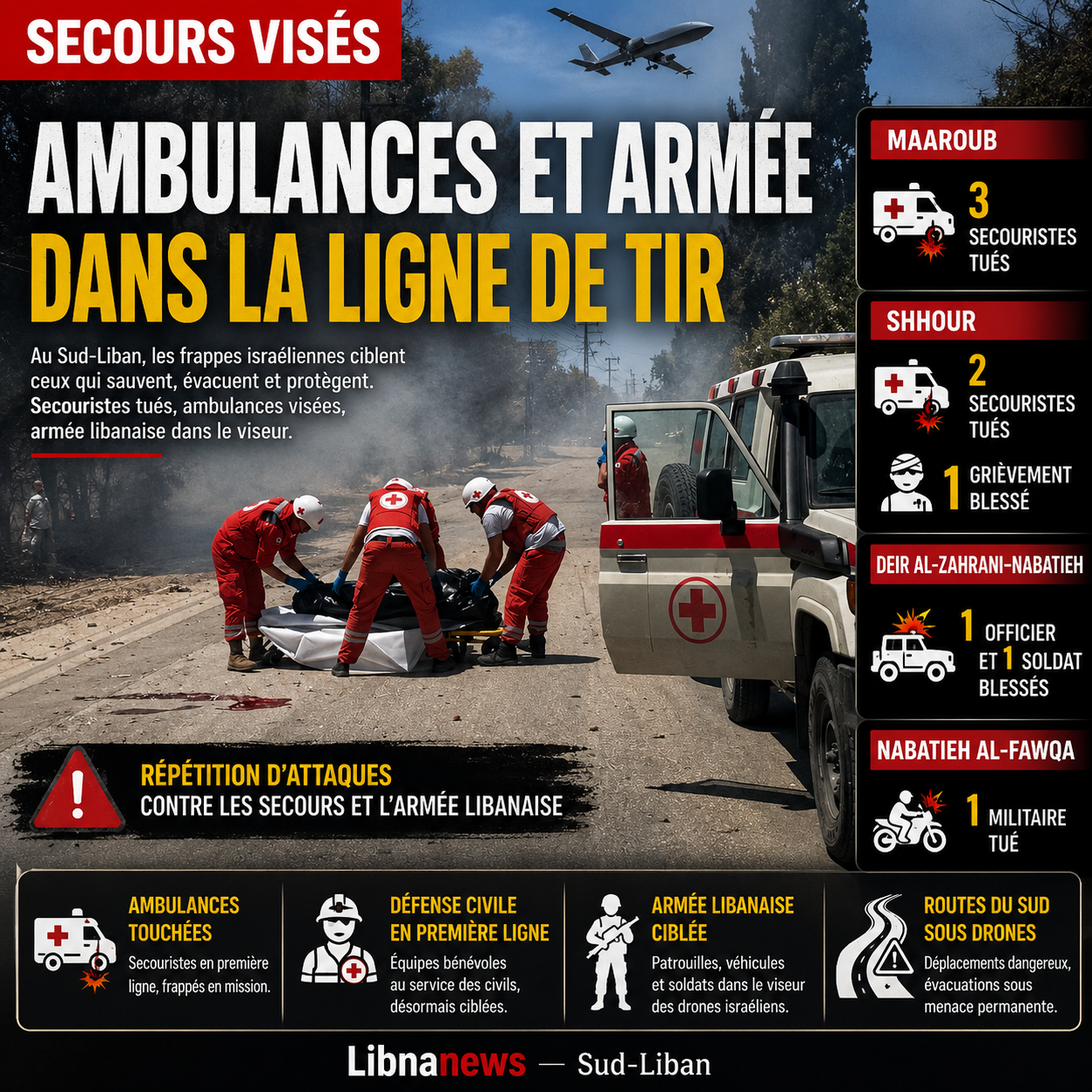
In southern Lebanon, a new sequence of Israeli strikes targets those who intervene after the bombings: first aid workers, paramedics, civil defence and the Lebanese army. In Maaroub, an ambulance from the Islamic Risala Scouts Civil Defense was hit by a drone, killing three people. In Shhour, two rescue workers were killed and a third seriously injured in a direct attack on an ambulance. The Lebanese Army also reports that one of its vehicles was targeted on the Deir al-Zahrani-Nabatiyah road, wounding an officer and a soldier. Another soldier fell in Nabatiyah al-Fawqa, targeted while travelling on a motorcycle.
Targeted first aid: a red line crossed
Lebanon has recorded a new sequence of attacks directly targeting those who intervene after the strikes: first aid workers, paramedics, civil defence and the Lebanese Armed Forces. During the night and during the day, several incidents were reported in the south, between Maarub, Shhour, Deir al-Zahrani, Nabatiyah and Nabatiyah al-Fawqa. They draw the same reality: the teams responsible for saving, evacuating or securing the roads are themselves in the firing line.
According to available evidence, at 0122 hours a drone struck the Maaroub road. The attack hit a civilian defence ambulance belonging to the Scouts of Islamic Risala. Three rescue workers were killed. The Lebanese Ministry of Health also announced two rescue workers killed and a third seriously injured in a direct strike against an ambulance in Shhour. These attacks add to a series of recent incidents against medical and relief teams in southern Lebanon.
The Lebanese army announced that one of its vehicles had been targeted by an Israeli drone on the Deir al-Zahrani-Nabatiyah road. One officer and one soldier were injured. In another incident, a Lebanese soldier was killed in Nabatiyah al-Fawqa after being targeted while riding a motorcycle. The military institution presents these facts as part of a repeated targeting of its elements, vehicles and positions, against the background of a continuing Israeli offensive in the South.
The day is therefore not limited to an assessment of isolated strikes. It raises a central question for Lebanon: what remains of the protection of relief services when ambulances, intervention centres, military motorcycles and army vehicles become targets? The question goes beyond military ground. It affects the continuity of the State, the ability to evacuate the wounded, access to hospitals, and the survival of the inhabitants still present in the villages exposed.
Maaroub: three dead in an ambulance
The Maaroub strike occurred in a locality of Tyre District, in an area already subjected to successive raids, overflights and alerts. The schedule at 1:22 a.m. gives an idea of the vulnerability of rescue teams. At night, paramedics travel with less visibility, on roads sometimes cut off, in areas where drones remain audible but difficult to locate. When an ambulance is hit, it is not only a vehicle that disappears. It is an immediate response capability that is removed from an entire area.
The Scouts of the Islamic Risala occupy an important place in the relief system in southern Lebanon. Their teams intervene in villages, evacuate wounded people, recover bodies, transport patients to hospitals and often work directly with bombed areas. Their political or community affiliation, often highlighted in the public debate, does not remove anything from the medical or rescue nature of a mission when it is conducted as such. This is the principle that humanitarian organizations regularly recall.
The case of Maaroub also crystallizes a recurring fear among rescuers: that of the second strike. In a number of recent episodes in Lebanon, emergency teams have been affected as they head for a bombed site or evacuate victims. This logic paralyzes operations. Ambulances sometimes have to wait before moving forward. The teams look at the sky before they take out the stretchers. The injured stay on site longer, reducing their chances of survival.
Shhour: an ambulance directly affected
In Shhour, the direct strike against an ambulance reinforces this feeling of a systematic threat. The Ministry of Health reported two rescuers killed and a third seriously injured. Again, the central element is not just the number of victims. It is due to the nature of the target announced: a rescue vehicle. An ambulance crew does not act as a combat unit. It transports, stabilizes, evacuates, sometimes under fire, often without knowing whether the road will remain open.
The loss of two relief workers in Shhour also deprives neighbouring villages of valuable operational experience. In a drone war, every minute counts. First aid workers are familiar with secondary roads, routes that are still feasible, isolated families, homes that are inhabited despite evacuation orders and hospitals that can receive injured people. Their disappearance is not only measured in lost lives. It is also measured in weak collective capacity.
Attacks on relief have an immediate impact on civilians. When a resident hears a strike, he no longer knows if the ambulance will come. When a family decides to leave a village, they no longer know whether the road to the hospital or to a reception centre will remain practicable. When a serious injury is to be transferred, the ambulance driver must arbitrate between the medical emergency and the risk of a strike on the route. This uncertainty turns every health shift into a survival decision.
South Lebanon is already experiencing an advanced hospital crisis. Establishments have suffered material damage. Health personnel were injured. Hospitals still open operate with small teams, pressure generators, stocks under pressure and an irregular flow of injured people. In this context, the destruction or immobilization of an ambulance has a chain effect. It slows down evacuations, overloads other teams and forces families to use private cars, sometimes without medical equipment or qualified support.
Lebanese Army targeted
The Lebanese army is in a different but equally sensitive position. She’s not a civilian medical service. It embodies the state, sovereignty and the maintenance of a minimum order in the affected areas. Its deployment to the South is used to guide the roads, accompany some evacuations, maintain liaison with local authorities and document violations. When a military vehicle is hit on the Deir al-Zahrani-Nabatiyah road, the attack targets an institution already under duress.
According to the army, the drone injured an officer and a soldier. The military communiqué places this incident in a series of targetings against its elements, vehicles and positions. The wording is serious. She’s not describing a trajectory accident. It accuses Israel of repeatedly targeting the Lebanese military institution. This accusation has a strong political significance, as the army is supposed to be the central interlocutor of any stabilization, withdrawal or redeployment mechanism in the South.
The death of a soldier in Nabatiyah al-Fawqa adds another dimension. According to the information provided, he was targeted while riding on a motorcycle. The place is important. Nabatieh al-Fawqa is located in an area that has become more exposed as Israeli operations have approached Nabatieh and the Beaufort Heights. The strike against an individual member on the move shows that the risk is not limited to posts, dams or visible convoys. It also affects the regular movements of soldiers.
These attacks against the army weaken the only national actor likely to be deployed in a consolidated ceasefire scenario. International discussions, including those conducted under American sponsorship, regularly evoke the role of the Lebanese army in controlling border areas, securing roads and accompanying an Israeli withdrawal. But every strike against his vehicles or soldiers reduces his margin of action and complicates his image with the inhabitants.
The Lebanese army does not have the same means as the Israeli army. It does not control airspace. It has no comparable anti-drone defence. It acts in an area where drones, aircraft and artillery fire often decide the pace. Its patrols are therefore exposed without being able to respond to the threat. This asymmetry reinforces the political character of each attack. It recalls that Lebanese sovereignty remains limited by Israeli air rule.
A displacement strategy denounced by Beirut
In its statement, the army also links these attacks with destruction and forced displacement. She claims that the escalation is aimed at pushing the inhabitants out of their villages and localities. This reading joins that of many local authorities in the South, who see evacuation orders, destruction of houses, road strikes and pressure on relief services as a strategy to make certain areas uninhabitable. Israel also claims to act against Hezbollah and its military infrastructure.
The debate on intent should not mask the effects. The villages are emptying. The residents who remain live in the anguish of the next alert. Rescue workers are responding with increasing risks. The roads between Tyre, Nabatieh, Deir al-Zahrani, Maaroub, Shhour and the nearby localities become lines of tension. Families travel by calculating flying hours, areas hit the day before and places where an ambulance can still pass.
Protection of relief is not a secondary issue in the law of war. Medical personnel, ambulances and care units are given special protection when they are assigned exclusively to medical missions. This protection is not absolute in the case of abusive military use, but can only be waived under strict conditions, after warning where circumstances permit. In practice, each attack on an ambulance therefore requires precise, verifiable and consistent explanations under international humanitarian law.
Civil Defence, too, enjoys a special status when it acts to protect civilians, extinguish fires, evacuate wounded or rescue buried persons. In a country like Lebanon, where several relief networks coexist with different affiliations, the distinction between institutional membership and operational mission becomes essential. An organization may be close to a political trend, but a rescuer in intervention remains protected if he performs a relief mission and does not participate in hostilities.
The precedent of attacks on caregivers
The repeated attacks are all the more worrying as international medical organizations have already denounced a pattern of attacks on health teams in Lebanon. Doctors Without Borders condemned in May the death of rescue workers killed while trying to assist an injured person in Nabatieh. The World Health Organization and several United Nations agencies have also warned about the damage suffered by healthcare infrastructure and health personnel since the intensification of the war.
The risk is now that of standardisation. With daily reports, the deaths of first aid workers can become one of several lines in the press releases. It is precisely this slippage that the Lebanese health authorities are seeking to prevent. They stress the direct nature of the strikes on ambulances and the need to document each incident. The families of the victims often expect names, bodies, certificates and official recognition that is not limited to the word martyr.
The first aid workers killed in Maaroub and Shhour join a long list of dead workers on duty. Not all of their names were made public in the material available at the time of writing. It would therefore be imprudent to publish it without official confirmation. But the absence of names must not make their death anonymous. They belonged to teams that get up at night, get in an ambulance and enter an area that others are trying to escape. Their function is sufficient to understand the nature of the risk assumed.
Washington, ceasefire and reality on the ground
This sequence occurs as Lebanon attempts to assert its diplomatic record. The Washington talks, initiated to preserve or strengthen an already largely fragile ceasefire, are based on several conditions: cessation of strikes, Israeli withdrawal, increased role of the Lebanese army and verification mechanisms. The attacks against the army and the rescues undermine each of these conditions. They weaken the actors who should precisely carry the stabilization.
The paradox is striking. On paper, any de-escalation mechanism requires safe roads, protected ambulances, an army capable of patrolling and accessible hospitals. On the ground, these same elements are affected or threatened. It becomes difficult to convince the inhabitants that a truce really exists. A truce is not only measured by the silence of weapons between combatants. It also measures the possibility for an ambulance to drive without being hit.
The Lebanese Government is facing an urgent issue. It must consolidate evidence, transmit reports to international organizations, request independent investigations and recall that protection of relief is not a political favour. It is subject to legal obligations. The strength of a file depends not only on indignation. It depends on the coordinates of the strikes, schedules, images, medical certificates, testimonies, ambulance numbers and the alleged chain of command.
Municipalities, for their part, must manage the after-effects. When an ambulance is destroyed, you have to find another one. When a crew is killed, families must be supported and guards reorganized. When a soldier is injured or killed, the road must be secured otherwise. These tasks appear administrative. Yet they are vital. South Lebanon still has a network of small local decisions, made by mayors, doctors, volunteers, soldiers and families.
Most of the people hold an image: that of the ambulance which no longer guarantees security. In a war, medical emblems and gyrophars are used to signal a rescue mission. When they no longer protect, trust collapses. Families are reluctant to call 911. The wounded fear the way. Volunteers wonder if they should move forward or wait. This rupture affects the very heart of civil life in times of war.
Finally, the situation requires a political reading. Aiming for or touching civil defence, ambulance workers and the Lebanese army not only causes death. This disorganizes the Lebanese response, weakens the state and accentuates the departure of the inhabitants. The army speaks of systematic hostile operations. The Ministry of Health is talking about direct strikes on ambulances. The humanitarians are talking about flouted protection. The terrain, on the other hand, shows killed rescuers, wounded soldiers, a soldier who fell on a motorcycle and villages that are still waiting to know who can come to their rescue in the next strike.




