

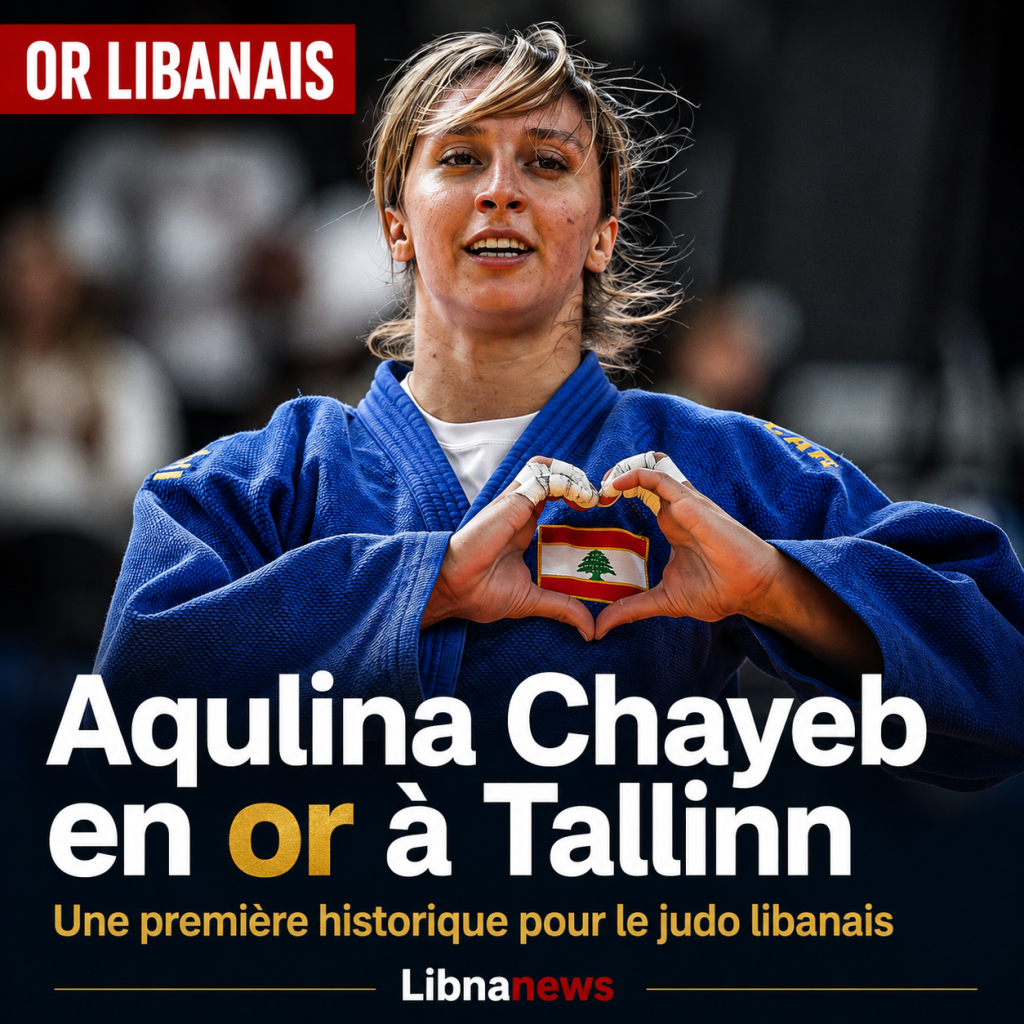
Aqulina Chayeb offered the Lebanese judo a historic gold medal at the Tallinn European Open 2026, played in Estonia. Engaged in the category of less than 78 kg, the Lebanese judokate won three fights to win on the highest step of the podium. This victory is a first for a Lebanese participation in the European Judo Open, according to the communiqué sent by the Lebanese Judo Federation and its branches. It comes at a time when the athlete continues to advance in the international ranking, with the assumed goal of registering in the race at the Los Angeles 2028 Olympic Games.
The performance was built with authority. Chayeb first beat a Polish opponent by ippon. She then dominated an Ukrainian, also before the limit, before winning in the final against the Croatian Betty Vuk. The International Judo Federation confirms Lebanon’s first place in Tallinn, as well as its position in the category of less than 78 kg. At the age of 22, she added this European title to a track already marked by a silver medal at the Dubrovnik European Seniors Cup in March 2026 and a victory at the Asian Open of Amman in August 2025.
In a Lebanese sport often constrained by lack of resources, the gold obtained in Tallinn exceeds the individual result. It offers rare visibility to a demanding discipline, less exposed than football or basketball, but capable of producing international results when athletes have consistent coaching. The victory of Aqulina Chayeb also places the issue of Olympic preparation at the centre of the sporting debate. The road to Los Angeles remains long, competitive and unstable, but the Estonian medal provides points, confidence and a strong signal to both opponents and Lebanese authorities.
Aqulina Chayeb, a historic medal
The Tallinn European Open had a special place in the calendar. The European Judo Union presented as the last competition on its circuit before the launch of the new Olympic cycle. The tournament, held on 6 and 7 June in the Estonian capital, brought together over 250 judokas from over 30 countries. This level of participation gives value to the title. A continental Open does not have the same status as a world championship or a Grand Slam, but it remains an important step to gain experience, face different profiles and earn points in a very dense world hierarchy.
For a Lebanese athlete, this type of competition counts double. We must first succeed on the tatami. It is also necessary to manage travel, preparation costs, climate change, internships abroad and the uncertainty inherent in a fragile national sport system. Chayeb had participated the previous week in a training camp in Spain as part of his technical preparation. This detail illuminates the method. Tallinn’s result doesn’t fall from the sky. It is part of a sequence of work, adjustments and repeated struggles, with a progression that begins to read in international results.
Three fights, three answers
The first victory against the Pole set the tone. In judo, winning by ippon means ending the fight without waiting for the full flow of regulatory time. This mode of victory often reveals a clear difference in execution, timing or ability to conclude. Chayeb imposed this scenario as soon as he entered the competition. She avoided the wear of a long fight and sent an immediate message to the category. In a tight competition, the energy preserved during the first round can weigh on the course’s continuation.
The second success, obtained against a Ukrainian woman by the same way, confirmed this dynamic. Ukrainian judokates operate in a school that is considered strong, physical and disciplined. Beating them before the limit requires a technical and mental mastery. Chayeb crossed that course without slowing down. She approached the final with two clear victories, a favorable pace and increased confidence. In judo competitions, a champion’s day often builds on this ability to win quickly, stay lucid and not let an opponent set up his fight.
The final against Betty Vuk was the decisive moment. The Croatian was the last obstacle between the Lebanese and a historic gold medal. The fight lasted more than six minutes according to available video data, a sign of a tight and prolonged confrontation beyond regulatory time. Chayeb eventually made a difference and secured the title. This victory in the final gives the course its density. It shows that the Lebanese has not only benefited from a favorable picture. It also held in the most tense moment, when fatigue and pressure turn each error into a possible swing.
Lebanese Judo Federation salutes exploit
The success provoked an immediate reaction within the Lebanese Judo Federation. Its president, lawyer François Saadé, contacted Aqulina Chayeb to congratulate her after the announcement of the result. He praised a major achievement for national judo and stressed its effect on the world ranking of sportsmen. The director of the federation, François Junior Saadé, also called him to congratulate him. These institutional actions are important in a sport where athletes need both recognition and material support.
However, the issue goes beyond congratulations. Lebanon must turn that result into a lever. A gold medal in a European Open can help an athlete get more attention, internships, partners and medical follow-up. It can also convince sports decision makers to better target means. In individual disciplines, some details often make the difference: physical preparation, nutrition, recovery, video, sparring-partners, choice of tournaments and mental accompaniment. Tallinn’s podium shows that a Lebanese judokate can compete with European opponents. It now requires a sustainable framework.
The Olympic ranking in line
Aqulina Chayeb operates in a demanding area of the world hierarchy. The category of less than 78 kg brings together powerful, experienced and often from countries where judo has strong infrastructure. In this division, progress requires a rare combination: strength, mobility, guardwork, explosiveness and tactical accuracy. The Lebanese woman has already shown that she can change status during the competitions. His victory in Amman, his medal in Dubrovnik and his title in Tallinn draw an ascending curve. It must now confirm against better ranked opponents and in higher-profile tournaments.
The question of the Olympic ranking will become central. To qualify at the Los Angeles Games, Chayeb will have to earn points in the competitions recognized by the International Federation. Every tournament will weigh in the strategy. It will be necessary to choose events where the level allows to earn points without exhausting the athlete, while gradually exposing to the elite. The margin of error is low. An injury, a bad draw or a poorly planned season can slow a trajectory. Tallinn’s title does not guarantee anything, but it provides a stronger basis for this cycle.
A victory for all Lebanese judo
Lebanese judo has often lived through talented but isolated generations. International results are rarely constructed by chance. They involve active clubs, trained coaches, organized federations, links with foreign circuits and an ability to finance travel. In the Lebanese economic context, these conditions are difficult to meet. Federations advance with limited budgets, families often participate in efforts, and athletes need to balance sports ambition with personal constraints. That’s why Aqulina Chayeb’s gold medal has a collective dimension. It also rewards a network that has kept discipline standing.
The national context gives even more prominence to this victory. Lebanese sport is going through a period marked by the economic crisis, the weakening of infrastructure, the exodus of many talents and the difficulty of organizing stable calendars. In this landscape, each international medal becomes a reminder of potential. It proves that Lebanese athletes remain able to exist on the world stage, despite an unfavourable environment. It also creates a respiration in a national topicality dominated by political tensions, war, social difficulties and financial uncertainties.
A visible champion for young judokas
Chayeb’s course can also serve as an example for young judokas. Judo is a sport of patience. Progress is not always immediately visible. We must accept defeats, repeat gestures, correct mistakes, work guard and learn to read opponents. A victory like that of Tallinn shows that this path can lead to a concrete result. It can attract new practitioners, especially in a discipline where female visibility remains essential. Seeing a Lebanese woman winning abroad can change expectations in clubs and strengthen the place of women on tatamis.
This female dimension deserves to be stressed. Lebanese sport needs visible champions. They open spaces, shake habits and broaden national representation. Chayeb won not only for herself. It also wins for all young athletes looking for proof of opportunity. In a country where women’s sporting paths may encounter social, financial or institutional obstacles, an open European title is a powerful argument. He says that performance does not depend on gender, but on work, coaching and access to competitions.
From Tallinn to Los Angeles 2028
Tallinn’s medal also comes at a time when world sport is already preparing Los Angeles 2028. The Olympic cycle imposes another discipline. It is no longer enough to succeed in a tournament. We need to build a two-year strategy, manage weight categories, preserve health, choose competitions and advance in ranking. For Chayeb, the objective must be clear without becoming overwhelming. The Olympic route is won in stages. Tallinn is one. Other appointments will come quickly, with opponents who will now look at it differently.
In judo, recognition changes the status of a fighter. An athlete who surprises at a tournament can then be studied, observed and prepared by his or her opponents. His favourite attacks, his sense of rhythm, his guard and his transitions to the ground become information. Victory therefore requires further progress. It requires varying solutions, strengthening weaknesses and remaining unpredictable. Chayeb is entering this new phase. His name circulates more. His fights will be looked at more. Its frame will have to transform this exposure into an engine, not an excessive pressure.
The Lebanese Judo Federation has every interest in capitalizing quickly on this momentum. It can communicate more about the results, organize meetings with young people, highlight training clubs and seek private support. An international gold medal is a rare moment. It must be used to broaden the base, not just to publish a press release. Judo needs rooms, carpets, coaches and regular local competitions. The success of a champion must become an argument for building a more coherent sports policy.
The Lebanese state, for its part, should look at this result seriously. Athletes who wear the flag in international tournaments represent the country as well as official delegations. Their visibility feeds the image of Lebanon. It can also offer a positive narrative to a youth often confronted with departure or discouragement. Supporting a judokate on its way to an Olympic qualification does not only require speeches. This requires targeted means, coordination between ministry, Olympic Committee, federation and private partners, and transparent monitoring.
The title of Aqulina Chayeb in Tallinn does not solve the difficulties of Lebanese sport. It alone does not change the level of infrastructure or the financial fragility of federations. But he creates a support point. It gives a name, a date and a medal to an ambition. It shows that serious preparation, even in a constrained environment, can produce a historical result. He also recalls that individual sports can offer strong performances in Lebanon when the talents are accompanied with method.
After Tallinn, the next step will be to keep pace. Chayeb will have to recover, analyze his fights, adjust his preparation and choose the next tournaments with lucidity. The Federation will have to accompany this sequence, as the progress towards Los Angeles 2028 will be played over time. Estonian gold opens a window. It makes more visible a 22-year-old Lebanese athlete who has just placed her name at the top of an open European podium. The challenge now is to turn this historic day into an Olympic journey.




