

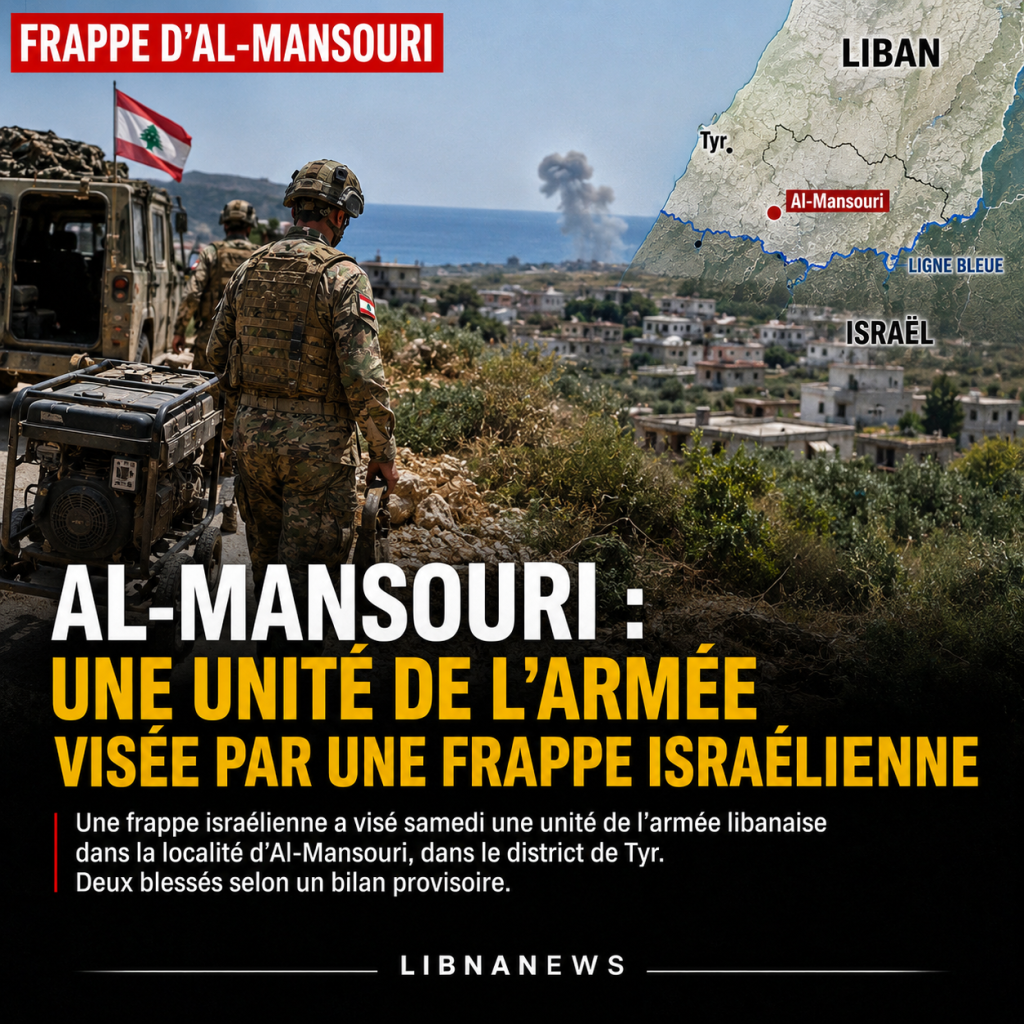
On Saturday, 18 July, an Israeli strike targeted a Lebanese Army unit in the town of Al-Mansouri in the Tyre district. According to the initial information available, the military was involved with a resident in transporting an electric generator when they were targeted. The provisional assessment reported two injuries. The exact nature of the projectile, the identity of the victims and the severity of their injuries were not yet officially specified at the time of dissemination of the information. The incident occurred in an area that had been subjected for several days to repeated strikes and grenade drops by Israeli drones. A few hours after the announcement of President Joseph Aoun’s departure for Washington, he must demand the consolidation of the ceasefire, the Israeli withdrawal and the deployment of the army throughout Lebanese territory.
Lebanese Army unit struck in Al-Mansuri
Initial information indicates that a Lebanese Army unit was in Al-Mansouri when it was targeted. The military was cooperating with a resident to move an electric generator. There is no evidence that they were involved in a combat operation or that an exchange of fire had preceded the strike.
Two injured were reported in the first few minutes. It remained provisional. The authorities had not yet indicated whether the victims were soldiers, civilians or a military and inhabitant accompanying the unit. No deaths were reported.
Caution is therefore required on the specific circumstances. The first warnings broadcast during a strike may evolve after the arrival of the rescue and the examination of the site. The Lebanese army must still confirm the course of the incident, the nature of the mission carried out by its unit and the state of health of the affected persons.
The available information nevertheless provides a central element: the target was in the context of an activity related to the transport of electrical equipment. A generator is an essential civilian tool in an area where the networks have suffered extensive destruction. Its travel can meet the needs of a dwelling, a municipal facility, a military post or a local service.
If the facts are confirmed in their original wording, the incident will raise a new question about the protection of Lebanese regular units. The army represents the institution called upon to regain control of the areas evacuated by Israel. Any attack on its members therefore weakens the mechanism defended by Beirut in the ongoing negotiations.
Al-Mansouri under persistent military pressure
The strike is not an isolated event for Al-Mansouri. This coastal town in the district of Tyre has been subjected to several Israeli attacks in recent days. Fighting aircraft targeted his residential areas, while drones dropped grenades in his vicinity.
The al-Machaa area has been hit several times. Missiles have affected inhabited areas and caused damage. Drainage of deafening or incendiary grenades has also been reported. These operations maintain strong pressure on residents and complicate the movement of civilian teams.
Repeating attacks reduces the space available for ordinary activities. Residents must move to recover property, repair facilities or provide minimum services. Each journey then becomes risky. The transport of a generator, water tank or building materials may expose civilians and military personnel to a strike.
However, the presence of the Lebanese army in these areas is an official mission. Its units patrol the areas where they are already deployed. They must also prepare for their entry into positions that Israel might evacuate as part of the discussions conducted under American mediation.
The Al-Mansouri incident shows the difficulty of this mission. The military must support the people and restore public authority in an environment where the air threat remains permanent. They can be targeted even when performing logistical tasks without apparent offensiveness.
Two injured remain provisional
Initial reports indicate two injuries. No reliable details of their identity have yet been provided. It is therefore not possible to claim that both persons belong to the Lebanese army. The relevant departments should clarify this point.
The severity of the injuries was also unknown. In the first few hours after a strike, the balance sheets can change. Some injuries occur after evacuation. Other victims may be near without immediate identification.
Rescue teams must also review the area before engaging. Israeli drones often remain present after a strike. This monitoring can delay the arrival of ambulances or make the evacuation of the injured dangerous.
The Lebanese authorities usually issue a statement after checking the situation with the on-site units. The Ministry of Health may also issue a medical report. Until such confirmations are available, the figure of two injured must be presented as an initial data and not as a definitive assessment.
This distinction is all the more important as several incidents have been reported in and around Al-Mansouri. Information about different strikes may sometimes cross. Therefore, it is necessary to avoid involving victims affected by a previous attack or in another part of the locality.
The transportation of a generator, a civilian mission
The context of the generator transport gives the incident a particular scope. In southern Lebanon, generators provide an essential part of the power supply. The public network remains fragile, while attacks have damaged local lines, transformers and installations.
The movement of this equipment could respond to an emergency. An army unit can help a resident when a road remains dangerous, when a civilian vehicle cannot access an area or when equipment is to be transferred to a safer place. This cooperation is part of the daily realities in the villages exposed.
There is no initial information on weapons carried with the generator. No hostile movement has been reported. However, it is up to the Lebanese Armed Forces to provide a full description of the mission in order to avoid confusion over the circumstances.
Israel regularly claims to target infrastructure or Hezbollah members in southern Lebanon. In the case of Al-Mansouri, no specific Israeli justification had yet been made public. The Israeli army had not announced that it had targeted a fighting position at the location where the Lebanese unit was affected.
The absence of an immediate explanation does not make it possible to determine whether the strike was voluntary, whether it resulted from incorrect identification or whether it was aimed at another objective. These possibilities must remain distinct until verifiable elements are published.
A Sensitive Attack on the Military Institution
A strike against a Lebanese army unit directly affects one of the pillars of the project defended by the authorities. President Joseph Aoun wants to strengthen the military deployment in the south and place the entire territory under state authority. The United States also presents the army as the actor responsible for ensuring the security of areas evacuated by Israel.
This strategy assumes that Lebanese units can move without being targeted. They must inspect the sectors, support the inhabitants, secure the roads and resume abandoned positions. If their movements remain exposed to drones, their mission becomes more difficult.
Attacks on military personnel can also affect the morale of units. Soldiers work in difficult economic and material conditions. They must cover a vast territory, maintain contacts with municipalities and intervene in areas where infrastructure is destroyed.
The army has already suffered losses during the various phases of the conflict. Several soldiers were killed or injured in Israeli strikes. Each new incident feeds stronger demands for international safeguards.
The command will have to decide whether to issue a conviction, whether to seize the ceasefire monitoring mechanism or whether to send a report to the political authorities. The nature of the response will depend on the conclusions reached on the ground.
An incident at the time of the withdrawal discussions
The strike comes as Lebanon and Israel discuss a gradual withdrawal mechanism. A meeting in Rome focused on the establishment of pilot areas. Israel had to leave certain areas before they were handed over to the Lebanese army.
No further withdrawals had yet taken place on Saturday. A Lebanese military source reported that the army had not received any new sites. It was continuing its patrols in areas where it was already present.
A virtual tripartite meeting between Lebanese, Israeli and American representatives was to discuss the technical aspects of the mechanism. It was postponed. Technical reasons related to the US and Israeli parties were put forward, without a new date being communicated.
In this context, the attack on a Lebanese unit creates an additional contradiction. Negotiations entrust the army with the responsibility of securing the evacuated areas. On the ground, the same institution remains exposed to Israeli attacks.
Beirut can use the incident to demand clearer protection rules. Movements of Lebanese units could be communicated through a coordination mechanism. However, the army cannot depend on an Israeli permit to move within the national territory.
Joseph Aoun’s trip to Washington
President Joseph Aoun left Beirut Saturday morning with First Lady Nehmat Aoun. He went to Washington at the invitation of US President Donald Trump. A meeting in the White House should focus on the Lebanese situation and the return of stability.
Israeli withdrawal is among the priorities announced. Joseph Aoun must also call for the consolidation of the ceasefire and the strengthening of state authority. The Lebanese army occupies a central place in this process.
The Al-Mansouri incident could therefore be invited to American consultations. It provides a concrete example of the risks that Lebanese units continue to face. The Head of State may ask Washington to prevent strikes against military positions and movements.
The United States has an important role in the negotiating mechanism. They can convey Lebanese protests, ask Israel for explanations and push for operational safeguards.
The credibility of American mediation also depends on its ability to protect the mechanism it supports. It would be difficult to ask the Lebanese army to deploy further if its units could be hit during regular missions.
Lebanese sovereignty faced with realities on the ground
The official Lebanese speech insists on the restoration of sovereignty. This means that the army must be able to move, patrol and intervene throughout the territory. It must also protect people without fear of an external attack.
The situation in Al-Mansouri shows that this goal remains far from being achieved. Part of the south remains under Israeli occupation or indirect military control. The drones are monitoring the movements. Strikes may target vehicles, buildings or open areas.
This control of the sky gives Israel a permanent capacity for action. Even in the absence of soldiers on the ground, a locality may remain under threat. The inhabitants then do not have the necessary conditions to resume normal life.
The Lebanese army is between two requirements. It must strengthen its presence to meet the commitments of the State. It must also avoid unnecessarily exposing its members to areas where coordination remains insufficient.
The development of patrols, posts and logistical missions therefore requires a genuine cessation of attacks. A simple reduction in strikes is not enough. The ceasefire must include the protection of regular forces and civilian teams.
The inhabitants facing the destruction of services
The generator carried at the time of the strike recalls the state of local infrastructure. In several villages, residents depend on private or municipal equipment to obtain electricity. Networks are fragile, repairs are difficult and technicians take risks to reach facilities.
Electricity conditions the operation of water pumps, refrigerators, medical equipment and means of communication. A generator can be used for several families or for an essential installation. Its loss or immobilization makes daily difficulties worse.
Southern municipalities have limited resources. They must repair roads, evacuate rubble and maintain services in a dangerous environment. The army’s help is sometimes needed, especially for access to areas monitored or damaged.
The strike can therefore have consequences beyond the two injured announced. It can interrupt the transport of equipment and delay the restoration of electricity. It can also discourage other residents from doing similar operations.
Reconstruction cannot begin on a lasting basis under the threat of drones. Companies, technicians and humanitarian organizations need guarantees. Without them, the work remains ad hoc and people continue to depend on emergency solutions.
The need for an investigation and a formal reaction
The Lebanese authorities shall establish the exact coordinates of the strike, the time of the incident and the type of projectile used. They will also have to gather the testimony of the military and the resident present.
These elements will determine whether the unit was clearly identifiable. Military vehicles normally carry distinctive signs. Their visibility can become a central point in the assessment of the attack.
An investigation will also have to verify whether a notification has been sent to the mechanism responsible for monitoring the cessation of hostilities. The absence or existence of coordination will influence the reading of the incident, without calling into question the right of the army to move within Lebanese territory.
The government can file a complaint with the United Nations or integrate the incident into a broader case of Israeli violations. He may also ask the United States to obtain an official response from Israel.
The effectiveness of these approaches will depend on the quality of the evidence. Images of the site, projectile fragments and medical reports can support the Lebanese position. Specific documentation will prevent the incident from being reduced to conflicting versions.
A new test for the ceasefire
The Al-Mansouri incident comes at a time when diplomatic declarations refer to gradual stabilization. On the ground, the attacks continue. This lag weakens confidence in the process.
A ceasefire is not limited to the absence of widespread fighting. It must protect civilians, the military and infrastructure. It must also enable the Lebanese authorities to perform their functions.
The strike against a unit carrying a generator, if confirmed, would illustrate precisely the lack of security necessary for the reconstruction. It would show that ordinary tasks remain exposed to military action.
The next few hours will have to provide answers on the balance sheet and the circumstances. The army command can confirm the identity of the wounded and specify the unit’s mission. The Ministry of Health can update the medical data. A possible Israeli statement should also be considered.
At 1307 hours, the report remained limited to two wounded. No deaths were reported and no specific Israeli claims were reported. The Lebanese unit was still at the centre of the first verifications, while the rescue and the authorities sought to establish the exact circumstances of the strike.




