

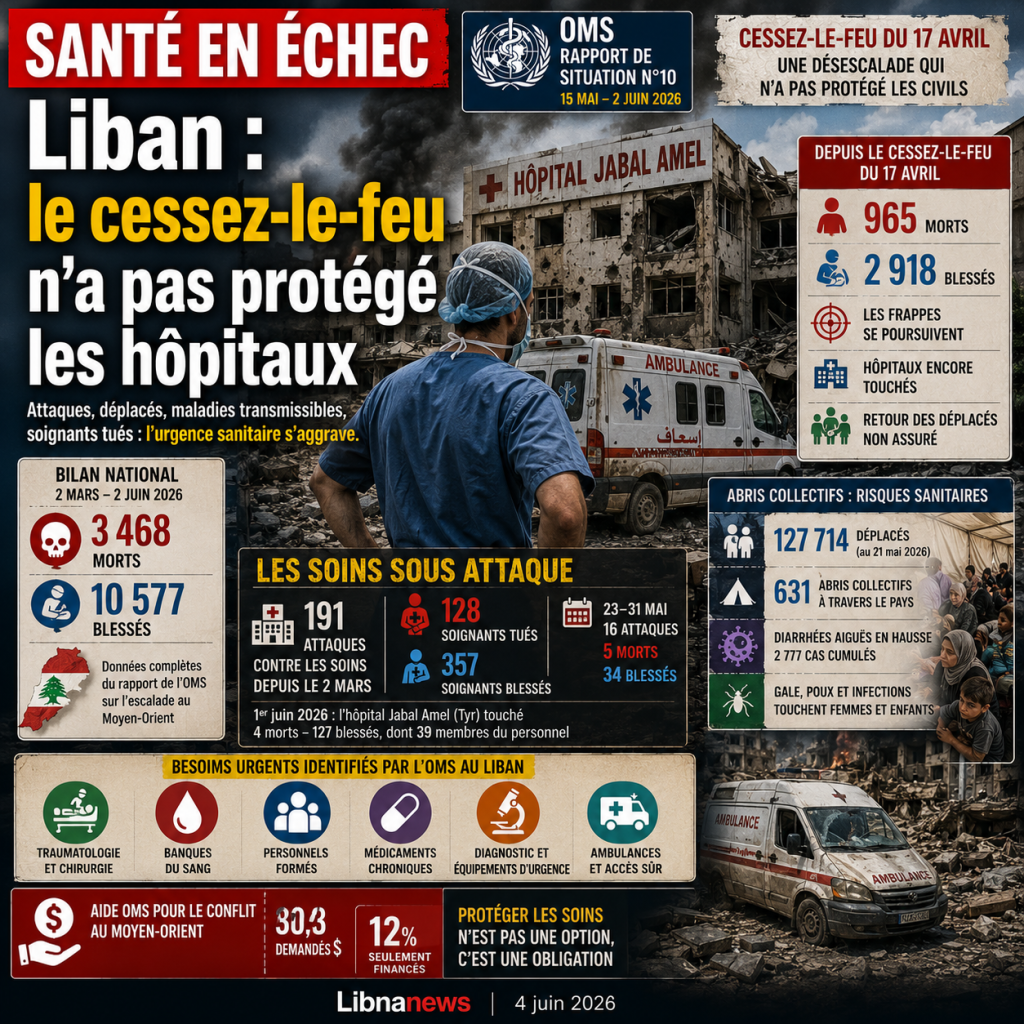
World Health Organization Situation Report No. 10 on the escalation of the Middle Eastplaces Lebanon at the centre of a health emergency that is no longer limited to fighting. Between 2 March and 2 June 2026, the country recorded 3,468 deaths and 10,577 injuries. Since the announcement of a ceasefire on 17 April, WHO has still recorded 965 deaths and 2,918 injuries. These figures say the failure of a de-escalation that has not protected civilians, hospitals or caregivers. Health in Lebanon thus becomes the indicator of a conflict that continues in multiple forms: strikes, displacement, communicable diseases, breakdown of services, psychological trauma and international underfunding. The country has successfully obtained a resolution at the World Health Assembly to protect care in times of war. But on the ground, attacks on medical facilities continue.
Diplomatic victory, failure on the ground
The contrast is severe. In Geneva, the seventy-ninth World Health Assembly adopted a resolution submitted by Lebanon and supported by the Council of Arab Ministers of Health. The text calls for strengthening the protection of health services, maintaining international support and improving operational assistance to maintain essential care during conflicts. This initiative gives Beirut a useful diplomatic visibility. It also recalls that the protection of hospitals and medical personnel is not a humanitarian favour. It falls under international law and the responsibility of the parties to the conflict. But the political scope of this resolution is immediately affected by the data in the same report.
WHO has recorded 191 attacks on health care in Lebanon since 2 March. These attacks killed 128 health workers and injured 357 others. Between 23 and 31 May alone, the organization verified sixteen attacks, with five deaths and 34 injuries among caregivers. On 1 June, Jabal Amel Hospital in Tyre was hit. Four people were killed and at least 127 injured, including 39 medical, nursing and administrative personnel. The damage affected several floors, internal departments, parking, adjacent buildings, the emergency department and the intensive care unit. A hospital then becomes itself a battlefield.
This reality undermines any reassuring reading of the ceasefire. A cessation of hostilities that leaves hospitals exposed is not an effective protection. Caregivers cannot operate in damaged services without security, without adequate equipment and with the permanent threat of a new impact. Patients are reluctant to visit facilities that may be affected or affected. Ambulances see their journeys become more dangerous. Families report essential care for fear of roads, strikes or cuts. So war doesn’t just kill by explosions. It also kills by preventing medical continuity.
Health in Lebanon in a systemic crisis
The report describes a health system that absorbs simultaneous shocks. Forty-two primary health care centres and three hospitals remain closed. Seventeen hospitals suffered partial damage, two with major structural damage. One hundred and eighteen pharmacies and pharmaceutical warehouses were also affected. This list is not only accounting. It shows the deterioration of a network already weakened by the economic crisis, shortages of medicines, the exodus of some skilled personnel and weak public finances. Lebanon is entering this war with a weakened system. It must now manage mass injuries, internally displaced persons, communicable diseases and chronic needs.
The needs identified by WHO are heavy: supplies for trauma and surgery, capacity of blood banks, trained personnel, medicines for chronic diseases, diagnostics and emergency equipment. These deficiencies directly affect patients. A serious injury requires surgery, blood, anaesthetics, antibiotics and teams that can intervene quickly. A diabetic or cardiac patient needs regular treatment, even if his home has been destroyed. A pregnant woman must find a functional maternity. An unvaccinated child becomes vulnerable when prevention services are interrupted. The health crisis thus moves from emergencies to the entire health care chain.
Health in Lebanon is also threatened by massive population displacement. As at 21 May, 127,714 people were living in 631 collective shelters across the country, an increase of 14% since 17 April. These figures show that the announced ceasefire did not trigger a significant return. Collective shelters offer minimal protection, but they focus on risks. Overcrowding, limited water, inadequate sanitation, promiscuity, warmth, fatigue and stress create an area conducive to infection. Women, children, the elderly and the chronically ill pay the heaviest price of this suspended life.
Acute diarrhoea, scab, lice: live shelters
The increase in acute aqueous diarrhoea illustrates this vulnerability. The report shows an increase of 504 cases in week 17 to 803 cases in week 20, for a cumulative total of 2,777 cases. No confirmed cases of cholera were detected at this stage. This precision is important, but should not lead to minimizing the warning signal. Acute aqueous diarrhea often indicates problems with water, sanitation, hygiene and monitoring. In overcrowded shelters, it can spread quickly. It can also dehydrate children, aggravate existing diseases and saturate medical teams already mobilized by the war wounded.
WHO and the Lebanese Ministry of Health responded with a simple tool, but revealing the nature of the crisis: a health awareness booklet for approximately 130,000 displaced persons living in collective shelters. It focuses on the prevention of common communicable diseases and responds to reports of lice, scabies and other infections especially affecting women and children. Integrated with the distribution of hygiene kits, it must reach about 34,000 families. This initiative is useful. It also shows that Lebanon is reduced to preventing promiscuity diseases in shelters, while the diplomatic debate speaks of a ceasefire and regional security.
Population movements to Syria add a cross-border dimension. Since 2 March, 448,582 people have crossed through official crossings from Lebanon to Syria. These include 367,291 Syrians and 81,291 Lebanese. This flow reverses the usual representations. For years, Syria has been the country of departure and Lebanon a welcoming space. The regional war is now moving Lebanese to a fragile country, marked by insecurity, shortages and epidemic outbreaks. The report mentions 545 cases of measles in Syria since January, 96 of which occurred in the last two weeks, and over 5,800 cases of cutaneous leishmaniasis in the first quarter.
A Lebanese Crisis in a Sick Region
This flow of risks directly affects Lebanon. Frontiers do not block diseases, especially when families move under pressure, with unvaccinated children, little access to clean water and overcrowded surveillance systems. Measles is very contagious. Skin leishmaniasis develops in degraded environments. Acute aqueous diarrhea is largely dependent on water and sanitation conditions. Lebanese public health can no longer be considered as an isolated national file. It depends on roads, shelters, border crossings, vaccination campaigns, warning systems and coordination with neighbouring countries.
The regional report further expands the picture. Iraq has reported 88 confirmed cases of Crimea-Congo haemorrhagic fever since the beginning of 2026, including eight deaths. On 3 June, Kuwait suffered strikes at its airport, residential areas and civilian and diplomatic facilities, with one dead and sixty-three wounded; Debris affected the United Nations House, where the WHO office is located, with no casualties. Iran reported 3,375 civilian deaths and more than 33,806 injuries, as well as 26 verified attacks on health care, from 28 February to 6 April. These elements show a region where health systems are exposed to both bombs, supply disruptions and diseases.
For Lebanon, this regional dimension is not abstract. Medical supply chains depend on roads, ports, airports, transport costs and regional stability. WHO notes that its Dubai logistics hub is still operational, but is subject to lower than average deliveries due to supply constraints and higher transport costs. It maintains $3.46 million in medical countermeasures ready for deployment to 26 countries, or approximately 200 tons of supplies. Since the onset of the regional crisis, it has delivered $4.57 million in countermeasures to 24 countries. These figures show capacity. They also reveal a demand that goes beyond means.
A useful answer, but still too limited
The WHO response in Lebanon combines several priorities. The organization trained emergency doctors in the preparation and response to radiological and nuclear risks and then supported the deployment of additional training in hospitals. It delivered 120 trauma bags to ambulance and emergency medical teams in order to strengthen preparedness for massive inflows of wounded. It also funds trauma-related hospitalizations for non-Lebanese patients affected by the conflict: 101 patients in 23 hospitals, including Syrians and migrant workers; Almost a quarter of beneficiaries are under the age of 18. War strikes beyond nationalities.
This support for non-Lebanese people deserves attention. She recalled that the Lebanese health system was caring for multiple populations at a time when resources were shrinking. Syrian refugees, migrant workers and displaced families are often among the most vulnerable. Excluding them from care would increase health risks for all. Taking charge of them requires external financing. Lebanon therefore faces a humanitarian and fiscal dilemma: it must maintain an inclusive response while its infrastructure is under attack and its finances remain unable to absorb the shock alone.
Mental health is another line of rupture. WHO reported on the continuation of psychosocial skills training on de-escalation techniques, with 35 additional professionals trained. It also works to strengthen coordination in mental health and psychosocial support at the subnational level. These measures appear modest in the face of the magnitude of the trauma. Yet they are essential. Caregivers work under threat. Displaced persons live in uncertainty. Children hear explosions, lose their marks and see their schools closed. Bereaved families must survive in damaged shelters or homes. The war leaves wounds that statistics of dead and wounded do not capture.
Underfunding, another front of the crisis
The most critical point in the report is funding. The WHO flash call for the Middle East conflict calls for $30.3 million. It is only funded at 12%. WHO regional emergency health calls require $633 million and are funded at 49 per cent. The first call deficit is alarming. It is taking place as the attacks on care continue, hospitals close, displaced persons increase and communicable diseases progress. Governments denounce violations, but do not fund the needs. This contradiction weakens any response.
Underfunding has concrete effects. It delays the purchase of medicines, limits mobile teams, hinders epidemiological surveillance, reduces training, complicates delivery of supplies and forces partners to choose between priorities that are all urgent. Should we fund trauma bags, antibiotics, chronic treatments, water and sanitation in shelters, vaccination campaigns, damaged hospitals or psychological care? In a properly funded system, these needs would be complementary. In a 12% funded response, they become competitors.
The report makes clear calls: to protect care at all times, to ensure safe and unhindered access to aid, patients, ambulances and personnel, to preserve vital water and energy infrastructure, to maintain humanitarian operations and to provide urgent funding for health activities. These demands appear to be elementary. Their repetition shows that they are not respected. The attack on a hospital, the closure of health centres, the spread of diseases in shelters and the lack of funds indicate a collective bankruptcy. The parties to the conflict bear direct responsibility for the violence. Donors bear that of insufficient response.
Lebanon has succeeded in bringing forward an international resolution on care protection. It’s a diplomatic acquis. But this success will remain symbolic if the hospitals continue to be hit, if the caregivers die, if the displaced enter shelters and if humanitarian appeals remain almost empty. Health protection is not measured by the texts adopted in Geneva. It is measured in Tyre, Marjayoun, collective shelters, ambulances, closed care centres, damaged pharmacies and families waiting for a return. The next WHO monthly report, announced on 2 July, will tell whether the ceasefire has finally begun to protect the sick, or whether health in Lebanon remains the most documented victim of a war that refuses to stop.




