

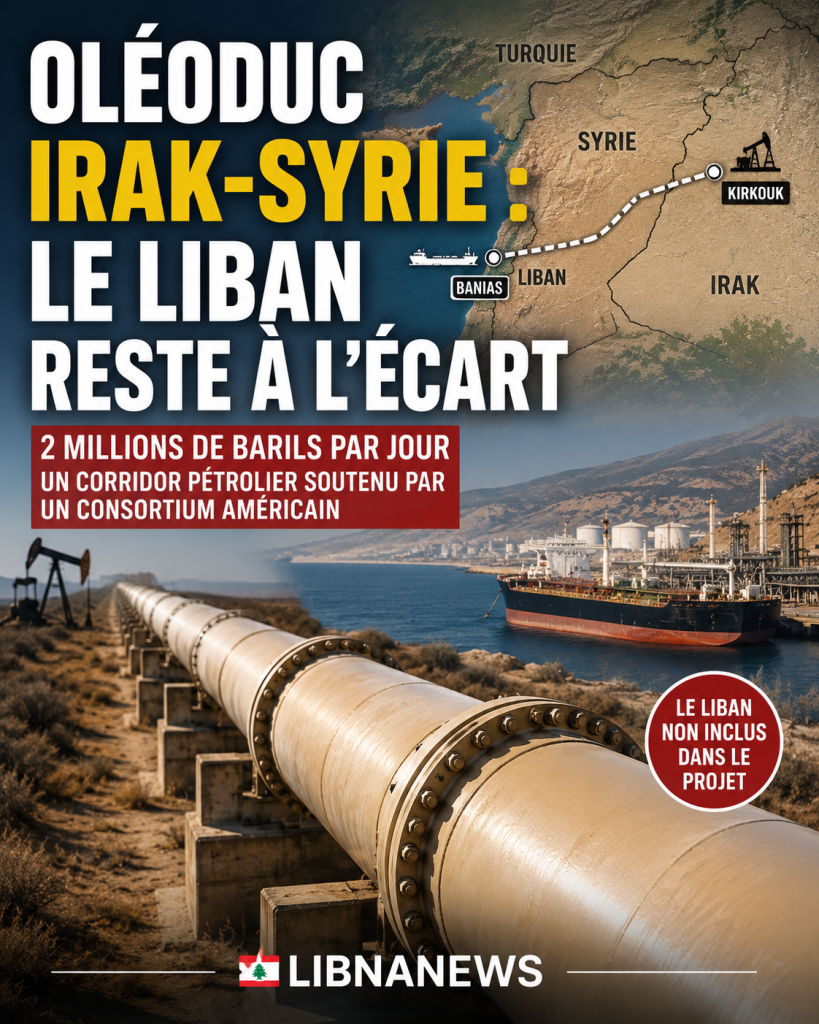
Iraq and Syria have officially placed the rehabilitation of their common pipeline among their infrastructure priorities. In a statement issued on 17 July 2026, the US State Department welcomed the intention of both governments to rebuild this oil corridor towards the Mediterranean. Washington announces an initial capacity of 2 million barrels of crude oil per day and the intervention of an international consortium led by the United States for technical and financial aspects. The project could offer Baghdad an export route less dependent on the Strait of Ormuz and allow Damascus to recover transit revenues. However, Lebanon is not affected by the agreement presented. No Lebanese officials, national port, oil terminal or connection to Tripoli appear in the press release. For the time being, Beirut’s possible participation is therefore speculative and should not be confused with the announced bilateral project.
A political announcement by Washington
The US text describes the reconstruction of the Iraq-Syria pipeline as a project of bilateral and regional importance. Both countries intend to work together to restore driving, organise its operation and establish the necessary legal framework. The United States supports in parallel the entry of an international consortium under American leadership. Its detailed composition, legal status and division of responsibilities have not yet been made public.
The communiqué is not yet a construction contract. It confirms a common political intention and the existence of US support. Governments still need to conclude technical, trade and financial agreements. They will have to define the route, cost, operating modalities, transit fees, safety standards and revenue sharing. No specific work or commissioning schedule was announced.
Washington attributes this initiative to the desire to strengthen security and stability through prosperity. This reading directly links energy infrastructure to the political recomposition of the Middle East. A pipeline of this size would create common economic interests between Baghdad and Damascus. It would also attract foreign companies, lenders and governments around an axis that will run for several decades.
US support is also strategic. The United States is seeking to reduce the vulnerability of Gulf oil exports to regional crises. They also want to encourage Western investment in the Iraqi and Syrian energy sectors. The announced project thus becomes a foreign policy tool as well as a commercial infrastructure.
Two million barrels a day, a considerable ambition
The initial announced capacity reaches 2 million barrels per day. This volume is equivalent to about 730 million barrels over a full year, if the driving operation is continuous and at its maximum level. This is a theoretical ability. The volumes actually transported will depend on Iraqi production, Baghdad oil commitments, demand, maintenance operations and user contracts.
This capacity far exceeds that of the former Kirkuk-Banias pipeline. The historic pipe, built in the early 1950s, could carry about 300,000 barrels per day. It connected the Kirkuk fields to the Syrian port of Banias, on the Mediterranean, on a journey of about 800 kilometres. It experienced several interruptions before becoming unusable after 2003.
The gap between the two capacities shows that the current project cannot be limited to restoring a few sections. Much of the network is likely to need to be built, new pumping stations installed and control systems upgraded. The arrival terminal will have to have tanks, port pipes and loading stations adapted to much larger volumes.
The American formulation speaks of an initial capacity. It may indicate that proponents are considering a further rise in power. However, no higher targets were announced. Before considering an extension, the partners will have to demonstrate the economic feasibility of the first set, secure supply and ensure continuous operation on Iraqi and Syrian territories.
A more precise outline
The State Department communiqué does not detail the exact path of the future infrastructure. It refers to a corridor linking Iraqi production to Mediterranean markets. This formulation leaves several options open. The pipeline could take over part of the old Kirkuk-Banias axis or integrate new segments from the producing regions of southern and central Iraq.
Recent media reports suggest a wider network, capable of connecting volumes produced around Bassora to a connection point in western Iraq, before crossing Syria to Banias. Other descriptions keep Kirkuk as an important node. At this stage, these schemes do not replace an official technical presentation.
The choice of route will determine a large part of the cost. A line from southern Iraq will require hundreds of additional kilometres. It will have to cross several governorates and connect to existing storage facilities. However, it will offer the advantage of access to the country’s main production areas, whose volumes exceed those of the north.
The border between Iraq and Syria also poses constraints. Authorities will need to secure stations, access routes and maintenance teams. They must protect the conduct against sabotage, theft and accidental damage. Finally, the project will have to take into account areas mined or marked by the fighting of previous years.
Why Iraq Wants a Mediterranean Exit
Iraq relies heavily on southern terminals to export its oil. These facilities provide access to the Gulf and then international shipping routes through the Strait of Ormuz. This organization allows for high volumes, but it focuses the risk on a narrow passage regularly affected by tensions between regional powers.
Any disruption to Ormuz can quickly affect Baghdad’s recipes. Oil finances most of Iraq’s public spending. A prolonged interruption would affect the payment of wages, investments, services and financial reserves. The Government is therefore seeking to increase opportunities and reduce dependence on a single maritime facade.
A way to Banias would give access to the Mediterranean and shorten the road to several European markets. The shipments would no longer have to leave the Gulf or bypass the Arabian peninsula. However, the final gain would depend on transit, pumping, storage and loading costs. The cost of driving should also be compared with that of southern terminals.
The Syrian pipeline would complement other Iraqi projects. Baghdad has long been examining routes to Turkey and Jordan. The strategy is less to replace southern ports than to create several options. This diversification would reorient flows in the event of a crisis, breakdown or trade dispute on one of the roads.
What Syria can expect from the project
For Syria, the immediate interest lies in transit revenues and investments. The passage of two million barrels per day could generate significant revenues, depending on the negotiated tariff. Damascus may also seek to receive some of the payments in the form of crude oil, but no such provision appears in the US press release.
The project will require a thorough renovation of Syrian facilities. Pump stations, pipelines, access roads and the Banias terminal will have to be inspected or rebuilt. This work can create jobs and support local businesses. They can also improve Syrian storage, import and refining capacities.
Syria would return mainly to a regional transit function that it had lost during the war years. Its territory would become a crossing between the Iraqi fields and the Mediterranean. This position would give him a common economic interest with Baghdad and foreign companies involved in the consortium.
However, profits are not automatic. The country should provide a legible legal environment, secure facilities and ensure business continuity. Investors will also require rules on payments, insurance, taxation and dispute resolution. The state of public infrastructure could also increase the cost of the project.
Lebanon absent from the announced agreement
The 17 July communiqué does not mention Lebanon. It does not mention the Lebanese government, the Ministry of Energy or the national oil facilities. It does not provide for any branch to Lebanese territory and does not refer to any port in the country. The project presented remains a cooperation between Iraq and Syria, supported by Washington and an international consortium.
This absence must be clearly underlined. The geographical proximity of Lebanon is not enough to make it a partner. A corridor to the Mediterranean can end in Syria without crossing Lebanese territory. Banias already has an oil terminal and is the historic outlet of the pipeline coming from Iraq.
There is also no official evidence that an extension to Tripoli would be planned in a second phase. Such a possibility would require a separate agreement between Baghdad, Damascus and Beirut. It would require studies, investments, a legal framework and a Lebanese political decision. None of this appears in the American announcement.
Lebanon can follow the project because of its regional consequences. It can study its effects on trade flows, ports and energy security. This observation, however, does not constitute participation. For the moment, Beirut remains outside the announced assembly and cannot claim any transit revenues, contracts or guarantees of supply.
Tripoli does not appear in any published document
The absence of Tripoli deserves particular precision. Northern Lebanon has a history of transporting Iraqi oil. An ancient branch of Iraq Petroleum Company’s network was once in Tripoli. Lebanese installations are therefore regularly cited when the debate on the energy corridors of the Levant reappears.
This industrial memory can nurture expectations. Officials or experts can defend the rehabilitation of an axis to Lebanon. Such a proposal would have economic arguments: proximity to the Mediterranean, presence of historical installations and need for investment in the north. It would also raise considerable technical, financial and political questions.
The US press release does not reactivate this branch. It deals only with the Iraq-Syria pipeline and access to Mediterranean markets by Syrian territory. It would therefore be incorrect to present the announcement as a revival of the Kirkuk-Tripoli corridor or as a future integration of Lebanon already decided.
Any Lebanese involvement should be announced separately. It would involve at least negotiations with Iraq and Syria, an assessment of the state of the pipelines, a decision on the arrival terminal and financing. In the absence of these steps, Tripoli remains a historical hypothesis and not a part of the July 2026 project.
An American consortium still without public composition
Washington welcomes the commitment of an international consortium led by the United States. The press release does not list the participating companies. It also does not specify which will conduct the studies or undertake the construction. United States energy groups are involved in broader discussions with Baghdad in the press, but their exact responsibilities must be confirmed by contractual documents.
The creation of a consortium responds to the scale of the project. Conducting this capacity requires expertise in engineering, financing, safety, environment, insurance and operations. Several companies can share risks and provide specialized equipment. Governments can also involve financial institutions and investment funds.
The US role can facilitate access to capital and technology. It can offer a political guarantee to investors. However, it does not remove commercial risks. Companies will have to ensure that the volumes transported will make it possible to repay the investments and cover the operating costs.
Contracts shall specify the duration of the concessions, the transport tariffs and the obligations of each party. They will also have to define the procedure applicable in case of interruption, damage or disagreement. Without these elements, the announcement remains a strategic direction rather than a project ready to start.
Heavy and still unknown financing
The State Department does not provide any financial estimates. Reconstruction of the former pipeline had already been estimated in previous studies at several billion dollars. The capacity now announced, almost seven times higher than that of the historical axis, suggests a much greater investment if the network is largely new.
The cost will depend on the pipe diameter, the length of the line and the number of pumping stations. It will also include reservoirs, monitoring systems, port facilities and protective devices. Work in difficult or unstable areas will increase insurance and safety costs.
Financing could involve private capital, loans and public guarantees. A concession model would allow the consortium to build and operate the pipeline for a specified period of time. Governments would then retain ownership of the corridor or recover it at the end of the contract.
Investors are likely to demand firm commitments on volumes. Iraq will have to set aside a minimum amount of crude oil for the pipeline to ensure its revenues. Syria must guarantee transit and access to the terminal. The clauses will have to withstand political changes, possible sanctions and market fluctuations.
Safety as a central condition of the construction site
The route crosses regions that have experienced conflict, sabotage and the presence of armed groups. The protection of the pipeline will therefore represent an ongoing cost. Governments will have to monitor stations, valves and vulnerable areas. They will also have to organize a rapid response in case of attack or flight.
A long line of several hundred kilometres cannot be protected only by fixed posts. Operators will use sensors, aerial images and pressure variation detection systems. These tools identify an illegal leak or opening, but require reliable communication networks.
Security cooperation between Iraq and Syria must be formalized. An incident in a territory may interrupt the entire corridor. Both States would therefore benefit from exchanging information and coordinating reparations. The consortium will request guarantees for the protection of its employees and subcontractors.
Marine safety also counts. The Banias terminal will have to accommodate ships, store large quantities of crude oil and meet fire prevention standards. A leak in the port would have major human, economic and environmental effects on the Syrian coast.
Possible effects on regional balances
The implementation of the project would change export routes in the Middle East. Iraq would gain additional Mediterranean access. Syria would strengthen its role in energy trade. The US would consolidate its influence through Western companies and financing.
The corridor could also reduce dependence on Iran’s controlled or threatened roads to the margin. This is one of the strategic interests highlighted in recent analyses. This dimension, however, exposes the project to regional rivalries. An infrastructure perceived as a containment tool can become a political target.
Turkey will also follow the case. It already welcomes Ceyhan’s Mediterranean outlet and wishes to retain its transit role. Jordan is also developing its own projects with Iraq. These routes may be complementary, but they also compete for volumes, financing and contracts.
Lebanon will observe this recomposition from outside. He might fear being further excluded from the major regional networks. It could also use the announcement to reopen a national debate on its oil facilities. None of these reactions, however, changes the content of the current draft, which remains limited to Iraq and Syria.
A major announcement, but many steps to go
The Iraqi and Syrian authorities must now transform their intention into binding agreements. A feasibility study should confirm the layout, costs and volumes. Governments will then need to adopt the legal framework, negotiate contracts and obtain funding.
The work itself could last several years. The necessary land will need to be acquired, pipeline production, site preparation and station construction. The Banias terminal will have to be upgraded in parallel. Pressure and safety tests will precede commercial operation.
The announced capacity will therefore not be available in the short term. Partners should avoid confusing a political decision with an operational infrastructure. The project has a high strategic value, but its implementation will depend on stability, funding and cooperation among several actors.
For Lebanon, the limit is clear as at 18 July 2026. No commitment is made, no connection is announced and no Lebanese authority is associated with the device. The expected next official step is on the Iraq-Syrian framework and the composition of the consortium, not on an extension to Lebanese territory.




