

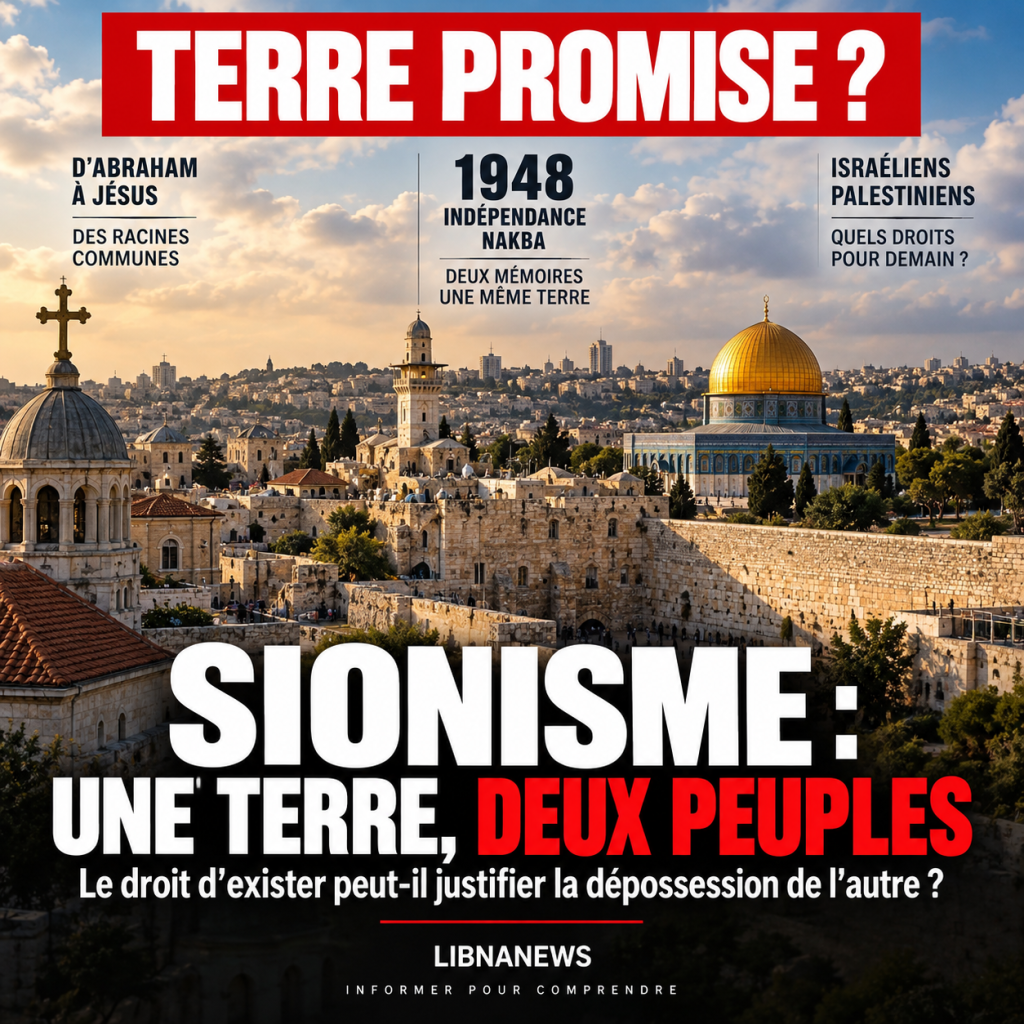
From the Promised Land to the Shared Land
There are words that, by being loaded with history, end up being unable to be spoken without immediately causing adhesion or anger. The word « Zionism » now belongs to this category.
For some, it represents the emancipation of a people long persecuted, dispersed, expelled, massacred, culminating in the absolute abyss of the Shoah. For others, he first evokes dispossession: that of another people who already lived in this land and who, in 1948, experienced the exodus, the loss of its villages, its houses and sometimes its territorial identity.
These two memories exist. And perhaps the drama begins precisely when each requires the erasure of the other.
A disturbing question must therefore be asked: when does the « Promised Land » cease to be a spiritual hope to become a political title? And above all, can a divine promise, for those who believe in it, give one man the right to dispossess another?
The promise and the cadastre
The Bible has in it the idea of a land promised to the descendants of Abraham, Isaac and Jacob. For centuries, Jerusalem was thus present in Jewish prayer and imagination far beyond real geography. « Next year in Jerusalem » expressed less a military program than loyalty, memory and hope.
But a religious promise and land title are different. The first belongs to faith. The second belongs to the right.
And that is precisely where the immense difficulty of modern political Zionism begins. It appears at the end of the 19th century in a Europe where nationalisms develop and where anti-Semitism brutally reminds Jews that assimilation does not guarantee their security. Theodor Herzl does not construct his project on a messianic reading of the Bible. His Zionism is largely political: since Jews are not safe anywhere, he thinks, they must have a state in which they can ensure their own security.
European history will tragically give him reason on one essential point: anti-Semitism could lead to extermination.
But a tragedy in Europe was going to meet another reality, in the Middle East: Palestine was not an empty land. It was inhabited.
A land twice loved
Perhaps that is where the heart of the problem lies.
Two peoples can love the same land. Two peoples may have dead under the same earth. Two peoples may have memories attached to the same hills. Two peoples can pronounce different names in front of the same landscape and consider, each sincerely, that he returns home.
The mistake begins when we turn this intimate relationship into absolute exclusivity: this land is mine, so it can no longer be yours.
Zionism from its very beginning contained a contradiction that was difficult to resolve: how could one create a Jewish national home on a territory already inhabited by an Arab population without the national affirmation of some of them ending up in conflict with that of others?
The following are known: British mandate, increasing Jewish immigration, clashes, Shoah, United Nations plan of division, 1948 war, birth of Israel and Palestinian Nakba.
Two dates overlap on the same calendar. For one: independence. For the other: disaster. What is born for some becomes torn apart for others.
And for nearly eighty years, Israelis and Palestinians seem doomed to watch the same historical event from both sides of a broken mirror.
« Take it easy »
The expression is deliberately brutal.
It cannot, of course, sum up Zionism alone, which has many currents: secular, socialist, religious, liberal, nationalist or revisionist. Many Zionists have sincerely sought coexistence, and it would be historically wrong to reduce the entire history of the movement to a uniform will of expulsion.
But the formula becomes terribly relevant when a national ideology stops saying, « I also have the right to live here » to start saying, « My right to this land cancels yours. »
This distinction is fundamental.
The right of the Jewish people to security should not imply the permanent insecurity of the Palestinian people. Israel’s right to exist should not require the impossibility for Palestine to exist.
And, conversely, recognizing Palestinian national rights does not mean denying Israelis the right to live in security on the land where several generations have now been born.
The problem may not be the idea of a homeland. The problem begins with the idea of an exclusive homeland.
When God enters the land register
There is something particularly dangerous when God becomes a geometer.
For if a border is negotiated by men, it can be moved by men. But if it is designed by God, who can still negotiate it?
It is here that certain currents of contemporary religious Zionism pose a much deeper question than that of Israel’s only security.
If Judea and Biblical Samaria are considered not as territories whose status must be determined politically, but as an inalienable divine inheritance, then the territorial compromise becomes almost a sacrilege.
The Palestinian then ceases to be only a political opponent. It becomes a human obstacle placed on a sacred earth.
And this is probably one of the most dangerous transformations of this conflict. Because we can negotiate with an opponent. It is much more difficult to negotiate with someone whose very existence is perceived as an anomaly of history.
But Palestinian history also has its absolutes
Criticism must, however, go to the end of its reasoning.
It would be intellectually too easy to denounce Israeli territorial exclusivism while closing its eyes to Palestinian or Arab discourses that have historically denied any Jewish national legitimacy.
To say that the Palestinians existed before the creation of Israel does not mean that the Jews would be alien to this land.
The Jewish history of Jerusalem, Hebron, Safed or Tiberias does not, of course, begin in 1948, nor with Herzl. The Jewish people have a historical, religious and cultural relationship several thousand years ago with this region.
The denial of this relationship is as absurd as the denial of the historical existence of the Palestinians.
That is why the two absolute slogans coincide paradoxically: « All this earth is mine because God gave me. » « All this land is mine because you have never been allowed to return. »
Two apparently opposite sentences. The same logic: erasing the other.
But Abraham had two sons
There’s an almost metaphysical irony here.
The Jewish, Christian and Muslim traditions are all called Abraham. And what exactly does Abraham’s story say? A filiation story. Isaac. Ishmael. Two sons. Two lines. Two memoirs. Two legacies.
But before even talking about peoples, a scene of Genesis deeply troubled: the expulsion of Hagar and Ishmael. Sarah asks that Hagar and his son be expelled; Abraham suffers pain; Agar goes with the child in the desert. Of course, the Bible account does not completely abandon them: God hears Ishmael, saves him, and promises him a large offspring. Yet, humanly, the image remains striking: one son stays in the house, the other takes the way to the desert.
Is there not there, long before our modern borders, an extraordinary figure of the difficulty of recognizing the Other and its rights? Two sons have the same father, but the promise goes through one and not the other. Why would a filiation become politically superior to another? Why should spiritual heritage become an exclusive territorial privilege?
However, we must be precise. Ishmael is not ruled out in Genesis because Agar would be « non-Jewish » in the sense of a matrilineal rule. Abraham himself historically precedes rabbinical Judaism, and the rule that Jewish belonging is traditionally passed on by the mother belongs to a much later legal elaboration. It would therefore be wrong to project this rule retrospectively on Abraham, Sarah and Hagar.
But this clarification makes the question even more interesting. If Ishmael is also Abraham’s son, what becomes the idea of an absolute right based on genealogy? And more broadly, why should the dignity, belonging or right of a human being depend on the maternal or paternal side of his family tree? filiation may establish a religious or cultural identity; Can it, alone, base an exclusive political right on a land of millennia later?
It is here that a word of Jesus, in the Gospel according to John, opens a philosophical abyss: « Before Abraham was, I am. In Christian theology, this sentence first affirms something important about the identity of Christ: His existence does not begin with his human birth; « I am » refers to a preexistence and, for traditional Christian reading, to the divine presence.
But philosophically, we can also hear this word as an invitation to go beyond the obsession of genealogy. Before Abraham, before Isaac and Ishmael, before peoples, before borders, before titles of property and national accounts, there is the being. There’s Life.
« I am. »
Not: « I come down from. » Not: « I was there before you. Not: « My ancestor gives me more rights than yours. But simply: « I am. »
What if that was precisely what humanity forgets when it turns genealogy into title to property? Is the life of a man living today worth less because his supposed ancestor did not belong to the right branch of a tree three thousand years old? Can we make the right to live, live, love and be buried in a genealogical chain that history, migration and mixedness have made infinitely complex?
Jesus obviously does not say that all genealogy is absurd: the Gospels themselves give him a genealogy. But his « I am » can be read as a radical shift from the centre of gravity: man does not receive his ultimate value from the purity of his lineage. Life precedes pedigree. The human being precedes the cadastre.
Then the story of Isaac and Ishmael takes on another dimension. Perhaps the question is no longer: which of the two sons received the house? Perhaps it is: why should the supposed descendants of two brothers, millennia later, continue to believe that for one to be heir, the other must be expelled?
We could have made their common origin a philosophy of sharing. History has often made it a competition for inheritance. As if two brothers came before the father’s house and each said, « She was promised. »
But if life precedes Abraham, if the living man precedes genealogy, then perhaps the Promised Land should never become the justification for expulsion. A promise that demands the denial of the Other ceases to be a promise of life. It becomes an act of possession.
And perhaps the real question isn’t, in the end, which one of the two owns the house, but why one should necessarily hunt the other in order to live there.
Jesus, Jew of this earth: the strange paradox of our time
And then there’s Jesus.
Perhaps he alone is the most vertiginous paradox of this earth.
Jesus was Jewish. He was born a Jew, lived in the Jewish world, prayed as a Jew, taught from Israel’s Scriptures and died a Jew. But he was also born and lived on this land that history will call Palestine and that today are fighting Israelis and Palestinians.
Simply saying that Jesus was a « Palestinian » in the modern national sense would be an anachronism: contemporary national identities did not exist in the first century. But this historical precision does not diminish the paradox. Maybe she’s making it deeper.
For Jesus belongs to a Jewish history rooted in this earth, while becoming the universal symbol of a message that refuses precisely to reduce man to his belonging.
He is Jewish, but speaks to Samaritan. It belongs to a people, but recognizes the alien. It has a tradition, but does not make this tradition a reason to deny the other.
He does not ask man to stop being himself. He asks him to recognize in him who is different from him a neighbor.
Isn’t that precisely what is lacking in this land today?
The Israeli-Palestinian conflict has all too often become a confrontation of exclusive legitimacy. For my story to be true, yours should be false. For my suffering to be recognized, yours should be relativized. If I’m going to be home, you’d have to be gone.
But the message attributed to Jesus radically reverses this logic: I can be me without demanding that you cease being yourself.
Perhaps this is its most contemporary political dimension — not in the partisan sense of the word, but in the first sense of politeness, in the way in which different men learn to live together in the same city.
To love one’s neighbor does not mean to abolish borders, peoples or identities. This means that no border, no people and no identity can exempt me from recognizing the humanity of the one on the other side.
And who is « the Other » on this earth? For the Israeli, it’s the Palestinian. For the Palestinian, it’s Israeli. For the Jew, it can be the Muslim or the Christian. For the Muslim or the Christian, it can be the Jew.
This is where the figure of Jesus becomes almost painfully contemporary.
A Jew born on this earth two thousand years ago teaches us that the next one is not just the one who looks like us. And two thousand years later, in this same land, the descendants of the peoples who claim to be Abraham continue to wonder who has the right to live there.
What an extraordinary contradiction.
One could even go further: does Jesus not propose, before any institutional construction, the moral principle without which no political solution can ever work?
Two states can be drawn on a map. A binational state can be imagined. Borders can be negotiated. Jerusalem can be the subject of the most sophisticated diplomatic architectures. But no solution will survive if each continues secretly to wish the other’s disappearance.
Coexistence therefore begins before the border. It begins in the gaze: to recognize that the Other has a history, a suffering, a memory, and above all that he also has the right to be there.
Perhaps that is what this sacred land should have taught the world. Not: « God gave me, so leave. But: « Since we both believe that she is sacred, let us learn not to profane her by the negation of the other. »
From the Promised Land to the Shared Land
So we have to get out of the impossible question: « Who owns this land? »
For a land crossed by millennia of history never belongs completely to anyone.
Empires pass. The borders are moving. The kingdoms disappear. Languages change. Temples become ruins, ruins become shrines and shrines become borders.
Man, on the other hand, continues to want to definitely possess what will always survive him.
Perhaps we should reverse the question. And who owns the land? But who has the right to live there?
And the answer suddenly becomes much simpler: both.
The Jew whose family has been remembering Jerusalem for two thousand years. The Palestinian whose grandfather owned a house in Jaffa or cultivated olive trees in Galilee. The Israeli child born in Tel Aviv who stole no one’s house. The Palestinian child born in Ramallah who is not responsible for any past war.
None of them has chosen the history of which he inherits. But all will have to choose what they will do with it.
The real choice
Zionism is therefore confronted today with an existential question.
If it means: « After centuries of persecution, the Jewish people must have a place where they can live freely and safely », this aspiration is understandable and has deep historical legitimacy.
But if he becomes: « This land has been promised, so your right over it is inferior to mine », then it changes nature.
Promise becomes privilege. The refuge becomes dominion. The memory of persecution no longer automatically protects against the temptation to inflict injustice on another.
And the same moral requirement applies to Palestinian nationalism: reparation for dispossession cannot go through the negation of millions of Israelis who now live on this land and whose homeland it is also.
Maybe that’s the real choice.
Promised land? Yes, if the promise means hope.
Earth that belongs to me? No, if membership means the other must disappear.
For no promise, even sacred, should be able to translate into this terribly human sentence: « Beware that I put myself in it. »
The greatness of a civilization may not consist in demonstrating that God has given it a land. It consists in understanding that, if God exists, it is difficult to imagine that He gave a man a land by ordering him to deny the humanity of those who were already there.
Peace may begin the day when Israelis and Palestinians will stop asking, « Who was there first? » to finally ask, « How can we be here together tomorrow? »
Then the Promised Land might change its meaning.
It would no longer be the land promised to one against the other.
It would become the land on which one and the Other would finally agree to live together.
And perhaps this, much more than in the possession of a territory, is what the promise would really begin.
Conclusion — The Promised Land cannot be the Earth forbidden to the Other
After Abraham, Isaac, and Ishmael, after Hagar and Sarah, after exile, persecution, the Shoah, the Nakba, wars, borders, settlements, attacks and reprisals, only one question remains.
It is an almost unbearable simplicity:
can one base his right on the denial of the other’s right?
The whole issue of Zionism may end up focusing on this issue.
For Zionism was born from an aspiration that European history has tragically made understandable: that a people persecuted for centuries can finally have a place where no one can decide on their expulsion, humiliation or extermination.
But this is the paradox.
How could the right never again to be hunted become the right to hunt?
How could the right never again be denied become the right to deny?
How could the memory of exile justify another’s exile?
And how could a land sought for two thousand years as a refuge become, for him who already lived, the land of his own uprooting?
It is here that the problem ceases to be only Israeli or Palestinian.
He becomes philosophical.
It concerns the very nature of the right.
For a true right cannot depend on the absence of the Other.
If my right to exist requires you to disappear, it is no longer just a right that I claim: it is an exclusivity.
If my memory demands the erasure of your memory, it ceases to be only memory to become domination.
If my suffering allows me not to see yours any more, then the victim yesterday may reproduce the very logic that she had asked the world to deliver her.
And it’s both ways.
Nor does Palestinian suffering give the right to deny Israeli existence.
The Nakba cannot erase the Shoah.
The Shoah cannot erase the Nakba.
One does not cancel the other.
Dead people don’t compete.
Tears have no nationality.
And no suffering should serve as a moral permit to produce the following suffering.
Perhaps we misunderstood the very idea of the Promised Land.
Can a promise from God, if one believes in God, truly mean: « This earth is yours because the other has no right over it »?
Or have we turned a spiritual promise into a notarial act, hope into a cadastre and God into a real estate agent of history?
For if God is really God, can he be owner in the sense that we hear?
Can he belong to one tribe against another?
Can he recognize the birth of one and forget the birth of the other?
Abraham had two sons.
And before Abraham, there was already man.
Even more deeply: there was already Life.
It is here that the word of Jesus takes on a dizzying dimension:
« Before Abraham was, I am. »
Before the genealogy: I am.
Before the tribe: I am.
Before the border: I am.
Before the title: I am.
Before the man asks another man who was his father, who was his mother, of what line he descends, what religion he professes and what ancestor would have received what land: he is.
It exists.
And perhaps this is the first right.
Not the right that comes from blood.
Not the one from the conquest.
Not the one from a genealogy.
Not even the one that man claims to receive from heaven to practice against another man.
But the right that comes from just being alive.
Then everything changes.
The Palestinian has no rights because he would descend from such people rather than from others.
Israel has no rights because its ancestors would have inhabited this land two or three thousand years ago.
They both have rights because they’re here.
Because they live.
Because they like it.
Because they bury their dead.
Because they raise their children.
Because they look at the same sun setting on Jerusalem and neither one of them has more than the other the light falling on his stones.
Perhaps this is the intellectual revolution this earth needs.
Moving from ownership to presence.
Switch from:
» This land is mine »
to:
« We are both of this land. »
Zionism would then perhaps find its fulfillment not in the definitive victory of one people over another, but in something much more difficult: the recognition by a people who have demanded from the world the right to exist that the same right is indivisible.
For the right that I demand for myself becomes universal at the very moment when I recognize it to the Other.
Otherwise it is not yet a right.
It’s a privilege.
And the Palestinian should take exactly the same path: to understand that recognizing his own right to the homeland now implies recognizing that the Israeli also has a homeland on this land.
Maybe that’s it, finally, recognizing the Other.
It’s not love.
It’s not giving him a reason.
It’s not to forget his dead.
It’s not giving up on your own story.
It’s something much more elementary and more difficult:
accept that the Other has the same right as me to pronounce the words: « I am. »
Then perhaps Abraham will stop separating his children.
Then only Hagar can symbolically return to the house from which she was driven.
Then only Isaac will no longer need to fear Ishmael, nor Ishmael to challenge Isaac.
Only then can Jerusalem begin to deserve its name as a city of peace.
And then perhaps we will finally understand that the Promised Land has never been truly promised to anyone who can possess it.
Maybe she was promised to whoever could share her.
For the Promised Land that refuses the Other becomes a forbidden Land.
The Holy Land that humiliates the Other ceases to be holy.
And a promise that requires the erasure of a man to fulfill is no longer a divine promise.
It has become a human will of power.
The true Promised Land may begin the day when no one will say:
« Take it easy. »
But where two peoples, after having argued so long the right to be Abraham’s heirs, will finally have the wisdom to look at each other and say:
« I am.
You are.
We are.
And this land is sacred enough for us to finally learn to live together. »
Bernard Raymond Jabre





Comments