

The problem is no longer just the fake medicine, but the medicine that no one can guarantee
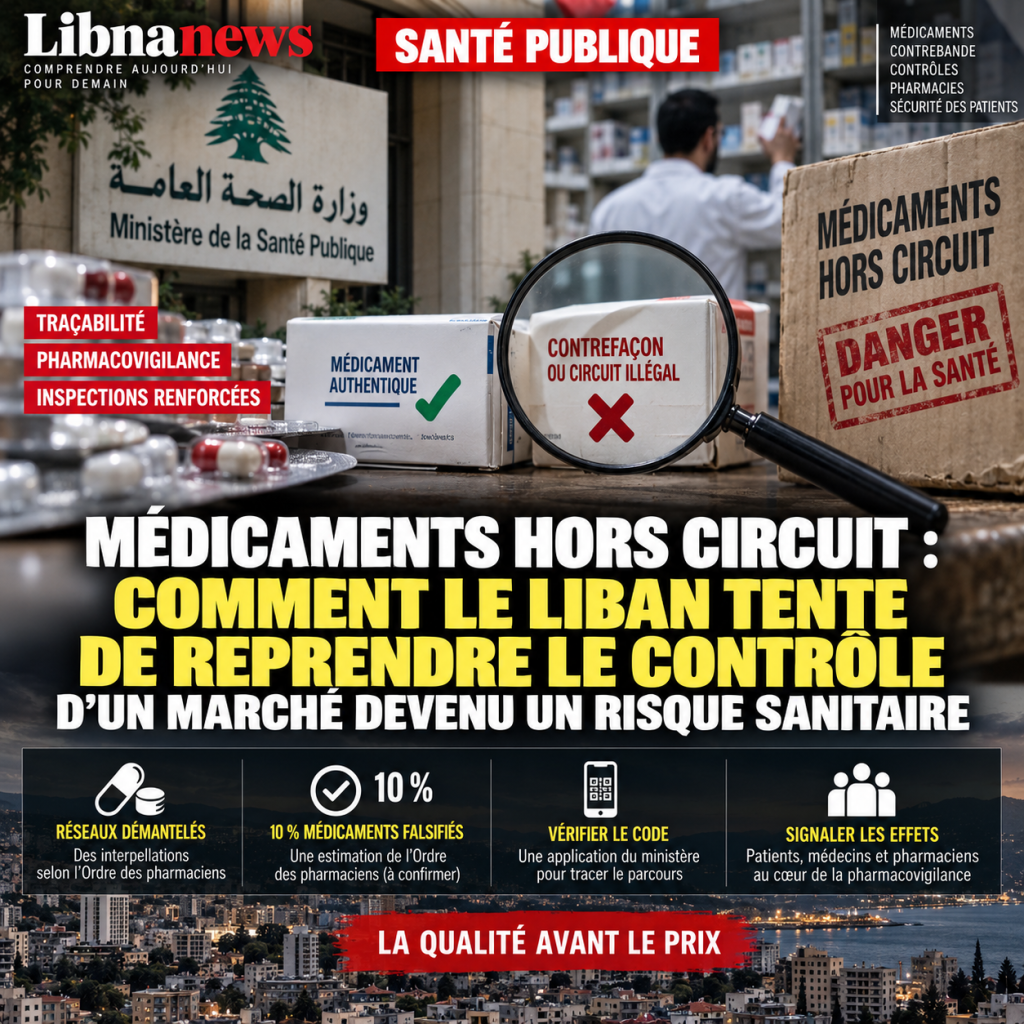
The debate on falsified medicines in Lebanon has moved. The Department of Health no longer limits the risk to boxes that have been deliberately falsified. It now places at the same level of vigilance medicines introduced outside the regulated circuit, because their journey, storage conditions and controls to which they have been subjected cannot be guaranteed. Minister of Health Rakan Nassereddine summarized this line by saying that he would not accept an unsafe drug and that pharmaceutical policy should put quality ahead of price. This position arises when the authorities recognise the existence of a market for products smuggled, non-compliant or falsified, and several networks have already been questioned according to the Pharmacists’ Order.
The distinction is important. A drug may have been manufactured by a legitimate producer and nevertheless become dangerous if it has been circulating unchecked, stored at a poor temperature or sold without traceability. Conversely, a falsified product may mimic a brand, can or active substance without offering the guarantees of the original medicine. The President of the Order of Pharmacists, Abdel Rahman Morqbaoui, uses a more radical formula by considering any contraband drug as a falsified drug. This statement must be understood as its position of health safety, not as a universal technical definition. The department formulates the problem more precisely: the smuggled drug presents a danger comparable to the fake drug because its path and the guarantees of its entry into the market are beyond control.
The 10% figure: an order of magnitude advanced by the Order, not a comprehensive census
Morqbaoui estimates that the proportion of falsified medicines on the market does not exceed 10%. This figure is important, but should be used with caution. The available evidence does not detail the method of calculation, the period of study, or the number of controlled products. This is therefore an estimate provided by the President of the Order of Pharmacists, not a complete statistical inventory of all boxes sold in Lebanon. Caution is all the more necessary because the very nature of the underground market makes it difficult to measure it: what escapes the official circuit is, by definition, less visible in the distribution databases.
Although this estimate is an upper limit and not a precise measure, the health issue remains considerable. The risk is not only measured by the percentage of boxes involved. It also depends on the type of drug, the number of patients exposed and the consequences of therapeutic ineffectiveness. A product that does not contain the expected dose may delay treatment. A poorly preserved medicine may lose some of its effectiveness. The hazard may occur only after several doses, when the patient finds that the treatment does not produce the expected effect. This is precisely why the authorities want to turn the patient, the doctor and the pharmacist into alert points of the system.
The first alarm signal may come from the patient
The ministry now asks patients to report any drugs that do not produce the expected therapeutic outcome. The mechanism passes through the doctor or pharmacist, who can complete a pharmacovigilance record. This is important because a problem product does not always recognise itself in its packaging. A box may seem normal, carry a known name and circulate without immediately awakening suspicions. The therapeutic failure then becomes an indication that has to be returned to the authorities rather than just an individual incident. The Ministry is working in parallel with the launch of an electronic application to simplify reporting by healthcare professionals.
This system of course does not make it possible to conclude that a drug is falsified as soon as a patient does not respond to the treatment. Lack of efficacy can have many medical causes. The value of pharmacovigilance lies in the accumulation of signals. Several notifications concerning the same lot or product may trigger further verification. The aim is to move from a mainly administrative control carried out at the time of registration and import to a monitoring which continues after entry into circulation. In a market exposed to smuggling, this second line of defence becomes essential.
A code on each box to check its passage through the official circuit
The department is also highlighting a traceability tool already linked to drug packs. Each package has a code that can be used in a departmental application to verify that the product has followed recognized procedures and controls. This verification does not replace laboratory analysis when there is doubt about composition. She answers another question: Did the box go through the regulated circuit? For the consumer, this information makes it possible to distinguish a product whose administrative path is identifiable from a drug that appears on the market without verifiable history.
Traceability is particularly important because the problem is not limited to the border entry point. A pharmaceutical chain includes the importer, storage, distribution and point of sale. A break at any stage can make it more difficult to identify the origin of the product. The code turns each box into a unit that can be controlled. For the system to be truly effective, however, professionals and patients must be able to use it and the data updated. The available evidence confirms the existence of this verification mechanism, but does not provide statistics on its use rate or the number of suspicious products detected by it.
Why authorities insist on purchasing exclusively in pharmacies
The College of Pharmacists makes a particularly strict recommendation: medicines must be purchased in pharmacy, not in clinics, clinics, shops or on the Internet. This direct response to the traceability problem. The pharmacy is an establishment subject to a professional framework and specific inspections. The Order has an inspection device which can enter the places within its jurisdiction, search for offences and prosecute the records found. A product purchased outside this network removes from the patient some of the guarantees associated with the regulated chain.
The Internet warning is particularly significant. A digital sale can completely separate the buyer from the actual origin of the product. Price or availability then become the only visible criteria, while storage conditions and seller identity remain difficult to verify. The same problem arises when a drug is offered in a place that is not allowed to function as a pharmacy. The patient may think he is buying a product that is cheaper or more readily available, while in reality he is abandoning the control mechanisms provided by the system. The message from the authorities is therefore less commercial than health: the place of purchase is part of the safety of the medicine.
Networks have been stopped, but the number and files are not detailed
The professional authorities indicate that several networks involved in this market have been arrested. The Order states that it works with the Ministry of Health, Customs, the Internal Security Forces and the State Security Services. When information is received, it is forwarded to the relevant bodies so that they can intervene. For its part, the department indicated that it had taken the status of complainant in more than one case concerning counterfeit or smuggled drugs. This confirms that it is not just a theoretical risk: procedures and arrests exist.
However, the available sources do not give the exact number of networks dismantled, the quantities seized, the financial values or the medicines involved in each case. It would therefore be abusive to construct a numerical table of pharmaceutical crime from these data alone. This lack of information is itself an issue. To measure the effectiveness of the control, the number of seizures, entry points, product categories, prosecutions and court decisions should be monitored. Without regular publication of these indicators, the public is aware that operations are taking place but cannot determine whether the underground market is actually declining.
The Ministry wants to strengthen the inspection rather than settle for seizures
Rakan Nassereddine states that the inspection apparatus must be strengthened in coordination with the security services. This approach aims to intervene before the problem drug reaches the patient. Customs controls border and entry flows. Security services can investigate networks. The department monitors regulatory compliance and pharmaceutical quality. The College of Pharmacists inspects establishments within its jurisdiction. The effectiveness of the scheme therefore depends on the rapid flow of information between several bodies which do not have the same powers.
This multiplicity can be a force if the roles are coordinated, but it can also create blind spots. Information held by a pharmacist must be able to reach the ministry quickly. A customs entry must identify the distribution chain. A health complaint must be related to the lot concerned. The code system and pharmacovigilance can serve as a bridge between these different levels. The challenge is to transform separate controls into a continuous monitoring chain, from the entry of the drug to its use by the patient.
The National Medicine Agency must take over the heart of the control
The most important institutional change is yet to come. The National Medicines Agency has been adopted and its operating decrees have been published. The process now awaits the appointment of its members. According to information provided by the College of Pharmacists, the Minister of Health sent the Council of Ministers a request for appointment so that the agency could start working. Once operational, it must take responsibility for matters relating to the registration and control of medicines. This means that a central part of pharmaceutical regulation must leave the current administrative operation to be concentrated in a specialised institution.
The issue goes beyond creating a new body. The agency will have to become the point where registration, market surveillance and drug control meet. In order for this change to have an effect on smuggling and falsification, it will be essential to avoid confusing overlap with existing services. Who triggers an inspection? Who removes a product from the market? Who publishes the alerts? Who keeps the pharmacovigilance data? The available elements specify the Agency’s overall competence but not yet all operational procedures. The appointment of its members will therefore only be the first step; Its ability to centralize information will be the real test.
The official low price is not enough to eliminate the underground market
The debate contains a paradox. Sector officials claim that Lebanon is one of the markets with the lowest official prices of medicines compared to neighbouring countries. If this price advantage is real for the products concerned, it should theoretically reduce the incentive to buy an underground medicine simply to save. Yet smuggling persists. This shows that the parallel market does not only meet the price. The availability of a product, point shortages, buying habits and easy access to unregulated circuits can also play a role.
The sources of the corpus do not provide a detailed comparison, medication per drug, to measure the price differential with each neighbouring country. The general statement on price levels should therefore not be transformed into a comprehensive statistical classification. However, it has a political implication: if regulated medicines are price-competitive, the authorities can focus more on safety and traceability. The patient is not only asked to avoid a suspicious product because it would be illegal; it is warned that a non-pharmaceutical purchase may expose to a health risk without a guarantee of a real economic advantage.
The weak point is the medicine that looks perfectly like the real
The fight against falsified products faces a fundamental difficulty: the patient is not a laboratory. It cannot always distinguish a convincing copy of an authentic medicine. The president of the Order warns moreover that a sick person may discover the problem only after having used the product. This fact explains why the authorities cannot rely safety on the visual vigilance of the consumer. Packaging, name and appearance are not enough. The guarantee must come from the distribution system, traceability and the ability to control the lot.
This also makes it dangerous to banish smuggling. A product introduced out of control may be authentic, altered, poorly preserved or falsified; the patient usually has no reliable way of knowing what category he is in. The department therefore prefers to treat the lack of traceability as a risk in itself. This doctrine is more demanding, but it corresponds to the normal functioning of a pharmaceutical system: safety depends not only on what a box claims to contain, but on the ability of the authorities to trace its course.
Success will be measured at alert speed, not just the number of arrests
Network arrests are necessary, but often occur after products enter the market. The system that the ministry is trying to build is based on another logic: to detect faster. The box code must be used to check the circuit. Pharmacovigilance must lead to suspicious therapeutic failures. The announced application should facilitate the reporting of physicians and pharmacists. Inspections must identify violations. The National Medicine Agency must then centralize a major part of the control and registration. If these tools work together, the time between the appearance of a suspect product and the intervention of the authorities can be reduced.
This is the real safety indicator. A falsified drug detected after months of circulation may have already affected many patients. A rapidly spotted batch can be removed before producing significant consequences. The next step should therefore be the publication of alerts and data allowing professionals to know which products or lots are being investigated. The sources examined do not yet indicate that such a comprehensive public table is operational. However, they show that the necessary architecture is beginning to be put in place.
A health battle that takes place both in confidence and in laboratories
The dossier finally touches on confidence in the medicine itself. When a patient starts to doubt the authenticity of a box, the problem goes beyond the product concerned. Mistrust can spread to pharmacies, importers and the control system. This is why the department insists on quality as the top priority and the need to report suspicious treatment. The answer cannot be limited to saying that the phenomenon remains a minority. It must give the patient simple means to check the circuit, report a problem and get an answer.
The available evidence thus shows a transition. Lebanon already has inspections, cooperation with customs and security services, verification codes and a pharmacovigilance system. It also prepares a reporting application and awaits the start-up of the National Drug Agency. The critical point will be the ability to link these tools. If each agency keeps its information separately, the clandestine networks will continue to exploit the gaps between the institutions. If traceability, alerts, inspections and prosecutions are linked, the parallel market will become more difficult to feed. For the patient, the immediate rule remains much simpler: not only to look for a box bearing the right name, but a box whose course can be checked.





Comments