

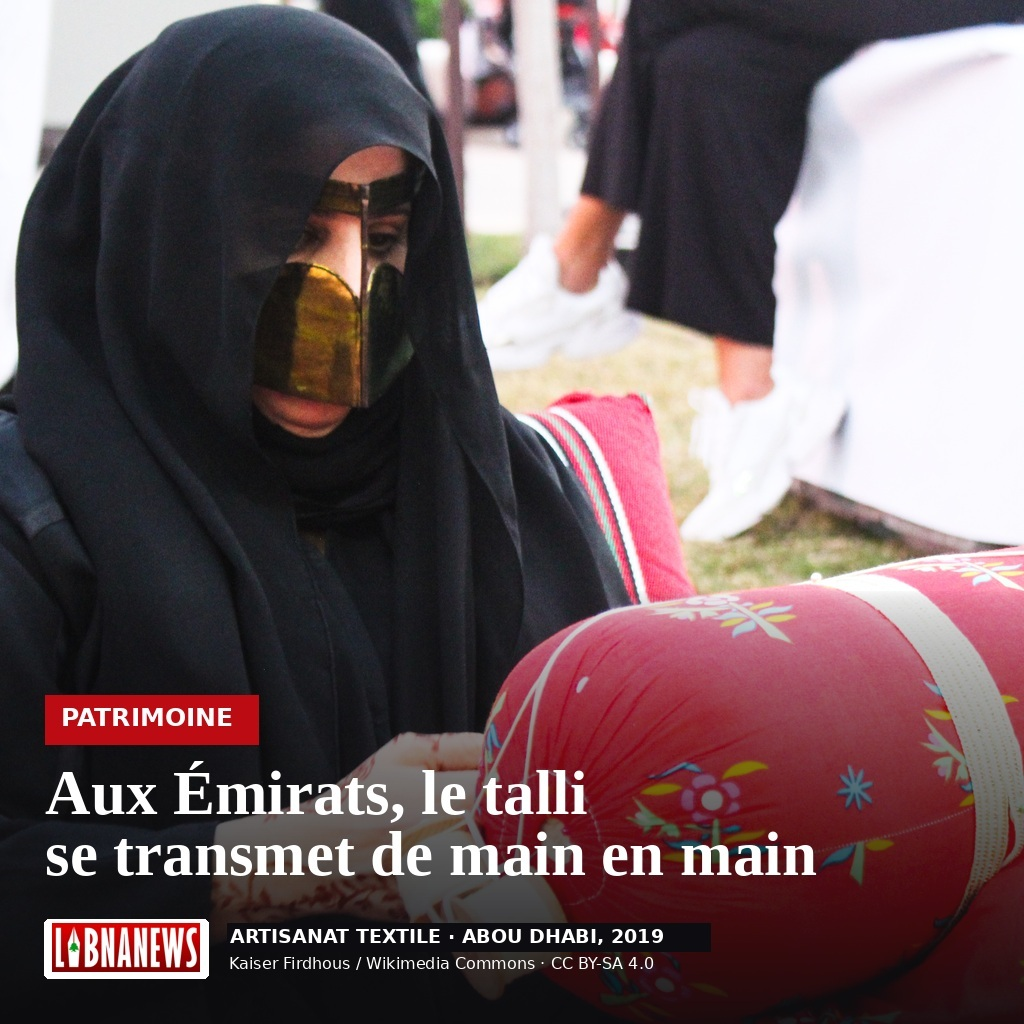
In the United Arab Emirates, the talli recognizes itself on a collar or sleeve, but learns from the garment: in front of a cushion, watching an artisan cross the threads at the end of their coils. In 2022, this know-how was incorporated into the intangible cultural heritage of humanity, and it was passed on to the house, to the workshops and to the design schools in Sharjah.
A band made before being sewn
The talli is not a pattern embroidered directly on a dress. A narrow band is first woven and then sewn onto the garment. The Emirati Ministry of Culture is particularly concerned with thethobicand thekanduraand along the legs of the pants. The cultural service of Abu Dhabi also points to bands sewn side by side to form a wider border. The gallon adorns both everyday clothes and ceremonial dresses.
The cushion on which the braid forms rests on a metal support, thekajoujah. The wires are wrapped on coils. The cultural service of Abu Dhabi indicates from eight to fifty, depending on the complexity of the motive. In the models described, a two-wire metallised central band is wider than that with a single wire. Synthetic metallic yarns have replaced genuine gold and silver in the practice described today by the institution.
Learning a move, listening to a story
In the UNESCO case file, family transmission goes mainly from mother to daughter. But learning is not limited to two people. Women gather in houses or in their neighbourhood to braid. There are ways of doing things, but also stories and proverbs. These meetings are one of the aspects of the know-how recognized in 2022 in the national file 01712; registration does not reward a single motif or a particular city.
The same file describes a more formal transmission to schools, universities and heritage centres. In Sharjah, the Traditional Trades Centre of the Heritage Institute places the talli among the know-how that it accompanies and presents the practice in the workshop as a means of transmitting them. A workshop and a neighbourhood meeting do not quite fulfill the same function: the first opens up learning to a new audience, the second circulates together the gestures and the stories that accompany them.
In Sharjah, also keep the manufacturing time
In its 2024 report to the UNESCO Creative Cities Network, Sharjah reviews the work of the Irthi Council between 2018 and 2023. Two bilingual publications are devoted to Talli. The report identifies more than 100 documented traditional or experimental models, with their materials, method and number of hours required. This last detail informs about the work that a simple photographed motif does not allow to appreciate.
The city states that more than 300 Emirati artisans based in Sharjah were trained in crafts and design as part of the program. This figure covers several occupations: it does not measure the number of talli braids or their current number in the Emirates. The report also distinguishes another experience: in 2022, five students from the American University of Sharjah participated in three-dimensional documentation of models from four trades. Here again, the archive goes beyond the only talli.
The band also knows uses outside the garment. For the Zenobia collection, Irthi has associated the talli and marquetry with the designer Nada Debs, based on container forms associated with Bedouin traditions. The object changes, but the braid remains a full job. This is the difference between resuming the appearance of a motif and continuing to teach the gesture that makes it possible to make it.
Archive: An artisan works with wires and a cushion in Abu Dhabi, December 2019. Illustration photography on the textile crafts emirati, outside Sharjah’s program. Kaiser Firdhous / Wikimedia Commons, CC BY-SA 4.0. Dress Libnanews.





Comments