

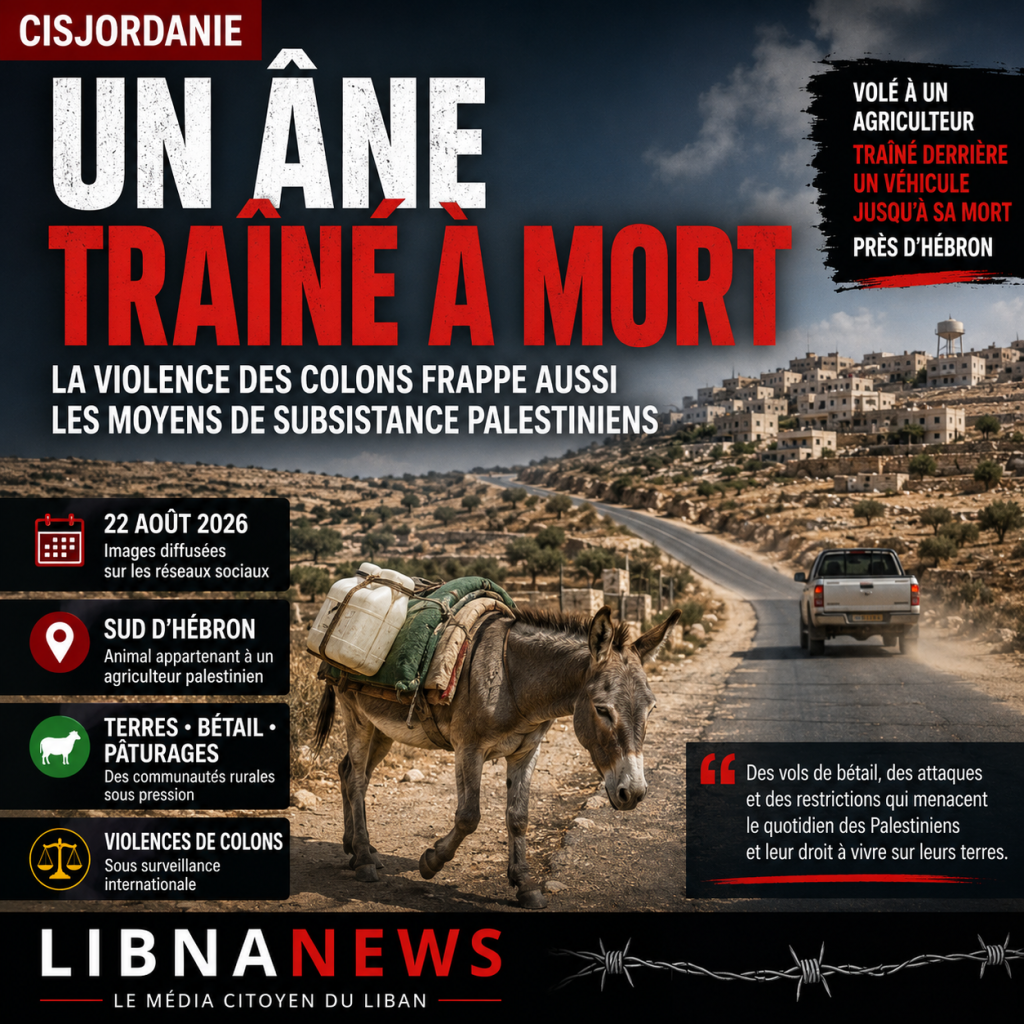
A donkey belonging to a Palestinian farmer was stolen and dragged behind a vehicle until his death in the southern occupied West Bank, near Hebron. Images of the scene, broadcast on 22 August 2026 on social media and repeated by several media, show the animal shot on the road. The incident occurred in a region where rural Palestinian communities had been denouncing for several months an increase in settler attacks, cattle theft and restrictions on access to agricultural land and pasture.
The images provoked many reactions after their broadcast on Saturday, August 22. According to reports accompanying the video, Israeli settlers seized a donkey belonging to a Palestinian in the southern Hebron area of the occupied West Bank. The animal was then allegedly attached to a vehicle and dragged on the road until his death. The precise circumstances preceding the scene and the identity of all those involved had not yet been independently established.
However, the visible sequence shows an animal shot behind a vehicle on a road. Palestinian and regional media presented the donkey as having been stolen from a Palestinian farmer before being killed. An Israeli media also reported on Sunday that images broadcast on social media showed settlers dragging a donkey until his death behind a tractor near Hebron, saying that the animal was stolen from a nearby Palestinian town.
The episode is first an act of cruelty against an animal. But in the context of the southern West Bank, it also has an economic and territorial dimension. Asses remain used by many Palestinian rural families to transport water, crops, equipment or goods to areas where motorized access is difficult. Loss of an animal can therefore directly affect the livelihoods of an agricultural home.
A stolen animal then dragged on the road
The video broadcast on 22 August alone does not allow for the reconstruction of all stages of the incident. The accompanying accounts indicate that the animal was first taken from its Palestinian owner before being tied and dragged. There was no immediate evidence of how many persons had participated in the act or whether arrests had been made specifically in the case.
This caution is necessary while names have been circulating on social networks. Some Internet users have associated the incident with already known figures of the settler movement. These statements cannot be presented as established without official confirmation or evidence to formally identify the persons visible in the images.
However, the context is documented. Several settler outpost organizations in the occupied West Bank have been subject to international sanctions because of violence and violations of Palestinian rights. In May 2026, the European Union punished Israeli organisation Hashomer Yosh and its leader Avichai Suissa. The EU considers that this structure provides material support to at least 28 outposts or settlements associated with violence and that it recruits in particular armed volunteers.
Avichai Suissa had already been sanctioned by the United States prior to its inclusion in the European list. European authorities accuse of facilitating and encouraging serious human rights violations in the West Bank. However, on the basis of publicly verifiable evidence available immediately after the video was broadcast, there is no direct attribution of the death of the donkey. The distinction between a documented context of violence and the individual attribution of this act remains essential.
In southern Hebron, cattle at the heart of pressures
The incident occurs in a part of the West Bank where livestock is an essential part of Palestinian economic life. The hills south of Hebron, especially around Masafer Yatta, are home to pastoral communities whose incomes depend heavily on sheep, goats, donkeys and other livestock. Access to land and water points directly conditions their ability to stay on site.
For several years, people and organizations following the situation have reported a growing number of confrontations around pastures. Violence can take several forms: intrusion into property, destruction of crops, denial of access to land, theft of livestock or the installation of new outposts near Palestinian communities.
Testimonials collected in recent months include seized or stolen herds and Palestinians who have been denied access to sources used for generations. In some communities, these losses are not just one-time material damage. They gradually reduce the means by which families can continue their pastoral work.
The donkey killed near Hebron fits into this environment. The particularly brutal nature of the images gives him unusual visibility, but the theft or loss of animals occurs in a broader dynamic of pressure on Palestinian farmers and herders.
Animals, an indispensable tool for rural communities
In the most isolated villages and hamlets in the southern West Bank, a donkey is not only a domestic animal. There is still a means of transport suitable for agricultural roads and rugged terrain. In particular, it allows water cans to be transported when dwellings are distant from networks or when access to tanks and sources is limited.
This function explains the economic consequences of theft or killing. A family can lose both the value of the animal and a necessary tool to transport its property. In communities where livestock farming is sometimes the main source of income, attacks on livestock can increase an already significant vulnerability.
The phenomenon exceeds the only south of Hebron. In several parts of the West Bank, Palestinian families reported seizures, disappearances or theft of animals in 2026 during incidents involving Israeli settlers or forces. Some said they had to sell part of their herds after losing access to their pastures.
Pressure on agricultural activities thus plays a role in population displacement. A pastoral community that can no longer feed its animals, access water or move to its land may eventually lose the economic conditions necessary to maintain it.
Settler violence under international surveillance
The incident comes at a time when settler violence in the West Bank is receiving increasing international attention. The European Union adopted new sanctions on 28 May 2026 against individuals and organizations accused of supporting violent or coercive activities against Palestinians.
In its decision, the EU stresses that some outposts prevent access to Palestinian farmland and pasture and that they constitute persistent outbreaks of violence. Brussels also believes that the methods used by certain groups contribute to the forced displacement of Palestinian communities and the dispossession of their property.
The region continued to be marked by incidents during the summer. Several communities reported settler incursions into their lands and confrontations around houses or farms. Recent reports have also documented the establishment of outposts and the growth of groups of young settlers in several rural areas.
The Israeli authorities distinguish between acts of violence committed by individuals and the activities of settlements recognized by Israel. Israeli officials themselves condemned some recent incidents involving settlers. However, the issue of law enforcement remains at the centre of criticism, with Palestinians and human rights organizations regularly denouncing the lack of prosecution after the attacks.
An increasingly fragmented West Bank
Southern Hebron is one of the areas where these tensions are particularly visible. The coexistence of Palestinian villages, Israeli settlements, more recent outposts and areas under different administrative regimes creates a strong fragmentation of the territory. Roads, pastures and water points regularly become places of confrontation.
Palestinian communities in Masafer Yatta have long faced land-use restrictions. Several sectors were designated by Israel as military zones, while expansion of settlers’ outposts increased pressure around grazing areas.
In recent months, tensions have also increased in other areas of the West Bank. In the vicinity of Nablus, settler groups attempted to settle or expand their presence near several Palestinian villages, causing confrontations with the inhabitants and sometimes with Israeli forces in charge of controlling the area.
In this climate, the fate of an animal may seem secondary to the deaths, injuries, displacements and destruction recorded in the occupied territory. The incident of 22 August shows yet another dimension of this daily pressure: that which directly affects the working tools and resources of rural families.
The immediate challenge now remains to establish the full circumstances of the donkey’s death and the identity of those responsible. The images broadcast document the brutality of the scene, but they do not yet allow to answer all judicial questions. The follow-up will depend, inter alia, on the existence of an investigation and the ability of the competent authorities to identify the participants in the act, while Palestinian communities in southern Hebron continue to report pressure on their lands, herds and livelihoods.




