

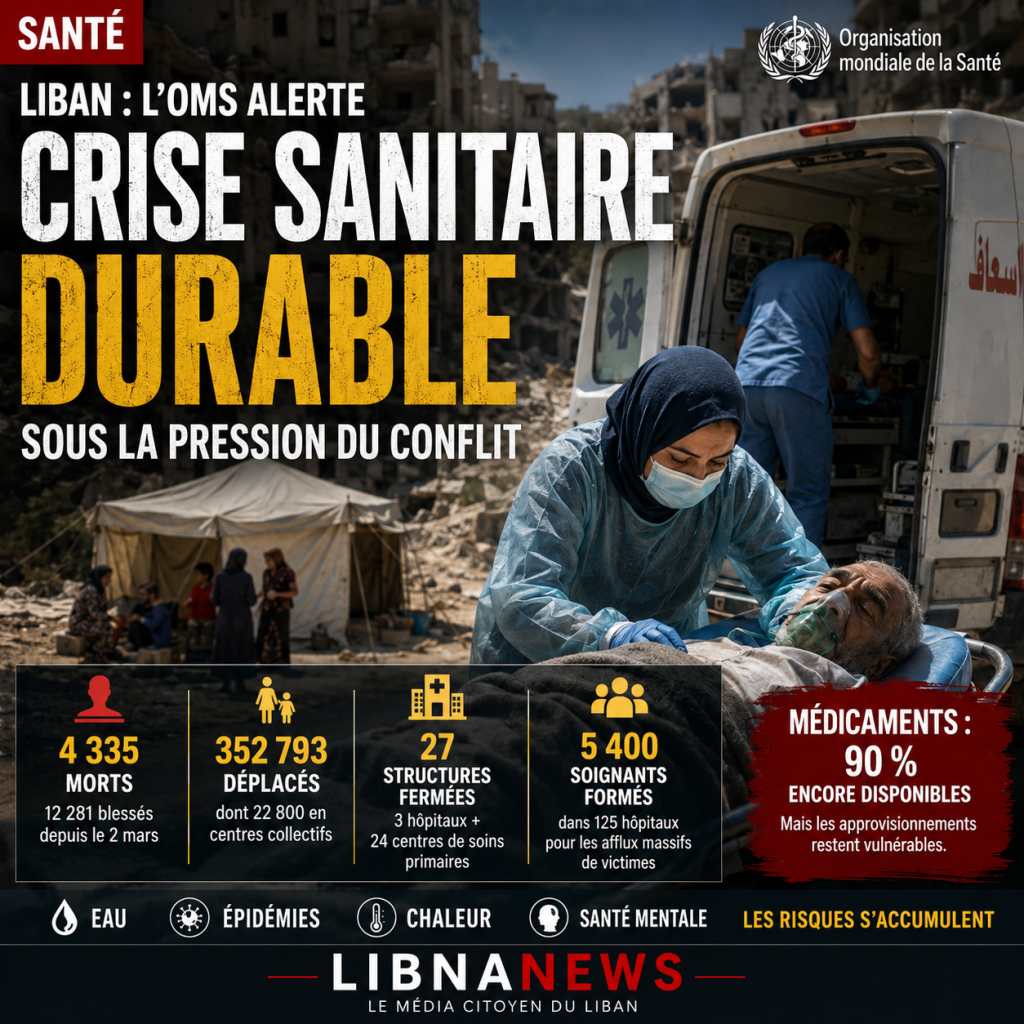
Lebanon remains one of the main focal points of the health crisis in the eastern Mediterranean. In its July 2026 progress report, the World Health Organization paints a picture of a country facing simultaneously the human consequences of the conflict, massive population displacement, the closure of medical facilities and the need to maintain a health system already weakened by several years of crisis. This Lebanese situation is part of a much larger regional emergency: 117 million people are now in need of humanitarian assistance in the Eastern Mediterranean region, which, however, accounts for only 8 to 9 per cent of the world’s population but concentrates 49 per cent of the world’s people in need of humanitarian assistance.
More than 4,300 dead in Lebanon
Data for Lebanon are among the most important in the report. WHO4,335 dead and 12,281 injured since 2 march, within the framework of the regional escalation classified by the organisation as alevel 3 acute emergency, its highest operational emergency level.
Beyond the immediate human balance, the war continues to produce an indirect health crisis through population displacement and access to care. According to the most recent data included in the document,352,793 persons were still internally displaced as at 6 August22,800 of which were housed in collective centres as at 10 August. At the same time, 834,651 people had returned to their home areas. However, three hospitals and 24 primary health care centres remained closed.
The numbers are changing rapidly. For the situation as at 29 July alone, WHO still recorded 360,132 internally displaced persons, of whom 27,177 in 262 collective sites, while 821,077 persons had started returning to their communities.
These return movements do not necessarily mean a return to a normal situation. Part of the population returns to areas where access to services remains difficult and the identification of health needs is itself a problem. WHO highlights, inter alia, the difficulties encountered in assessing the needs of returnees in difficult-to-access areas and in collecting health signals from communities.
5,400 hospital staff trained in victim care
In the face of the risk of further massive arrivals of injured persons, WHO is focusing a significant part of its Lebanese system on emergency medicine and the capacity of hospitals to absorb a sudden influx of victims.
About5,400 personnel from 125 lebanese hospitals were trained in the management of mass influxes of victims and traumatological care. Equipment for trauma management was also distributed.
The organization is also involved in the restoration of the Central Public Health Laboratory, including the National Reference Laboratory for Emerging and Reemerging Diseases. Three nurses were deployed to strengthen epidemiological surveillance, early disease detection, infection prevention and the implementation of the International Health Regulations.
This dimension is important: the Lebanese health crisis is no longer limited to the injuries directly caused by the violence. Travel, promiscuity in community centres, difficulties in water supply and disruption of public services also increase the risk of communicable diseases.
For example, the Ministry of Health and WHO have disseminated information on the prevention of contagious diseases, water and food quality, diarrhoeal diseases, hepatitis A, respiratory infections, measles and rabies to shelters.
Epidemiological surveillance remains active
Despite the crisis, the Lebanese health surveillance system continues to operate. Between weeks 27 and 30 of 2026,33 epidemiological signals were recorded in Lebanon. According to WHO, they were all verified within 24 hours and the related investigations were completed.
Food-related incidents were the first reported category in acute diarrhoeal diseases and rabies exposures. In the latter field, WHO237 health professionals in the management of rabies and animal bites12 sessions.
Food security is also being given special attention. Representatives of WHO, the Ministry of Health and the Ministry of Agriculture participated in trainings on multisectoral food emergency response plans. Recommendations have also been prepared for inspectors and collective kitchens.
Medicines remain available, but supply chain is vulnerable
On the pharmaceutical front, the report provides a relatively reassuring element:approximately 90% of drugs on the Ministry of Health’s list of essential drugs against non-communicable diseases remain available.
But this availability remains fragile. WHO explicitly identifies regional instability, shipping costs and delivery delays as risks that could disrupt future supplies.
The issue is particularly sensitive in a country that is highly dependent on imports and where chronic diseases require continuous supply. A prolonged logistical breakdown would thus have consequences far exceeding the care of the victims of the conflict alone.
More than 485,000 people receiving health interventions
The scale of the humanitarian system also provides a measure of the pressure exerted on the country. By the end of July, the coordinated response had reached about1.2 million people in Lebanonaccording to WHO. More485 000 people benefited from health interventionswhile water, sanitation and hygiene interventions had affected more than 1.3 million people.
The issue is not just about physical care. The report reveals persistent gaps in mental health care. Four workshops with approximately 90 participants from 57 organizations were organized to map the actors and services available.
A national workshop increased participants ‘ stated level of confidence in coordination from 36 per cent to 60 per cent. WHO notes, however, thatfragmentation of patient guidance systems and limited coordination capacity remain major challenges.
Heat, lack of water and pollution add to the crisis
In addition to war and displacement, there is another less dramatic but long-lasting pressure on public health. WHO identifies several simultaneous environmental risks in Lebanon:extreme heat, water shortages, energy insecurity, air pollution and floods.
The organisation is working with its partners to develop standards to make health facilities more resilient to the effects of climate change and to prepare water quality monitoring devices.
This accumulation of factors shows above all that the Lebanese health problem now far exceeds the functioning of hospitals. A health system must simultaneously absorb the injured, monitor the hundreds of thousands of internally displaced persons and returnees in their villages, maintain chronic treatment, monitor communicable diseases and operate in an environment where water, electricity and transport can themselves become uncertain.
Health structures themselves remain exposed
The protection of health facilities and personnel remains a major regional issue. WHO identified19 attacks on health care in the Eastern Mediterranean in July alonemore than half of the 36 incidents recorded worldwide during this period. Three people were killed and 15 injured.
The WHO graph shows thattwo of these attacks were recorded in Lebanon in July, wounding fourwhile 15 attacks were recorded in the Occupied Palestinian Territory, with three dead and eleven injured. The organization points out that attacks on health services have decreased compared to previous months with the decline in some violence after the ceasefires, but have not disappeared.
WHO recalls that health personnel, facilities and means of transport are protected under international humanitarian law and the Geneva Conventions.
An entire region on the brink of humanitarian saturation
The Lebanese case is finally part of an extremely degraded regional environment. WHO estimates that117 million people in need of humanitarian assistancein its Eastern Mediterranean region. Some 80 million are at levels of acute food insecurity, 60.4 million are displaced or considered displaced persons under humanitarian assistance and 48 epidemic outbreaks remain active.
In Sudan, cholera, dengue fever, malaria, measles, diphtheria and poliomyelitis are circulating simultaneously. Between 8 May and 3 August, 2,399 cases of cholera and 215 deaths were reported in six States. In Somalia, approximately 15,800 cases of cholera or acute aqueous diarrhoea had been recorded in the first 30 weeks of the year.
Syria continues to face shortages of medicines, fuel, diagnostics and health transport, while in Iran attacks between 27 June and 24 July resulted in 59 deaths and more than 666 injuries. In Iraq, the 29 July airstrikes reportedly killed some 20 people and injured 32 people, while national stocks of several essential medicines were exhausted.
This crisis is finally facing a financial problem. For its urgent appeal on the Middle East conflict, WHO believes that it needs$30.3 million. Only 10.5 million, or 35%, had been received at the time of the report, leaving close to$20 million unfunded.
For Lebanon, WHO data thus describe less a one-off health emergency than a crisis that has become structural. The country maintains significant medical and surveillance capacities, and the availability of essential drugs remains relatively high. But these capacities work under the combined pressure of the victims of conflict, population displacement, returns to areas that are sometimes difficult to access, the closure of care structures and increasing epidemiological and environmental risks.
In this context, the central question is no longer whether the Lebanese health system can respond to the current emergency. She asked how long it could maintain that level of response if conflict and regional instability continued.




