

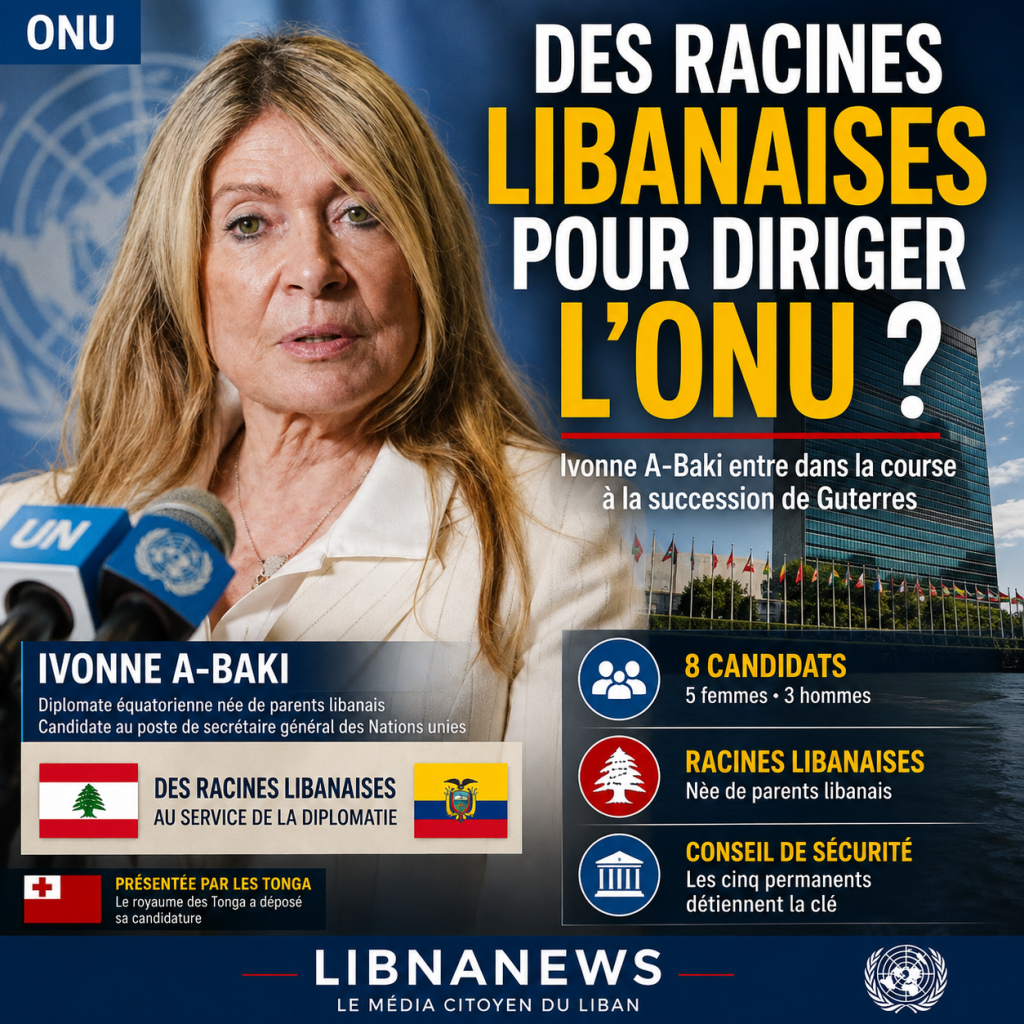
Ivonne A-Baki, Ecuadorian diplomat born to Lebanese parents, entered the succession race of António Guterres as Secretary-General of the United Nations. His candidacy, submitted by Tonga, adds a profile directly linked to Lebanon to a competition that now has eight suitors. Former ambassador of Ecuador to the United States and Qatar, she highlights her Lebanese origins, her experience between Latin America and the Middle East and her role in bringing Ecuador closer to Peru after their 1995 border war.
A Lebanese diplomat could succeed António Guterres as head of the United Nations. Ivonne A-Baki officially joined the race as Secretary General, according to a letter from the President of the UN General Assembly announcing his candidacy. The former Ecuadorian Minister of Foreign Trade, however, was not presented by Ecuador: his appointment was tabled by the Kingdom of Tonga in the Pacific.
This entry brings to eight the number of declared candidates, five women and three men, while appointments remain open. The next Secretary-General will have to take office after the end of the second term of office of António Guterres, scheduled for 31 December 2026. Competition takes place in a context marked by divisions between major powers, the proliferation of conflicts and the budgetary difficulties of the United Nations.
For Lebanon, the special feature of this new application lies in the origins of Ivonne A-Baki. Born to Lebanese parents and having grown up in an environment linking several cultures, the diplomat herself claims this heritage as one of the characteristics of her candidacy. It presents itself as a potential link between Latin America and the Middle East, two regions that occupy a central place in its personal and diplomatic journey.
Ivonne A-Baki claims its Lebanese roots directly
The Lebanese origin of Ivonne A-Baki is not a secondary element of his campaign. The candidate integrates directly into the argument she presents to the UN Member States. In a message announcing her candidacy, she stressed that she was the only contender whose personal legacy links Latin America and the Middle East. She stated that she wanted to use this dual membership to help restore the United Nations mediation capacity in a world marked by a proliferation of conflicts.
« I’ve lived the ravages of war, » she wrote when she applied. It also highlighted its experience in conflict resolution and its role in the post-Ecuador-Peru process in 1995. His message thus seeks to combine his personal history, Lebanese origins and diplomatic experience with one of the founding missions of the United Nations: the prevention of wars.
Ivonne A-Baki belongs to this important Lebanese diaspora that has been settled for several generations in Latin America. Communities resulting from Lebanese emigration have developed in Brazil, Argentina, Mexico, Colombia, Venezuela and Ecuador. Several leading political figures on the continent have Lebanese origins, reflecting a migration that began in the late nineteenth century and continued during the twentieth century.
In the case of A-Baki, this heritage accompanied a career built in the service of Ecuador. His candidacy therefore remains legally and diplomatically that of an Ecuadorian person nominated by Tonga. However, its Lebanese roots give it a special dimension at a time when the Middle East is one of the main hotbeds of crisis facing the future Secretary-General.
A diplomat from Washington and Doha
The Ivonne A-Baki journey spans several decades and combines diplomacy, ministerial functions and international initiatives. In particular, she was the first Ecuadorian woman to be appointed ambassador to the United States, one of the most important positions in Quito’s diplomacy. She also represented her country in Qatar, enabling her to gain direct diplomatic experience in the Middle East.
Tonga specifically highlighted this combination in the appointment file. The kingdom highlights its experience as a member of the government, ambassador to Washington and ambassador to Doha. For a position whose incumbent must engage in continuous dialogue with governments with opposing interests, this ability to evolve between several diplomatic spaces is one of the main arguments of his candidacy.
A-Baki also occupied the foreign trade portfolio in Ecuador. This experience gives him a profile that is not limited to political and security issues. The future Secretary-General will have to manage an organization facing growing financial constraints, while development, trade, climate and international financing issues remain closely linked to political crises.
His candidacy, however, focuses mainly on mediation and conflict prevention. She claims to be the only candidate currently competing for participation in the negotiation of a peace agreement between two sovereign States members of the United Nations. This reference concerns the border conflict between Ecuador and Peru, which had undergone a new military phase in 1995.
Peace between Ecuador and Peru at the heart of his candidacy
The Cenepa war had opposed the two countries in an Amazon region whose border remained contested. The relatively brief fighting, however, confirmed the persistence of an ancient territorial dispute between Lima and Quito. After the hostilities, several years of negotiations had been required to reach a final settlement.
Ivonne A-Baki had participated in efforts to create a dialogue between the two countries after the confrontation. The final peace agreement was signed in 1998, ending one of the oldest border disputes in Latin America. The candidate now uses this experience as a central element of her UN file.
This reference directly responds to the international situation of 2026. The next Secretary-General will inherit an organization facing several simultaneous conflicts and the deep divisions of the Security Council. Disagreements between the United States, Russia and China regularly reduce the Council’s ability to adopt common positions on major international crises.
A-Baki therefore seeks to present her experience as a mediator as a competence directly applicable to the functions of Secretary General. The post does not allow for a solution to be imposed on States, but the incumbent can use his good offices, facilitate negotiations and open channels when official relations are blocked.
An application also marked by the Yasuni dossier
The Ecuadorian diplomat’s journey also included a more controversial episode. Ivonne A-Baki was one of the leading international representatives of the Yasuni-ITT initiative, a project launched by Ecuador to avoid the exploitation of oil reserves located in a part of the Amazon region that is particularly rich in biodiversity.
The principle was to keep oil in the basement of Yasuni National Park in exchange for a significant financial contribution from the international community. Ecuador thus asked foreign countries to contribute to the economic cost of non-exploitation of resources, in return for an overall climate and environmental benefit.
A-Baki was one of the international faces of this initiative. However, the project has not managed to mobilize the funds expected. In 2013, the then Ecuadorian president, Rafael Correa, put an end to it and authorized oil exploitation, recognizing that international contributions had been far below targets.
However, this episode may influence the assessment of its profile from a different angle. He gave him direct experience in international negotiations on climate finance, biodiversity and the tension between economic development and environmental protection. These issues now occupy an important part of the UN agenda.
Eight candidates to succeed António Guterres
Ivonne A-Baki joins an already advanced competition. Five women and three men are now candidates for the succession of António Guterres, who will leave office after his second term of office on 31 December 2026. The nominations remain open, however, leaving the possibility for other personalities to enter the race.
Candidates include Rebeca Grynspan, former Vice-President of Costa Rica and current Secretary-General of the United Nations Conference on Trade and Development; Michelle Bachelet, former President of Chile and former United Nations High Commissioner for Human Rights; and María Fernanda Espinosa, former Minister for Foreign Affairs of Ecuador and former President of the General Assembly.
The list also includes Carolyn Rodrigues-Birkett, former Foreign Minister of Guyana; Rafael Grossi, an Argentine diplomat who heads the International Atomic Energy Agency; Olara Otunnu, former Ugandan Foreign Minister and former UN senior official; and Macky Sall, former President of Senegal.
The presence of Ivonne A-Baki also means that two Ecuadorian personalities are now in the competition, since she joins María Fernanda Espinosa. This situation illustrates the particular nature of the procedure: a candidate may be nominated by a State other than that of which he or she is a national or whose career is primarily associated.
A race where no favourites still have to
The competition remains open despite a first test in the Security Council. In July, the Council organized a first « straw poll », an informal consultation allowing the fifteen members to measure the level of support available to candidates. Ivonne A-Baki did not yet participate, since his candidacy was submitted after this first round.
Rebeca Grynspan came first after this first consultation. However, this result does not guarantee his appointment. Several rounds may be necessary before a candidate can achieve a sufficient majority while avoiding opposition by a permanent member.
Rafael Grossi, on the other hand, has high international visibility because of his leadership of the International Atomic Energy Agency. It has been central to Iran’s and Ukraine’s nuclear issues in recent years. This reputation, however, is not enough to make him a sure candidate to win, in a procedure where geopolitical considerations play a decisive role.
A woman’s candidacy also has an important institutional argument. Since the establishment of the United Nations in 1945, no woman has held the post of Secretary-General. The presence of five of the eight candidates now declared strengthens the possibility of a first in 2027, but does not constitute a guarantee in a procedure dominated by the balances of the Security Council.
The five permanent members hold the key
The Secretary-General is not directly elected by the General Assembly. The Security Council must first recommend a candidate. To achieve this, the Council must obtain at least nine votes out of the fifteen members of the Council and, above all, avoid the veto of each of the five permanent members: the United States, Russia, China, France and the United Kingdom.
This second condition makes forecasting particularly difficult. A candidate may have substantial support among the members of the Council and may nevertheless be blocked by a single great power. Informal consultations serve precisely to gradually identify candidates who can build consensus among Governments whose relations are currently very tense.
The five permanent members have not yet publicly announced their final preferences. Their position will be decisive for both Ivonne A-Baki and its competitors. His experience in Washington may form part of his profile with the United States, while his visit to Qatar and his Middle Eastern origins allow him to highlight a knowledge of regions at the heart of international crises. These characteristics, however, do not make it possible to assume the vote of the United States or of the other permanent members.
Once recommended by the Security Council, the candidate must be appointed by the General Assembly, which brings together all member States. In practice, therefore, the decisive step remains the search for an agreement in the Council and, in particular, between its five permanent members.
Lebanese roots in a global competition
For Ivonne A-Baki, the late entry into the race is now a first challenge. Its seven competitors have already participated in part of the process and some have significant visibility within the UN system. His candidacy will need to obtain early support before the next Security Council consultations.
In this context, its Lebanese roots constitute an identity element which it itself has chosen to place in the foreground. They do not make his candidacy that of Lebanon, since his political and diplomatic career is Ecuadorian and his appointment has been submitted by Tonga. On the other hand, they allow him to claim a personal experience linking Latin America to the Middle East at a time when these two spaces occupy an important place in international debates.
This dimension could also attract attention to Lebanon, a country whose diaspora has produced many political, economic and cultural figures in the Americas. An accession of Ivonne A-Baki to the General Secretariat would thus have a strong symbolic significance, even if the competition is still very open today.
The diplomat must now pass the same obstacle as his competitors: to convince at least nine members of the Security Council without provoking the veto of Washington, Moscow, Beijing, Paris or London. Its arrival after the first informal vote also requires it to quickly catch up with the candidates already tested. The forthcoming consultations will determine whether her background as a mediator and the Lebanese roots she claims can turn her late application into a compromise.




