

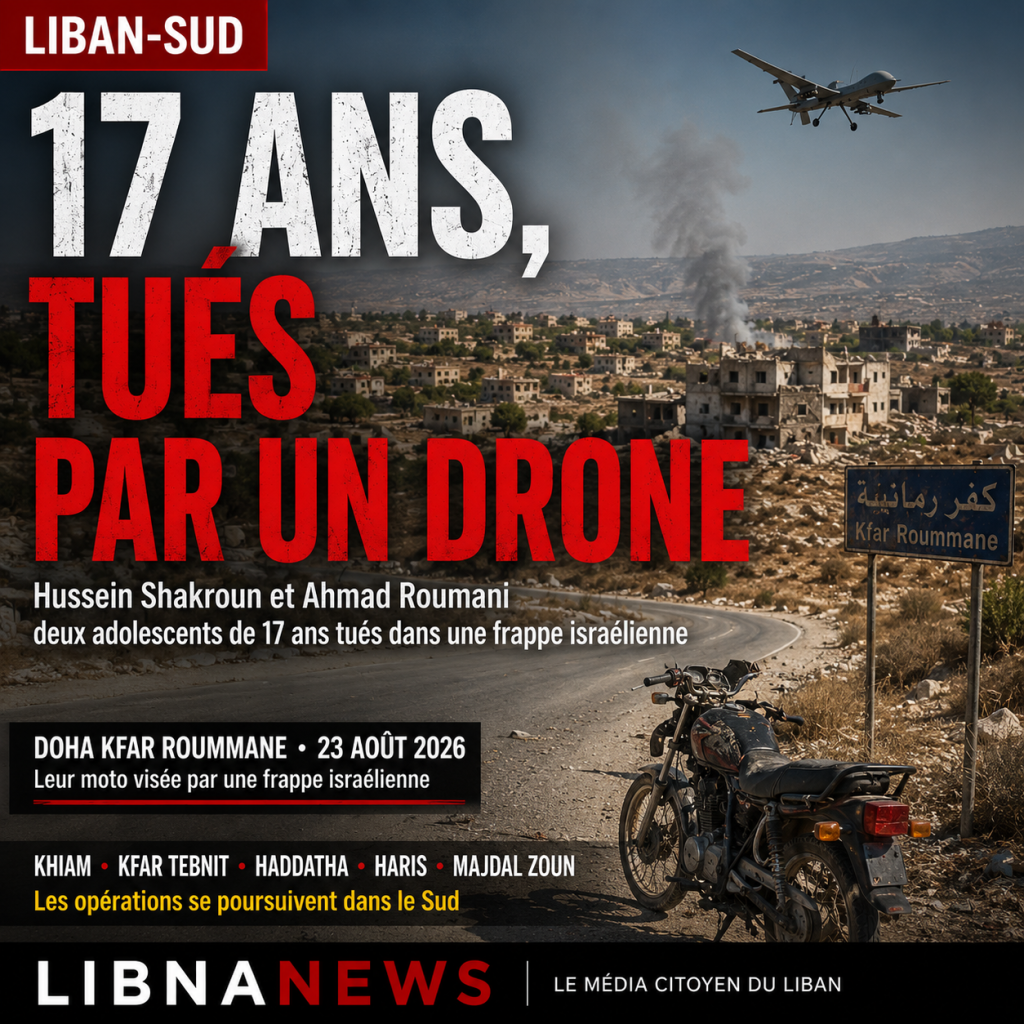
Two 17-year-old Lebanese teenagers, Hussein Shakrun and Ahmad Rumani, from Deir al-Zahrani, were killed on Sunday, 23 August by an Israeli drone strike against their motorcycle in the Doha Kfar Rummane area, near Nabatiyah. Their bodies were found Monday, 24 August, after their relatives had lost all contact with them. Their death occurred on another day of Israeli operations in southern Lebanon, marked by explosions, house blasts, property fires and earthworks in several localities.
The two teenagers were riding on motorcycles in the Kfar Rumman area when the Israeli drone targeted their vehicle on Sunday. According to information provided by the Lebanese authorities on Monday, the aid recovered the bodies of Hussein Shakrun and Ahmad Rumani, both 17 years old and from Deir al-Zahrani, after an interruption of contact the previous day. Their disappearance had led the rescue teams to search for their tracks in the affected area.
The initial information available does not indicate any evidence that the two adolescents were involved in military activity at the time of the strike. Israel had not immediately published a detailed explanation of the target or the reasons for the attack. Their death once again focuses on civilian victims and very young victims of operations in southern Lebanon since the resumption of the war in 2026.
The tragedy occurs in a region that has already been heavily affected in recent weeks. Deir al-Zahrani, from whom the two teenagers came, was himself struck on 15 August in an Israeli bombardment that had resulted in several deaths and injuries. Nabatiyah and its surroundings have since been subjected to repeated strikes, drone overflights and ground operations.
Two 17-year-olds killed near Nabatiyah
The strike against the motorcycle occurred in the Doha area of Kfar Rummane, in the governorate of Nabatiyah. This area is in the immediate vicinity of a range of localities that have been hit in recent days by Israeli strikes, including around the heights of Ali al-Taher and the axes leading to Nabatiyah.
Rescue recovered both bodies on Monday after locating the target vehicle. The victims were later identified as Hussein Shakrun and Ahmad Rumani. The age of the two young men, 17, gives this strike a particular dimension in a context where several children and adolescents have already been killed during Israeli operations in the South since the beginning of the year.
The strike also illustrates the increasing role of drones in Israeli operations in Lebanon. These aircraft are used for both surveillance and targeted strikes against vehicles, motorcycles or persons travelling in the southern and Bekaa regions. Their permanent presence over many localities maintains a climate of insecurity even outside the large waves of bombing.
For the inhabitants, this threat affects the most ordinary movements. Motorbike or car traffic between villages can become dangerous when drones remain present for several hours over an area. The death of the two adolescents occurs precisely in this type of local displacement, without any military activity on their part being established in the available information.
Kfar Tebnit shaken by a strong explosion
At the same time, Monday, 24 August, was marked by a succession of Israeli operations in several areas of southern Lebanon. A very strong explosion was reported in Kfar Tebnit, Nabatiyah District. The detonation was heard in a wide perimeter and is part of the continuation of operations around the heights that dominate the region.
Kfar Tebnit is located near Nabatiyah and Ali al-Taher, an area that has become one of the main hotbeds of military tension in recent days. Israeli strikes have repeatedly targeted the heights and surrounding areas, while residents of neighbouring villages report regular explosions, firing and movements of Israeli units.
The exact nature of the explosion observed on Monday in Kfar Tebnit was not yet fully specified in the initial information. However, several Lebanese media reported a large-scale Israeli operation. No immediate human assessment had been announced for this separate episode.
Military activity around Nabatiyah helps maintain continuous pressure on a region that is, however, north of some of the traditionally most exposed border areas. The increased number of strikes in the area shows that Israeli operations do not remain confined to the band immediately along the border.
Dynamited houses in Khiam
Further south-east, Israeli forces continued their operations in Khiam, Marjayoun District. Several houses in the western quarter were dynamited on Monday morning, especially in the area close to al-Mabarrat schools. Successive explosions were heard while smoke columns were rising above the area.
After the blasts, local information also reported fires in houses and properties. Agricultural land was affected, increasing damage in a locality already heavily affected by successive military operations.
Khiam holds a sensitive position in the discussions on the control of South Lebanon. The city and its surrounding areas have suffered extensive destruction since the beginning of the conflict, while the presence and movements of Israeli forces remain a major subject for the Lebanese authorities.
House destruction is not an isolated phenomenon. Over the past several months, blasting operations have been reported in various locations in the South, including areas where Israeli forces operate on the ground. They produce damage that remains even when fighting decreases, since they directly affect the possibility for the inhabitants to return to their villages.
Earthworks between Haddatha and Haris
On Monday, an Israeli mechanized force also advanced towards the al-Khala area between Haddatha and Haris. Two D9 bulldozers started earthworks under the protection of military vehicles, according to information reported by the National Information Agency.
A remote-controlled bulldozer was also reported in the Haris area. These devices are used to move large amounts of earth, change terrain, clear axes or destroy certain structures. Their presence in areas near Lebanese villages is fuelling concerns about the sustainable transformation of the land.
Levelling operations do not only have an immediate military function. They can also affect agricultural land, rural roads and accesses used by residents. In a region where agriculture is an important source of income, damage to soil, olive groves and rural infrastructure can have lasting consequences.
This presence of bulldozers comes as Beirut continues to demand Israeli withdrawal from the Lebanese areas still occupied. The continuation of military work on the ground is perceived by the Lebanese authorities as contradictory to efforts to stabilize the border and strengthen the role of the Lebanese army.
Majdal Zoun in turn affected
In Tyre District, Israeli forces also carried out destruction in Majdal Zun. Infrastructure and several houses were demolished, while images broadcast during the day showed an explosion in the community.
Majdal Zoun had already been affected by military movements in previous weeks. Its location between several axes in south-western Lebanon makes it an area regularly exposed to incursions, armoured movements and destruction operations.
Simultaneous action on Monday gives the day a special dimension. Nabatiyah, Kfar Tebnit, Khiam, Haddatha, Haris and Majdal Zun were all affected, to varying degrees, by Israeli operations. The set draws a military pressure spread over several cazas and not a sequence limited to one front.
This dispersion also complicates the assessment of damage. Each operation may appear limited when considered separately, but their accumulation on the same day affects movement, economic life, access to land and the return of the inhabitants to a much larger space.
A new deadly sequence after the strikes of 15 August
The deaths of the two teenagers occurred nine days after a particularly deadly day in Nabatiyah governorate. On 15 August, Israeli strikes had killed eleven people in the area, including women and children. One house had been hit in Ansar, while another attack had hit Deir al-Zahrani.
According to the Lebanese authorities, the bombing of Deir al-Zahrani resulted in four deaths and seventeen injuries, including one child and eleven women. Israel had stated that it had targeted a Hezbollah official, while the Lebanese authorities had denounced the presence of many civilian casualties.
This sequence had already revived criticisms of the protection of civilians. The United Nations humanitarian coordinator in Lebanon recalled that civilians should be protected under all circumstances in accordance with international humanitarian law.
The death of Hussein Shakrun and Ahmad Roumani adds two teenagers to this assessment. It intervenes as Israeli operations continue despite the security arrangements reached in early summer and the negotiations initiated to try to reduce hostilities.
A ceasefire that did not end the strikes
The cease-fire that entered into force on 20 June reduced the overall intensity of the fighting without stopping military operations. A framework agreement reached a few days later under American mediation was to organize several stages, including the deployment of the Lebanese army, the treatment of Hezbollah weapons and an Israeli progressive withdrawal.
However, implementation remains difficult. Israel continues to accuse Hezbollah of maintaining military capabilities in the South and affirms that some strikes are aimed at preventing their reconstruction. Lebanon, for its part, denounces the continued shelling, occupation and destruction, which it considers to be violations of its sovereignty.
Differences also relate to the timing. Beirut hopes that Israeli withdrawals will allow the Lebanese army to gradually expand its control, while Israel demands guarantees on the disarmament of Hezbollah before further reducing its presence.
This diplomatic impasse is directly reflected on the ground. As long as no robust enough mechanism prevents new strikes and incursions, residents remain exposed to daily violence that can take the form of aerial bombardment, drone fire, blasting or bulldozer destruction.
Two deaths that recall the human cost of this pressure
The case of the two adolescents of Deir al-Zahrani summarizes this vulnerability. They were 17 years old, riding on a motorcycle and had no news since Sunday. Their bodies were found only the next day in the area hit by the drone.
At this stage, no public information establishes that they represented a military threat. In the absence of a detailed Israeli explanation of this particular strike, the exact circumstances of targeting therefore remain to be clarified.
Their death, however, occurs in an environment where the distinction between periods of intense combat and periods of calm becomes increasingly difficult for the inhabitants. Drones remain present in the sky, military movements are reported on the ground and strikes may target vehicles travelling between villages.
On Monday evening, while the families of Hussein Shakrun and Ahmad Rumani were confronted with the announcement of their death, operations continued elsewhere in southern Lebanon. The dynamiting, earthworks and explosions observed in several localities indicated that the reduction of clashes since June has not yet led to a return to normal security for the inhabitants of Nabatiyah, Marjayoun and Tyre.




